Showing posts with label Devotion. Show all posts

Saturday, June 08, 2024

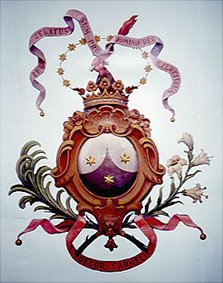
Immaculate Heart of Mary


Devotion to Immaculate Heart of Our Lady is connected on many points with that to the Heart of Jesus. The attention of Christians was early attracted by the love and virtues of the Heart of Mary. The Gospels recount the prophecy delivered to her at Jesus' presentation at the temple: that her heart would be pierced with a sword. This image of the pierced heart is the most popular representation of the Immaculate Heart. The Gospels further invited attention to Mary's heart with its depictions of Mary at the foot of the cross at Jesus' crucifixion. St. Augustine said of this that Mary was not merely passive at the foot of the cross; "she cooperated through charity in the work of our redemption"
"O most pure Mary, I offer and give myself to you, not only with that purity and innocence that I received when I consecrated myself to you, but adorned beyond that, and then repurified, and then adorned again. Receive me, therefore, O Mary, and keep me within yourself". St Mary Magdalen de Pazzi.


Read whole post......

Sunday, March 19, 2023

St Joseph, Protector of the Carmelite Order - pray for us!


St Teresa devotion to St Joseph in her own words - taken from 'Autobiography' chapter 6

I took for my advocate and lord the glorious Saint Joseph and commended myself earnestly to him; and I found that this my father and lord delivered me both from this trouble and also from other and greater troubles concerning my honour and the loss of my soul, and that he gave me greater blessings than I could ask of him. I do not remember even now that I have ever asked anything of him which he has failed to grant. I am astonished at the great favours which God has bestowed on me through this blessed saint, and at the perils from which He has freed me, both in body and in soul. To other saints the Lord seems to have given grace to succour us in some of our necessities but of this glorious saint my experience is that he succours us in them all and that the Lord wishes to teach us that as He was Himself subject to him on earth (for, being His guardian and being called His father, he could command Him) just so in Heaven He still does all that he asks. This has also been the experience of other persons whom I have advised to commend themselves to him; and even to-day there are many who have great devotion to him through having newly experienced this truth.I used to try to keep his feast with the greatest possible solemnity; but, though my intentions were good, I would observe it with more vanity than spirituality, for I always wanted things to be done very meticulously and well. I had this unfortunate characteristic that, if the Lord gave me grace to do anything good, the way I did it was full of imperfections and extremely faulty. I was very assiduous and skilful in wrongdoing and in my meticulousness and vanity. May the Lord forgive me. I wish I could persuade everyone to be devoted to this glorious saint, for I have great experience of the blessings which he can obtain from God. I have never known anyone to be truly devoted to him and render him particular services who did not notably advance in virtue, for he gives very real help to souls who commend themselves to him. For some years now, I think, I have made some request of him every year on his festival and I have always had it granted. If my petition is in any way ill directed, he directs it aright for my greater good.
If I were a person writing with authority, I would gladly describe, at greater length and in the minutest detail, the favours which this glorious saint has granted to me and to others. But in order not to do more than I have been commanded I shall have to write about many things briefly, much more so than I should wish, and at unnecessarily great length about others: in short, I must act like one who has little discretion in all that is good. I only beg, for the love of God, that anyone who does not believe me will put what I say to the test, and he will see by experience what great advantages come from his commending himself to this glorious patriarch and having devotion to him. Those who practise prayer should have a special affection for him always. I do not know how anyone can think of the Queen of the Angels, during the time that she suffered so much with the Child Jesus, without giving thanks to Saint Joseph for the way he helped them. If anyone cannot find a master to teach him how to pray, let him take this glorious saint as his master and he will not go astray. May the Lord grant that I have not erred in venturing to speak of him; for though I make public acknowledgment of my devotion to him, in serving and imitating him I have always failed. He was true to his own nature when he cured my paralysis and gave me the power to rise and walk; and I am following my own nature in using this favour so ill.Who would have said that I should fall so soon, after receiving so many favours from God, and after His Majesty had begun to grant me virtues which themselves aroused me to serve Him; after I had seen myself at death's door and in such great peril of damnation; after He had raised me up, in soul and in body, so that all who saw me were amazed to see me alive? What it is, my Lord, to have to live a life so full of perils! For here I am writing this, and it seems to me that with Thy favour and through Thy mercy I might say with Saint Paul, though not so perfectly as he: For it is not I now who live, but Thou, my Creator, livest in me. For some years, so far as I can see, Thou hast held me by Thy hand, and I find I have desires and resolutions -- tested to a certain extent, during these years, in many ways, by experience -- to do nothing contrary to Thy will, however trifling it may be, though I must often have caused Thy Majesty numerous offences without knowing it. It seems to me, too, that nothing can present itself to me which I would not with great resolution undertake for love of Thee, and some of these things Thou hast helped me successfully to accomplish. I desire neither the world nor anything that is worldly, and nothing seems to give me pleasure unless it comes from Thee: everything else seems to me a heavy cross. I may well be mistaken and it may be that I have not the desire that I have described; but Thou seest, my Lord, that, so far as I can understand, I am not lying. I am afraid, and with good reason, that Thou mayest once more forsake me; for I know well how little my strength and insufficiency of virtue can achieve if Thou be not ever granting me Thy grace and helping me not to forsake Thee. May it please Thy Majesty that I be not forsaken by Thee even now, while I am thinking all this about myself. I do not know why we wish to live, when everything is so uncertain. I used to think, my Lord, that it was impossible to forsake Thee wholly; yet how many times have I forsaken Thee! I cannot but fear; for, when Thou didst withdraw from me but a little, I fell utterly to the ground. Blessed be Thou for ever! For, though I have forsaken Thee, Thou hast not so completely forsaken me as not to raise me up again by continually giving me Thy hand. Often, Lord, I would not take it, and often when Thou didst call me a second time I would not listen, as I shall now relate.

Today's image is by Guido Reni

CARMELITE MEDITATION ON ST. JOSEPH, SPOUSE OF THE BLESSED VIRGIN MARY, PATRON OF THE UNIVERSAL CHURCH.

PRESENCE OF GOD
O glorious St. Joseph, under your patronage may my interior life grow and develop.

MEDITATION
1. Today the Church presents St. Joseph, the great Patriarchs, to whose care God willed to entrust the most chosen portion of His flock, Mary and Jesus. Because Joseph was selected by God to be the guardian of the family of the Nazareth, the nucleus of the great Christian family, the Church recognizes in him the Guardian and patron of all Christendom. Herein lies the significance of today's Feast, which invites us to fix our attention on the mission entrusted to this great Saint in relation to Jesus and to the Church. Aware of the great mystery of the Incarnation, Joseph's whole life gravitated about that of the Incarnate Word: for Him he endured worry, suffering, fatigue, labour. To Him he consecrated all his solicitude, his energy, his resources, his time. He reserved nothing for himself, but completely oblivious of any personal needs, desires, or views, he devoted himself entirely to the interests and the needs of Jesus. Nothing existed for Joseph except Jesus and Mary, and he felt that his life on earth had no other raison d'etre than his care of them. In this way he participated fully, as a humble, hidden collaborator, in this work of the Redemption; if he did not accompany Jesus in His apostolic life and to His death on the Cross - as Mary did - nevertheless, he worked for the same end as the Saviour. Having been the faithful guardian of the Holy Family, it is impossible that from the heights of heaven St. Joseph should not continue to protect the great Christian family, the Universal Church, which , confident of his protection, and relying on his assistance, prays thus: "Sustained, O Lord, by the protection of the spouse of Your holy Mother, we beseech Your clemency....that by his merits and intercession You will guide us to eternal glory" (Roman Missal).

2. St. Joseph's vocation to become the guardian of the Holy Family was also an invitation to divine intimacy. We must not forget that he stood at the dividing line between Old and New Testament. The first part of his life belonged to the Old Testament, the second, to the New. Before the coming of Jesus, he, like all the patriarchs of the Old Law, would certainly have followed the trend of his time, and his relations with God would have been especially influenced by the sentiment of reverent fear. But as soon as the Angel revealed to him the mystery of Incarnation, and he learned that Mary his Spouse was to be the Mother of the Redeemer , everything in his life changed. God, whom he had always honoured as the Most High, the Inaccessible, the Thrice Holy, had now come near to him, so near that He had taken flesh in the womb of his Spouse, and had chosen him, Joseph, as His foster father. As soon as Jesus was born, He was placed in Joseph's arms and entrusted to his care; later He would grow in his sight, be fed at his table, and sleep under his roof. What a life of intimacy! And it was not only an intimacy of external relations, but also one of profoundly interior, spiritual relations, for Joseph knew by faith that Jesus was his God. Thus, together with Mary, this great Saint was the first one to enter into that life of love and intimacy with God, to which Jesus opened the door. Let us, then, watch Joseph fulfill his mission, not only with complete exterior dedication, but also with a heart filled with Jesus, a heart in which a glorious life of divine intimacy flourishes. While he is devoting himself to the work required by his position as foster father, he lives, in the secrecy of his heart, in continual relations of love with his God, the Incarnate Word.
In the Church, each one of us has his mission to fulfill for the good of souls and the glory of God. This mission requires work - often fatiguing work - and much sacrifice and intense activity. Like St. Joseph, we must give ourselves generously and totally, without sparing, without reserve, but, at the same time, we must also give ourselves to the works of God with a heart filled with God, with a heart which lives with Him in an intimacy nourished by the assiduous exercise of prayer. St. Joseph teaches us the blessed secret of a life of combined activity and contemplation, so that, following his example, we may give ourselves to the active life without neglecting our life of intimate union with God.

COLLOQUY

........O glorious Saint, it is a thing which truly astonishes me, the great favours which God has bestowed on me and the perils from which He has freed me, both in body and in soul, through your intercession. To other saints the Lord seems to have given grace to succour us in some of our necessities, but you succour us in them all...... If anyone cannot find a master to teach him how to pray, let him take you as his master and he will not go astray" (T.J. Life, 6).
May the life of the whole Church, as well as the interior life of every Christian, grow and prosper under your patronage, O Saint Joseph. I place my spiritual life under your protection. You, who lived so close to Jesus, bring me to intimacy with Him with a heart full of love.

credit: "Divine Intimacy" by Fr. Gabriel of St. Mary Magdalen OCD
Read whole post......

Thursday, June 23, 2022

St John the Baptist Litany and Prayer

Lord, have mercy on us, Christ, have mercy on us.
Christ, hear us. Christ, graciously hear us.
God the Father of Heaven, Have mercy on us.


God the Son, Redeemer of the world, Have mercy on us.
God, the Holy Ghost, Have mercy on us.
Holy Trinity, One God, Have mercy on us.

Holy Mary, Pray for us.
Queen of Prophets, Pray for us.
Queen of Martyrs, Pray for us.

St. John the Baptist, Pray for us.
St. John the Baptist, precursor of Christ, Pray for us.
St. John the Baptist, glorious forerunner of the Sun of Justice, Pray for us.
St. John the Baptist, minister of Baptism to Jesus, Pray for us.

St. John the Baptist, burning and shining lamp of the world, Pray for us.
St. John the Baptist, angel of purity before thy birth, Pray for us.
St. John the Baptist, special friend and favorite of Christ, Pray for us.
St. John the Baptist, heavenly contemplative, whose element was prayer, Pray for us.

St. John the Baptist, intrepid preacher of truth, Pray for us.
St. John the Baptist, voice crying in the wilderness, Pray for us.
St. John the Baptist, miracle of mortification and penance, Pray for us.
St. John the Baptist, example of profound humility, Pray for us.

St. John the Baptist, glorious martyr of zeal for God’s holy law, Pray for us.
St. John the Baptist, gloriously fulfilling thy mission, Pray for us.

Lamb of God, Who takest away the sins of the world, Spare us, O Lord.
Lamb of God, Who takest away the sins of the world, Graciously hear us, O Lord.
Lamb of God, Who takes away the sins of the world, Have mercy on us.

Christ, hear us. Christ, graciously hear us.

V. Pray for us, O glorious St. John the Baptist,
R. That we may be made worthy of the promises of Christ.

Let Us Pray: O God, Who hast honored this world by the birth of Saint John the Baptist, grant that Thy faithful people may rejoice in the way of eternal salvation, through Jesus Christ Our Lord.

Amen.

Prayer to St. John the Baptist

O God, You raised up St. John the Baptist to prepare a perfect people for Christ. Fill Your people with the joy of possessing His grace, and direct the minds of all the faithful in the way of peace and salvation.

Grant that as St. John was martyred for truth and justice, so we may energetically profess our Faith in You, and lead others to the Way, the Truth, and Eternal Life.

Amen.


Read whole post......

Friday, August 28, 2020

St John the Baptist

The BEHEADING of SAINT JOHN the BAPTIST (†31 A.D.) Spiritual Bouquet: All power in heaven and on earth has been given to Me. St. Matthew 28:18 Saint John the Baptist was called by God to be the precursor of His divine Son. In order to preserve his innocence spotless, and to improve upon the extraordinary graces which he had received in his earliest infancy, he was directed by the Holy Spirit to lead an austere and contemplative life in the wilderness. There he devoted himself to the continuous exercise of devout prayer and penance. When Saint John was thirty years old, the faithful minister of the Lord began to discharge his mission. Clothed with the garments of penance, he announced to all men the obligation weighing upon them of washing away their iniquities with the tears of sincere compunction. He proclaimed the Messiah, who was of his own age but whom he had never seen, when one day Jesus came to be baptized by him in the Jordan. Saint John was received by the poor folk as the true herald of the Most High God, and his voice was, as it were, a trumpet sounding from heaven to summon all men to avert the divine judgments. Souls were exhorted by him to prepare themselves to reap the benefit of the mercy offered them. When the tetrarch Herod Antipas, in defiance of all laws divine and human, married Herodias, the wife of his brother Philip who was yet living, Saint John the Baptist boldly reprimanded the tetrarch and his accomplice for so scandalous an adultery. Herod, motivated by his lust and his anger, cast the Saint into prison. About a year after Saint John had been made a prisoner, Herod gave a splendid entertainment to the official world of Galilee. Salome, a daughter of Herodias by her lawful husband, pleased Herod by her dancing, to the point that he made her the foolish promise of granting whatever she might ask. Salome consulted with her mother as to what to ask, and that immoral woman instructed her daughter to demand the death of John the Baptist, and that the head of the prisoner should be immediately brought to her on a platter. This barbaric request startled the tyrant himself; but governed by human respect he assented and sent a soldier of his guard to behead the Saint in prison. Thus died the great forerunner of our blessed Saviour, some two years after his entrance upon his public ministry, and a year before the death of the One he announced. Reflection: All the signal graces with which Saint John was favored sprang from his humility; in that virtue all his other virtues were founded. If we desire to form ourselves to solid virtue, we must, above all things, labor to lay the same deep foundation. Source: Little Pictorial Lives of the Saints, a compilation based on Butler’s Lives of the Saints and other sources by John Gilmary Shea (Benziger Brothers: New York, 1894).
Read whole post......

Sunday, October 06, 2019

NOVENA TO ST TERESA OF AVILA starts Oct 6 -Oct 14 - click to pray!


The pious Catholic devotion to saying Novenas has been attacked in the Church history in particular by Jansenists or rigorists. But Catholics know from their own experience that the novena (..) is the best means to obtain signal heavenly graces through the intercession of Our Lady and all the saints. The novena of prayer is the prayer of confidence and perseverance, with a pledge of being heard, the most important qualities of efficacious prayer. Moreover, from the Holy Scriptures we know Our Lady and the Apostles prayed in the Upper room for nine consecutive days before the descend of the Holy Spirit at Pentecost.

Novenas - info

And now, words of St Teresa on prayer:

Prayer brings us here and now into God's kingdom
"Hallowed be Your name, Your kingdom come within us.» Now behold, daughters, how great the wisdom of our Master is... I am reflecting here on what we are asking for when we ask for this kingdom. But since His Majesty saw that we could neither hallow, nor praise, nor extol, nor glorify this holy name of the Eternal Father in a fitting way, because of the tiny amount we ourselves are capable of doing, He provided for us by giving us here on earth His kingdom. That is why Jesus put these two petitions next to each other...
   Now, then, the great good that it seems to me there will be in the kingdom of heaven, among many other blessings, is that one will no longer take any account of earthly things, but have a calmness and glory within, rejoice in the fact that all are rejoicing, experience perpetual peace and a wonderful inner satisfaction that comes from seeing that everyone hallows and praises the Lord and blesses His name and that no one offends Him. Everyone loves Him there, and the soul itself doesn't think about anything else than loving Him; nor can it cease loving Him, because it knows Him.
    And would that we could love Him in this way here below, even though we may not be able to do so with such perfection or stability. But if we knew Him we would love in a way very different from that in which we do love Him... The above would be possible, through the favor of God, for the soul placed in this exile, but not in perfection... for we are at sea and journeying along this way. But there are times when, tired from our travels, we experience that the Lord calms our faculties and quiets the soul. As though by signs, He gives us a clear foretaste of what will be given to those He brings into His kingdom. (St Teresa, Way of Perfection ch.30)

Previous posts Feast of St Teresa of Jesus

Recommended reading: 'The life and letters of St Teresa of Jesus' by Henry James Coleridge

'The life of St Teresa'translation from French original 'A Carmelite Nun' by Alice Lady Lovat with a preface by Robert Hugh Benson

St Teresa and her first English daughters

The life of St Teresa of Jesus of the Order of Our Lady of Carmel, written by herself"
St Teresa of Jesus of the Order of Our Lady of Mt Carmel written by the Saint also A History of St Teresa's journeys and Foundations with Maps and Illustrations with a preface an and introduction by Walter Elliot and edited by John J. Burke

The Wonders of the Heart of St Teresa of Jesus"by Simon of St Joseph and Teresa, priest of the 3rd Order of Discalced Carmelites

St Teresa book-mark - a Meditative Commentary Spanish translation by the Very reverend Luke of St Joseph, Assistant General of the Order of the Discalced Carmelites, Rome


Read whole post......

Thursday, February 04, 2010

St. Andrew Corsini, Bishop and Confessor of the Carmelite Order


Prayer
O God! who dost ever renew the examples of virtue in Thy Church; grant that Thy people may so walk in the footsteps of Blessed Andrew, Thy Confessor and Pontiff, whose feast we celebrate today, that they may obtain the same rewards. Through our Lord.

St Andrew Corsini of illustrious Corsini family, was born in Florence in 1302 and died 1373. Wild and dissolute in youth, he was startled one day by the words of his mother about what had happened to her before his birth, and, becoming a Carmelite monk in his native city, began a life of great mortification. He studied at Paris and Avignon, and, on his return, became the Apostle of Florence. He was regarded as a prophet and a thaumaturgus, or wonders maker. Called to the See of Fiesoli, he fled, but was discovered by a child, and compelled to accept the honour. He redoubled his austerities as a bishop, was lavish in his care of the poor, and was sought for everywhere as a peacemaker, notably at Bologna, whither he was sent as papal legate to heal the breach between the nobility and the people. After twelve years in the episcopacy, he died at the age of seventy-one, and miracles were so multiplied at his death that Eugenius IV permitted a public cult immediately; but it was only in 1629 that Urban VIII canonized him. His feast is kept on 4 February.

St Gregory of Nysa tell us in his sermon of the battle with passions St Andrew had to endured to become a holy person.


When the pure and modest church first looked upon the Blessed Andrew, she saw that his countenance was truly made to the likness of God; she saw grace flowing in abundance from his lips; she saw his humility carried to a degree beyond which she could conceive none higher; she saw gentleness and mercy like David's, understanding and prudence like Solomon's, goodness like that of Moses, perfection like Samuel's, continence and modesty equal to Joseph's, wisdom like Daniel's; she saw him endowed with zeal for the faith like unto that of the heavenly John, gifted like Paul, with charity that could not be quenched. She saw wounded with a blessed love, and with a chaste and righteous affection she loved her spouse, lavishing upon him the tokens of love. Yet before she had fulfilled her desire, before she had indulged and satisfied her longing, and while she was still on fire with love, temptations called the athlete to combat, and she was left alone. While he was pouring forth his sweat in the strife upon which he had entered in the cause of holiness, whe waited in chastity, guarding the marriage vow. The bridegroom is not taken away from us; he stands in our midst, although we see him not. Within the shrine, and in the innermost part of the temple, within the veil, where Christ, our forerunner, is entered for us, there is the Priest, who had left behind him the covering of his flesh. No longer doth he serve unto the example and shadow of heavenly things, but he gazeth upon the very image of the things. No longer seeing through a glass, not through a lattice, in a dark manner, but to face, he intercedeth with God. He intercedeth for us also, and for the sins of his people. He hath laid aside his garment of skins, for they that dwell ion Paradise need not such garments, but he hath the covering which he hath woven out of purity of his life, and with it hath adorned himself. The death of such a man is honorable and precious in the sight of the Lord. Verily, it is not death, but the breaking loose from the hold of the flesh; for he sayeth, "Thou hast broken my bonds." Simon hath been dismissed; he hath been freed from the bonds of the body. The snare is broken and the little bird hath flown away. He hath reached the promised land, and he speaketh wisdom with God upon the Mount. he hath loosed the shoes of the soul, that with the pure feet of the mind he may go up to the holy ground where God is see.
Read whole post......

Monday, January 25, 2010

The CONVERSION of SAINT PAUL

The great Apostle Paul, named Saul at his circumcision, was born in Tarsus, the capital of Cilicia, and was by that privilege a Roman citizen, to which quality a great distinction and several exemptions were granted by the laws of the Empire. He was early instructed in the strict observance of the Mosaic law, and lived up to it in the most scrupulous manner. In his zeal for the Jewish law, which he believed to be the divine Cause of God, he became a violent persecutor of the Christians. He was one of those who combined to murder Saint Stephen, and then he presided in the violent persecution of the faithful which followed the holy deacon’s martyrdom. By virtue of the power he had received from the high priest, he dragged the Christians out of their houses, loaded them with chains, and thrust them into prison. In the fury of his zeal he applied for a commission to seize in Damascus all Jews who confessed Jesus Christ, and to bring them in bonds to Jerusalem, that they might serve as examples for the others.

But God was pleased to manifest in him His patience and mercy. While Saul was journeying to Damascus, he and his party were surrounded by a light from heaven, brighter than the sun, and suddenly the chief was struck to the ground. And then a voice was heard saying, “Saul, Saul, why do you persecute Me?” And Saul answered, “ and the voice replied, Who art Thou, Lord?”“I am Jesus, whom you persecute.” This mild admonition of Our Redeemer, accompanied with a powerful interior grace, cured Saul’s pride, assuaged his rage, and wrought at once a total change in him. Therefore, trembling and astonished, he cried out, “Lord, what wilt Thou have me do?” Our Lord ordered him to proceed on his way to the city of Damascus, where he would be informed of what was expected of him. Saul, arising from the ground, found that although his eyes were open, he saw nothing.

He was led into the city, where he was lodged in the house of a Christian named Judas. To this house came by divine appointment a holy man named Ananias, who, laying his hands on Saul, said, “Brother Saul, the Lord Jesus, who appeared to you on your journey, has sent me that you may receive your sight and be filled with the Holy Ghost.” Immediately something like scales fell from Saul’s eyes, and he recovered his sight; then he arose and was baptized. He stayed a few days with the disciples at Damascus, and began immediately to preach in the synagogues that Jesus was the Son of God. Thus a blasphemer and a persecutor was made an Apostle, and chosen as one of God’s principal instruments in the conversion of the world.
“He who would keep the grace of God, let him be grateful for grace when it is given, and patient when it is taken away. Let him pray that it may be given back to him, and be careful and humble, lest he lose it.”(Imitation of Christ)

Sources: Little Pictorial Lives of the Saints, a compilation based on Butler’s Lives of the Saints and other sources by John Gilmary Shea (Benziger Brothers: New York, 1894); The Holy Bible: Old and New Testaments.


Read whole post......

Sunday, November 01, 2009

All Saints Day


“After this I had a vision of a great multitude, which no one could count, from every nation, race, people, and tongue. They stood before the throne and before the Lamb, wearing white robes and holding palm branches in their hands.... [One of the elders] said to me, ‘These are the ones who have survived the time of great distress; they have washed their robes and made them white in the blood of the Lamb’” (Revelation 7:9,14).


Read whole post......

Wednesday, October 28, 2009

Efficacious Novena to St Jude, patron of desparate cases - click for link

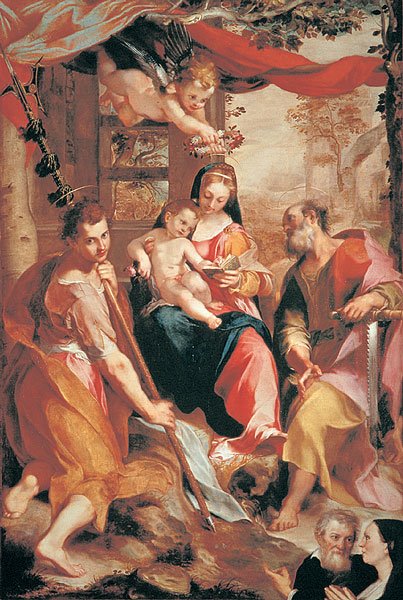
Today is the Feast of St Simon and Jude, the picture below shows both of the Apostles with Our Lady and Child Jesus and below is some information to read and reflect upon.

It is God who works in you both to will and to accomplish. Phil. 2:13
Simon was a simple Galilean, and one of Our Lord’s four first cousins, with James the Less, Jude and Joseph, all sons of Mary, the wife of Cleophas, who was the brother of Saint Joseph, according to tradition. All the sons of this family were raised at Nazareth near the Holy Family (Matt 13:53-58). Simon, Jude and James were called by Our Lord to be Apostles, pillars of His Church, and Joseph the Just was His loyal disciple. Saint Simon the Zealot or the Zealous, was the name this Apostle bore among the twelve. He preached in Egypt, Spain, and Libia, leaving behind him the fertile hills of Galilee, where he had been engaged in the cultivation of the vineyards and olive gardens. He later rejoined his brother, Saint Jude, in Persia, where they labored and died together. Tradition has it, that at first they were respected by the king, for they had manifested power over two ferocious tigers who had terrorized the land. With the king, sixty thousand Persians became Christians, and churches rose over the ruins of the idolatrous temples. However, when the two went elsewhere the pagans commanded them to sacrifice to the sun. Both Apostles, just before that time, had seen Our Lord amid His Angels. Simon said to Jude, “One of the Angels said to me, I will take you out of the temple and bring the building down upon their heads. I answered him, Let it not be so; perhaps some of them will be converted.” They prayed for mercy for the people and offered their lives to God. Saint Simon told the crowd that their gods were only demons, and ordered them to come out of the statues, which they did, revealing themselves under hideous forms. But idolaters fell on the Apostles and massacred them, while they blessed God and prayed for their murderers.Saint Jude has left us a short but powerful epistle, written after the death of his brother James, bishop of Jerusalem, and addressed to the new Christians being tempted by false brethren and heretics.

Reflection: Zeal is an ardent love which makes a man fearless in defense of God’s honor, and earnest to make known the truth at all costs. If we desire to be children of the Saints, we must be zealous for the Faith.


Read whole post......

Tuesday, August 25, 2009

SAINT LOUIS IX King of France (1215-1270


Spiritual Bouquet:
Watch and pray, that you may not enter into temptation. The spirit is willing, but the flesh is weak. St. Matthew 26:41

The mother of the incomparable Saint Louis IX of France, Blanche of Castille, told him when he was still a child that she would rather see him dead in a coffin than stained by a single mortal sin. He never forgot her words. Raised to the throne and anointed in the Rheims Cathedral at the age of twelve, while still remaining under his mother’s regency for several years, he made the defense of God’s honor the aim of his life. Before one year of their mutual sovereignty had ended, the Catholic armies of France, by a particular blessing, had crushed the Albigensians of the south who had risen up under a heretical prince, and forced them by stringent penalties to respect the Catholic faith. Amid the cares of government, the young prince daily recited the Divine Office and heard two Masses. The most glorious churches in France are still memorials to his piety, among them the beautiful Sainte Chapelle of Notre Dame Cathedral in Paris, where the Crown of Thorns, the great relic which he brought back from the Holy Land, is enshrined. When his courtiers remonstrated with Louis for his law that blasphemers must be branded on the lips, he replied, “I would willingly have my own lips branded if I could thereby root out blasphemy from my kingdom.” fearless protector of the weak and the oppressed, a monarch whose justice was universally recognized, he was chosen to arbitrate in all the great feuds of his age.
In 1248, to rescue the land where Christ had walked, he gathered round him the chivalry of France, and embarked for the East. He visited the holy places; approaching Nazareth he dismounted, knelt down to pray, then entered on foot. He visited the Holy House of Nazareth and on its wall a fresco was afterwards painted, still visible when the House was translated to Loreto, depicting him offering his manacles to the Mother of God. Wherever he was: at home with his many children, facing the infidel armies, in victory or in defeat, on a bed of sickness or as a captive in chains, King Louis showed himself ever the same — the first, the best, and the bravest of Christian knights.

When he was a captive at Damietta, an Emir rushed into his tent brandishing a dagger red with the blood of the Sultan, and threatened to stab him also unless he would make him a knight. Louis calmly replied that no unbeliever could perform the duties of a Christian knight. In the same captivity he was offered his liberty on terms lawful in themselves, but enforced by an oath which implied a blasphemy, and although the infidels held their swords’ points at his throat and threatened a massacre of the Christians, Louis inflexibly refused.
The death of his mother recalled him to France in 1252; but when order was re-established he again set out for a second crusade. In August of 1270 his army landed at Tunis, won a victory over the enemy, then was laid low by a malignant fever. Saint Louis was one of the victims. He received the Viaticum kneeling by his camp bed, and gave up his life with the same joy in which he had given all else for the honor of God.

Reflection: Saint Louis wrote to his oldest son Philip, heir to the crown: “I recommend to you before all else to apply yourself with all your heart to love God.”

The picture from old manuscript depicts King Louis IX on the Crusade

The Feast of St Louis reminds me of my little, five days pilgrimage to Rome this year to visit seven Churches of Rome, the route of pilgrimages as recommended by St Philip Neri. After I visited the must Churches, participated in Wednesday Papal Audience and spent two days revisiting St Peters Basilica, the Santa Scala Church and praying at the tomb of St Ignatius who is my Patron Saint, in Il Gesu Church, I decided to see on my last day the most famous landmarks of Rome such as Fontana di Trevi and Spanish Steps. The area of Spanish Steps was called in the 18th century Roman slang "er ghetto de l'inglesi" (the English ghetto), because it was the preferred area of the English artists and tourists. Pope Sixtus V, the great townplanner, set the architecture layout of this beautiful place as we can see it now. I took some pictures which are in a little movie below. Spanish Steps (Scalinata di Trinità dei Monti) by Francesco De Sanctis (1723-1726) are made of twelve flight of steps of varying width moving upwards towards the Piazza Trinità dei Monti. Before the steps there is a fountain in the form of large boat "Barcaccia", spouting water while it sinks. The fountain is the work of Bernini and the movie starts with the picture of Barcaccia. At the top of steps I saw the Church and I decided to go up there to visit it, not knowing that actually I would make, as tradition calls it, the most beautiful climbing to the Trinity of Mounts Church. Only inside the Church I realized that it is dedicated to the Holy Trinity and built in honour of St. Louis IX in 1502 and consecrated by Pope Sixtus V in 1585. The Church was restored after the Napoleonic occupation of Rome. The view of the City from a little piazza around the Church is splendid, one of the pictures shows beautiful gardens, cafes and little restaurants on the roofs of buildings. The Church interior deserves admiration: it still preserves some of the original Gothic arches and contains artistic treasures in the lateral chapels such as impressive frescoes and altarpiece by Daniele da Volterra, a pupil of Michelangelo: "The Deposition" and "The Assumption". Interestingly, when I visited the Church there was a Mass and Liturgy of the Hours chanted by the group of young men and women wearing white habits. I read that they belong to religious Order established originally in honour of St Louis. These young religious are captured by me while kneeling in the picture of the Church interior in the movie below. The Mass and Liturgy were in French and it was beautiful and spiritual experience.


Read whole post......

Tuesday, August 18, 2009

Feast of St Emygdius, Bishop and Martyr

Today is the feast of St Emygdius, who by God's grace had great power over evil spirits, destroyed many idols and converted hundreds of heathen in ancient Rome. In our difficult and dark times we need the intercession and help of Saints like Emygdius, who is venerated and commemorated in the Traditional Carmelite Breviary.

Emygdius was born in Treves [Germany] of a noble Frank family. In his twenty-third year he embraced the faith of Christ in spite of opposition of his parents who were idolaters, and this faith he steadfastly professed. He lived with three disciples, Euplus, Germanus and Valentinus. He scorned human pleasures, and thus he applied himself the more entirely to divine things. Fired with a burning love of the neighbour, he journeyed to Rome in order to bring about the salvation to many souls, and he was there received as a guest, in the Island of the Tiber, where he cured, by baptism, the daughter of his host, who had been ill for five years of an incurable disease. A little later he opened the eyes of a blind man, in the presence of the people by the sign of the Cross. Thereupon the crowd, thinking that he was the son of Apollo, carried him off by force to the Temple of Aesculapius. he there declared himself the servant of Christ, and by calling upon Christ's name he restored to health a great number of sick persons, who were vainly beseeching the help of the idol. Emygdius tore down the altars, and having broken in pieces the statue of Aesculapius, he cast it into the Tiber. These acts, and the conversion of thirteen hundred of the heathen, which followed, together with that of the priests of Aesculapius, enraged Posthumius Titanus, the Prefect of City. Emygdius, by the counsel of an angel, escaped from his threats, and betook himself to the Pontiff, Saint Marcellus, by whom he was consecrated Bishop, and sent to Ascoli.
On his way thither Emygdius converted a multitude of persons to Christ by the many miracles which he wrought. The demons, whose wailing issued from the idols and filled the temples upon his arrival at Ascoli, declared a traveller to be the cause of their distress. The people were aroused, and sought to slay him, whereupon Polymius, the Governor, who was brought out by the tumult, called Emygdius to him, and in a long fruitless discourse he urged him to worship Jupiter and the goddess Angaria, the patroness of Ascoli. He even promised him as a reward the hand of his daughter Polisia, whom Emygdius converted to Christ and baptized on the spot. Her baptism was followed by that of sixteen hundred men, the Saint having drawn, by a miracle, an abundance of water from the rock. Thrown into fury by these events, Polymius cut off the head of the holy Bishop, whereupon the body, wonderful to relate, stood erect, and , bearing in its hands the head which had been cast upon the ground, carried it to the Oratory, a disctance of three hundred feet. it was removed thence to the principal church, where it is honoured by the people of Ascoli, as well as by a multitude of people from other parts of [Italy]. The blessed death of Emygdius took place during the persecution of Diocletian.

Prayer
O God! who hast adorned the Blessed Emygdius, Thy Martyr and Bishop, with victory over idols, and with the splendor of miracles; mercifully grant that, through his mediation, we may deserve to conquer the deceits of evil spirits, and to shine by our virtue. Through our Lord.

Text's excerpts after 'Saints of Carmel - Proper Offices of the Saints Granted to the Barefoot Carmelites' 1896 edition


Read whole post......

Thursday, July 09, 2009

Martyrs of Gorkum, Netherlands

In 1572, following the first Calvinist synod at Embden in the Netherlands, the Watergeuzen heretics seized 17 priests and two lay-brothers in Gorkum and its environs. They threw them into prison, and, after transferring them to Brielle, cruelly mutilated and hanged them, 9 July, for refusing to deny their belief in the Blessed Sacrament and the papal supremacy; this in spite of an order of William of Orange that priests should not be molested. They were beatified in 1675 and canonized in 1865.

Holy Martyrs of Gorkum, pray for us!


Read whole post......

Friday, June 19, 2009

Feast of the Sacred Heart - click to read


Heart of Jesus wounded for love of us

Encyclica of Pope Pius XII Haurietis Aquas


Read whole post......

Thursday, June 18, 2009

Efficatious Novena to the Sacred Heart of Jesus starts on 10th of June - click to read the prayer

"We can contemplate and honour the Heart of the divine Redeemer as a symbolic image of His love and a witness of our redemption and, at the same time, as a sort of mystical ladder by which we mount to the embrace of God our Saviour" - Pope Pius XII Text and photo credit to Fr Lawrence, OP The LifeSiteNews reports attempts to make amendments to the Euthanasia Bill in the UK Parliament:... "Lord Falconer of Thoroton has tabled an amendment to the Coroners and Justice Bill that would make it legal to assist a person to leave the country to commit suicide. Presently, it is illegal for someone to assist another to commit suicide, even if done out of the country. The law, however, is generally not enforced because it “is not in the public interest,” according to Sir Ken Macdonald, former Director of Public Prosecutions (DPP). Numerous U.K. residents have in recent years travelled to Switzerland, where assisted suicide is legal, to commit suicide with the help of the suicide group Dignitas. While a number of investigations have been initiated against relatives who have travelled with the person who was committing suicide, none have resulted in charges being laid. Lord Alton of Liverpool, however, said that the bill “marks the beginning of the creation of a death cult. It is not the terminally-ill but the perfectly healthy we are talking about,” referencing the fact that Dignitas is willing to assist the suicide even of those who are merely depressed and not suffering any physical illness. Falconer, on the other hand, argued that some people, fearing the unenforced law, leave the country to commit suicide “alone.” “They go early. And they die in the hands of strangers.” He claimed that the current law “only works because of the good sense of the DPP [not to prosecute offenders].” “The amendment I am tabling to the Coroners and Justice Bill does not make it an easier for people to go to Switzerland to die in a Dignitas clinic,” he said, “they can already do this. Rather, it is making sure that the law reflects the sensible position adopted to date by the courts and the DPP, while protecting people from abuse.”.... Please offer your Novena to the Sacred Heart of Jesus in reparation for the sin of promoting horrific culture of death.
Read whole post......

Carmelite Spirituality and devotion to the Sacred Heart of Jesus

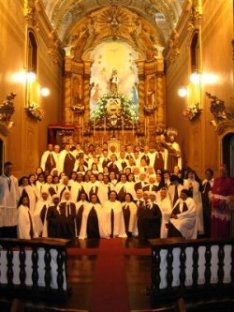
Spirituality of St Teresa Margaret Redi developed on her devotion to the Sacred Heart of Jesus. She lived in times when this devotion was spreading rapidly throughout the world, propagated by the Order of Jesuits and it is quite possible she was actually introduced to this devotion by her Jesuit uncle, Father Diego Redi. Devotion to the Sacred Heart brought young Sister Teresa to the mystical period of her spiritual life. In 1767, first time in her life, was seized with a type of rapture during recitation of the Divine office when the words from the first epistle of St John were chanted: "God is love, and he who dwells in love dwells in God and God in him." Although she was diligent not to manifest in any way the secrets of her hidden, interior life, she was so overwhelmed by the divine action that she went through the cloister so elated frequently repeating the words: "God is love" to herself. Other nuns were wondering at this peculiar behaviour and asked her why she repeated these words so often. The Saint, realising she had betrayed herself said: "Having heard them one Sunday at the little Chapter of Terce, I found such sweetness in them, and they made such an impression on me, that I must repeat them." One of her companion, Sister Teresa Maria Racasoli, said "Her face was flushed and her bearing was that of one beside himself" she "pronounced the words with feeling, in a high voice, with meaning". According to Saint spiritual Father and confessor, Father Ildefonse: "she was so enraptured by the words that she remained in a state of elation for several days,... and one can surmise that they had been accompanied by an extraordinary outpouring of God upon her soul. From that day it was obvious that she was making giant strides forward in the practice of virtues." Fr Gabriel of St Mary Magdalene, OCD who wrote a little treatise "From the Sacred Heart to the Trinity" about St Teresa spirituality, is convinced that the Saint was blessed by unitive grace that produced such profound effects as spoken of by St Teresa in the fifth and sixth mansions and by St John of the Cross in the twenty sixth stanza of the Spiritual Canticle. Remarkably, afterwards St Teresa Margaret lived in oblivion of everything else and in absorption with God, the signs marking the beginning of a new stage of her spiritual life. She was experiencing many lofty spiritual secrets that she confessed to Fr Ildefonse. She made him understand, without intending it, some wonderful concepts of the knowledge of God that she had been nourishing in her soul. Let us listen to her words: "charity is the same love with which God love Himself from all eternity, the Spirit of God Himself, which is life and His breath. Who is the Holy Spirit, the Third Person of the Blessed Trinity. And when it is said that he who dwells in charity dwells in God and God in him, the meaning is that he lives in the life of God and God, after a certain fashion, lives His life in him. becasue between them there is but one life, one charity, one God; in God this all by essence but in the creature by participation and grace; thus it is true that everything is held in common by lovers". Very beautiful description of the meaning of God's love!

Based upon "From the Sacred Heart to the Trinity" by Fr Gabriel of St Mary Magdalen, OCD


Read whole post......

Tuesday, June 16, 2009

Most Holy Sacrament of the Altar, St Thomas Aquinas and Carmelite Saints, part 2.


Because Holy Sacrament contains Christ Himself and the Passion of Christ, it has in itself the power to forgive sins. But the sinner himself must be considered. If a sinner, in the state of mortal sin, should receive this sacrament while intending to remain attached to his sin, then he will not be forgiven. On the contrary, he will commit a sacrilege in profaning in this way the Body and Blood of Christ. But if he is ready to give up his attachment to sin, and if he approaches the sacrament in forgetfullness of his sin, then his sin will be forgiven. The sacrament will give him charity, which will protect his contrition and bring forgiveness of sin. Of course, if he remembers his sin, he ought first obtain the forgiveness of his sin in the sacrament of penance. No one should approach the sacrament of Christ's Body and Blood while still conciously in the state of mortal sin. Since the effects of this sacrament are grace and charity, it will forgive venial sins and restore the fervour of charity. The Eucharist can also release man from the punishment due to sin. It is both a sacrament and a sacrifice. As a sacrament, it unites a man to Christ through charity. But it is by the fervour of charity that a man obtains the forgiveness of the punishment due to his sins. The degree of fervour will determine the amount of punishment which is forgiven, as a sacrifice, the Eucharist can also forgive the penalty of sin. In itself, the Eucharist is powerful enough to forgive all the penalty for all the sin of all men. But, in matters of satisfaction, the disposition of men must be taken into account. The Eucharistic sacrifice will remit their punishment according to the measures of their devotion. The Eucharist produces these wonderful effect when it is properly received...But not everyone will receive the effect of the sacrament, grace. The unbeliever and the Catholic in mortal sin will receive the Body and Blood of Christ. But they will not receive the grace of the sacrament. They are said to receive the Eucharist sacramentally, but not spiritually. On the other hand, it is possible to receive the grace of the sacrament spiritually by desiring it. Lastly, the man in the state of grace who receives Christ in Communion also receives grace, the spiritual effect of the sacrament. In this case he receives the Eucharist both sacramentally and spiritually. The reception of this sacrament is an expression of a man's union with Christ and with the members of His Church in faith and charity. But the sinner is not united in charity to Christ. In receiving this sacrament he is guilty of lying. He uses the sacrament to lie. This is a grave abuse of a sacred thing, the sacrament of the Body and Blood of Christ.

St Therese of Child Jesus: Prayer to Jesus in the Tabernacle:
O God hidden in the prison of the tabernacle! I come with joy to You each evening to thank You for the graces You have given me. I ask pardon for the faults I committed today, which has just slipped away like a dream...
O Jesus! How happy I would be if I had been faithful, but alas! Often in the evening I am sad because I feel I could have corresponded better with Your graces....If I were more united to You, more charitable with my sisters, more humble and more mortified, I would feel less sorrow when I talk with ou in prayer. And yet, O my God, very far from becoming discouraged at the sight of my miseries, I come to You with confidence, recalling that "those who are well do not need a doctor but the sick do." I beg You, then, to cure me and to pardon me. I will keep in mind, Lord, "that the soul to whom You have forgiven more should also love You more than the others"!...I offer You every beat of my heart as so many acts of love and reparation and I unite them to Your infinite merits. I beg You, O my Divine Bridegroom, to be the Restorer of my soul, to act in me despite my resistance; nd lastly, I wish to have no other will but Yours. Tomorrow, with the help of Your grace, I will begin a new life in which each moment will be an act of love and renunciation.
Thus, after coming each evening to the foot of Your Altar, I will finally reach the last evening of my life. Then will begin for me the unending day of eterninty when I will place in Your Divine heart the struggles of exile! Amen.

When Christ instituted this Sacrament, He commanded His Apostles to administer It as He did. This means that both the Apostles and their successors, the priests of the Church, must consecrate both bread and wine and receive Christ under both species. The priests of the Church must, when they celebrate Mass, receive Christ under the appearance of bread and under the appearance of wine. But , since Christ is wholly present under both species, a man can receive the whole Christ under either species. Since the Church has grown so greatly, and since so many of the faithful receive Communion the Church gives this sacrament to the faithful only under one species, the species of bread. The chief reason for this is the great respect due to the Blood of Christ in this sacrament. When so many people receive Communion and many of them are children, there is a serious concern that the Precious Blood of Christ might be spilled on clothing, on the altar rail, or on the ground, if It were administered to all.
As we have already said, in this sacrament, bread and wine are changed into the Body and Blood of Christ Himself. The man who performs this rite acts s in the name of the person of Christ Himself. Now no one can act in the name and person of someone else, unless the power to do so is given to him. Christ has given this power only to His priests. Only the ordained priest can change bread and wine into the Body and Blood of Christ in the name of Christ. Ordinarily, too, only the ordained priest can dispense this sacrament to the people in Communion. The priest does what Christ did at the Last Supper. Christ consecrated bread and wine and He distributed His Body and Blood to the Apostles. The priest consecrates bread and wine and distributes Communion to the people. By office a priest is intermediary between God and the people. He offers the people's gifts to God and God's gifts to the people. Again, the Eucharist is a sacred thing. It can be touched only by consecrated or sacred things. The linen cloth - the corporal - on which the Body of Christ rests on the altar, the chalice in which the Blood of Christ rests are consecrated for this purpose. So too, the hands of the priest are blessed and consecrated so that they may handle the sacrament worthily. The priest consecrates bread and wine in the sacrifice of the Mass. But whoever offers sacrifice must share in the sacrifice. The outward sacrifice is a sign of the inner sacrifice by which he offers himself to God. By sharing in the external sacrifice he shows that he is making the internal sacrifice. For this reason, the priest who celebrates Mass must receive the Eucharist in Communion at that Mass. Moreover, he dispenses this sacrament to others in Communion. He himself ought to receive first. In this way, he proves to the people that he is the dispenser of divine gift.
The priest who approaches the altar to offer the sacrifice of Mass, to change bread and wine into the Body and Blood of Christ, ought to be a spiritual man, a holy man. He ought to be united to Christ in faith and charity. But Christ remembers the weakness of men. In His great desire to give Himself to the faithful, he has not linked either the reality or the power of this sacrament to the changeable disposition of men. As long as a man is a validly ordained priest, he can validly perform and administer this sacrament. He may even be a heretic, or a schismatic, or excommunicated by the Church. Still, if he consecrates bread and wine, they become the Body and Blood of Christ. Of course, such a man is guilty of grave sacrilege in celebrating Mass. But his Mass is a Mass, and he does change bread and wine into Body and Blood of Christ. Since Christ Himself is the chief Priest in every Mass, and the Victim of every Mass, then even the Mass celebrated by a wicked priest is fruitful for the Church. Obviously, the great devotion of a good priest will make the Mass he celebrates much more fruitful than the Mass of a sinful priest. But the essential fruitfulness of the Mass can never be lost, for even the sinful priest offers Mass in the name and by the power of Christ.

St Teresa of Jesus (from Meditation of the Song of Songs, 4:6):
Great is this favour, my Spouse; a pleasing feast. Precious wine do You give me, for with one drop alone You make me forget all of creation and go out from creatures and myself, so that i will no longer want the joys and comforts that my sensuality desired up until now. Great is this favour; I did not deserve it.

You say: Come to me all who labour and are burdened, for I will comfort you. What more do we want, Lord? What are we asking for? What do we seek? Why are those in the world so unhappy if not because of seeking rest? (Soliloquies 8:2)


/span>
Read whole post......

Monday, June 15, 2009

Feast of St Germaine of Pibrac, Patroness of Unwanted - click to read


One of the Eucharistic Miracles took place in 1589 in a small village of Pibrac, near Touluse, France, and is connected with the name of young shepherdess, Germaine Cousin. From the time this our young girl became motherless, her father remarried a woman who, from the very start, demonstrated hostility towards her because Germaine’s face was full of acne and was not easy to look at. The stepmother, who could not stand the sight of Germaine, convinced her husband to make Germaine live in the small basement under the steps. The poor girl found herself so completely isolated in that basement that the rats were often her only companions. Germaine, however, was very close and devoted to Our Lord and prayed before the Blessed Sacrament on a daily basis. Every day she would leave her sheep unattended to receive the Holy Communion and miraculously the herd would never be attacked by wolves. To reach the church, however, Germaine had to cross the stream called Courbet. One day the heavy rains had rendered the stream impossible to pass through, but the young girl decided to affront the furious waters of the stream and get through so she could receive her daily Communion. Before going into the water in order to get across, she made the sign of the Cross and while she was reciting her prayers she saw the waters miraculously separate in two. This happened on the way back, also.

Catholic Encyclopedia entry on St Germaine


Read whole post......

Tuesday, June 09, 2009

Most Holy Trinity

Belief in God's word is a necessary preliminary to the vision of God. As St Paul says this belief must be at least an explicit or conscious belief in the existence of God and in the fact that God rewards those who seek Him. St Thomas adds that the object of faith also includes the means to happiness which is Incarnation. Therefore, an explicit belief in Incarnation is also necessary. Since the Incarnation cannot be believed in explicitly without believing in the Trinity - for how can a man believe the Second Person of the Trinity became man unless he believes in the mystery of the Trinity - it follows that the belief in the Trinity is also required for the attainment of the vision of God. By accepting these truth in faith man begins to learn to know God as He really is.

after "My Way of Life - The Summa Simplified"


Canticle of Love
Come, kings of the earth, to Love; come and adore my Love
I sing of our Creator's power and glory; come let us adore Him.
For we are the work of His hands, the price of His Blood.
There is no one like to God; come let us adore Him.
Stop not at the things of the earth, for they are nothing; pass to their Maker's praise.
Come, all dwellers on the earth, for they are nothing; pass by the passing things on earth.
And remembering we are only pilgrims, come in adoration to our Father and King.
Fall down before the Creator of all and offer Him your hearts.
praise and bless Him, sing with lips and heart! There is no one like You, Lord.
Let us adore the Trinity, One God, mystery unfathomable;
Three immensities making only one power; come and adore.
His anger is terrible; come, let us adore Him.
The fiercest of wild beast tremble before Him; come, sinners, let us adore Him.
His tenderest goodness is for souls who seek after Him; come , you upright, and adore Him.
All creation bows down with rejoicing before Him; come, all, and adore Him.


O my God, my God! If my eye is going to offend You, pluck it out, or I shall pluck it out myself. If my hands, my feet, my tongue are going to offend you, cut them off. Break my body with pains the most intolerable rather than allow any of my members to offend you.

after "The Thoughts of Sister Mary of Jesus Crucified"


Read whole post......

Sunday, June 07, 2009

Feast of the Most Holy Trinity


Consecration to the Holy Trinity
O everlasting and Triune God,
I consecrate myself wholly to you today
Let all my days offer you ceaseless praise,
My hands move to the rythm of your impulses,
My feet be swift in your service,
My voice sing constantly of you,
My lips proclaim your message,
My eyes perceive you everywhere,
And my ears be attuned to your inspirations.
May my intellect be filled with your wisdom,
My will be moved by your beauty,
My heart be enraptured with your love,
And my soul be flooded with your grace,
Grant that every action of mine be done
For your greater glory
And the advancement of my salvation. AMEN

Prayer to the Holy Trinity
Glory be to the Father,
Who by His almighty power and love created me,
making me in the image and likeness of God.

Glory be to the Son, Who by His
Precious Blood delivered me from hell,
and opened for me the gates of heaven.

Glory be to the Holy Spirit,
Who has sanctified me in the Sacrament of Baptism,
and continues to sanctify me
by the graces I receive daily from His bounty.

GLORY BE TO THE THREE ADORABLE
PERSONS OF THE HOLY TRINITY,
NOW AND FOR EVER. AMEN


O MY GOD, TRINITY WHOM I ADORE.

O my God, Trinity whom I adore, help me to forget myself entirely that I may be established in You as still and as peaceful as if my soul were already in eternity. May nothing trouble my peace or make me leave You, O my Unchanging One, but may each minute carry me further into the depths of Your Mystery. Give peace to my soul; make it Your heaven, Your beloved dwelling place. May I never leave You there alone but be wholly present, my faith wholly vigilant, wholly adoring, and wholly surrendered to Your creative Action.
O my Beloved Christ,crucified by love, I wish to be a bride for Your Heart; I wish to cover you with glory; I wish to love You...even to dying of it! But I feel my weekness and I ask You "to clothe me with Yourself", to identify my soul with all the movements of Your soul, to overwhelm me, to possess me, to substitute Yourself for me that my life may be a radiance of Your Life. Come into me as Adorer, as Restorer, as Saviour.
O Eternal Word, Word of my God, I want to spend my life listening to You, to become wholly teachable that I may learn all from You. Then, through all nights, all voids, all helplesness, I want to gaze on You always and remain in Your great light. O my Beloved Star, so fascinate me that I may not withdraw from Your radiance.
O consuming Fire, Spirit of Love, "come upon me", and create in my soul a kind of incarnation of the Word: that I may be another humaity in which He can renew His whole Mystery. And You, O Father, bend lovingly over Your poor little creature; "cover her with Your shadow," seeing in her only the "Beloved in whom You are well pleased."
O my Three, my All, my Beatitude, Infinite Solitude, Immensity in which I lose myself, I surrender myself to You as Your prey. Bury Yourself in me that I may bury myself in ou until I depart to contemplate in Your light the abyss of Your greatness.

Bl Elizabeth of the Trinity "Light, Love, Life"

The main picture is Murillo's painting "The Heavenly and Earthly Trinities"


Read whole post......

Wednesday, May 20, 2009

Rogation Days

"Ask, and you shall receive; that your joy may be full." (John 16:24)

These are another words of Jesus referring to the efficacy of prayers offered in His name. Let us think carefully about these words. For God, priority prayers are always those referring to our spiritual progress, such as petitions for strength to overcome faults, imperfections and habitual sins that may separate us from Him. Equally important are prayers for help to overcome passions, for guidance and light in doubts, for grace to overcome laziness, sloth, for patience and resignation in trials, for spiritual progress and increase in virtues. Only after these petitions come those for temporal favours such as good health, successful and profitable jobs, good and happy marriage, long life etc. Although praying for temporal favours is well justified, however, we can re-consider our priorities and remember to ask first for spiritual needs: "Not in bread alone doth man live" (Matt 4:4). Wellbeing of the soul should be our priority for eternity is our ultimate end. Our Lord has given us instruction on well structured prayer. We address God as our dearest and loving Father with affectionate words of first petition: "Our Father, hallowed be Thy Name!" - followed by second and third petitions: "Thy Kingdom come!" "Thy will be done". Now comes petition for our temporal needs: "Give us this day our daily bread". In the Litany of the Saints, we first petition God to spare us from every evil, sin, God's wrath, deception, from sudden and unprovided death and these petitions are followed by prayer for deliverance from thunderstorms, lightnings, hunger and war. In our prayers we should be always careful to ask for first for: "the kingdom of God, and his justice, and all these things shall be added unto you." (Matt 6:33)


Read whole post......