Showing posts with label Saints. Show all posts

Monday, March 17, 2025

Happy and Blessed St Patrick's Day!


St Patrick "Confession" part 1
"Confession" part 2

Lorica Prayer of St Patrick

I arise today Through a mighty strength, the invocation of the Trinity, Through a belief in the Threeness, Through confession of the Oneness Of the Creator of creation. I arise today Through the strength of Christ's birth and His baptism, Through the strength of His crucifixion and His burial, Through the strength of His resurrection and His ascension, Through the strength of His descent for the judgment of doom. I arise today Through the strength of the love of cherubim, In obedience of angels, In service of archangels, In the hope of resurrection to meet with reward, In the prayers of patriarchs, In preachings of the apostles, In faiths of confessors, In innocence of virgins, In deeds of righteous men. I arise today Through the strength of heaven; Light of the sun, Splendor of fire, Speed of lightning, Swiftness of the wind, Depth of the sea, Stability of the earth, Firmness of the rock. I arise today Through God's strength to pilot me; God's might to uphold me, God's wisdom to guide me, God's eye to look before me, God's ear to hear me, God's word to speak for me, God's hand to guard me, God's way to lie before me, God's shield to protect me, God's hosts to save me From snares of the devil, From temptations of vices, From every one who desires me ill, Afar and anear, Alone or in a multitude. I summon today all these powers between me and evil, Against every cruel merciless power that opposes my body and soul, Against incantations of false prophets, Against black laws of pagandom, Against false laws of heretics, Against craft of idolatry, Against spells of women and smiths and wizards, Against every knowledge that corrupts man's body and soul. Christ shield me today Against poison, against burning, Against drowning, against wounding, So that reward may come to me in abundance. Christ with me, Christ before me, Christ behind me, Christ in me, Christ beneath me, Christ above me, Christ on my right, Christ on my left, Christ when I lie down, Christ when I sit down, Christ in the heart of every man who thinks of me, Christ in the mouth of every man who speaks of me, Christ in the eye that sees me, Christ in the ear that hears me. I arise today Through a mighty strength, the invocation of the Trinity, Through a belief in the Threeness, Through a confession of the Oneness Of the Creator of creation.


Read whole post......

Sunday, March 19, 2023

St Joseph, Protector of the Carmelite Order - pray for us!


St Teresa devotion to St Joseph in her own words - taken from 'Autobiography' chapter 6

I took for my advocate and lord the glorious Saint Joseph and commended myself earnestly to him; and I found that this my father and lord delivered me both from this trouble and also from other and greater troubles concerning my honour and the loss of my soul, and that he gave me greater blessings than I could ask of him. I do not remember even now that I have ever asked anything of him which he has failed to grant. I am astonished at the great favours which God has bestowed on me through this blessed saint, and at the perils from which He has freed me, both in body and in soul. To other saints the Lord seems to have given grace to succour us in some of our necessities but of this glorious saint my experience is that he succours us in them all and that the Lord wishes to teach us that as He was Himself subject to him on earth (for, being His guardian and being called His father, he could command Him) just so in Heaven He still does all that he asks. This has also been the experience of other persons whom I have advised to commend themselves to him; and even to-day there are many who have great devotion to him through having newly experienced this truth.I used to try to keep his feast with the greatest possible solemnity; but, though my intentions were good, I would observe it with more vanity than spirituality, for I always wanted things to be done very meticulously and well. I had this unfortunate characteristic that, if the Lord gave me grace to do anything good, the way I did it was full of imperfections and extremely faulty. I was very assiduous and skilful in wrongdoing and in my meticulousness and vanity. May the Lord forgive me. I wish I could persuade everyone to be devoted to this glorious saint, for I have great experience of the blessings which he can obtain from God. I have never known anyone to be truly devoted to him and render him particular services who did not notably advance in virtue, for he gives very real help to souls who commend themselves to him. For some years now, I think, I have made some request of him every year on his festival and I have always had it granted. If my petition is in any way ill directed, he directs it aright for my greater good.
If I were a person writing with authority, I would gladly describe, at greater length and in the minutest detail, the favours which this glorious saint has granted to me and to others. But in order not to do more than I have been commanded I shall have to write about many things briefly, much more so than I should wish, and at unnecessarily great length about others: in short, I must act like one who has little discretion in all that is good. I only beg, for the love of God, that anyone who does not believe me will put what I say to the test, and he will see by experience what great advantages come from his commending himself to this glorious patriarch and having devotion to him. Those who practise prayer should have a special affection for him always. I do not know how anyone can think of the Queen of the Angels, during the time that she suffered so much with the Child Jesus, without giving thanks to Saint Joseph for the way he helped them. If anyone cannot find a master to teach him how to pray, let him take this glorious saint as his master and he will not go astray. May the Lord grant that I have not erred in venturing to speak of him; for though I make public acknowledgment of my devotion to him, in serving and imitating him I have always failed. He was true to his own nature when he cured my paralysis and gave me the power to rise and walk; and I am following my own nature in using this favour so ill.Who would have said that I should fall so soon, after receiving so many favours from God, and after His Majesty had begun to grant me virtues which themselves aroused me to serve Him; after I had seen myself at death's door and in such great peril of damnation; after He had raised me up, in soul and in body, so that all who saw me were amazed to see me alive? What it is, my Lord, to have to live a life so full of perils! For here I am writing this, and it seems to me that with Thy favour and through Thy mercy I might say with Saint Paul, though not so perfectly as he: For it is not I now who live, but Thou, my Creator, livest in me. For some years, so far as I can see, Thou hast held me by Thy hand, and I find I have desires and resolutions -- tested to a certain extent, during these years, in many ways, by experience -- to do nothing contrary to Thy will, however trifling it may be, though I must often have caused Thy Majesty numerous offences without knowing it. It seems to me, too, that nothing can present itself to me which I would not with great resolution undertake for love of Thee, and some of these things Thou hast helped me successfully to accomplish. I desire neither the world nor anything that is worldly, and nothing seems to give me pleasure unless it comes from Thee: everything else seems to me a heavy cross. I may well be mistaken and it may be that I have not the desire that I have described; but Thou seest, my Lord, that, so far as I can understand, I am not lying. I am afraid, and with good reason, that Thou mayest once more forsake me; for I know well how little my strength and insufficiency of virtue can achieve if Thou be not ever granting me Thy grace and helping me not to forsake Thee. May it please Thy Majesty that I be not forsaken by Thee even now, while I am thinking all this about myself. I do not know why we wish to live, when everything is so uncertain. I used to think, my Lord, that it was impossible to forsake Thee wholly; yet how many times have I forsaken Thee! I cannot but fear; for, when Thou didst withdraw from me but a little, I fell utterly to the ground. Blessed be Thou for ever! For, though I have forsaken Thee, Thou hast not so completely forsaken me as not to raise me up again by continually giving me Thy hand. Often, Lord, I would not take it, and often when Thou didst call me a second time I would not listen, as I shall now relate.

Today's image is by Guido Reni

CARMELITE MEDITATION ON ST. JOSEPH, SPOUSE OF THE BLESSED VIRGIN MARY, PATRON OF THE UNIVERSAL CHURCH.

PRESENCE OF GOD
O glorious St. Joseph, under your patronage may my interior life grow and develop.

MEDITATION
1. Today the Church presents St. Joseph, the great Patriarchs, to whose care God willed to entrust the most chosen portion of His flock, Mary and Jesus. Because Joseph was selected by God to be the guardian of the family of the Nazareth, the nucleus of the great Christian family, the Church recognizes in him the Guardian and patron of all Christendom. Herein lies the significance of today's Feast, which invites us to fix our attention on the mission entrusted to this great Saint in relation to Jesus and to the Church. Aware of the great mystery of the Incarnation, Joseph's whole life gravitated about that of the Incarnate Word: for Him he endured worry, suffering, fatigue, labour. To Him he consecrated all his solicitude, his energy, his resources, his time. He reserved nothing for himself, but completely oblivious of any personal needs, desires, or views, he devoted himself entirely to the interests and the needs of Jesus. Nothing existed for Joseph except Jesus and Mary, and he felt that his life on earth had no other raison d'etre than his care of them. In this way he participated fully, as a humble, hidden collaborator, in this work of the Redemption; if he did not accompany Jesus in His apostolic life and to His death on the Cross - as Mary did - nevertheless, he worked for the same end as the Saviour. Having been the faithful guardian of the Holy Family, it is impossible that from the heights of heaven St. Joseph should not continue to protect the great Christian family, the Universal Church, which , confident of his protection, and relying on his assistance, prays thus: "Sustained, O Lord, by the protection of the spouse of Your holy Mother, we beseech Your clemency....that by his merits and intercession You will guide us to eternal glory" (Roman Missal).

2. St. Joseph's vocation to become the guardian of the Holy Family was also an invitation to divine intimacy. We must not forget that he stood at the dividing line between Old and New Testament. The first part of his life belonged to the Old Testament, the second, to the New. Before the coming of Jesus, he, like all the patriarchs of the Old Law, would certainly have followed the trend of his time, and his relations with God would have been especially influenced by the sentiment of reverent fear. But as soon as the Angel revealed to him the mystery of Incarnation, and he learned that Mary his Spouse was to be the Mother of the Redeemer , everything in his life changed. God, whom he had always honoured as the Most High, the Inaccessible, the Thrice Holy, had now come near to him, so near that He had taken flesh in the womb of his Spouse, and had chosen him, Joseph, as His foster father. As soon as Jesus was born, He was placed in Joseph's arms and entrusted to his care; later He would grow in his sight, be fed at his table, and sleep under his roof. What a life of intimacy! And it was not only an intimacy of external relations, but also one of profoundly interior, spiritual relations, for Joseph knew by faith that Jesus was his God. Thus, together with Mary, this great Saint was the first one to enter into that life of love and intimacy with God, to which Jesus opened the door. Let us, then, watch Joseph fulfill his mission, not only with complete exterior dedication, but also with a heart filled with Jesus, a heart in which a glorious life of divine intimacy flourishes. While he is devoting himself to the work required by his position as foster father, he lives, in the secrecy of his heart, in continual relations of love with his God, the Incarnate Word.
In the Church, each one of us has his mission to fulfill for the good of souls and the glory of God. This mission requires work - often fatiguing work - and much sacrifice and intense activity. Like St. Joseph, we must give ourselves generously and totally, without sparing, without reserve, but, at the same time, we must also give ourselves to the works of God with a heart filled with God, with a heart which lives with Him in an intimacy nourished by the assiduous exercise of prayer. St. Joseph teaches us the blessed secret of a life of combined activity and contemplation, so that, following his example, we may give ourselves to the active life without neglecting our life of intimate union with God.

COLLOQUY

........O glorious Saint, it is a thing which truly astonishes me, the great favours which God has bestowed on me and the perils from which He has freed me, both in body and in soul, through your intercession. To other saints the Lord seems to have given grace to succour us in some of our necessities, but you succour us in them all...... If anyone cannot find a master to teach him how to pray, let him take you as his master and he will not go astray" (T.J. Life, 6).
May the life of the whole Church, as well as the interior life of every Christian, grow and prosper under your patronage, O Saint Joseph. I place my spiritual life under your protection. You, who lived so close to Jesus, bring me to intimacy with Him with a heart full of love.

credit: "Divine Intimacy" by Fr. Gabriel of St. Mary Magdalen OCD
Read whole post......

Tuesday, November 30, 2021

Feast of St Andrew the Apostle - click for link

As in the case of all the apostles except Peter and John, the Gospels give us little about Andrew. He was an apostle. That is enough. He was called personally by Jesus to proclaim the Good News, to heal with Jesus' power and to share his life and death. Holiness today is no different. It is a gift that includes a call to be concerned about the Kingdom, an outgoing attitude that wants nothing more than to share the riches of Christ with all people. “The Twelve called together the community of the disciples and said, ‘It is not right for us to neglect the word of God to serve at table. Brothers, select from among you seven reputable men, filled with the Spirit and wisdom, whom we shall appoint to this task, whereas we shall devote ourselves to prayer and to the ministry of the word’” (Acts 6:2-4).
Read whole post......

Thursday, October 01, 2020

Feast of the Holy Guardian Angels

Perhaps no aspect of Catholic piety is as comforting to parents as the belief that an angel protects their little ones from dangers real and imagined. Yet guardian angels are not just for children. Their role is to represent individuals before God, to watch over them always, to aid their prayer and to present their souls to God at death. The concept of an angel assigned to guide and nurture each human being is a development of Catholic doctrine and piety based on Scripture but not directly drawn from it. Jesus' words in Matthew 18:10 best support the belief: "See that you do not despise one of these little ones, for I say to you that their angels in heaven always look upon the face of my heavenly Father." Devotion to the angels began to develop with the birth of the monastic tradition. St. Benedict gave it impetus and Bernard of Clairvaux, the great 12th-century reformer, was such an eloquent spokesman for the guardian angels that angelic devotion assumed its current form in his day. A feast in honor of the guardian angels was first observed in the 16th century. In 1615, Pope Paul V added it to the Roman calendar.

Comment:
The concept of an unseen companion has given rise to many childish titters about leaving room for an angel in a crowded seat and teacher-induced terrors about the danger of sudden death for a child who fails to honor the angel with prayer. But devotion to the angels is, at base, an expression of faith in God's enduring love and providential care extended to each person day in and day out until life's end.

Quote:

"May the angels lead you into paradise; may the martyrs come to welcome you and take you to the holy city, the new and eternal Jerusalem." (Rite for Christian Burial)

after www.AmericanCatholic.org
Picture "Guardian Angels" by JHS Mann
Read whole post......

Friday, August 28, 2020

St John the Baptist

The BEHEADING of SAINT JOHN the BAPTIST (†31 A.D.) Spiritual Bouquet: All power in heaven and on earth has been given to Me. St. Matthew 28:18 Saint John the Baptist was called by God to be the precursor of His divine Son. In order to preserve his innocence spotless, and to improve upon the extraordinary graces which he had received in his earliest infancy, he was directed by the Holy Spirit to lead an austere and contemplative life in the wilderness. There he devoted himself to the continuous exercise of devout prayer and penance. When Saint John was thirty years old, the faithful minister of the Lord began to discharge his mission. Clothed with the garments of penance, he announced to all men the obligation weighing upon them of washing away their iniquities with the tears of sincere compunction. He proclaimed the Messiah, who was of his own age but whom he had never seen, when one day Jesus came to be baptized by him in the Jordan. Saint John was received by the poor folk as the true herald of the Most High God, and his voice was, as it were, a trumpet sounding from heaven to summon all men to avert the divine judgments. Souls were exhorted by him to prepare themselves to reap the benefit of the mercy offered them. When the tetrarch Herod Antipas, in defiance of all laws divine and human, married Herodias, the wife of his brother Philip who was yet living, Saint John the Baptist boldly reprimanded the tetrarch and his accomplice for so scandalous an adultery. Herod, motivated by his lust and his anger, cast the Saint into prison. About a year after Saint John had been made a prisoner, Herod gave a splendid entertainment to the official world of Galilee. Salome, a daughter of Herodias by her lawful husband, pleased Herod by her dancing, to the point that he made her the foolish promise of granting whatever she might ask. Salome consulted with her mother as to what to ask, and that immoral woman instructed her daughter to demand the death of John the Baptist, and that the head of the prisoner should be immediately brought to her on a platter. This barbaric request startled the tyrant himself; but governed by human respect he assented and sent a soldier of his guard to behead the Saint in prison. Thus died the great forerunner of our blessed Saviour, some two years after his entrance upon his public ministry, and a year before the death of the One he announced. Reflection: All the signal graces with which Saint John was favored sprang from his humility; in that virtue all his other virtues were founded. If we desire to form ourselves to solid virtue, we must, above all things, labor to lay the same deep foundation. Source: Little Pictorial Lives of the Saints, a compilation based on Butler’s Lives of the Saints and other sources by John Gilmary Shea (Benziger Brothers: New York, 1894).
Read whole post......

Saturday, July 25, 2020

St. James the Greater, Apostle

Two of the twelve apostles were named James. St. James the Greater is the brother of the apostle St. John and son of Zebedee and Mary Salome. He is "the Greater" because he was called to the apostolate earlier than St. James the Less, the "Brother of Jesus" who led the Christians of Jerusalem until that city's destruction in 70 AD. A tradition in late antiquity held that the apostles divided up the world into territories to be evangelized, with Spain falling to St. James. In the ninth century a Galician monk announced that a star had led him to a field where he found the remains of the saint. This "field of the star" became the city of Compostela, one of the most important medieval pilgrimage destinations.

Many images of St. James the Greater represent him as a well-equipped medieval pilgrim with an ample cape, sturdy boots, a broad-brimmed hat, and a walking stick with a hook for hanging a drinking gourd. The hat will be adorned with a scallop shell, which is in the nature of a heraldic device for the St. James; Compostela pilgrims have used it to identify themselves for more than a thousand years. Less literal portraits of the pilgrim saint may show him in the kind of antique garb associated with apostles, with the walking stick as his one irreducible attribute. A second iconographic type presents St. James as Santiago Matamoros -- St. James the Moor Slayer. This image recalls Ramiro of Castile's victory over the Muslims at the Battle of Clavijo (ca. 844). Christian participants in the battle said they saw St. James riding with them, slaying the enemy on every side. Santiago Matamoros became the patron saint of Christian Spain, and an iconography developed in which the horseback saint raises his sword in the midst of the fray, with dead and dying Moors at his feet.

More details about St James the Greater and pilgrimages to Santiago di Compostela in Spain on the website of Confraternity of St James


Read whole post......

Monday, July 22, 2013

St Mary Magdalen Penitent - click to read more

He who believes in Me, the works that I do he also shall do, and greater than these shall he do. (John 14:12)
Of the earlier life of Saint Mary Magdalen we know only that she was "a woman who was a sinner." From the depth of her degradation she raised her eyes to Jesus with sorrow, hope, and love. Covered with shame, she came to where Jesus was at table, and knelt behind Him. She said not a word, but bathed His feet with her tears, wiped them with the hair of her head and kissed them with humility. Then she poured on them costly ointment. The divine lips of her Saviour removed her reproach, spoke her absolution, and bade her go in peace. From that time on, she ministered to Jesus, sat at His feet, and listened to His words. She was one of the family of Bethany "whom Jesus so loved" that He raised her brother Lazarus from the dead. It happened that once again, on the eve of His Passion, she brought precious ointment, and this time, as His purified and beloved follower, poured it on His head; and we may say that the entire House of God is still filled with the fragrance of her anointing. Mary Magdalen stood with Our Lady and Saint John at the foot of the cross, representative of the many who have loved much because much has been forgiven them. To her, the first after His blessed Mother, and through her to His Apostles, Our Lord gave the certainty of His resurrection. When the faithful were scattered by persecution, the family of Bethany found refuge in the south of France. The cave in which Saint Mary Magdalen lived for thirty years is still seen, with a chapel on the mountaintop, in which she was caught up daily, like Saint Paul, to “visions and revelations of the Lord.” When her end drew near she was borne to a place still marked by a monument, where the holy Bishop Maximin awaited her; and when she had received her Lord, she peacefully fell asleep in death.


Read whole post......

Saturday, June 19, 2010

New! Year for Priest under the patronage of St John Marie Vianney - click to read the Papal letter

His Holiness Pope Benedict XVI proclaims special year for Priests commencing on 19th June 2009 till 19th June 2010 under the patronage of St John Mary Vianney. The year will mark also special celebration of the 150th Anniversary of St John Mary Vianney's death.


An encyclical Sacerdotii Nostri Primordia on St John Vianney written by Pope John XXIII in 1959.
Short biography by Dom Ernest Graft (Monk of Buckfast) - THE CURE OF ARS (ST. JEAN MARIE BAPTISTE VIANNEY, 1786-1859) 1952 edition available from EWTN library.


Read whole post......

Thursday, December 10, 2009

Feast of St Juan Diego - click for link


Thousands of people gathered in the Basilica of Our Lady of Guadalupe July 31, 2002, for the canonization of Juan Diego, to whom the Blessed Mother appeared in the 16th century. He became the Church’s first saint indigenous to the Americas. First called Cuauhtlatohuac (“The eagle who speaks”), Juan Diego’s name is forever linked with Our Lady of Guadalupe because it was to him that she first appeared at Tepeyac hill on December 9, 1531. The most famous part of his story is told in connection with the Feast of Our Lady of Guadalupe (December 12). After the roses gathered in his tilma were transformed into the miraculous image of Our Lady of Guadalupe, however, little more is said about Juan Diego. In time he lived near the shrine constructed at Tepeyac, revered as a holy, unselfish and compassionate catechist who taught by word and especially by example. Juan Diego was beatified in 1990 and twelve years later he was proclaimed a saint.

“Similar to ancient biblical personages who were collective representations of all the people, we could say that Juan Diego represents all the indigenous peoples who accepted the Gospel of Jesus, thanks to the maternal aid of Mary, who is always inseparable from the manifestation of her Son and the spread of the Church, as was her presence among the Apostles on the day of Pentecost” (from beatification homily).

Adopted from 'American Catholic'


Read whole post......

Thursday, September 17, 2009

THE STIGMATA OF ST FRANCIS

Spiritual Bouquet: Put on the Lord Jesus Christ, and as for the flesh, take no thought for its desires. Rom. 13:14

Saint Bonaventure, biographer of Saint Francis of Assisi, wrote that two years before his holy death he had been praying on Mount Alverno in a solitary retreat, where he had gone to fast for forty days in honor of the Archangel Michael. No one ever meditated more than Francis on the Passion of his Lord. During his retreat he beheld in vision a six-winged Seraph attached to a cross, and received at the same time a painful wound of the heart, which seemed to transpierce it. When the vision ended his own hands and feet bore the marks of the angelic crucifixion which he had seen in the vision. He understood by his vision that the soul must come to resemble Christ by the ardors of its interior fire, rather than by any physical, exterior means. We reproduce here a meditation of the saintly 19th century Abbot, Dom Guéranger of Solemnes in France:

“The Feast of the Stigmata of Saint Francis, whom we will soon honor again on his feast of October 4th, is not only to glorify a Saint; it commemorates and signifies something which goes beyond the life of any single man, even one of the greatest of the Church. The God-Man never ceases to live on in His Church, and the reproduction of His own mysteries in this Spouse whom He wants to be similar to Himself, is the explanation of history.

“In the thirteenth century it seemed that charity, whose divine precept many no longer heeded, concentrated in a few souls the fires which had once sufficed to inflame multitudes. Sanctity shone as brilliantly as ever, but the hour for the cooling of the brazier had struck for the peoples. The Church itself says so today in its liturgy, at the Collect: ‘Lord Jesus Christ, when the world was growing cold, You reproduced the sacred marks of Your passion in the body of the most blessed Francis, in order that Your love might also set our hearts afire.’ The Spouse of Christ had already begun to experience the long series of social defections among the nations, with their denials, treasons, derision, slaps, spittings in the very praetorium, all of which conclude in the legalized separation of society from its Author. The era of the Passion is advanced; the exaltation of the Holy Cross, which for centuries was triumphant in the eyes of the nations, acquires in the sight of heaven, as the Angels look down upon it, the aspect of an ever closer resemblance with the Spouse to the sufferings of her crucified Beloved.

“Saint Francis, loved today by all who know of him — and few there are who do not — was like precious marble placed before an expert sculptor. The Holy Spirit chose the flesh of the seraph of Assisi to express His divine thought, thus manifesting to the world the very specific direction He intends to give to souls thereafter. This stigmatization offers a first example, a complete image, of the new labor the divine Spirit is meditating — total union, on the very Cross of Christ itself, of the mystical Body with the divine Head. Francis is the one honored by this primacy of choice; but after him the sacred sign will be received by others, who also personify the Church. From this time on, the Stigmata of the Lord Jesus will be at all times visible, here and there on this earth.”

Today's picture is 'The Stigmata of St. Francis' by Ubaldo Gandolfi, 1728


Read whole post......

Tuesday, August 25, 2009

SAINT LOUIS IX King of France (1215-1270


Spiritual Bouquet:
Watch and pray, that you may not enter into temptation. The spirit is willing, but the flesh is weak. St. Matthew 26:41

The mother of the incomparable Saint Louis IX of France, Blanche of Castille, told him when he was still a child that she would rather see him dead in a coffin than stained by a single mortal sin. He never forgot her words. Raised to the throne and anointed in the Rheims Cathedral at the age of twelve, while still remaining under his mother’s regency for several years, he made the defense of God’s honor the aim of his life. Before one year of their mutual sovereignty had ended, the Catholic armies of France, by a particular blessing, had crushed the Albigensians of the south who had risen up under a heretical prince, and forced them by stringent penalties to respect the Catholic faith. Amid the cares of government, the young prince daily recited the Divine Office and heard two Masses. The most glorious churches in France are still memorials to his piety, among them the beautiful Sainte Chapelle of Notre Dame Cathedral in Paris, where the Crown of Thorns, the great relic which he brought back from the Holy Land, is enshrined. When his courtiers remonstrated with Louis for his law that blasphemers must be branded on the lips, he replied, “I would willingly have my own lips branded if I could thereby root out blasphemy from my kingdom.” fearless protector of the weak and the oppressed, a monarch whose justice was universally recognized, he was chosen to arbitrate in all the great feuds of his age.
In 1248, to rescue the land where Christ had walked, he gathered round him the chivalry of France, and embarked for the East. He visited the holy places; approaching Nazareth he dismounted, knelt down to pray, then entered on foot. He visited the Holy House of Nazareth and on its wall a fresco was afterwards painted, still visible when the House was translated to Loreto, depicting him offering his manacles to the Mother of God. Wherever he was: at home with his many children, facing the infidel armies, in victory or in defeat, on a bed of sickness or as a captive in chains, King Louis showed himself ever the same — the first, the best, and the bravest of Christian knights.

When he was a captive at Damietta, an Emir rushed into his tent brandishing a dagger red with the blood of the Sultan, and threatened to stab him also unless he would make him a knight. Louis calmly replied that no unbeliever could perform the duties of a Christian knight. In the same captivity he was offered his liberty on terms lawful in themselves, but enforced by an oath which implied a blasphemy, and although the infidels held their swords’ points at his throat and threatened a massacre of the Christians, Louis inflexibly refused.
The death of his mother recalled him to France in 1252; but when order was re-established he again set out for a second crusade. In August of 1270 his army landed at Tunis, won a victory over the enemy, then was laid low by a malignant fever. Saint Louis was one of the victims. He received the Viaticum kneeling by his camp bed, and gave up his life with the same joy in which he had given all else for the honor of God.

Reflection: Saint Louis wrote to his oldest son Philip, heir to the crown: “I recommend to you before all else to apply yourself with all your heart to love God.”

The picture from old manuscript depicts King Louis IX on the Crusade

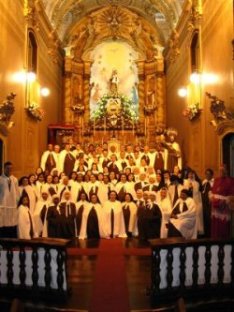
The Feast of St Louis reminds me of my little, five days pilgrimage to Rome this year to visit seven Churches of Rome, the route of pilgrimages as recommended by St Philip Neri. After I visited the must Churches, participated in Wednesday Papal Audience and spent two days revisiting St Peters Basilica, the Santa Scala Church and praying at the tomb of St Ignatius who is my Patron Saint, in Il Gesu Church, I decided to see on my last day the most famous landmarks of Rome such as Fontana di Trevi and Spanish Steps. The area of Spanish Steps was called in the 18th century Roman slang "er ghetto de l'inglesi" (the English ghetto), because it was the preferred area of the English artists and tourists. Pope Sixtus V, the great townplanner, set the architecture layout of this beautiful place as we can see it now. I took some pictures which are in a little movie below. Spanish Steps (Scalinata di Trinità dei Monti) by Francesco De Sanctis (1723-1726) are made of twelve flight of steps of varying width moving upwards towards the Piazza Trinità dei Monti. Before the steps there is a fountain in the form of large boat "Barcaccia", spouting water while it sinks. The fountain is the work of Bernini and the movie starts with the picture of Barcaccia. At the top of steps I saw the Church and I decided to go up there to visit it, not knowing that actually I would make, as tradition calls it, the most beautiful climbing to the Trinity of Mounts Church. Only inside the Church I realized that it is dedicated to the Holy Trinity and built in honour of St. Louis IX in 1502 and consecrated by Pope Sixtus V in 1585. The Church was restored after the Napoleonic occupation of Rome. The view of the City from a little piazza around the Church is splendid, one of the pictures shows beautiful gardens, cafes and little restaurants on the roofs of buildings. The Church interior deserves admiration: it still preserves some of the original Gothic arches and contains artistic treasures in the lateral chapels such as impressive frescoes and altarpiece by Daniele da Volterra, a pupil of Michelangelo: "The Deposition" and "The Assumption". Interestingly, when I visited the Church there was a Mass and Liturgy of the Hours chanted by the group of young men and women wearing white habits. I read that they belong to religious Order established originally in honour of St Louis. These young religious are captured by me while kneeling in the picture of the Church interior in the movie below. The Mass and Liturgy were in French and it was beautiful and spiritual experience.


Read whole post......

Thursday, August 20, 2009

Feast of St Bernard, Abbot of Clairvoux and Doctor of the Church - click to read

Today is the Feast of St Bernard and asking his intercession we may pray today for our Holy Father, Pope Benedict XVI. St Bernard's disciple became Pope Eugenius III and fulfilling his request, St Bernard composed for him the book "On Considerations" - the most beautiful book ever written on the Papacy.


....Innocent II died in 1143. His two successors, Celestin II and Lucius, reigned only a short time, and then Bernard saw one of his disciples, Bernard of Pisa, Abbot of Three Fountains, and known there-after as Eugenius III, raised to the Chair of St. Peter. Bernard sent him, at his own request, various instructions which compose the Book on Considerations - click to read online, the predominating idea of which is that the reformation of the Church ought to commence with the sanctity of its head. Temporal matters are merely accessories; the principal are piety, meditation, or consideration, which ought to precede action. The book contains a most beautiful page on the papacy, and has always been greatly esteemed by the sovereign pontiffs, many of whom used it for their ordinary reading...


Read whole post......

Tuesday, August 18, 2009

Feast of St Emygdius, Bishop and Martyr

Today is the feast of St Emygdius, who by God's grace had great power over evil spirits, destroyed many idols and converted hundreds of heathen in ancient Rome. In our difficult and dark times we need the intercession and help of Saints like Emygdius, who is venerated and commemorated in the Traditional Carmelite Breviary.

Emygdius was born in Treves [Germany] of a noble Frank family. In his twenty-third year he embraced the faith of Christ in spite of opposition of his parents who were idolaters, and this faith he steadfastly professed. He lived with three disciples, Euplus, Germanus and Valentinus. He scorned human pleasures, and thus he applied himself the more entirely to divine things. Fired with a burning love of the neighbour, he journeyed to Rome in order to bring about the salvation to many souls, and he was there received as a guest, in the Island of the Tiber, where he cured, by baptism, the daughter of his host, who had been ill for five years of an incurable disease. A little later he opened the eyes of a blind man, in the presence of the people by the sign of the Cross. Thereupon the crowd, thinking that he was the son of Apollo, carried him off by force to the Temple of Aesculapius. he there declared himself the servant of Christ, and by calling upon Christ's name he restored to health a great number of sick persons, who were vainly beseeching the help of the idol. Emygdius tore down the altars, and having broken in pieces the statue of Aesculapius, he cast it into the Tiber. These acts, and the conversion of thirteen hundred of the heathen, which followed, together with that of the priests of Aesculapius, enraged Posthumius Titanus, the Prefect of City. Emygdius, by the counsel of an angel, escaped from his threats, and betook himself to the Pontiff, Saint Marcellus, by whom he was consecrated Bishop, and sent to Ascoli.
On his way thither Emygdius converted a multitude of persons to Christ by the many miracles which he wrought. The demons, whose wailing issued from the idols and filled the temples upon his arrival at Ascoli, declared a traveller to be the cause of their distress. The people were aroused, and sought to slay him, whereupon Polymius, the Governor, who was brought out by the tumult, called Emygdius to him, and in a long fruitless discourse he urged him to worship Jupiter and the goddess Angaria, the patroness of Ascoli. He even promised him as a reward the hand of his daughter Polisia, whom Emygdius converted to Christ and baptized on the spot. Her baptism was followed by that of sixteen hundred men, the Saint having drawn, by a miracle, an abundance of water from the rock. Thrown into fury by these events, Polymius cut off the head of the holy Bishop, whereupon the body, wonderful to relate, stood erect, and , bearing in its hands the head which had been cast upon the ground, carried it to the Oratory, a disctance of three hundred feet. it was removed thence to the principal church, where it is honoured by the people of Ascoli, as well as by a multitude of people from other parts of [Italy]. The blessed death of Emygdius took place during the persecution of Diocletian.

Prayer
O God! who hast adorned the Blessed Emygdius, Thy Martyr and Bishop, with victory over idols, and with the splendor of miracles; mercifully grant that, through his mediation, we may deserve to conquer the deceits of evil spirits, and to shine by our virtue. Through our Lord.

Text's excerpts after 'Saints of Carmel - Proper Offices of the Saints Granted to the Barefoot Carmelites' 1896 edition


Read whole post......

Thursday, August 13, 2009

Feast of St John Berchmans - click to read

Today is the Feast of St John Berchmans, SJ who is the patron of the young. In these day young Catholics need very much good role models in particularly in spiritual life. He died when he was only 22, and much like St Terese of Lisieux, was the kind of saint who performed ordinary actions with extraordinary perfection. He is excellent role model for young Catholics. Let us pray and recommend them all to his intercession.

St John Berchmans Holy Card, he is often depicted holding his crucifix, his book of rules, and his rosary.

St John Berchmans shrine in St Ignazio Church, Rome (picture by Fr Lawrence, OP)

Close up of his tomb

..."St. John Berchmans was born in Belgium in the times of war between the Catholics and Protestants of the Netherlands. He was the oldest of five children and his parents watched him growing and richly endowed by God with kind, gentle and affectionate nature. He was but nine years of old when his mother was stricken with a long and serious illness. John would pass several hours each day by her bedside, and console her with his affectionate though serious, words. Later, when he lived with some other boys at their little parish school dormitory, he would undertake more than his share of the domestic work, selecting by preference the more difficult occupations. If he was loved by his comrades, he repaid their affection by his kindness, without, however, deviating from the dictates of his conscience. It was noticed even that he availed himself discreetly of his influence over them to correct their negligences and to restrain their frivolous conversation. Eager to learn, and naturally endowed with a bright intellect and a retentive memory, he enhanced the effect of these gifts by devoting to study whatever time he could legitimately take from his ordinary recreation.

It was obvious to his parents of to their parish priest, Fr M. Emmerick, that the Lord may work wonders in the soul of this child. When he was hardly seven years old, he was accustomed to rise early and serve two or three Masses with the greatest fervour. He attended religious instructions and listened to Sunday sermons with the deepest recollection, and made pilgrimages to the sanctuary of Montaigu, a few miles from Diest, reciting the rosary as he went, or absorbed in meditation. As soon as he entered the Jesuit college at Mechlin, he was enrolled in the Society of the Blessed Virgin, and made a resolution to recite her Office daily. He would, moreover, ask the director of the sodality every month to prescribe for him some special acts of devotion to Mary. On Fridays, at nightfall, he would go out barefooted and make the Stations of the Cross in the town. Such fervent, filial piety won for him the grace of a religious vocation. Towards the end of his rhetoric course, he felt a distinct call to the Society of Jesus. His family was decidedly opposed to this, and on 24 September, 1616, he was received into the novitiate at Mechlin. After two years passed in Mechlin he made his simple vows, and was sent to Antwerp to begin the study of philosophy. Remaining there only a few weeks, he set out for Rome, where he was to continue the same study. After the journeying three hundred leagues on foot, carrying a wallet on his back, he arrived at theRoman College, he studied for two years and passed on to the third year class in philosophy in the year 1621. One day early in August of that same year he was selected by the prefect of studies to take part in a philosophical disputation at the Greek College, at that time under the charge of the Dominicans. He opened the discussion with great perspicuity and erudition, but, on returning to his own college, he was seized with a violent fever of which he died, on 13 August, at the age of twenty-two years and five months, and numerous miracles were attributed to him at the time of his funeral and his feast is on 26 November.

He was beatified by Pope Pius IX in 1865 and canonized by Pope Leo XIII in 1888."

Text based mainly on Catholic Encyclopedia entry.


Read whole post......

Saturday, August 01, 2009

Feast of St Alphonsus de Liquori - click to read

Commemoration of St Alphonsus, founder of Redemptorist Order.


Read whole post......

Friday, July 31, 2009

Feast of St Ignatius of Loyola - click to read

It would be not enough words to praise the founder of the Society of Jesus. For centuries Jesuits served the Papacy and evangelized half of the world bringing Catholic faith to Amerindia and Asia, faith bought often at the price of blood of their Saints and martyrs. AMDG
Statue of St Ignatius lit for his Feast day in Il Gesu Church in Rome
2 Tim 2:8-10, 3:10-12. Be mindful that the Lord Jesus Christ is risen again from the dead, of the seed of David, according to my gospel: Wherein I labour even unto bands, as an evildoer. But the word of God is not bound. Therefore I endure all things for the sake of the elect, that they also may obtain the salvation which is in Christ Jesus, with heavenly glory. But thou hast fully known my doctrine, manner of life, purpose, faith, longsuffering, love, patience, persecutions, afflictions: such as came upon me at Antioch, at Iconium and at Lystra: what persecutions I endured, and out of them all the Lord delivered me. And all that will live godly in Christ Jesus shall suffer persecution. Luke 10:1-9. And after these things, the Lord appointed also other seventy-two. And he sent them two and two before his face into every city and place whither he himself was to come. And he said to them: The harvest indeed is great, but the labourers are few. Pray ye therefore the Lord of the harvest that he send labourers into his harvest. Go: Behold I send you as lambs among wolves. Carry neither purse, nor scrip, nor shoes: and salute no man by the way. Into whatever house you enter, first say: Peace be to this house. And if the son of peace be there, your peace shall rest upon him: but if not, it shall return to you. And in the same house, remain, eating and drinking such things as they have: for the labourer is worthy of his hire. Remove not from house to house. And into what city soever you enter, and they receive you, eat such things as are set before you. And heal the sick that are therein and say to them: The kingdom of God is come nigh unto you.
Letter of St Ignatius with his signature.
Read whole post......

Sunday, July 26, 2009

Commemoration of St Ann, mother of the Blessed Virgin - click to read


Read whole post......

Monday, June 29, 2009

Feast of St Peter and Paul - click to read


Read whole post......

Tuesday, April 28, 2009

Feast of St Paul of the Cross, founder of Passionists - click to read


More aboutPassionists

..."Clement XIV and gave Paul of the Cross the house and basilica on the Celian hill, SS. Giovanni e Paolo. A short distance from the Coliseum, it was here Paul passed the last years of his life. Here, too, he was visited by two Popes, Clement XIV in 1774 and by Pius VI in 1775. He died a few months after the latter visit. His mortal remains are enshrined in the chapel, completed in 1880, dedicated to him....


Read whole post......

Saturday, April 25, 2009

Feast of St Mark Evangelist - click to read


St Mark by Donatello

"...When, on the occasion of the famine of A.D. 45-46, Barnabas and Saul had completed their ministration in Jerusalem, they took Mark with them on their return to Antioch (Acts 12:25). Not long after, when they started on St. Paul's first Apostolic journey, they had Mark with them as some sort of assistant (hupereten, Acts 13:5);...The context of Acts 13:5, suggests that he helped even in preaching the Word. When Paul and Barnabas resolved to push on from Perga into central Asia Minor, Mark, departed from them.... and returned to Jerusalem (Acts 13:13)... St. Paul, who refused on account of it to take Mark with him on the second Apostolic journey. This refusal led to the separation of Paul and Barnabas, and the latter, taking Mark with him, sailed to Cyprus (Acts 15:37-40). At this point (A.D. 49-50) we lose sight of Mark in Acts, and we meet him no more in the New Testament, till he appears some ten years afterwards as the fellow-worker of St. Paul, and in the company of St. Peter, at Rome (Colossians 4:10)....and he was probably there when St. Paul was martyred.

When we turn to tradition, Papias (Eusebius, Church History 3:39) asserts not later than A.D. 130, on the authority of an "elder", that Mark had been the interpreter (hermeneutes) of Peter, and wrote down accurately, though not in order, the teaching of Peter (GOSPEL OF SAINT MARK). A widespread... tradition represents St. Mark as the founder of the Church of Alexandria...The date of Mark's death is uncertain. As to the manner of his death, the "Acts" of Mark give the saint the glory of martyrdom, and say that he died while being dragged through the streets of Alexandria; so too the Paschal Chronicle.... In Christian literature and art St. Mark is symbolically represented by a lion. The Latin and Greek Churches celebrate his feast on 25 April, but the Greek Church keeps also the feast of John Mark on 27 September."


Read whole post......