This blog is to propagate genuine Catholic devotions in the spirit of Traditional Carmel by providing texts useful for spiritual readings and meditations. "The devil knows that he has lost the soul that perseveringly practices mental prayer" - St Teresa of Avila. "For we preach not ourselves, but Jesus Christ our Lord; and ourselves your servants through Jesus" (2Cor 4:5). Soli Deo honor et gloria.
The blog is lovingly dedicated to the Infant Jesus of Prague and under His Patronage
Our Lady of Walsingham belongs to England. And it is a 15th-century poet, laureate of the famous chapel now destroyed, who sang that England belonged to Mary:
O England, great cause thou hast glad for to be,
Compared to the land of promised Sion,
Thou attainest my grace to stand in that degree
Through this glorious Lady’s supportation,
To be called in every realm and region
The holy land, Our Lady’s dowry;
Thus art thou named of old antiquity.
One cannot doubt that Our Lady is still looking with a maternal love on this island where, for centuries, countless pilgrims came to put down their burden at her shrine «where grace is poured out daily upon men of all ages» and, when they departed, they carried with them in the intimate recess of their heart the peace of heaven, sprung from the faith of their childhood, which brings peace to the heart and lifts up the veil that hides the vision of a pure and everlasting joy. (His Holiness Pope Pius XII - An address to British Soldiers on April 11, 1947)
O God, Who on this day givest us joy by the annual solemnnity of the exaltation of the holy cross, grant, we beseech Thee, that we may deserve the reward of His redemption in heaven Whose mystery we have known upon earth. Through the same Lord Jesus Christ, etc. Amen.
EPISTLE
Brethren. Let this mind be in you, which was also in Christ Jesus: Who being in the form of God, thought it not robbery to be equal with God: But emptied himself, taking the form of a servant, being made in the likeness of men, and in habit found as a man. He humbled himself, becoming obedient unto death, even to the death of the cross. For which cause God also hath exalted him, and hath given him a name which is above all names: That in the name of Jesus every knee should bow, of those that are in heaven, on earth, and under the earth: And that every tongue should confess that the Lord Jesus Christ is in the glory of God the Father.
GOSPEL (John 12:31-36)
At that time Jesus said to the multitude of the Jews: Now is the judgment of the world: now shall the prince of this world be cast out. And I, if I be lifted up from the earth, will draw all things to myself. (Now this he said, signifying what death he should die.) The multitude answered him: We have heard out of the law, that Christ abideth for ever; and how sayest thou: The Son of man must be lifted up? Who is this Son of man? Jesus therefore said to them: Yet a little while, the light is among you. Walk whilst you have the light, that the darkness overtake you not. And he that walketh in darkness, knoweth not whither he goeth.Whilst you have the light, believe in the light, that you may be the children of light. These things Jesus spoke; and he went away, and hid himself from them.
INSTRUCTION ON THE WAY OF THE CROSS
What is the Holy Way of the Cross?
It is a devotional exercise by which we meditate upon the passion and death of Jesus, and particularly upon His last way of sorrows, from the house of Pilate to Mount Calvary.
Tradition testifies that after Christ's ascension the Christians living in Jerusalem were accustomed particularly to venerate the holy places which had been sanctified by the passion of the divine Redeemer. But after Jerusalem fell into hands of the infidels, so that it became dangerous, and often impossible, to pass over the ground which Our Lord had trod, the children of St. Francis of Assisi began to erect in their churches the fourteen stations of the Way of the Cross, by meditating on which the faithfull might, in spirit, accompany the pilgrims to Jerusalem on the way to Calvary, dwelling in thought on what Christ had suffered for men. Stations here means a place to pause, a resting-point for meditation. This devoution has been examined and approved by many Popes, enriched with indulgences, and earnestly recommended to Christians. It may be found in any prayer-book. No exercise is more profitable to our souls than this. What can bring before us the love of God and the abominabless and frightfulness of sin in a more vivid manner than the sufferings of the God-man? How can we any longer indulge in hate when we hear Jesus pray for His enemies? How can we give ourselves up to sensuality and lust when we see the divine Saviour scourged, crowned with thorns, and hanging on the cross? How can we murmur at our trials when we think that Jesus innocent takes up the cross for us guilty? In truth, we should see our coldness and indifference disappear, as ice melts in the heat, we should grow more and more zealous in the way of virtue, if we would but rightly meditate upon the passion of Christ.
How are visit to the stations of the Cross to be made?
Rightly to visit the Stations of the Cross, and to draw therefrom real benefit, we should at each station consider with attention, with devotion and sorrow, what Jesus has done and suffered for us. We should not content ourselves with merely reciting at each station the proper prayers and meditations, but should pause, to impress upon our hearts what is there represented, that we may be moved and quickened to wholesome resolutions. In order to gain indulgences we must endeavour to be in the state of grace, and therefore at least, by the way of beginning, we must have perfect contrition for our sins.
Our Lady's Birthday! What a beautiful feast on which to become the bride of Christ, baby Mary a day old presenting His little flower to little Jesus! On that day everything was little except the graces I received, and the peace and joy I felt when evening came and I gazed up at the starry heavens, where I would soon be united to my divine Bridegroom in everalsting happiness.
From the time I awoke in the morning I was filled with peace, and it was in the peace of God which surpasseth all understanding (Phil 4; 7) that I pronounced my holy vows. At the close of this beautiful day I laid my wreath, as is the custom, at Our Lady's feet without any feeling of sadness, for I felt that time would not lessen my hapiness.
O Jesus, I only ask Thee to give me peace!....Peace, and above all a love that knows no bounds. (St Therese, The Story of a Soul)
Carmelite Saint, St Teresa Margaret Redi, has some words to encourage the practice of recollection and the presence of God amid our daily duties:
“If we work here through obedience to God’s commands, it is impossible that He should destroy His own work in the soul....If we live and move in God, ... I do not think His company or love will desert us when we perform necessary external tasks, let alone constitute any obstacleto them....When I place everything in Love, Love will never abandon me. So I in my turn abandon myself to the love of Jesus Christ with love for love, because His loving Heart desires to rule and reign in me, and of myself I would not know how to behave unless I place no obstacle to His acting in me.”
Father, you unabled St Teresa Margaret Redi to draw untold resorces of humility and charity from the fountain-head, our Sviour. Through her prayers may we never be separated from the love of Christ. Grant this through our Lord, amen. After concluding prayer, Discalced Carmelite Proper Office.
Today, Discalced Carmelites commemorate transverberation (piercing) of the heart of St. Teresa of Avila. In 1559, at the age of 44, the saint experienced one of the most sublime of her many mystical ecstasies. In a vision, she saw an angel, and in his hand he held a golden spear tipped with fire. He penetrated her heart and caused a very sharp pain that was at the same time exquisitely beautiful.Signs that the piercing were real are visible in her heart, which is incorrupt and kept in the glass reliquary (photo on the left) located in the Carmelite convent in Alba de Tormes, where St Teresa died in 1582 on her way back to Avila. We can read description of this mystical experience in Chapter 29 of her "Autobiography": “It pleased the Lord that I should sometimes…see beside me…an angel in bodily form…. He was not tall, but short, and very beautiful, his face so aflame that he appeared to be one of the highest types of angel who seemed all afire…. In his hands I saw a long golden spear and at the end of its iron tip I seemed to see a point of fire. With this he seemed to pierce my heart several times…[leaving] me completely afire with a great love of God.”
See the beauty of the daughter of Jerusalem, who ascended to heaven like the rising sun at dawn (Morning Prayer, Benedictus Antiphon.
One day, the feast of the Assumption of our Lady, Queen of Angels,
the Lord desired to grant me the following favor; in a rapture He
showed me her ascent to heaven, the happiness and solemnity with
which she was received, and the place where she is. I wouldn't be
able to describe how this happened. The glory my spirit experienced
in seeing so much glory was magnificent. The effects of this favor
were great. I was helped in having a deeper desire to undergo
difficult trials, and I was left with a longing to serve our Lady
since she deserved this so much. St Teresa of Avila, The book of her
life, ch 39.
The image represents Titiano Vecelli's 'The Assumption of the Virgin' altarpiece, Venice Basilica di Santa Gloriosa dei Frari, after Titian.org Read whole post......
"Those who join the Carmelite Order are not lost to their near and dear ones, but have been won for them, because it is our vocation to intercede to God for everyone....I keep thinking of Queen Esther who was taken away from her people precisely because God wanted her to plead with the king on behalf of her nation. I am a very poor and powerless little Esther, but the King who has chosen me is infinitely great and merciful. This is great comfort." (Edith Stein on Carmelite vocation, 1938). After being transferred to Dutch Carmelite convent from Cologne because of severe persecusion of Jews in Nazi Germany, she wrote in her will these words: "Even now I accept the death that God has prepared for me in complete submission and with joy as being his most holy will for me. I ask the Lord to accept my life and my death ... so that the Lord will be accepted by His people and that His Kingdom may come in glory, for the salvation of Germany and the peace of the world.""
A brilliant philosopher who stopped believing in God when she was 14, Edith Stein was so captivated by reading the autobiography of Teresa of Avila that she began a spiritual journey that led to her Baptism in 1922. Twelve years later she imitated Teresa by becoming a Carmelite, taking the name Teresa Benedicta of the Cross. Born into a prominent Jewish family in Wroclaw (Poland), Edith abandoned Judaism in her teens. As a student at the University of Göttingen, she became fascinated by phenomenology, an approach to philosophy. Excelling as a protégé of Edmund Husserl, one of the leading phenomenologists, Edith earned a doctorate in philosophy in 1916. She continued as a university teacher until 1922 when she moved to a Dominican school in Speyer; her appointment as lecturer at the Educational Institute of Munich ended under pressure from the Nazis.
After living in the Cologne Carmel (1934-38), she was moved to the Carmelite monastery in Echt, Netherlands. In Echt, Edith Stein completed her study of "The Church's Teacher of Mysticism and the Father of the Carmelites, John of the Cross, on the Occasion of the 400th Anniversary of His Birth, 1542-1942." In 1941 she wrote to a friend, who was also a member of her order: "One can only gain a scientia crucis (knowledge of the cross) if one has thoroughly experienced the cross. I have been convinced of this from the first moment onwards and have said with all my heart: 'Ave, Crux, Spes unica' (I welcome you, Cross, our only hope)." Her study on St. John of the Cross is entitled: "Kreuzeswissenschaft" (The Science of the Cross).
In retaliation for being denounced by the Dutch bishops, the Nazis arrested all Dutch Jews who had become Christians. Teresa Benedicta was arrested by the Gestapo on 2 August 1942, while she was praying in the convent's chapel with the other sisters. She was to report within five minutes, together with her sister Rosa, who had also converted and was serving at the Echt Convent. Her last words to be heard in Echt were addressed to Rosa: "Come, we are going for our people."
Together with many other Jewish Christians, the two women were taken to a transit camp in Amersfoort and then to Westerbork. This was an act of retaliation against the letter of protest written by the Dutch Roman Catholic Bishops against the pogroms and deportations of Jews. Edith commented, "I never knew that people could be like this, neither did I know that my brothers and sisters would have to suffer like this. ... I pray for them every hour. Will God hear my prayers? He will certainly hear them in their distress." Prof. Jan Nota, who was greatly attached to her, wrote later: "She is a witness to God's presence in a world where God is absent."
On 7 August, early in the morning, 987 Jews were deported to Auschwitz. It was probably on 9 August that Sister Teresia Benedicta a Cruce, her sister and many other of her people were gassed.
When Edith Stein was beatified in Cologne on 1 May 1987, the Church honoured "a daughter of Israel", as Pope John Paul II put it, who, as a Catholic during Nazi persecution, remained faithful to the crucified Lord Jesus Christ and, as a Jew, to her people in loving faithfulness."
To read the writings of St Teresa Benedicta on the history and spirit of Carmel, please follow LINK1
We address Our Lady with this title to praise her faithfulness to God. She says: "Behold the handmaid of the Lord" (Luke 1:38) and in these words is her readiness to accept all God wish to send her, no matter if it brings joy or sadness. She was steady and meek to keep her words in poor and cold stable in Bethlehem, during hard times of exile in Egypt, in poor house in Nazareth, during Jesus bloodstained way to Calvary, standing under His Cross and during long years without Jesus after His Ascension to Heaven. Let us meditate on her care and faithfulness to us. In short testament:"This is your son!" (John 19:26)she was given by Jesus all of us in the person of St John. Acting as the best mother she takes all Adam's descendants under her mantle. St Bernard says that Satan is roaming around looking for someone to devour, but Mary is tirelessly looking for those to save. Let us be filled with gratitude and appreciation for Our Immaculate Lady most faithful care and work for the salvation of souls. Let us follow closely her example for she fulfills her promises with great care. Let us do all we can to keep our Baptismal and First Holy Communion promises remembering Our Lord words: "No man putting his hand to the plough, and looking back, is fit for the kingdom of God" (Luke 9:62)
Today's picture of this beautiful statue "Ave Regina Pacis" was taken in St Mary Major Basilica in Rome
I already feel completely at home in this little cell. I haven’t been bored at all, in fact just the opposite. I am here alone, but never was our Lord so close to me. I could shout for joy that He has again let himself be found by me without me being able to be among people or people with me. He is now my only refuge and I feel safe and happy. I would like to stay here always, If He wills that. I have seldom been so happy and so content.” (Carmelnet)
Bl Titus Brandsma was Dutch Carmelite of Ancient Observance who was martyred in Nazi concentration camp of Dachau, Germany, during WW2. The portrait of him posted today is kept in Carmelite Friary in Kinsale Co Cork, Ireland, and was painted to commemorte his visit there that took place just before he commenced the lecture tour in America. His words on solitude were written during his imprisonment in Dachau years later. He was aware of his uncertain future and coming end but his optimism and love for God brightens his mind and heart and makes him, as he says, more happy and aware of Jesus presence than ever before in his life. Excellent words to meditate on our dependency on God in particular in moments of desolation and aloneness.
Praises to the great Elijah! Let our song to heaven rise.
His the grace to hear God's whisper
Where all earthly music dies.
Clad in skins he made his dwelling
On Mount Carmel, finding there
That austere and lonely wisdom
Hidden in a life of prayer.
Now we pray our Prophet-father
That our lives obtain this grace,
An outpouring of the Spirit
Over every time and place.
Praise and honour to the Father,
To the Son and Spirit praise
Their be all love abd worship
Now and for eternal days.
Hymn from the 'Discalced Carmelte Proper Offices'
The monastery of Carmel, Stella Maris, is situated two miles from Haifa. It is four hundred and ninety-five feet above the sea and has all the solidity of a fortress. Its thick walls, its heavily barred windows, its low doors, present a fine specimen of Medieval Monasteries in the Orient, always exposed to attack.
On reaching the esplanade you are faced with a bronze pillar set in a granite plinth and crowned by a statue of Immaculate Conception, the gift of Chile. To the right is a guest house, Stella Maris, once a villa built by Abdullah Pasha of Acre in 1821 from the ruins of the monastery.
This building also serves as the base of a lighthouse, whose big white light flashes one minute out over the sea and then back over the mountain. It can be seen at a distance of fifteen miles: surely a Star of the Sea.
To the right is the monastery within which is enclosed the church. In front of the monastery is a stone pyramid built in 1876, a monument to the two thousand dead of Bonaparte.
The main door leads into the church, which makes a profound impression for its sheer beauty.
Above the High Altar rises the statue of Our Lady of Carmel. Graceful and lonely the Virgin sits enthroned with the Child Jesus in her left arm, her sceptre in her right hand from which hangs a scapular.
The original statue was carved in 1821 by the Genoese Caraventa, but strange to relate it consisted only of head, hands and feet in wood, the rest was arrayed in rich clothing. In 1933, these were attached to a new statue carved from Lebanese cedar by the sculptor Rieda.
Beneath the altar is a dim grotto supported by two porphyry pillars. This grotto served on many occasions as the dwelling of St Elias.
It was near this grotto that the hermits had built the small chapel, during the lifetime of the Virgin. Within the Grotto an altar hewn in the rock is adorned with a statue of St Elias, his arm raised in a threatening gesture.
Beautiful dome above St Elias Grotto
Thousands of pilgrims flock to Mt Carmel on July 20, the feast of St Elias. From the terrace of the monastery the view is magnificent.
You seem to stand on the neck of a lusty giant resting on ancient and solid foundations, embraced by the waters of the Mediterranean. Two powerful forces, two giants, meet face to face. Between these two imposing elements puny man is ruler of all he surveys - how finite and insignificant he feels. It is difficult to decide which of the two elements encroaches upon the other - whether the land abuts on the sea, or the sea threatens the land. But it is Carmel at least that places the frame for the fascinating picture.
Who are You, and who am I? I am a creature formed by Your hands, a creature taken from nothingness, formed from clay, but with a soul that is like unto God, a soul that is like unto God, a soul that is intelligent and free, destined to give You the glory of the invisible world. My God, we are so miserable that we rebel against You, our Creator. Pardon me! For instead of loving You, we offend You. There is only one commandment You imposed on us and we do not fulfill that one. What does it profit us to gain the whole world if we lose our soul? What do riches, honours, glory, human affections matter, for they pass away and end? How do they compare with my soul, which is immortal and has been made worthy by the Blood of Jesus Christ, my God? How precious must a soul be since the devil will be watching out to destroy it. Either I am going to save my soul or I am going to condemn it forever. That is why I am resolved to save it.
The National Gallery, Carlo Crivelli, 'St Peter and Paul'
Are you ready to ascend Mt. Carmel on the wings of a bird? Are you tired of being tied down by the things of this earth? Everything that God created is good. But He made the physical world as a means of drawing us towards Himself. One day, it will have served its purpose and be gone. Will you be ready to leave it behind when God calls you? “You can’t take it with you” - not to Heaven, and not up the mountain. Let’s follow St. Paul in enjoying the things of this earth without being consumed by them (1 Corinthians 7:31). St John of the Cross, Ascent of Mt. Carmel, Book One, 11.4.“May grace and peace be accomplished and perfect in you in the knowledge of God and of our Lord Jesus Christ, as all things of his divine power that pertain to life and piety are given us through the knowledge of him who called us with his own glory and power, by whom he has given us very great and precious promises, that by these we may be made partakers of the divine nature” [2 Pt. 1:2-4]. These are words from St. Peter in which he clearly indicates that the soul will participate in God himself by performing in him, in company with him, the work of the Most Blessed Trinity because of the substantial union between the soul and God. Although this participation will be perfectly accomplished in the next life, still in this life when the soul has reached the state of perfection…. she obtains a foretaste and noticeable trace of it in the way we are describing, although as we said it is indescribable.St. John of the Cross. Spiritual Canticle, Stanza 39.
"O Jesus, I know that Your Heart is more grieved by the thousand little imperfections of Your friends than by the faults, even grave, which Your enemies commit. Yet, it seems to me, that it is only when those who are Your own are habitually guilty of thoughtlessness and neglect to seek Your pardon, that You can say: 'These wounds which you see in the midst of My hands I have received in the house of those who love Me.' But Your Heart thrills with joy when You have to deal with all those who truly love, and who after each little fault come to fling themselves into Your arms, imploring forgiveness. You say to Your angels what the prodigal's father said to his servants: 'Put a ring upon his finger, and let us rejoice.' O Jesus, how little known is the merciful love of Your Heart!" (St Therese of Child Jesus, Letters, Councels and Souvenirs)
In the encyclicalAnnum Sacrum, Pope Leo XIII declares, "The Sacred Heart is the symbol and image of the infinite charity of Jesus Christ, the charity which urges us to give him love in return." Indeed, nothing is more able to arouse love than love itself. St Teresa of Jesus said: "Whenever we think of Christ, we should remember with what love He has bestowed all these favours upon us...for love begets love. And though we may be only beginners...let us strive ever to bear this in mind and awaken our own love" (Life, 22). The Church offers us the devotion to the Sacred Heart of Jesus to stir up our love and asks us "Who would not love Him who has loved us so much? Who among His redeemed would not love Him dearly?" (RB). Jesus said through the Prophet: "I have loved thee with an everlasting love; therefore have I drawn thee, taking pity on thee" (Jer 31:30). Devotion to the Sacred Heart, which is devotion to the infinite love of Jesus, should produce this particular effect on us: it should give us an ever increasing comprehension of "the charity of Christ which surpasseth all knowledge" (Eph 3:19). Meditating and contemplating the Heart of Jesus pierced for love of us, may be the way to learn the science of love, a science which no book on earth can teach us, because it is a science that can be acquired only from the open book of the Heart of Christ, our one and only Teacher, as St John of the Cross said: "He thought me a science most delectable". Therefore, the answer to His love is easy: He "loved me and delivered Himself for me...and I most gladly will spent and be spent myself for Him and for the souls that are His treasure" (Gal 2:20, Cor 12:15). Behold the love that raises us above all calculation, all self-love.
I invite all visitors to this blog, to read this beautiful devotional meditation written by Fr Gabriel of St Mary Magdalen, OCD, which may help us to understand better Our Lord's love and compassion for us, poor sinners, that prompted Him to remain with us for ever in the Most Holy Sacrament of the altar.
PRESENCE OF GOD: "The eternal tide flows hid in living bread. That with its heavenly life to be fed" (St John of the Cross 'Poems').
MEDITATION 1. We have gone, step by step, in the course of the liturgical year, from the consideration of the mysteries of the life of Jesus to the contemplation of the Blessed Trinity, whose feast we celebrated last Sunday. Jesus, our Mediator, our Way, has taken us by the hand and led us to the Trinity; and today it seems as though the three Persons Themselves wish to take us back to Jesus, considered in His Eucharist. "No man cometh to the Father but by Me" (Jn 14:6), Jesus said, and He added, "No man can come to Me except the Father...draw him" (Jn 6:44). This is the journey of the Christian soul: from Jesus to the Father, to the Trinity; from the Trinity, from the Father, to Jesus. Jesus brings us to the Father, the Father draws us to Jesus A Christian cannot do without Christ; He is, in the strictest sense of the word, our Pontiff, the great Bridge-builder who has spanned the abyss between God and us. At the end of the liturgical cycle in which we commemorate the mysteries of the Savior, the Church, who like a good Mother knows that our spiritual life cannot subsist without Jesus, leads us to Him, really and truly present in the Most Holy Sacrament of the altar. The solemnity of the Corpus Christ is not just the simple memorial of an historical event which took place almost two thousand years ago at the Last Supper; rather, it recalls us to the ever-present reality of Jesus always living in our midst. We can say, in truth, that He has not "left us orphans", but has willed to remain permanently with us, in the integrity of His Person in the fullness of His humanity and His divinity. "There is no other nation so great," the Divine Office enthusiastically sings, "as to have its gods so near as our God is present to us" (Roman Breviary). In the Eucharist, Jesus is really Emmanuel, God with us.
2. The Eucharist is not only Jesus actually living among us, but it is jesus become our Food. This is the chief aspect under which today's liturgy present the mystery to us; there is no part of the Mass which does not treat of it directly, or which does not, at least, make some allusion to it. The Introit refers to it when it mentions the wheat and honey with which God once fed the Hebrews in the desert, a miraculous food, and yet a very poor representation of the living, life-giving bread of the Eucharist. The Epistle (1 Cor 11: 23-39) speaks of it, recalling the institution of this Sacrament, when Jesus "took bread, and giving thanks, broke, and said, 'Take ye, and eat; this is My Body'"; the Gradual chants, "The eyes of all hope in You, O Lord, and You give them meat in due season". The very beautiful Sequence, Lauda Sion, celebrates it at length, and the Gospel (Jn 6: 56-59), echoing the Alleluia, cites the most significant passage in the discourse when Jesus Himself announced the Eucharist, "My Flesh is meat indeed, and My Blood is drink indeed"
The Communion Hymn repeats a sentence of the Epistle, and reminds us that we receive the Body of the Lord worthily. Finally, the Postcommunion tells us that Eucharistic Communion is the pledge of eternal communion, in heaven. But in order to have a better understanding of the immense value of the Eucharist, we must go back to the very words of Jesus, most opportunely recalled in the Gospel of the day, "He that eateth My Flesh and drinketh My Blood, abideth in Me and I in Him." Jesus made Himself our food in order to assimilate us to Himself, to make us live His life, to make us live in Him, as He Himself lives in His Father. The Eucharist is truly the Sacrament of the union and at the same time it is the clearest and most convincing proof that God calls us and pleads with us tp come to intimate union with Himself.
COLLOQUY
"O God, O Creator, O Spirit of life overwhelming Your creatures with ever new graces! You grant to Your chosen ones the gift which is ever renewed: the Body and Blood of Jesus Christ!...O my soul, how can you refrain yourself from plunging deeper and deeper into the love of Christ, who did not forget you in life or in death, but who willed to give Himself wholly to you, and to unite to Himself forever "St Angela of Folignio.
"You know, my God, that my one desire is to be a victim of Your Sacred Heart, wholly consumed as a holocaust in the fire of Your holy love. Your Heart will be the altar on which I shall be consumed by You, my dear Spouse, and You will be the Priest who will consume this victim by the fires of Your most Sacred Heart. But, O my God, how ashamed I am to see how guilty is this victim and how unworthy to have her sacrifice accepted by You! But I am confident that all will be consumed by this divine fire!
By offering my whole self to You, I understand that I am giving You my free will, so that henceforth, You alone will be the Master of my heart, and Your will alone will regulate my actions. Therefore, dispose of me always according to Your good pleasure; I am content with everything, since I wish to love You with a love that is patient, mortified, wholly abandoned to You, an active love, a strong, undivided love and, what is more important, a persevering love." (St Teresa Margaret Redi)
It seems to me that the attitude of the Virgin during the months that elapsed between the Annunciation and the Nativity is the model for interior souls, those whom God has chosen to live within, in the depths of the bottomless abyss. In what peace, in what recollection Mary lent herself to everything she did! How even the most trivial things were divinized by her! For through it all the Virgin remained the adorer of the gift of God! This did not prevent her from spending herself outwardly when it was a matter of charity. The Gospel tells us that Mary went in haste to the mountains of Judea to visit her cousin Elizabeth. Never did the ineffable vision that she contemplated within herself in any way diminish her outward charity. For, a pious author [Ruusbroeck] says, if contemplation "continues towards praise and towards the eternity of its Lord, it possesses unity and will not lose it. If an order from Heaven arrives, contemplation turns towards men, sympathizes with their needs, is inclined towards all their miseries; it must cry and be fruitful. It illuminates like fire, and like it, it burns, absorbs and devours, lifting up to Heaven what it has devoured. And when it has finished its work here below, it rises, burning with its fire, and takes up again the road on high."(Blessed Elizabeth of the Trinity)
Patron of this blog - click for link to Our Lady Victorious church images of the statue
Search This Blog
ABOUT CARMELITES
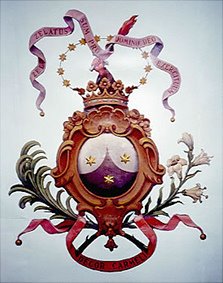
This is the Carmelite shield of the Ancient Observance. The palm and the lily signifies the first saints of the order: St. Angelus of Sicily (signified by the palm of martyrdom) and St. Albert of Trapani (signified by the lily). Six pieces of spiritual armour are described in the rule of the Order; the cincture is the symbol of purity, indispensable for one who desires to reach the holy mountain of the vision of God: "Blessed are the pure of heart, for they shall see God". The corselet which protects the vital parts of the body represents good thoughts: "Holy thoughts will protect you". The breastplate which covers the whole body represents justice, a well regulated life, the observance of the commandments and duties of daily life. The shield is faith; for a living faith is the best safeguard for the spiritual life. The helmet symbolizes hope, confidence in God, which gives us the right to walk with freedom and confidence. Finally, the sword indicates conversation with God which as a double edge blade comes to our aid and defends us in all our difficulties.
Mount Carmel, Carmelite Monastery - beautiful statue of Our Lady. Picture credit: Karmel im Heiligen Land
Carmelites are one of four mendicant religious Orders, originally founded in ancient Palestine with spirituality drawn from the imitation of the holy Prophet Elijah and zealous veneration of the Blessed Virgin Mary. The Order is dedicated to Our Lady, she is particularly honoured and venerated by Carmelites and the life of Carmelite should be focused on imitation of Mary. Devotion of the Brown Scapular, Mary's habit, caused Carmelites to be known as "Brothers of the Blessed Virgin Mary of Mount Carmel", to which Popes and Bishops attached indulgences. The oldest preserved constitution of the Order, established during General Chapter of Barcelona (1324), tells us that from the times of the holy Prophets, Elijah and Elisha, devout hermits lived continuously on Mt. Carmel, sought this holy mountain and loved its solitude in order to give their minds over to the contemplation of heavenly things; they built a chapel there in honor of the Virgin and thus deserved to be called the Brothers of Our Lady of Mount Carmel, a name recognized by Popes. St. Albert gave them a rule which was approved and the Carmelites, as we know them today, are successors of these holy hermits. Therefore, from its origin, their spirituality has been founded on these two specific elements, an imitation of the holy Prophet Elijah and veneration of the Blessed Virgin Mary (from Bl Titus Brandsma - "Lectures on Carmelite Spirituality" - Carmelnet).
Carmel in Toledo - Under Our Lady's mantle - St Elijah in Carmelite habit in company of other prophets (lower left panel). Picture credit: Karmel im Heiligen Land
Therefore, since the beginning of this blog established to promote Carmelite spirituality, special care has been taken to dedicate meditations of Saturday - day of Our Lady in Church's tradition - in honour and veneration of the Blessed Virgin, the ever glorious Patroness of all Carmelites.
ST ELIJAH AND CARMELITE SPIRITUALITY
1Kings 17:4 - Elijah by the brook of Cherith
In The Book of the First Monks, a medieval Carmelite work on the spirit of the order, the following teaching stands out: "The goal of this life is twofold. One part we acquire, with the help of divine grace, through our efforts and virtuous works. This is to offer God a pure heart, free from all stain of actual sin. We do this when we are perfect and in Cherith, that is, hidden in that charity of which we read:"Charity covers all sins " (Prov. 10:12). God desired Elijah to advance thus far when he said to him: "Hide yourself by the brook Cherith " (1 Kings 17:3-4).The other part of the goal of this life is granted us as the free gift of God: namely, to taste somewhat in the heart and to experience in the soul, not only after death but even in this mortal life, the intensity of the divine presence and the sweetness of the glory of heaven. This is to drink of the torrent of the love of God. God promised it to Elijah in the words: "You shall drink from the brook. "It is in view of this double end that the monk ought to give himself to the eremitic and prophetic life" (after Carmelites.com).
Prophet Elijah testimony: "I have burned with zeal for the Lord God of hosts" (1 Kings 19:9) - has become spiritual motto of Carmelites
Prophet Elijah victory at Mt Carmel over idolatrous prophets of Baal (1Kings 18)
Elijah statue in front of Carmelite Monastery on Mt Carmel
The greatest achievement of Elijah's life was his victory over the priests of Baal at Mt. Carmel. Having heard that the other prophets of Yahwh were also persecuted, he requested King Ahab to gather the people of Israel, the 450 priests of Baal, and the 400 prophets of Ashtaroth on Mt. Carmel. Then he asked Israel the famous question of 1 Kings 18:21: "How long will you waver between two opinions? If the LORD is God, follow him; but if Baal is God, follow him", meaning, "How long will ye be undecided as to whether ye shall follow Yahwh or Baal?"The people remaining silent. He invited the priests of Baal to a contest, proposing that he and they should each build an altar and lay a burnt offering thereon, and that the God who should send down fire from heaven to consume the offering should be accepted as the true God. After various unsuccessful attempts to get a favorable answer had been made by the prophets of Baal, while they were ridiculed with subtle irony by Elijah, Elijah prayed, and Yahwh sent fire from heaven to consume his offering. Yahwh was recognized by Israel, and the priests of Baal were slain by the people near the brook Kishon (1 Kings 18:17-40).
TWO CARMELITE ORDERS - TWO BRANCHES OF THE SAME TRUNK
Looking at Carmel from above, its two branches are united at their summits. Despite the separation which exists on the trunk, the two branches intermingle their foliage and blossoms without our being able to distinguish those which belong to the one from those which belong to the other. The blind singer of Rennes, Ven. John of St. Samson, does not have a different melody from that of the inspired singer imprisoned in the Carmel of Toledo, because both repeat what the Institutio primorum monachorum had inculcated in the Carmelites of the first centuries, namely, that all Carmelites, Brothers and Sisters of the Order of Our Lady of Mt. Carmel, in order to be faithful to their vocation should do their very utmost to go, under the guidance of the saintly hermit and prophet Elijah, across the desert of this life up to the Mt. Horeb of the vision of God, strengthened by the heavenly nourishment which is shown on the altar. (Bl Titus Brandsma, Lectures)
PRAYER TO THE HOLY GHOST - St MARY OF JESUS CRUCIFIED, OCD
Holy Spirit, inspire me. Love of God, consume me. Along the true road, lead me. Mary my Mother, look upon me. With Jesus, bless me. From all evil, from all illusion, from all danger, preserve me.
Source of peace, Light, come and enlighten me. I am hungry, come and nourish me. I am thirsty, come and quench my thirst. I am blind, come and give me light. I am poor, come and enrich me.
'Jay' stands for the phonetics of my first name initial 'J', as I have chosen anonymity in blogging. I am 'cradle' Roman Catholic, happy wife, mother and grandmother. I am professed Discalced Carmelite tertiary now, who loves and respects Our Lady of Mount Carmel and Holy Tradition of the RC Church - "Therefore, brethren, stand fast; and hold the traditions which you have learned, whether by word, or by our epistle" (2Thes 2:14), and: "Even if Catholics faithful to Tradition are reduced to a handful, they are the ones who are the true Church of Jesus Christ” (St. Athanasius, AD 373). In my devotion to Church's Tradition and Tridentine Mass I am with the Latin Mass Society of England and Wales and in union with the Holy Roman Catholic Church. In conclusion, the aim of this blog is to present and propagate traditional Catholic devotions, piety and Carmelite Spirituality in the richness of Tradition. All my efforts are aimed to help to preserve Catholic identity. The idea of this project is entirely private and comes from my own convictions and understanding of Catholicism.
Traditional Rite Discalced Carmelite Nuns in Valparaido, Nebraska
Jesus, Mary and Joseph Monastery associated with Fraternity of St Peter
Hermits of the Blessed Virgin Mary of Mount Carmel
Christoval, Texas
TRADITIONAL RITE CARMELITE MONKS OF WYOMING
Click on the picture for website link
TRADITIONAL RITE THIRD ORDER CARMELITES
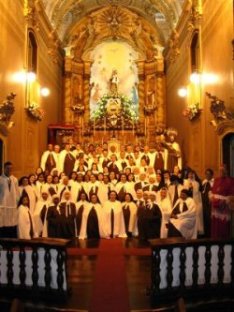
Traditional Latin Rite Third Order of Carmelites of Ancient Observance from Campos, Brasil was originally established on 13 May 1752. Their spiritual director is Rev. Father Everaldo Bon Robert, who is also O. Carm Tertiary. The Order numbers 150 members, among them 15 priests, 3 religious brothers of “conventual life” plus some associated Regular Third Order Sisters. The Order is under jurisdiction of the Personal Apostolic Administration of St. John Mary Vianney, which was created by the Holy See in 2002 for the Traditional Catholics of the Latin Rite in Brazil under administration of the Bishop Fernando Areas Rifan. In their church, the Traditional Latin Mass is the only Mass celebrated and every member of the Order pray Saturday's Rosary fervently in honour of the Queen and Mother of Carmel to keep them always in such a special grace. Third Order meetings take place on every 2nd Sunday of the month, and all Tertiaries, brothers and sisters, wear full Carmelite habit (as featured in the picture above). Church of Our Lady of Mt Carmel in Campos - blog and news Flos Carmeli Vitis Florigera blog of the Order Short history of the Society of St John Vianney in Campos, Brazil
DEVOTION TO THE MOST HOLY ROSARY OF THE BLESSED VIRGIN MARY
Why we should meditate on Our Lady's titles and invocations of Loreto Litany
This litany to the Blessed Virgin Mary was composed during the Middle Ages. The place of honor it now holds in the life of the Church is due to its faithful use at the shrine of the Holy House at Loreto. It was definitely approved by Sixtus V in 1587, and all other Marian litanies were suppressed, at least for public use. Its titles and invocations set before us Mary's exalted privileges, her holiness of life, her amiability and power, her motherly spirit and queenly majesty. The principle that has been followed in their interpretation is the one enunciated by the same Pius IX: "God enriched her so wonderfully from the treasury of His divinity, far beyond all angels and saints with the abundance of all heavenly gifts, that she . . .should show forth such fullness of innocence and holiness, than which a greater under God is unthinkable and which, beside God, no one can even conceive in thought." Hence, whatever virtue and holiness is found in angels and saints must be present in Mary in an immeasurably higher degree.
Reflection on the titles of the litany will unfold before us the grand picture of our heavenly Mother, even though we know only little about her life. We will also come to see why Mary's example, guidance, and help is the need of the hour (from Intermirifica, Litany of Loreto).
DEVOTION TO THE PASSION OF OUR LORD JESUS CHRIST
Stations of the Cross - click on the image to enter - it works now!
All the Saints achieved sanctity by meditating upon the Passion of Our Lord Jesus Christ. By this devotion, we have an irresistible and proven method to advance in our love for Our Divine Master as well as overcoming all our personal faults. The Passion of Jesus is also a treasure-house whose wealth will never suffer devaluation and obtains for us from the Eternal Father, Who cannot resists this devotion, all of those graces essential for our salvation as well as to that of others. This is the reason for which the Crucifix occupies a place of Honour upon our Altars, our Churches, our tombstones, in Christian bedrooms, as well as in the households of Christian families. "One thing only I do know", says St Paul,"and that is Jesus and Jesus Crucified" (1 Cor 2:2). And St Augustine:"I know of no remedy more effective against the sins of the flesh (i.e. concupiscence) than the Passion of my Lord Jesus Christ". Saint Bonaventure: "The Passion of Jesus dissolves in Divine Love even the most callous hearts of obstinate sinners". Saint Albert the Great:"One gains more merits by meditating lovingly on the Passion than by scourging oneself most severely or by fasting on bread and water every day of one's life". Always keep in mind the devotion of (King) Saint Louis to the Relics of the Passion. Saint Teresa of Avila began her spiritual ascent to high sanctity following a vision of Jesus after His Scourging and a glimpse of the "Ecce Homo"...behold also Saint Therese of The Child Jesus contemplating the Holy Face. Second only to the Most Holy Sacrifice of the Mass, the merits of which are applied to our souls and which truly renews before us, albeit in an unbloody manner, the Infinite Sacrifice of the Lamb of God on Calvary, the Holy Hour of Reparation and the Way of the Cross consitute the most effective practices regarding the Devotion of the Most Holy Passion of Jesus.
The Way of the Cross Final Prayer - St Alphonsus Liquori
O God who for the world's redemption was pleased to be born, circumcised, rejected by the Jews, betrayed by the kiss of Judas, bound with chains, led like an innocent lamb to sacrifice, and shamefully presented before Annas, Caiphas, Pilate, and Herod, accused by false witnesses, beaten with whips, buffeted, insulted, spat upon, crowned with thorns, smitten with a reed, blindfolded, stripped of thy garments, fastened with nail to the cross and lifted high, reputed among thieves and made to drink vinegar, and wounded with a lance; O by these most sacred sufferings which unworthy as I am, I thus commemorate, and by Thy Holy Cross and death deliver me Lord from the pains of hell and deign to lead me where thou didst lead the penitent thief who was crucified by thy side; Thou, Who, with the Father and the Holy Ghost livest and reignest world without end. Amen
PRAYING ANGELUS
V. Angelus Domini nuntiavit Mariae.
R. Et concepit de Spiritu Sancto.
Ave, Maria...

V. Ecce ancilla Domini,
R. Fiat mihi secundum verbum tuum.
Ave, Maria...

V. Et Verbum caro factum est,
R. Et habitavit in nobis.
Ave, Maria......

V. Ora pro nobis, sancta Dei Genetrix,
R. Ut digni efficiamur promissionibus Christi.

Oremus:
Gratiam tuam, quaesumus,
Domine, mentibus nostris infunde;
ut qui, Angelo nuntiante,
Christi Filii tui incarnationem cognovimus,
per  passionem eius et crucem
ad resurrectionis gloriam perducamur.
Per eumdem Christum Dominum nostrum.
R. Amen.
THE THREE GREAT HAIL MARY'S DEVOTION
"While St. Mechtilde was beseeching the glorious Virgin to assist her in her hour of death, Our Lady appeared to her and said: 'I will certainly. But I also want you to say three special Hail Mary's to me every day.
"'The first will be in honor of God the Father, Whose omnipotence raised my soul so high above every other creature that after God I have the greatest power in heaven and on earth. In the hour of your death I will use that power of God the Father to keep any hostile power far from you.
"''The second Hail Mary will be said in honor of the Son of God Who communicated His inscrutable wisdom to me. In the hour of your death I will fill your soul with the light of that wisdom so that all the darkness of ignorance and error will be dispelled.
"'The third Hail Mary will be in honor of God the Holy Spirit Who filled my soul with the sweetness of His love and tenderness and mercy. In your last hour I will then change the bitterness of death into divine sweetness and delight.' "








 Posts
Posts


