Thursday, September 08, 2022

Nativity of the Blessed Virgin Mary - click to read more


"Who is this that comes forth like the dawn, as beautiful as the moon, as resplendent as the sun?"(Sg 6,10)


On the feast of the Nativity of our Lady, I feel special joy. When this day comes I think it's good to renew my vows. And once while I was about to do so, the Blessed Virgin, Our Lady, appeared to me through an illuminative vision; and it seems to me I renewed them in her hands and that they were pleasing to her. This vision remained with me for some days, as though she were next to me at my left. (St Teresa of Avila, Spiritual Testimonies, Collected Works)

citation after 'Mary's Vitamin'
'Nativity of the Blessed Virgin Mary' by Ghirlandaio


Read whole post......

Thursday, September 01, 2022

Carmelite Saints - St Teresa Margaret of the Sacred Heart (1747-1769)

In honour of Our Lady of Mount Carmel I will present the series of post about spirituality of great Carmelite Saint, St Teresa Margaret Redi who took as her motto: “Always receive with equal contentment from God’s hand either consolations or sufferings, peace or distress, health or illness. Ask nothing, refuse nothing, but always be ready to do and to suffer anything that comes from His Providence.”
Her spiritual life enriched by extraordinary graces was in fact very much hidden, for she did her best to appear ordinary to others in her attempt to follow the example of hidden life of the 'ordinary' Holy Family in Nazareth. St. Teresa Margaret's love of God was so remarkable that she literally died out of this love. The opening post today presents her short biography.

Text and pictures after www.stteresamargaret.org

Her Early Life

St. Teresa Margaret was born Anna Maria Redi on July 15, 1747 to a large, loving Catholic family in Arezzo, Italy. She was baptized the following day, the Feast of Our Lady of Mount Carmel by V.R. Canon John Baptist, the brother of her father. Her Godfather was Cardinal Henry Enriquez. She was a beautiful child with clear blue eyes, golden hair and delicate features which might have caused one anticipate for her a future as the lady of a manor and a life of leisure.

Her father Ignatius and her mother Camille were of the lower Tuscan nobility but were not overly wealthy. Anna Maria was the second of thirteen children. Her mother bore twelve children in fourteen years. The last two were twins who lived only a few weeks. Three other children also died in infancy. After a gap of six years the last child, Teresa was born. This child was given the name in religion of Anna Maria who had died six years before little Teresa’s birth.

Camille did not have a strong constitution and the strain of childbirth left her a semi-invalid. As the oldest girl, Anna Maria was entrusted with the supervision of the older of her little siblings while her mother was busy in the nursery. Her father said of Anna Maria that she had a fiery temperament and she was not above getting physical to maintain control over her little charges.

Her father testified that he could clearly see that from the age of five, Anna Maria had given her heart completely to God and she used all her facilities to know and to love Him. In later years she told her confessor simply that “from infancy I have never longed for anything other than to become a saint.”

“Who is God?” she asked her mother, her aunt, her father… The answers she received from the adults around her never fully satisfied her. People told her about God, what God is, not who God is. When her mother told her one day that God is love, Anna Maria lit up with joy. This answer at last gave her some satisfaction. But then she wondered, “What can I do to please Him?” From this moment her inexhaustible quest to love God as He loved her had begun. It is touching to note that when this childhood zeal was brought up to her, she replied in innocence “But everyone does that”.

Anna Maria’s parents were serious and pious. The family circle was warm and loving. Family prayer and daily Mass were an integral part of their lives. It appears that Camilla would have liked more social life in the villa but Ignatius would have seen that as a waste of resources and time.

The Redi villa was an ideal home for a child with a religious disposition and it is probably not an accident that all but one of the eight surviving children entered religious life or the priesthood. The large comfortable house had inspiring murals of the crusades on the walls of the entrance hall. The bedrooms contained religious art. A striking fresco of the Assumption was on the ceiling of Camilla’s room. Anna Maria’s bedroom had its own altar where she spent hours in prayer, after bribing the young ones with holy cards if they would leave her in peace. Sometimes they would creep back to observe her absorbed in prayer. Her brother Cecchino recorded that he thought she looked like a little Madonna.

The villa contained beautiful gardens and orchards. Anna Maria could be found in the corner of the gardens looking toward heaven and “thinking”. Close to the house was a chapel. It was decorated simply with frescos from episodes in the life St. Francis of Assisi. Anna Maria took St. Francis as her patron and was inspired by him with a love of poverty.

Although it was a peaceful and prosperous home, the children were not permitted to be idle. They were expected to spend their leisure time constructively. Anna Maria learned sewing and knitting and she was sometimes found knitting a simple object while completely absorbed in prayer.

At the age of seven Anna Maria made her first Confession. At that time first Confession preceded first Communion by several years. She was very attracted to the sacrament and prepared for it carefully and received it often. A conversation which took place while returning from Church and recorded by her father gives an idea of her attitude towards the sacrament.

“I have been thinking about the text that was preached on Sunday, the unforgiving servant. We come to the great King of Heaven with empty hands, in debt to Him for everything: life itself, and grace, and all the gifts He lavishes on us. Yet all we can say is, ‘Have patience with me, and I will pay thee all I owe,’ while all the time we could never pay anything towards the remission of our own debts, if God did not put into our hands the means to do so. And then, how often do we go away and refuse pardon for some slight fault in our neighbors, withholding our love, remaining aloof, or even nursing a grievance against them, and building up grudges that cool charity.”

After this conversation, Ignatius, who already appreciated the piety of this child, felt certain that God was calling Anna Maria in a special way. From that point on he began to provide her with true spiritual direction appropriate to her understanding. It was Ignatius who introduced Anna Maria to the devotion to the Sacred Heart, a devotion which became one of the central focuses of her spiritual life. The love of this father and daughter grew deeper as their profound spiritual confidences expanded the already deep familial affection. As an adult, Sr. Teresa Margaret would say “So great was the good my father has done to my soul that I can truly claim that he has been my father twice over”. It is a tender irony that in aiding the rapid spiritual growth of this most beloved daughter Ignatius was preparing the path that would take her away from him forever.

St. Apollonia’s Boarding School
At the age of nine, Anna Maria was sent to the boarding school of the Benedictine nuns of St. Apollonia’s in Florence. While other families of their status thought educating their daughters was a waste of money, the Redi family was determined to do so. His decision to provide the best of educations for Anna Maria and her three sisters as well as for his four sons forced Ignatius to tighten the family budget. One of their sacrifices was to give up the family coach. This was not only a sacrifice in convenience but also in status. A coach was mark of a family’s situation but Ignatius was not moved by such considerations. Young Anna Maria was deeply impressed by this sacrifice and urged her older brother to be very diligent in his studies in response to this generosity.

St. Apollonia’s boarding school, being Benedictine, was simple, austere and unadorned. It was quite a change from the lush sun-drenched Redi villa. But Anna Maria had wanted to attend St. Apollonia’s because she heard that one could better serve God there.

The daily life of the school was likewise simple and austere following in many ways that of the nuns themselves. Each pupil had her own room, the day was regulated by the sound of a bell, and meals were taken in silence or with the reading aloud from a good book. The course of studies was more in the line of a finishing school rather than one of rigorous academics. Even so, Anna Maria had some difficulty with her studies, especially Latin and mathematics and it was only with regard to her studies that she was ever found lacking. She was scolded for being lazy although she did apply herself to the work. Otherwise the nuns considered her modest, cheerful and obedient and it was clear that Anna Maria was very happy at the school.

She passed her years at school appearing little different from her classmates. Yet Anna Maria was already working on a method of perfection which was to last all her life and take her to the heights of sanctity.

Aside from the noise of her younger brothers and sisters, it was easy enough at home to slip away unnoticed and spend hours in prayer and meditation to which she was called at a very early age. At home she could spend time with her holy cards or alone and in thought in the corner of the garden. She could pursue her program of holiness without arousing the curiosity of those around her. The environment at school was quite different. It would be difficult to continue her practices without calling attention to herself yet she was determined to continue her spiritual progress while not appearing to be different from any other student.

At the age of ten, Anna Maria was developing a well-balanced program for her spiritual life. She saw the necessity of exterior conformity to all the directions of her teachers and the practices of her classmates all the while striving quietly for sanctity. Her method was to hide herself. She would shun anything which would appear singular or attract attention. She would appear no different than any other student, or better yet, she would pass unnoticed while her interior life flourished.

There were two reasons Anna Maria wanted to keep her interior life hidden. First, she understood from an early age that “the merits of a good action can diminish when exposed to the eyes of others who, by their praise or approval, give us satisfaction or at least flatter our self-love and pride too much; and that therefore it is necessary to be content to have God alone.” The second reason was in order to imitate the hidden life of the Holy Family. This singular family appeared to the folk of the little village of Nazareth to be no different from any other. This was Anna Maria’s goal.

But she needed help in carrying out her program especially after making her First Communion. The nuns allowed her to make her First Communion on the Feast of the Assumption, one month after her tenth birthday and a year earlier than usual. Though she tried to hide her piety, the nuns had noticed her devout and recollected attitude in prayer. They noticed her joy in the presence of the Tabernacle and the deep sighs which escaped while she gazed upon it. Sometimes tears betrayed her emotions as the older children went to receive the Blessed Sacrament. And so the good sisters moved up the date for her First Communion.

From that day she continually experienced movements of love which impelled her to try to live a more holy life. Yet she feared others would notice if she intensified her devotional exercises and this went against her determination to remain hidden. She did not want to turn to the regular confessor of the school for advice for the same reasons. Any extended time in the confessional would arouse curiosity. In her need, she turned to the one she called twice her father, and so started an extraordinary correspondence with Ignatius Redi. He remained her spiritual director for the next five years until, as the result of a retreat, she came under the direction of Dom Peter Pellegrini. It is a great loss for us that Ignatius, obedient to her wishes, burned each of Anna Maria’s letters after reading it.

Dom Pellegrini had great confidence in Anna Maria’s piety, disposition for the religious life and love of God. He immediately endeavored to help her “to soar in the way of God”. He gave her good reading material and helped her to make rapid progress in mental prayer and the virtues.

It is a mark of Anna Maria’s intelligence that she succeeded in her almost contradictory goals, extraordinary growth in holiness while appearing to be just like all the rest. The proof of her success can be found on the one hand, in the permission her confessor gave her to receive Communion as often as the nuns, and on the other, by the general opinion of her held by her classmates and most teachers that she was a good, but more or less ordinary, girl.

At the age of sixteen as her time at St. Apollonia was coming to an end, Anna Maria was finding it difficult to make a decision regarding her future. She felt drawn to the religious life and loved the Benedictine nuns at St. Apollonia yet there was something missing. A very strange and singular incident put Anna Maria on the path to Carmel.

One day a distant acquaintance of Anna Maria, Cecilia Albergotti, who was about to enter Carmel, paid a farewell visit to St. Apollonia. She told Anna Maria she wished to speak to her but the time passed and there was no opportunity to do so. However, as she was leaving Cecilia took Anna Maria’s hand and looked at her intently, saying nothing. Anna Maria walked back to her room with a strange feeling inside. Suddenly she heard the words “I am Teresa of Jesus, and I want you among my daughters.” Confused and a bit frightened, she went to the chapel and knelt before the Blessed Sacrament. She heard the words again.

Now convinced of the authenticity of the locution, she determined at that moment to enter Carmel and started immediately making plans to leave the school. She was only home for a few months when preparations were made for her application to the Carmel in Florence. She entered on September 1, 1764 a few weeks after her seventeenth birthday taking the name Teresa Margaret of the Heart of Jesus.


Entrance into Carmel
The community she entered contained thirteen professed nuns and two novices. The religious observance in the convent was excellent and Teresa Margaret always had high regard for the nuns there whom she called angels or great saints. She always, to her last day, felt unworthy to be among them.

From her first days in Carmel it was obvious to her superiors that she was an unusually mature and capable young woman. Because of her spiritual maturity she was treated severely by the novice mistress, Mother Teresa Maria, for the purposes of aiding her growth. Although Teresa Margaret exercised complete control over her actions and attitudes, her fair complexion which blushed bright red often gave away the interior battle she waged to maintain this control.

The period of postulancy was usually three months but it was extended one month because she developed an abscess on her knee. The ailment required surgery to scrape the infection away from the bone. This was done without anesthesia and the nuns marveled at her courage. Teresa Margaret however chided herself when a small whimper escaped her during the cutting. She feared that this ailment might cause the nuns not to accept her into the novitiate but there was no cause to worry. The nuns had found her spiritually mature, obedient, with a sweet and gentle nature. They considered her a gift and a true daughter of St. Teresa. She was accepted by a unanimous vote.

It was the custom at the time for the candidate to make a brief return to the world to consider once more the life she was leaving behind. Teresa Margaret visited again with members of her family and spent precious time with her father. There was no doubt now that their next parting would be forever. If anything could have kept Teresa Margaret from retuning to the Carmel, it would have been the pain she was causing her father. When Ignatius brought her back to the convent those around her were alarmed at her pallor. That evening she confided in her superior, Mother Anna Maria “I do not think that it is possible for me ever to suffer greater pain than that which I experienced in leaving my father.” She wept copious tears that night to the point of alarming Mother Anna Maria and causing her to wonder how Teresa Margaret had kept her composure through the day.

The next day Teresa Margaret was composed and radiant. Her father however was overcome and moved to a back corner of the church unable to watch the clothing ceremony. Later in the afternoon he was able to visit with her in the parlor. He could see her flooded with the peace the world cannot give and a joy no earthly pleasure can produce. He left her with an emptiness his other children could never fill yet he was at peace and thankful to God for the gift of this sacrifice.

The duties of the novices were general housekeeping and various small tasks needed by the community. But even as a novice, Teresa Margaret started the work that would take most of her time and energy for the rest of her years in Carmel; that of caring for the sick. Of the thirteen professed nuns, nine were elderly and often ill. Teresa Margaret started by assisting the aged novice mistress prepare for bed each night. She then took on the care of an ailing novice. More and more she spent any free time assisting the infirmarian in caring for one or the other of the seriously ill nuns. Some times she would move into the room of a sick sister to provide care during the night. Aside from the required periods of prayer Teresa Margaret gave her self to physical labor. Her work went far beyond what was required or expected.

A year after her clothing Teresa Margaret was scheduled to be professed. The abscess on her knee reappeared. She wondered if this might be a sign that she was mistaken, that she did not have a vocation after all. She brought her doubts before God with simplicity and humility desiring only the will of God whatever it might be. The abscess disappeared. When the time came for her profession, with honest feelings of unworthiness she asked to be professed as a simple lay Sister. This was not allowed but she kept this humble attitude all through her life in Carmel and often helped the lay sisters at their tasks. No duty was too lowly for her.

Theresa Margaret lived only four years after her Profession. For two years she served as assistant sacristan but never gave up her work among the sick. She was finally named assistant infirmarian though she had been doing the job all along.

She loved this job and the constant charity it demanded for she stated “love of neighbor consists in service.” Although “assistant” she soon was in fact exercising full responsibility for the infirmary. She was young and strong and seemed to thrive on the hard work. During her years of service, in spite of her continued determination to keep hidden her gifts and graces, remarkable incidences occurred: the miraculous healing which occurred after Teresa Margaret, filled with compassion, kissed a sister weeping in pain; her ability to converse with a deaf nun with whom no one else could communicate; various cures which, though not miraculous were at the least unusual; and her uncanny ability to know when a patient needed her no matter where in the monastery she might be.


Her Interior Life
Teresa Margaret had a rich, active interior life. The first tenant, as has been mentioned, was to remain hidden, to keep her gifts and graces hidden from all but her Lord while appearing quite ordinary to the world.

In her desire to prove her love to God, she practiced severe penances; sleeping on the floor, using a hairshirt, leaving windows open in the winter and closed in the summer, taking the discipline, etc. There was nothing masochistic in these practices. She wanted to discipline her body and unite herself to the suffering Christ. For her suffering was a way of repaying love for love. As she grew she modified these practices and took as her motto “Always receive with equal contentment from God’s hand either consolations or sufferings, peace or distress, health or illness. Ask nothing, refuse nothing, but always be ready to do and to suffer anything that comes from His Providence.”

Her daily spiritual exercises were simple. She determined to present a smiling and serene exterior no matter how severe her interior and exterior trials. She practiced the art of never doing her own will for she believed that “she who does not know how to conform her will to that of others will never be perfect.” She would never offer an excuse for a fault or defend herself when falsely accused. She wrote that “everything can be reduced to interior movements, where the constant exercise of abnegation is essential.” She believed that God would be found when God alone is sought. To that end the made the following resolution: “I propose to have no other purpose in all my activities, either interior or exterior, than the motive of love alone, by constantly asking myself: ‘Now what am I doing in this action? Do I love God?’ If I should notice any obstacle to pure love, I shall take myself in hand and recall that I must seek to return my love for His love.” As for love of neighbor, she determined to “sympathize with their troubles, excuse their faults, always speak well of them, and never willing fail in charity in thought, word or deed”.

All these little practices seem to be no more than what any good Christian should be doing. How simple and unheroic they are. Yet to spend even one day in the minute by minute application of them would be more than most of us could hope to accomplish.

One Sunday in choir, Teresa Margaret was given a particular grace to understand the meaning of the love of God. While the community was reciting Terce, the words “Deus caritus est”, (God is Love) were read and it seemed to her she heard them for the first time. She was flooded with an elevated understanding of these words that seemed to be a new revelation. Despite the fact that she tried carefully to hide this sudden grace, all around her were aware something out of the ordinary had happened. These words occasioned a mystical experience which transformed her knowledge of God.

For the next few days the words “God Is Love” were constantly on her lips as she went about her duties. She appeared so out of herself that the Carmelite Provincial was brought in to examine her to see if she were suffering from “melancholy”. After examining her he responded: “I would indeed very happily see every sister in this community afflicted with such ‘melancholy’ as that of Sister Teresa Margaret!” It was only later that the community came to attribute her “faraway look” to her habitual awareness of the presence of God and His continual operations in her.


Night of the Spirit
This grace was however to start a great spiritual trial for Teresa Margaret. She had always found it impossible to return to God “love for love” as she desired. Now that she had a mystical experience of the love of God the abyss between God’s love for her and her ability to return that love sufficiently became a source of increasing torment to her.

In a series of letters to her spiritual director Fr. Ildephonse she wrote: “I am telling you in strict confidence, sure of your discretion that I find myself in pain because I am not doing anything to correspond to the demands of love. I feel that I am continually being reproached by my Sovereign Good and yet, I am very sensitive to the slightest movement contrary to the love and knowledge of Him. I do not see, I do not feel, I do not understand anything interiorly or exteriorly which could impel me to love … no one can imagine how terrible it is to live without any love when one is actually burning with the desire for it.”

“This is a torture to me, let alone the fact that it requires such an effort to apply myself to the things of God,” she confessed later. “I fear that God is very displeased with my Communions; it seems that I have no desire to ask His help because of the great coldness which I experience ... It is the same with prayer and, of course, in all the other spiritual exercises. I am continually making good resolutions but I never succeed in attaining some way of successfully overcoming these obstacles which stand in my way and prevent me from throwing myself at His feet.”

“The tempest has become extremely violent and I feel myself being so knocked about that I scarcely know what to do if this continues. Everywhere there is darkness and danger. My soul is so dark that the very things which used to afford me some spiritual consolation are only a source of torture to me ... I must do violence to myself in order to perform each interior and exterior spiritual exercise ... Finding myself in this state of supreme weariness I commit many failings at each step ... My mind is in such turmoil that it is open to temptations of every sort, especially to those of despair ... I have a great fear of offending God grievously ... I see that I do wrong and at the same time try to follow the inspiration to do good and then I feel remorse for my infidelity; and to top it all, I am not succeeding in conquering myself because my repugnance is so great ...”

“The cruelest torturer of her soul,” wrote Fr. Ildephonse, “was her love which, in the very same measure that it increased – hid itself from the eyes of her spirit. She loved, yet believed she did not; in the measure love grew in her soul, in the same measure augmented the desire of loving and the pain of thinking that she did not love.” He was convinced that she was at the stage of Spiritual Marriage. When he later heard of her sudden and unexpected death he remarked “she could not have lived very much longer so great was the strength of the love of God in her.”


Her Death
It is suspected that Teresa Margaret had a premonition of her death. After obtaining permission from Fr. Ildephonse, she made a pack with Sr. Adelaide, an elderly nun she was caring for. The pact was that when she died, Sr. Adelaide would ask God “to permit Sister Teresa Margaret to join her quickly in order that she may love Him without hindrance for all eternity and be fully united with the fount of divine charity.” Shortly after the death of Sr. Adelaide, Teresa Margaret was indeed with God. It is believed that the cause of Teresa Margaret’s death was a strangulated hernia. If so, it is more than likely that it was in lifting the heavy, inert body of Sister Adelaide that she strained herself causing the hernia. If so, it was a delightful seal to their pact.

In mid-February, 1770, Teresa Margaret wrote her last letter to her father, in which she begged that he begin a novena to the Sacred Heart at once for a most pressing intention of hers.

On March 4th she asked Father Ildefonse to allow her to make a general confession, as though it were to be the last of her life, and to receive Communion the following morning in the same dispositions. Whether or not she had any presentiment that this was indeed to be her Viaticum one cannot know; but in fact it was. She was only twenty-two years old and in excellent health, yet it appears she was making preparations for her death.

On the evening of March 6th Teresa Margaret arrived late to dinner from her work in the infirmary. She ate the light Lenten meal alone. As she was returning to her room, she collapsed from violent abdominal spasms. She was put to bed and the doctor was called. He diagnosed a bout of colic, painful but not serious. Teresa Margaret did not sleep at all during the night, and she tried to lie still so as not to disturb those in the adjoining cells. The following morning she seemed to have taken a slight turn for the better

But when the doctor returned he recognized that her internal organs were paralyzed and ordered a surgeon for a bleeding. Her foot was cut and a bit of congealed blood oozed out. The doctor was alarmed and recommended that she should receive the Last Sacraments right away. The infirmarian however, felt that this was not necessary, and was reluctant to send for a priest because of the patient’s continued vomiting. In addition, Sister Teresa Margaret’s pain appeared to have lessened. The priest was not called.

Teresa Margaret offered no comment, nor did she ask for the Last Sacraments. She seemed to have had a premonition of this when making her last Communion “as Viaticum”. She held her crucifix in her hands, from time to time pressing her lips to the five wounds, and invoking the names of Jesus and Mary, otherwise she continued to pray and suffer, as always, in silence.

By 3 p.m. her strength was almost exhausted, and her face had assumed an alarmingly livid hue. Finally a priest was called. He had time only to anoint her before she took her flight to God. She remained silent and uncomplaining to the end, with her crucifix pressed to her lips and her head slightly turned towards the Blessed Sacrament. The community was stunned. Less than twenty-four hours earlier she had been full of life and smiling serenely as she went about her usual duties.


Glory Revealed
Teresa Margaret had attempted all her life to remain hidden. In many ways she succeeded. But upon her death, the veil over her exalted sanctity was lifted by God Himself. The condition of Teresa Margaret’s body was such that the nuns feared it would decay before proper funeral rites could be accomplished. Her face was discolored, her extremities were black, the body already bloated and stiff. When her body was prepared and laid out in the choir later in the day, it was almost unrecognizable to the sisters who had lived with her for the last five years.
Her funeral was held the following day and plans were made for her immediate burial. When she was taken into the vault however, everyone noticed that a change had taken place in the body. The blue-black discoloration of her face was much less noticeable. The community decided to postpone the burial. A few hours later a second examination showed that the entire body had regained its natural color. The nuns were consoled to see the lovely face of Teresa Margaret looking just as they had known her.

They begged the Provincial’s permission to leave her unburied until the next day, a request which he, dumbfounded at this astonishing reversal of natural processes, readily granted. The final burial of the body was arranged for the evening of the 9th of March, fifty-two hours after her death. By that time her skin tint was as natural as when alive and in full health, and the limbs, which had been so rigid that dressing her in the habit had been a difficult task, were flexible and could now be moved with ease.

This was all so unprecedented that the coffin was permitted to remain open. The nuns, the Provincial, several priests and doctors all saw and testified to the fact that the body was as lifelike as if she were sleeping, and there was not the least visible evidence of corruption or decay. Her face regained its healthy appearance; there was color in her cheeks. Mother Victoria, who had received the profession of this young nun, suggested that a portrait should be painted before the eventual burial. This was unanimously agreed to, and Anna Piattoli, a portrait painter of Florence, was taken down to the crypt to capture forever the features that now in death looked totally life-like.

The Carmel burial vault was a scene of much coming and going during these days, and had assumed anything but a mournful atmosphere. By the time the painting was completed, a strange fragrance was detected about the crypt. The flowers that still remained near the bier had withered. But the fragrance persisted, and grew in strength, pervading the whole chamber. And then, miles away in Arezzo her mother Camilla also became aware of an elusive perfume which noticeably clung to certain parts of the house.

During the next two weeks several doctors and ecclesial authorities came to the crypt to examine the body. As the days continued to pass the body regained more and more the characteristics of a living being. The Archbishop of Florence came on March 21 to make his own examination. The body was now totally subtle. Her bright blue eyes could be seen under lids slightly opened. Finally a little moisture collected on her upper lip. It was wiped off with a piece of cloth and rendered a “heavenly fragrance”. The Archbishop declared: “Extraordinary! Indeed, it is a miracle to see a body completely flexible after death, the eyes those of a living person, the complexion that of one in the best of health. Why, even the soles of her feet appear so lifelike that she might have been walking about a few minutes ago. She appears to be asleep. There is no odor of decay, but on the contrary a most delightful fragrance. Indeed, it is the odor of sanctity.”

Teresa Margaret was finally buried eighteen days after her death. The report of miracles attributed to her intercession began immediately. Thirty-five years later, on June 21, 1805, the Feast of the Sacred Heart, the incorrupt body of St. Teresa Margaret was transferred to the nuns’ choir in the Carmel of Florence where it remains to this day.

Read whole post......

Friday, August 26, 2022

Feast of the Transverberation of the Heart of St Teresa

Brethren: the word of God is living and affectual, and more piercing than any two-edged sword; and reaching unto the division of the soul and the spirit, of the joints also and the marrow, and is a discerner of the thought and intents of the heart (Hebrew 4).

Amid the other virtues of Teresa, the love of God shone forth with particular lustre. It burned in her heart so strongly that the confessors of Theresa marvelled thereat, and extolled it as the love belonging to the Cherubim rather than to man. Our Lord Jesus Christ increased it, in a wonderful manner, by many visions and revelations, for once he adopted her as His spouse, giving to her His right hand, and holding forth to her a nail. He moreover vouchsafed to speak to her in these words: "Henceforth thou shalt be zealous for my honour like a true Spouse; now I am wholly thine, and thou art wholly mine".
At another time she saw an angel, who pierced her heart with a fiery dart. She herself narrates the vision as follows: "I saw an angel standing at my left hand in bodily shape. He was not large, but small, and most beautiful in form. His countenance was so bright and shining that he seemed to belong to the highest choir of angels, who are all on fire, or, in other words, to those who are called Seraphim. I saw that he carried in his hands a long golden dart, even to my entrails, which he seemed to me to carry away with him when he drew forth the dart, thus leaving me all on fire with the love of God. The pain of the would was so violent that it forced me to break forth into repeated groans; and yet so excellent is the sweetness to which this intense pain gives rise, that one desires not to be freed from it, and naught is pleasing to the soul save God Himself".
In consequence of these heavenly gifts, the flames of divine love burned in her heart so strongly that, under God's guidance, she made a very difficult vow. She bound herself always to do that which she should see to be the more perfect, and that which might tend to the greater glory of God. After her death, moreover, she made known to a certain nun, in a vision, that she had died of the unbearable burning of divine love, and not from the attacks of illness.


Her heart, which was incorrupt and adorned with the marks of the piercing, was placed in the Church of the Most Holy Incarnation, belonging to the nuns of the Order of Barefooted Carmelites in Alba de Tormes, and it has been venerated down to the present day by the large and devout crowds of Christian who flock thither. All these things having been carefully examined, the Sovereign Pontiff Benedict the Thirteenth, in order to recall the remembrance of this great miracle, permitted the celebration of this feast each year in that Order.

The text after Traditional Carmelite Breviary Matins Lessons (1887 edition)

To view the previous post commemorating the Feast please follow the LINK


Read whole post......

Tuesday, August 16, 2022

Bl Maria Sagraria of Saint Aloysius Gonzaga, optional memoria


She was born Elvira Moragas y Cantarero in Lillo near Toledo, on the 8th January 1881, the third of four children of Ricardo Moragas, a pharmacist, and his wife, Isabel. Like her father she became pharmacist by trade, and one of the first women in Spain to be admitted to this qualification. After her younger brother became qualified pharmacist and took over the pharmacy in 1915, she was able to answer her religious vocation and entered the Carmel of St Anne and St Joseph in Madrid and took the name of Maria Sagrario of Saint Aloysius Gonzaga. Through her spirit of prayer and her love for the Eucharist she was a perfect embodiment of the contemplative and ecclesial ideal of the Teresian Carmel. She was re-elected Prioress of her community and several days after she was martyred on August 15 1936 by Republicans. It was a grace she longed for and accepted in perfection and ardent love for Christ. 

   May Jesus reign in my heart. The Lord asks me to be humble, to weep over my sins, to love him much, to love my sisters much, to mortify them in nothing, not to mortify myself uselessly, to live recollected in him wanting nothing for myself, completely surrendered to his divine will. 

   In this vale of tears, suffering will not be lacking and we should be content to have something to offer to our most beloved Jesus who wanted so much to suffer for love of us. The most direct way to unite ourselves to God is that of the cross, so we should always desire it. May the Lord not permit that I be separated from his divine will. Blessed be he who arranges everything for our good! In possesing him, we possess everything. . Fragment of the writing of Blessed Maria Sagrario of St Aloysius Gonzaga, all text after Discalced Carmelite Proper offices.

Read whole post......

Sunday, August 14, 2022

Assumption of Our Lady


Peter Paul Rubens 'Assumption of Our Lady'

Christ has been raised from the dead, the first-fruits of all who have fallen asleep. Death came through one man and in the same way the resurrection of the dead has come through one man. Just as all men die in Adam, so all men will be brought to life in Christ; but all of them in their proper order: Christ as the first-fruits and then, after the coming of Christ, those who belong to him. After that will come the end, when he hands over the kingdom to God the Father, having done away with every sovereignty, authority and power. For he must be king until he has put all his enemies under his feet and the last of the enemies to be destroyed is death, for everything is to be put under his feet. 
1 Corinthians, 15:20

On one of these same days, the feast of the Assumption of our Lady while at a monastery of the order of the glorious St. Dominic, I was reflecting upon the many sins I had in the past confessed in that house and many things about my wretched life. A rapture came upon me so great that it almost took me out of myself. I sat down; it still seems to me I couldn't see the elevation or hear Mass, and afterward I had a scruple about this. It seemed to me while in this state that I saw myself vested in a white robe of shining brightness, but at first I didn't see who was clothing me in it. Afterward I saw our Lady at my right side and my father St. Joseph at the left, for they were putting that robe on me. I was given to understand that I was now cleansed of my sins. After being clothed and while experiencing the most marvelous delight and glory, it seemed to me then that our Lady took me by the hands. She told me I made her very happy in serving the glorious St. Joseph, that I should believe that what I was striving for in regard to the monastery would be accomplished, that the Lord and those two would be greatly served in it, that I shouldn't fear there would ever be any failure in this matter even though the obedience which was to be given was not to my liking, because they would watch over us, and that her Son had already promised us He would be with us, that as a sign that this was true she was giving me a jewel. It seemed to me she placed around my neck a very beautiful golden necklace to which was attached a highly valuable cross. This gold and these stones are incomparably different from earthly ones. Their beauty is very different from what is imaginable here below. And the intellect cannot attain to an understanding of the nature of the robe that the Lord desires to have represented, nor can one imagine its whiteness; everything here on earth in comparison is like a sketch made from soot, so to speak. The beauty I saw in our Lady was extraordinary, although I didn't make out any particular details except the form of her face in general and that her garment was of the most brilliant white, not dazzling but soft. I didn't see the glorious St. Joseph so clearly, although I saw indeed that he was there, as in the visions I mentioned that are not seen. Our Lady seemed to me to be a very young girl. They were with me a little while; and I was in a state of wonderful glory and happiness, which in my opinion I had never experienced and which I did not want to see come to an end; then it seemed to me I saw them ascend to heaven with a great multitude of angels. I was left in deep loneliness, although so consoled and elevated and recollected in prayer and moved to love that I remained some time without being able to stir or speak, but almost outside myself. I was left with a great impulse to be dissolved for God and with similar effects. And everything happened in such a way that I could never doubt, no matter how much I tried, that the vision was from God. It left me very comforted and with great peace. St Teresa of Avila 'The Book of Her Life', ch.33.
Read whole post......

Tuesday, August 09, 2022

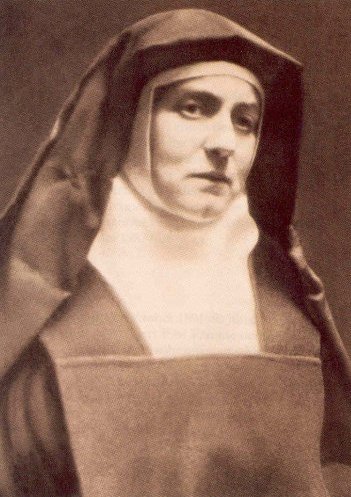
St Teresa Benedicta of the Cross, feast

EDITH STEIN St. TERESA BENEDICTA OF THE CROSS, Martyr, 1891-1942 "Born in Breslau, Germany, murdered in the Nazi death camp of Auschwitz, Poland, Edith Stein dedicated her life to a pursuit of truth leading from her roots in Judaism, via adolescent agnosticism to the study of philosophy, to Catholicism and ultimately to life as a Carmelite. She served God with prayer, scholarship and dedication to her fellow human beings, created in God's image.  In 1933, while others kept silent, she sought help from the Vatican for her beleaguered Jewish community, an Esther who pleaded for her people. In her writings she probed the meaning of suffering and reached for closeness to God. She endured the indignities inflicted by her Nazi persecutors sustained by prayer and caring for the children around her. With her older sister Rosa, she died in the gas chambers of Auschwitz. Edith Stein was beatified and declared a saint by Pope John Paul II." Text by Susanne M. Batzdorff  (Poet and Writer; niece of Edith Stein) For more information and beautiful resume please follow the link to Vatican website http://www.vatican.va/news_services/liturgy/saints ns_lit_doc_19981011_edith_stein_en.html 

 NOVENA to St Teresa Benedicta of the Cross 

Who are You, sweet light, that fills me And illumines the darkness of my heart? You lead me like a mother's hand, And should You let go of me, I would not know how to take another step. You are the space that embraces my being and buries it in Yourself. Away from You it sinks into the abyss of nothingness, from which You raised it to the light. You, nearer to me than I to myself And more interior than my most interior And still impalpable and intangible And beyond any name: Holy Spirit eternal love! Are You not the sweet manna That from the Son's heart Overflows into my heart, The food of angels and the blessed? He who raised himself from death to life, He has also awakened me to new life From the sleep of death. And He gives me new life from day to day, And at some time His fullness Is to stream through me, Life of Your life indeed, You Yourself: Holy Spirit eternal life! Are you the ray That flashes down from the eternal Judge's throne And breaks into the night of the soul That had never known itself? Mercifully relentlessly It penetrates hidden folds. Alarmed at seeing itself, The self makes space for holy fear, The beginning of that wisdom That comes from on high And anchors us firmly in the heights, Your action, that creates us anew: Holy Spirit ray that penetrates everything! Are You the spirit's fullness and the power By which the Lamb releases the seal Of God's eternal decree? Driven by You The messengers of judgment ride through the world And separate with a sharp sword The kingdom of light from the kingdom of night. Then heaven becomes new and new the earth, And all finds its proper place Through Your breath: Holy Spirit victorious power! Are You the master who builds the eternal cathedral, Which towers from the earth through the heavens? Animated by You, the columns are raised high And stand immovably firm. Marked with the eternal name of God, They stretch up to the light, Bearing the dome, Which crowns the holy cathedral, Your work that encircles the world: Holy Spirit God's moulding hand! Are you the one who created the unclouded mirror Next to the Almighty's throne, Like a crystal sea, In which Divinity lovingly looks at Itself? You bend over the fairest work of Your creation, And radiantly Your own gaze Is illumined in return. And of all creatures the pure beauty Is joined in one in the dear form Of the Virgin, your immaculate bride: Holy Spirit Creator of all! Are You the sweet song of love And of holy awe That eternally resounds around the Triune Throne, That weds in itself the clear chimes of each and every being? The harmony, That joins together the members to the Head, In which each one finds the mysterious meaning of his being blessed And joyously surges forth, Freely dissolved in Your surging: Holy Spirit eternal jubilation! after www.cathoilcdoors.com/prayers

Read whole post......

Wednesday, July 27, 2022

Bl Titus Brandsma, Priest and Martyr, memoria. His thought on contemplative life, characterised in Elias.

Today is the memoria of Bl Titus and good moment to read and contemplate on the first part of lecture given by Bl Titus on the subject of Carmelite Spirituality during the lecture tour in America before WW2.

As in daily life, so also in spiritual life, it is of the greatest importance to have a model of inspiration, an exemplar for imitation. Carmelite spirituality has such a model. The Carmelite Order derives its name from the holy mountain of its beginning. In that eastern land where every mountain has its own great memories Mount Carmel has some of the most holy. Carmel is a name which is familiar in every part of the Catholic world; it is intimately known as no other, and its natural beauty seems to be exactly in keeping with its gracious associations. Its quiet outline may be seen rising above the waters of the Mediterranean and from its summit one may see the great plain of Esdraelon stretching away into the distance, where the contemplative soul looks down on the mystery of Nazareth.

Carmel is the natural retreat of the contemplative, and it is not unfitting that on its slopes should stand the Cloister of Carmel, the cradle of the Order. It stands above the turmoil of life, above the world's stormy sea; its solitude is beyond the reach of "life's fitful fever"; it is wrapped in the peace of God. Such a peace we naturally associate with Carmel, but it has other associations more stirring and more turbulent. The memory of the great spiritual warfare of Elias still clings to it. It was here he gathered together all Israel and flung reproach at their heads. "How long do you halt between two sides? If the Lord be God, follow Him." Here Israel heard his challenge in words of flame, as a burning torch. But here he was more than the Prophet of the sword, here he was also the first of a long line of those who would worship God in spirit and in truth. In his lifetime disciples gathered round him and learned from him the deep secrets of his prayer and communion with God. His double spirit passed to Eliseus, and from him to the school of Prophets, and so down through the ages, the life of Elias has been continued in these hermits who ever sought inspiration in their great exemplar.

When Europe was full of the battle cry of the Crusaders, "God wills it," and the Crusaders set out to recapture the holy places, Carmel was one of the first places to be won back. There they found the ruins of the old sanctuaries, and we are told some of them remained to restore the old life. From the narrative of John Phocas, a Greek monk, 1177, we know that one of the Crusaders of the West, St. Berthold, was instructed by the holy Prophet to collect together on Mount Carmel, those who were living the eremitical life there, and to unite them in community life; the year may be 1155. So the Prophet stands at the Order's beginning. For proof of this we rely not so much on historical research, as on the fact that his memory and life has left their stamp upon the Order's life. He has ever been the Order's great exemplar. Indeed, so permanent has been his influence that St. Jerome calls him "the father of all the hermits and monks." In his epistle to Paulinus (Ep. 58: Ed. Migne, P.L. t. 22, p.583), he makes reference to Elias, Noster princeps Elias, nostri duces, filii Prophetarum . Likewise, Cassian in his conferences points to him as the great example of all monks. Similarly the testimony of Phocas, already mentioned, is completed by that of James de Vitry who was Bishop of Jean d'Acre, and well known to the hermits. It was written in 1221. He tells us that many Crusaders remained in the Holy Land for the sake of their devotion, to sacrifice their lives to God in places sanctified by His life. Some of those, he says, after the example of the Prophet Elias, dwelt in the caves of Carmel near the fountain of the Prophet and the sanctuary of Saint Margarita. Is it not providential that the first monks of the Order of Carmel, symbolising the imitation of Elias, drank the water from the fountain that bears his name?

Also we may mention here an old manuscript, the lnstitutio Primorum Monachorum, which contains the oldest traditions of the Order. It was probably written late in the 13th or at the beginning of the 14th century after the dispersion of the monks to the West, but was formerly ascribed to a much earlier date. It is a record of traditions much older than itself, and was meant to be a definite and permanent guide for the monks. In it we read that the guidance which the Holy Ghost gave to Elias and the promises made to him, must be the guiding principles in the life of the hermits on Carmel. The monastic life must follow the lines indicated by his life and experience. It must reflect his double spirit, the life of activity and the exercise of virtue in individual or social activity. This double spirit has a three-fold sense.

Read whole post......

Saturday, July 16, 2022

Feast of Our Lady of Mt Carmel

Most Blessed and Immaculate Virgin, ornament and splendour of Mount Carmel, thou who regardest with particular goodness those who wear Thy scapular, beningly look upon me also, and cover me with the mantle of Thy maternal protection. Fortify my weakness with Thy strength, illuminate the darkness of my mind with Thy wisdom, increase Faith, Hope and Charity within me, adorn my soul with such graces and virtues that it may be always precious to Thee and thy Divine Son, assist me in life, console me at the hour of death with they most loving presence and present me to the most sugust Trinity and thy son/daughter and devout servant, to eternally praise and bless thee in heaven. Amen. Prayer to The Blessed Virgin of Mt Carmel (with Ecclesiastical Approbation)
Read whole post......

Thursday, June 23, 2022

St John the Baptist Litany and Prayer

Lord, have mercy on us, Christ, have mercy on us.
Christ, hear us. Christ, graciously hear us.
God the Father of Heaven, Have mercy on us.


God the Son, Redeemer of the world, Have mercy on us.
God, the Holy Ghost, Have mercy on us.
Holy Trinity, One God, Have mercy on us.

Holy Mary, Pray for us.
Queen of Prophets, Pray for us.
Queen of Martyrs, Pray for us.

St. John the Baptist, Pray for us.
St. John the Baptist, precursor of Christ, Pray for us.
St. John the Baptist, glorious forerunner of the Sun of Justice, Pray for us.
St. John the Baptist, minister of Baptism to Jesus, Pray for us.

St. John the Baptist, burning and shining lamp of the world, Pray for us.
St. John the Baptist, angel of purity before thy birth, Pray for us.
St. John the Baptist, special friend and favorite of Christ, Pray for us.
St. John the Baptist, heavenly contemplative, whose element was prayer, Pray for us.

St. John the Baptist, intrepid preacher of truth, Pray for us.
St. John the Baptist, voice crying in the wilderness, Pray for us.
St. John the Baptist, miracle of mortification and penance, Pray for us.
St. John the Baptist, example of profound humility, Pray for us.

St. John the Baptist, glorious martyr of zeal for God’s holy law, Pray for us.
St. John the Baptist, gloriously fulfilling thy mission, Pray for us.

Lamb of God, Who takest away the sins of the world, Spare us, O Lord.
Lamb of God, Who takest away the sins of the world, Graciously hear us, O Lord.
Lamb of God, Who takes away the sins of the world, Have mercy on us.

Christ, hear us. Christ, graciously hear us.

V. Pray for us, O glorious St. John the Baptist,
R. That we may be made worthy of the promises of Christ.

Let Us Pray: O God, Who hast honored this world by the birth of Saint John the Baptist, grant that Thy faithful people may rejoice in the way of eternal salvation, through Jesus Christ Our Lord.

Amen.

Prayer to St. John the Baptist

O God, You raised up St. John the Baptist to prepare a perfect people for Christ. Fill Your people with the joy of possessing His grace, and direct the minds of all the faithful in the way of peace and salvation.

Grant that as St. John was martyred for truth and justice, so we may energetically profess our Faith in You, and lead others to the Way, the Truth, and Eternal Life.

Amen.


Read whole post......
Sunday, June 19, 2022

Corpus Christi, solemnity


Daily food of the soul.


Christ by instituting the Blessed Eucharist gave the culminating proof of his love for God, His Father, and for men, his brethren. In that upper room in which the last Feast of the Old Law was celebrated, the God-made-man fulfilled, not only the first commandment, but also the second which is like to it. He gave endless honour to his Father, and to man the Food which is eternal life. Sacrifice and Communion make one in the Heart of Christ, of the Incarnate Word, whose love embraces his Father in heaven and his children on earth. The Christ of the Eucharist invites us to the table: "Take and eat: take and drink."
If he makes himself present under the species of bread, it is that we may feed upon Him. His will is to be our daily nourishment, our subsistence. St John declares that "the Word was made flesh"; was united, by His Incarnation, to the flesh that is an essential portion of our humanity, in a union so actual that it glorified the very depth of our nature. In Communion, he goes yet farther; as food, He unites himself to the flesh of each one of us, personally. "The Word was made flesh, and come to dwell among us". I can add, "and to be the Food which sustains the life of my soul." An old ecclesiatical decree declares: This Sacrament is for life of the soul what food is for the life of the body. It is our subsistence, the cause of growth, the joy of life. On the other hand, because the life of the soul consists in union with Christ, the effects of the divine Food are different from those of unconsecrated bread. Natural food becomes part of ourselves, and ceases to exist as and when we do, but by the divine Bread of the Eucharist our life is absorbed in His, so that we can say with St Paul, "I am alive; or rather, not I; it is Christ that lives in me." (Gal. 2:20). The branch lives by the sap of the Vine; it is Communion that the true Vine pours its sap into each one of its branches. "He who eats my flesh, and drinks my blood, lives continually in me, and I in him" (John 6:56). To live in Christ is to identify thought and will with His in a word, to become one Spirit with Him. When he enters the soul, h becomes the soul of all it says or does. He gives His Flesh to each one individually, that all may form but one Body. Not content with keeping life in us, he makes it sanctifies and supernaturalizes out human faculties by claiming them for his own. As we grow in grace, our lips will speak Christ's words, our affection bear the mark of his loving-kindness. the heart that loves God in man will become yet more loving, since it will be the love of the Heart of Jesus. Full-grown, we shall become other Christs. The fire of divine love which the Son of God brought upon earth will not only burn in our hearts but will warm and enlighten others, that his wish may be accomplished. "It is fire that I have come to spread over the earth, and what better wish can I have that it should be kindled?" (Luke 12:49).
Thus, in Communion heavenly joys and blessings are poured into our hearts without stint or measure. "God, who in this wonderful sacrament hast left us a memorial of thy passion, enable us, we pray thee, so to venerate the mysteries of thy Body and Blood that we may constantly feel in our lives the effects of thy redemption!"(Collect for Corpus Christi.)

The picture is "Eucharist in the fruit wreath" by Jan van de Heem
Read whole post......

Sunday, June 12, 2022

Holy Trinity Sunday

Masaccio, Holy Trinity fresco, Santa Maria Novella, Florence

In the beginning the Word was; he lived in God and possessed in him his infinite happiness. The same Word was God, who is the Beginning… The Word is called Son; he was born of the Beginning who had always conceived him, giving of his substance always, yet always possessing it. And thus the glory of the Son was the Father’s glory, and the Father possessed all his glory in the Son….and the Love that unites them is one with them, their equal, excellent as the One and the Other; Three Persons and one Beloved among all three…. In that immense love proceeding from the two the Father spoke words of great affection to the Son….: “My Son, only your company contents me, and when something pleases me I love that thing in you; whoever resembled you most satisfies me most, and whoever is like you in nothing will find nothing in me. I am pleased with you alone, O life of my life! You are the light of my light, you are my wisdom, the image of my substance in whom I am well pleased. On creation. “My Son, I wish to give you a bride who will love you. Because of you she will deserve to share our company and eat at our table, the same bread I eat, that she may know the good I have in such a Son; and rejoice with me in your grace and fullness.” “I am very grateful, the Son answered; “I will show my brightness to the bride you give me, so that by it she may see how great my Father is, and how I have received my being from your being”….“Let it be done, then” said the Father, for your love has deserved it. And by these words the world was created, a palace for the bride made with great wisdom and divided into rooms, and above, the other below. The lower was furnished with infinite variety, while the higher was made beautiful with marvellous jewels, that the bride might know the Bridegroom she had. The orders of angels were placed in the higher, but humanity was given the lower place, for it was, in its being, a lesser thing. And though beings and places were divided in this way, yet all form one, who is called the bride; for love of the same Bridegroom made one bride of them. Those higher ones possessed the Bridegroom in gladness; the lower in hope, founded on the faith that he infused in them, telling them that one day he would exalt them, and that he would lift them up from their lowness so that no one could mock it anymore; for he would make himself wholly like them, and he would come to them and dwell with them; and God would be man and man would be God, and he would walk with them and eat and drink with them; and he himself would be with them continually until the consummation of this world…..For as the Father and the Son and he who proceeds from them live in one another, so it would be with the bride; for, taken wholly into God, she will live the life of God. By this bright hope which came to them from above, their wearying labours were lightened; but the drawn-out waiting and their growing desire to rejoice with their Bridegroom wore on them continually, So with prayers and sigh and suffering, with tears and moaning they asked night and day that now he would determine to grant them his company….. In these and other prayers a long time had passed; but in the later years their fervour swelled and grew when the aged Simeon burned with longing, and begged God that he might see this day. And so the Holy Spirit answering the good old man gave him his word that he would not see death until he saw Life descending from the heights, until he took God himself into his own hands and holding him in his arms, pressed him to himself. The Incarnation. Now that the time had come when it would be good to ransom the bride serving under the hard yoke of that law which Moses had given her, the Father, with tender love spoke… “Surely your bride’s delight would greatly increase were she to see you like her, in her own flesh.” “My will is yours,” the Son replied …..”This is fitting, Father, what you, the Most High, say, for in this way your goodness will be more evident, your great power will be seen and your justice and wisdom I will go and tell the world….I will go and seek my bride and take upon myself her weariness and labours in which she suffers so; and that she may have life, I will die for her, and lifting her out of that deep I will restore her to you”. Then he called the archangel Gabriel and sent him to the virgin Mary, at whose consent the mystery was wrought....and the Word lived incarnate in the womb of Mary. And he who had only a Father now had a Mother too, but she was not like others who conceived by man. From her own flesh he received his flesh, so he is called Son of God and of man. When the time had come for him to be born, he went forth like the bridegroom from his bridal chamber, embracing his bride, holding her in his arms, whom the gracious Mother laid in a manger among the animals that were there at that time. Men sang songs and angels melodies….but God there in the manger cried and moaned; and these tears were jewels the bride brought to the wedding. The Mother gazed in sheer wonder on such an exchange: in God, man’s weeping, and in man, gladness, to the one and the other things usually so strange. St John of the Cross, 'The Romances'.
Read whole post......

Saturday, June 04, 2022

Pentecost 1883, Our Lady's smile


One Sunday, during the novena (Whit Sunday, 1883), Marie went into the garden, leaving me with Leonie, who was reading near the window. After a few minutes, I began to call softly: "Marie! Marie!" Leonie, accustomed to hear me moan like that, paid no attention, so I called louder, until Marie came back to me. I saw her come into the room quite well, but, at first, I did not recognize her. I looked around myself. I glanced anxiously into the garden, still calling: "Marie! Marie!"

What unutterable anguish that forceful struggle was, and Marie perhaps suffered even more than her poor little Therese. Finally, after vain efforts to make me recognize her, she whispered a few words to Leonie, and went away pale and trembling.

Soon my dear Leonie carried me to the window. There I saw the garden, but still I did not recognize Marie, who walked slowly, held out her arms, smiling at me, and calling me tenderly: "Therese, dear little Therese!" That last attempt failed again, my dear sister came in again and knelt at the foot of my bed in tears. She turned towards the statue of Our Lady, and pleaded her with the fervor of a mother who begs for her child's life. Leonie and Celine joined Marie in prayer, and that cry of faith forced open the gates of Heaven.

I too turned to my Heavenly Mother, finding no relief on earth and nearly dead with pain, begging Our Lady from the bottom of my heart to have pity on me.
 Suddenly, the statue came to life! The Virgin became very beautiful, so divinely beautiful that I shall never find words to describe her. The expression of Our Lady's face radiated an ineffable gentleness, goodness, and tenderness, but what touched me to the very depths of my soul was her gracious smile. Then, all my pain vanished; two big tears welled up in my eyes and flowed silently.

Ah, they were indeed tears of unmixed heavenly joy. "Our Blessed Lady has come to me, she has smiled at me. How happy I am, but I shall tell no one, or my happiness might disappear!" Such were my thoughts. Then, without any effort, I lowered my eyes, and I recognized my darling Marie. She looked lovingly at me, seemed very agitated, and she appeared as if she doubted the grace that I had just received.

Ah, indeed thanks to her prayers I had received the most unfathomable favor - a smile from the Blessed Virgin! Seeing my eyes fixed on the statue, she said to herself: "Therese is cured!" Yes, it was true. The Little Flower had come back to life again - a bright ray from Our Lady's glorious Sun had warmed and set her free forever from her cruel enemy. "The dark winter is past, the rain is over and gone," and the Virgin Mary's Little Flower became so strong that five years later she opened wide her petals on the fertile mountain of Carmel.
(Story of the Soul, ch. 3)

 credit: after A Moment with Mary

Read whole post......

Tuesday, May 31, 2022

The Visitation of the Blessed Virgin Mary - Feast


When the angel announced to me that I should bear a Son, as soon as I consented, I felt something amazing and inexplicable in me, so that greatly wondering, I at once went up to my cousin Elizabeth to console her in her pregnancy and confer with her on what the angel had announced to me. And when she met me at the well, and we enjoyed each other's embrace and kiss, the infant in her womb, by a wonderful and visible motion, rejoiced. And I likewise was then moved in my heart by unwonted exultation, so that my tongue spoke unpremeditated words of God, and my soul could scarce contain itself for joy. And when Elizabeth wondered at the fervor of spirit that spoke in me, and I not otherwise wondered at the grace of God in her, we remained together many days blessing God. And after this a certain thought began to impress my mind, how and how devoutly I should act after so great a favour bestowed on me. What should I reply, if asked how I conceived, or who was the father of the Son I was to bear; or lest perchance Joseph, instigated by the enemy, should suspect me of evil. While thinking of these things, an angel, not unlike the one whom I had seen before, stood by me, saying: "Our God, who is eternal, is with thee and in thee. Fear not then, He will give thee to speak, He will direct thy steps and abode, he will perfect His work with thee powerfully and wisely." But Joseph, to whom I had been confided, when he perceived me to be pregnant, wondering and thinking himself unworthy to dwell with me, was troubled, not knowing what to do, till the angel told him in the sleep: "Depart not from the virgin confided to thee, for it is most true as thou hast heard from her, for she has conceived of the Spirit of God, and shall bear a Son, the Saviour of the world. Therefore, serve her faithfully, and be thou the guardian and witness of her purity." Then from that day Joseph served me as his lady, and I humbled to his lowest labour. After this I was constantly in prayer, rarely wishing to see or be seen, and I most rarely going forth, unless to the appointed feasts; and I was assiduous in the watches and readiness given by our priests. I had a fixed time for manual labour, and I was discreet in fasting as much as my constitution could bear in God's service. Whatever we had over our daily sustenance we gave to the poor, content with what we had. Joseph so served me, that no scurrilous, murmuring, or angry word was heard from him, for he was most patient in poverty, solicitous in labour when it was necessary, most mild to those who reproached, most obedient in my service, a most prompt defender against those who gainsaid my virginity, a most faithful witness of the wonders of God. For he was so dead to the world and the flesh that he never desired aught but heavenly things. And so confident was he in God's promises, that he would constantly exclaim: "Would that I could live to see God's will fulfilled!" Most rarely did he go to gatherings of men and their councils, because his whole desire was to obey the will of God, and therefore is his glory now so great (Lib VI, c.59).

Picture credit: unknown Flemish artist "Visitation". Text from "Revelations of St Bridget on the life and Passion of Our Lord and the Life of His Blessed Mother".

Read whole post......

Thursday, May 26, 2022

The Ascension of Our Lord


Ascension is the feast of joyful hope, a foretaste of heaven. We are rising our hearts toward heaven, so that we may begin to dwell in spirit where Jesus had gone before us as we pray the beautiful prayer in the liturgy today: "Grant, O almighty God, that we, too, may dwell in spirit in the heavenly mansions" (Collect).  St Leo says: "Christ's Ascension is our own ascension; our body has the hope of one day  being where its glorious Head has preceded it" (Roman Breviary). In fact, Our Lord had already said in His discourse after Last Supper: "I go to prepare a place for you. And if I shall go and prepare a place for you, I will come again and will take you to Myself; that where I am, you also may be" (John 14:2,3). By going before us, Jesus our Head has given us the right to follow Him there some day for "in the person of Jesus, we have penetrated the heights of heaven" (St Leo RB). As in Christ Crucified we die to sin, as in the risen Christ we rise to the life of grace, so too, we are raised up to heaven in the Ascension of Christ. Our right to heaven has been given to us, our place is ready; it is for us to live in such a way that we may occupy it some day, for Christ says: "Where thy treasure  is, there is thy heart also" (Mt 6:21).

Let us thank Our Lord for all He has done for us and love Him with our imperfect love as much as we can. Let us express our gratitude and love with beautiful words of St Mary Magdalen de Pazzi: "O my God, O my Jesus, You are going away and leaving us! Oh! what joy there will in heaven! But we have to remain here on earth. O eternal Word, what has Your creature done for You, that You should do so much for him and then ascend into heaven to glorify him even more? What has he given You? What do You look for in him? You love him so much that You give Yourself to him, You who are all things, and besides whom there is nothing. You want from him his entire will and intellect, because when he gives them to You, he gives You all that he has. O infinite Wisdom, O supreme Good, O Love, O Love so little known, little loved, and possessed by so few! Oh! our ingratitude, cause of every evil! O Purity, so little known and so little desired! O my Spouse, now that You are in heaven, seated at the right hand of the eternal Father, create in me a pure heart and renew a right spirit within me"


Read whole post......

Wednesday, May 25, 2022

Feast of St Mary Magdalene de Pazzi - click to read

"Holy Spirit, I see You coming down into the soul like the sun which, finding no obstacle, no impediment, illumines everything; I see You descending like a fiery thunderbolt which, in falling, goes up to the lowest place it finds and there it reposes, never stopping on the way nor resting on the mountainous or high places but rather in the center of the earth. Thus You, O Holy Spirit, when You come down from heaven with the fiery dart of Your divine love, You do not repose in proud hearts or in arrogant spirits, but You make Your abode in souls that are humble and contemptible in their own eyes" (St. Mary Magdalen dei Pazzi).
Read whole post......

Monday, May 16, 2022

St Simon Stock, Carmelite, memoria, 16th May


Corrado Giaquinto, 'St Simon Stock'

Simon, an Englishman, died at Bordeaux in mid-thirteenth century. He has been venerated in the Carmleite Order for his personal holiness and his devotion to Our Lady. A liturgical celebration in his honour was observed locally in the 15th century, and later extended to the whole Order. ....'It was this rule of our Saviour, a rule of utmost holiness, that some of our predecessors followed of old. They tarried long in the solitude of the dessert, concious of their own imperfection. Sometimes however - though rarely - they came down from the dessert, anxious, so as not to fail in what they regarded as their duty, to be of service to their neighbours, and sowed broadcast of the grain, threshed out in preaching, that they had so sweetly reaped in solitude with the sickle of contemplation. (Fragment of the reading from 'The Flaming Arrow' Ch. 6 by Nicholas of Narbonne, Prior General, after Discalced Carmelite Proper Offices for 16th May) 

Father, you called Saint Simon Stock to serve you in the brotherhood of Our Lady of Mount Carmel. Through his prayers help us to live in your presence and to work for man's salvation. Grant this through our Lord. (Morning Prayer from Discalced Carmelite Proper Offices for 16th May)


Read whole post......

Thursday, May 05, 2022

St Angelus, Carmelite Friar and Martyr

St. Angelus was one of the first Carmelite to come to Sicily form Mount Carmel about the year 1217. He preached at Palermo and Messina. He was martyred by a certain Count Berenger, a powerful lord of that country, who for several years had lived openly in unhallowed union with his own sister. St. Angelus rebuked him severely, as St John the Baptist had formerly rebuked Herod, and found the same recompence. By command of Berenger he was hung upon a tree and shot with arrows. Only in 1632 were his relics transferred to the Carmelite Church. Veneration of St. Angelus spread throughout the Carmelite Order as well as among the Universal Church. He has been named patron of many places in Sicily and up to this day many Catholics invoke his intercession faithfully in their needs. Hymn in honour of St Angelus (fragments from Thaditional Carmelite Propers of Divine Office) Hail, happy Angelus of blest renown! Hail, in the beauty of thy martyr's crown! Rejoice, O Carmel, at his heavenly birth, Rejoice to greet thy favoured child, O Earth! This chosen son, as presage of his fame, Hears from the Virgin's lips his angel name, Sweet pledge and token Heaven doth bestow, his kinship with the Blessed to foreshow. Sing glory to the Father and the Son And to the Holy Spirit, Three in one! Then haste to join the glad angelic lay, And praise our glorious Mother on this day. Prayer O Lord, let Thy people glorify Thee by honouring the Blessed Angelus, Thy Priest and Martyr, and through his intercession, may they deserve to be led by Thee. Through our Lord.
Read whole post......

Wednesday, May 04, 2022

FR. ÁNGEL MARIA PRAT O.CARM. AND COMPANIONS DECLARED BLESSED

In 1936 seventeen Spanish members of various Carmelite communities gave their lives in defence of and in witness to their Christian faith and consecration to Jesus Christ.

On 28 July at the railway station in Tarrega, twelve religious belonging to the Tarrega community were arrested. They were moved to Clots dels Aubens di Cervera and were shot at dawn on 29 July while they called on Jesus’ name and that of the Mother of Carmel. These men were: Fr. Ángel Maria Prat Hostench, the prior, Fr. Eliseo Maria Maneus Besalduch, novice master, Fr. Anastasio Maria Dorca Coramina, from the community of Olot (Girona) who had been preaching at Tarrega for the feast of Our Lady of Mount Carmel, Fr. Eduardo Maria Serrano Buj, a professor. There were also philosophy students: Bros. Pedro Maria Ferrer Marin, Andrés Maria Solé Rovina, Juan Maria Puigmitjà Rubió, Miguel Maria. Soler Sala and Pedro–Tomás MariaPrat Colledecarrara and the lay brother Eliseo Maria Fontdecaba Quiroga, as well as the novices, Bros. Elías Maria Garre Egea and José Maria Escoto Ruíz.

During the night of 13 August in Vic, Barcelona, Sr. Mary of St. Joseph Badía Flaquer, an enclosed nun from the monastery of Vic, was arrested. She was killed the same night defending her chastity and witnessing to her consecration to Christ.
Bro. Eufrosino Maria Raga Nadal, a sub deacon and member of the community of Olot, was killed on 3 October.
Bros. Ludovico Maria Ayet Canós and Angel Maria Presta Batlle, Carmelites from the community of Terrassa (Barcelona) were arrested on 21 July and imprisoned in the Modelo jail in Barcelona. On 13 August they were shot in the cemetery in Terrassa.
The prior of the community of Olot, Fr. Fernando Maria Llobera Puigsech, was killed in the ditches of Santa Elena of Montjuic (Barcelona) after a summary trial, and for simply being a religious.

The process for the beatification of this group began in the diocese of Barcelona in September 1959. On 26 June 2006, the Holy Father, Benedict XVI, signed the decree for their beatification. On 28 October 2007 the were declared Blesseds among a group of 498 Spanish Martyrs of the 20th Century.

Text and picture after O.Carm website
Read whole post......