His Holiness, Pope Francis praying before the statue of Our Lady with Child Jesus at the end of Inaugural Mass of his Pontificate.
Tuesday, March 19, 2013
Wednesday, February 13, 2013
Monday, February 11, 2013
Our Lady of Lourdes, pray for us! - click here for link to previous posts
No sudden splendour broke the grey
And even tenor of your days
No ecstasy made you forget
Your poverty in its bright rays.
Mary, the lowliest can tread
With confidence the path you trod
Your life the bright and shining star
That leads the wayfarer to God
(St Therese, Poems)
Read whole post......
Thursday, January 03, 2013
Feast of the Holy Name of Jesus - click to read more
Luke 2:21
And after eight days were accomplished, that the child should be circumcised, his name was called JESUS, which was called by the angel before he was conceived in the womb.
At the name of Jesus every knee should bow of those that are in heaven, on earth and under the earth: And that every tongue should confess that the Lord Jesus Christ is in the glory of God the father. O Lord, our Lord, how wonderful is Thy Name in the whole earth! (Introit of the Mass, Phillip. 2:10,11)
Labels:
Devotion to Our Lord
January, the Month dedicated to the Most Holy Name of Jesus - click to listen to Iesu Dulcis Memoria, Jesus, Sweet Memory
O taste, and see that the Lord is sweet: blessed is the man who hopeth in Him (Ps. 33:9)
Jesus, the very thought of Thee,
With sweetness fills my breast;
But sweeter far Thy Face to see
And in Thy presence rest.
With sweetness fills my breast;
But sweeter far Thy Face to see
And in Thy presence rest.
Nor voice can sing, nor heart can frame,
Nor can the memory find
A sweeter sound than Thy blest Name,
O Saviour of mankind!
Nor can the memory find
A sweeter sound than Thy blest Name,
O Saviour of mankind!
O Hope of every contrite heart,
O joy of all the meek,
To those who fall, how kind Thou art,
How good to those who seek.
O joy of all the meek,
To those who fall, how kind Thou art,
How good to those who seek.
My tongue and words cannot express,
Their usefulness is low
But having felt is to believe,
sweet Jesus' love to know.
Their usefulness is low
But having felt is to believe,
sweet Jesus' love to know.
Jesus, our only joy be Thou,
As Thou our prize wilt be;
O Jesus, be our glory now
And through eternity.
Amen.
As Thou our prize wilt be;
O Jesus, be our glory now
And through eternity.
Amen.
(Jesus, Sweet Memory, Vespers hymn for the Feast of the Holy Name of Jesus -
St. Bernard of Clairvaux)
Adopted from Angelqueen
Read whole post......
Sunday, December 16, 2012
Tuesday, November 27, 2012
While some people were speaking about how the temple was adorned with costly stones and votive offerings, he said,
All that you see here--the days will come when there will not be left a stone upon another stone that will not be thrown down.
Then they asked him, "Teacher, when will this happen? And what sign will there be when all these things are about to happen?"
He answered, "See that you not be deceived, for many will come in my name, saying, 'I am he,' and 'The time has come.' Do not follow them!
When you hear of wars and insurrections, do not be terrified; for such things must happen first, but it will not immediately be the end."
Then he said to them, "Nation will rise against nation, and kingdom against kingdom.
There will be powerful earthquakes, famines, and plagues from place to place; and awesome sights and mighty signs will come from the sky. (St Luke, 21:5-11)
In place of Solomon's temple, Christ has built a temple of living stones, (1Pt 2;5) the communion of saints. At its center, he stands as the eternal high priest; on its altar he is himself the perpetual sacrifice. And, in turn, the whole of creation is drawn into the "liturgy": the fruits of the earth as the mysterious offerings, the flowers and the lighted candlesticks, the carpets and the curtain, the ordained priest, and the anointing and blessing of God's house.
Not even the cherubim are missing. Fashioned by the hand of the artist, the visible forms stand watch beside the Holy of Holies. And, as living copies of them, the monks resembling angels surround the sacrificial altar and make sure that the praise of God does not cease, as in heaven so on earth... Their morning hymns of praise call all of creation together to unit once more in praising the Lord: mountains and hills, streams and rivers, seas and lands and all that inhabit them, clouds and winds, rain and snow, all peoples of the earth, every class and race of people, and finally also the inhabitants of heaven, the angels and the saints (cf. Dan 3,57-90)... We are to unite ourselves through our liturgy to the eternal praise of God. “We”, here, refers not just to the consecrated religious who are called to give solemn praise to God, but to all Christian people. (St Benedicta of the Cross, Edith Stein, OCD)
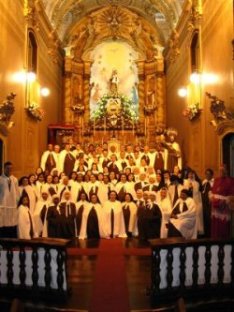
The picture represents interior of the Parish Church in Oberammegau, Bavaria. Oberammegau is the only place holding Papal license to stage the Christ Passion Play every ten years since 17th century. The Mass on the picture was celebrated by Scottish Cardinal, Keith O'Brien (May, 2010)
Wednesday, September 12, 2012
The Holy Name of Mary
…the angel Gabriel was sent from God into a city of Galilee, called Nazareth,
To a virgin espoused to a man whose name was Joseph, of the house of David: and the virgin's name was Mary. And the angel being come in, said unto her: Hail, full of grace, the Lord is with thee: blessed art thou among women. Who having heard, was troubled at his saying and thought with herself what manner of salutation this should be. And the angel said to her: Fear not, Mary, for thou hast found grace with God. (Luke 1:26)
Fain would I sing, O Mother blest! the reasons why I love thee;
Why e’en to name thy name, with joy, O Mary! fills my heart;
And why the glorious thoughts of thee, in greatness far above me, inspire no fear within my soul, so dear and sweet thou art.
Yet, if I were to see thee now, in majesty stupendous,
Surpassing all the crowned saints in highest heaven above,
Scarce could I dream I am thy child, (O truth sublime tremendous!),
For I should think myself to be unworthy of thy love.
The mother, who desires to be her child’s best earthly treasure,
Must ever share its grief with it, must understand its pain.
Why e’en to name thy name, with joy, O Mary! fills my heart;
And why the glorious thoughts of thee, in greatness far above me, inspire no fear within my soul, so dear and sweet thou art.
Yet, if I were to see thee now, in majesty stupendous,
Surpassing all the crowned saints in highest heaven above,
Scarce could I dream I am thy child, (O truth sublime tremendous!),
For I should think myself to be unworthy of thy love.
The mother, who desires to be her child’s best earthly treasure,
Must ever share its grief with it, must understand its pain.
From 'Why I love thee of Mary' (Last poem of St Terese)
Thursday, August 09, 2012
Feast of St Teresa Benedicta of the Cross
O Prince of Peace, to all who receive You, You bring light and peace. Help me to live in daily contact with You, listening to the words You have spoken and obeying them. O Divine Child, I place my hands in Yours, I shall follow You. Oh, let Your divine life flow into me. (St Teresa Benedicta of the Cross, Carmelite Meditation)
Friday, June 01, 2012
Queenship of the Blessed Virgin Mary
Blessed be God.
Blessed be His holy name.
Blessed be Jesus Christ, true God and true man.
Blessed be the name of Jesus.
Blessed be His most Sacred Heart.
Blessed be His most Precious Blood.
Blessed be Jesus in the most holy sacrament of the altar.
Blessed be the Holy Spirit, the Paraclete.
Blessed be the great Mother of God, Mary most holy.
Blessed be her holy and Immaculate Conception.
Blessed be her glorious Assumption.
Blessed be the name of Mary, virgin and Mother.
Blessed be Saint Joseph, her most chaste spouse.
Blessed be God in His angels and in His saints.
Amen. (Divine Praises)
Sunday, May 27, 2012
Pentecost
'O consuming Fire, Spirit of Love! Come down into me and reproduce in me, as it were, an incarnation of the Word; that I may be to Him an added humanity, wherein He may renew all His mystery!' (St Elizabeth of the Trinity)
Sunday, May 13, 2012
May 13 - First Apparition in Fatima, 1917
I Am from Heaven -
"...In the Cova da Iria....we saw what seemed to be a flash of lightning. (...) There before us on a small oak tree, we beheld a Lady all dressed in white. She was more brilliant than a crystal glass filled with sparkling water, when the rays of the burning sun shine through it. ... 'Do not be afraid. I will do you no harm. (...) I am from heaven. (...) I am here to ask you to come here for six months in succession, on the 13th day, at this same hour. Later on, I will tell you who I am and what I want. Afterwards, I will return here yet a seventh time.' (...) 'Will I go to heaven too?' 'Yes, you will.' 'And Jacinta?' 'She will go also.' 'And Francisco?' 'He will go there too, but he must say many Rosaries.' 'Are you willing to offer yourselves to God and bear all the sufferings He wills to send you, as an act of reparation for the sins by which He is offended, and as an act of supplication for the conversion of sinners?' (...)'Then you are going to have much to suffer, but the grace of God will be your comfort.' We fell on our knees, repeating in our hearts: 'O Most Holy Trinity, I adore You! My God, my God, I love You in the most Blessed Sacrament!' ... Our Lady spoke again: 'Pray the Rosary every day, in order to obtain peace for the world, and the end of the war.'" (Sister Lucia's description of the first apparition of Our Lady on May 13, 1917)
Biographical note:
Young Lucia (first on the right, picture above) entered the Institute of the Sisters of St. Dorothy as a postulant in the convent in Tuy, Spain in 1924. She made her first vows in 1928, and her perpetual vows in 1934, receiving the name Sister Maria das Dores (Mary of the Sorrows). She returned to Portugal from Spain in 1946. On her return she visited Fatima and in March 1948 after receiving special papal permission to be relieved of her perpetual vows, she entered the Carmelite convent of St. Teresa in Coimbra where she resided until her death. She made her profession as a Discalced Carmelite on May 31, 1949, taking the name Sister Maria LĂșcia of Jesus and the Immaculate Heart.
"...In the Cova da Iria....we saw what seemed to be a flash of lightning. (...) There before us on a small oak tree, we beheld a Lady all dressed in white. She was more brilliant than a crystal glass filled with sparkling water, when the rays of the burning sun shine through it. ... 'Do not be afraid. I will do you no harm. (...) I am from heaven. (...) I am here to ask you to come here for six months in succession, on the 13th day, at this same hour. Later on, I will tell you who I am and what I want. Afterwards, I will return here yet a seventh time.' (...) 'Will I go to heaven too?' 'Yes, you will.' 'And Jacinta?' 'She will go also.' 'And Francisco?' 'He will go there too, but he must say many Rosaries.' 'Are you willing to offer yourselves to God and bear all the sufferings He wills to send you, as an act of reparation for the sins by which He is offended, and as an act of supplication for the conversion of sinners?' (...)'Then you are going to have much to suffer, but the grace of God will be your comfort.' We fell on our knees, repeating in our hearts: 'O Most Holy Trinity, I adore You! My God, my God, I love You in the most Blessed Sacrament!' ... Our Lady spoke again: 'Pray the Rosary every day, in order to obtain peace for the world, and the end of the war.'" (Sister Lucia's description of the first apparition of Our Lady on May 13, 1917)
Biographical note:
Young Lucia (first on the right, picture above) entered the Institute of the Sisters of St. Dorothy as a postulant in the convent in Tuy, Spain in 1924. She made her first vows in 1928, and her perpetual vows in 1934, receiving the name Sister Maria das Dores (Mary of the Sorrows). She returned to Portugal from Spain in 1946. On her return she visited Fatima and in March 1948 after receiving special papal permission to be relieved of her perpetual vows, she entered the Carmelite convent of St. Teresa in Coimbra where she resided until her death. She made her profession as a Discalced Carmelite on May 31, 1949, taking the name Sister Maria LĂșcia of Jesus and the Immaculate Heart.
credit: main text after 'A Moment with Mary'
Tuesday, April 17, 2012
"And just as Moses lifted up the serpent in the desert, so must the Son of Man be lifted up, so that everyone who believes in him may have eternal life." (Jn 3:15)
My Lord, God,
You have led me by a long, dark path,
Rocky and hard.
Often my strength threatened to fail me.
I almost lost all hope of seeing the light.
But when my heart grew numb with deepest grief,
A clear star rose for me.
Steadfast it guided me- I followed,
At first reluctant, but more confidently later.
At last I stood at Church's gate.
It opened. I sought admission.
From your priest's mouth Your blessing greets me.
Within me stars are strung like pearls.
Red blossom stars show me the path to You.
They wait for you at Holy Night.
But your goodness
Allows them to illuminate my path to You.
They lead me on.
The secret which I had to keep in hiding
Deep in my heart,
Now I can shout it out:
I believe, I profess!
The priest accompanies me to the altar:
I bend my face,
Holy water flows over my head.
Lord, is it possible that someone who is past
Midlife can be reborn (Jn 3:4)?
You said so, and for me it was fulfilled,
A long life's burden of guilt and suffering
Fell away from me.
Erect I receive the white cloak,
Which they place round my shoulders,
Radiant image of purity!
In my hand I hold a candle.
Its flame makes known
That deep within me glows your holy life.
My heart has become your manger,
Awaiting you,
But not for long!
Maria, your mother and also mine
Has given me her name.
At midnight she will place her newborn child
Into my heart.
Ah, no one's heart can fathom,
What you've in store for those who love you (1Cor 2:9).
Now you are mine, and I won't let you go.
Wherever my life's road may lead,
You are with me.
Nothing can ever part me from your love (Rm 8:39).
St Teresa Benedicta of the Cross, 'Holy Night' Poem)
Text after DGO, picture represents 'Nicodemus seeks Jesus by night' by Alexander Bida
Sunday, April 15, 2012
Low Sunday and Divine Mercy - invitation to spiritual childhood
Today, the newly baptized at the close of Easter week laid aside the white garment which they had received at the baptismal font. To them St Peter (1P2:2) addressed his affectionate recommendation: "As newborn babes, desire the pure spiritual milk". These words are also applied to us, cradle Catholics. Although we were baptised as infants, we can say that every Easter regenerates us in Christ by means of our spiritual resurrection in Him. Therefore, we also must be like "newborn babes", in whom there is no malice, deceit, pride and presumption, but only candour and simplicity, confidence and love. This is wonderful invitation to the spiritual childhood which Jesus told us is indispensable condition for attaining salvation: "Unless you be converted and became as little children, you shall not enter into the kingdom of heaven" (Mt 18:3). Each wave of grace purifies and cleanses our soul from sin and its roots, giving us rebirth to a new life in Christ, a pure, innocent life, which craves only "the pure spiritual milk" of the doctrine of Christ, His love and His grace. In this spirit we can see connection between Traditional Low Sunday and Divine Mercy Sunday. It is a matter of conversion of heart.
"O Lord, grant me true purity and simplicity: in my looks, words, heart, intentions, works, and in all my interior and exterior acts. I should like to know, O Lord, what there is in me that impedes these virtues. I shall tell you, O my soul, since I cannot make anyone else understand. Do you know that the obstacle is the smallest glance that is not directed to God, and all the words that are not spoken in praise of Him or for the benefit of your neighbour. Do you know how you drive these virtues out of my heart? You banish them every time you fail to have the pure intentions of honouring God or helping your neighbour; you also expel them when you try to cover up and excuse your faults, forgetting that God sees everything, including your heart. O Lord, give me real purity and true simlicity, for You cannot find Your rest in a soul which is without them" (St Mary Magdalen de Pazzi).
Main text adopted from "Divine Intimacy" by Fr Gabriel of St Mary Magdalen, OCD
The picture represents engraving of St Mary Magdalen de Pazzi.
Read whole post......
The picture represents engraving of St Mary Magdalen de Pazzi.
Saturday, March 10, 2012
The War of Vendee - a new Catholic movie by Navis Pictures, click for website
Perfect picture for Lent, great project, the movie is available now on dvd, all cast is by young Catholics. The movie features the epic story of resistance to insane terros and persecutions of Catholicism by French revolutionaries. The resistance, inspired by the preaching of St Louis de Monfort, eventually won the end of Church persecution in France. This movie was made to honour the memory of those who decided to resist terror and fight for their religious freedom. If you would like to support this project and the future projects to come, you may buy this dvd.
Read whole post......
Monday, February 06, 2012
Now if, when Jesus went about in the world, the mere touch of his robes cured the sick, why doubt, if we have faith, that miracles will be worked while he is within us and that he will give what we ask of him since, in eucharistic communion, he is in our house? His Majesty is not accustomed to paying poorly for his lodging if the hospitality is good. If it pains you not to see him with your bodily eyes, consider that seeing him so is not fitting for us...
But our Lord reveals himself to those who he sees will benefit by his presence. Even though they fail to see him with their bodily eyes, he has many methods of showing himself to the soul, through great interior feelings and through other different ways. Be with him willingly; don't lose so good an occasion for conversing with him as is the hour after having received Communion. (St Teresa, The Way of Perfection)
Picture 'The Vision of St Teresa' by Alonso Cano, adopted from Idlle Speculation blog
Quotation after DGO
Saturday, February 04, 2012
St Andrew Corsini, OCarm
"This Andrew was born at Florence, of the noble family of Corsini. His birth was a special answer to prayer, and his parents vowed him to the Blessed Virgin. God foreshewed even before his birth what he was to be. While his mother was great with child she dreamt that she brought forth a wolf, which ran to the Carmelite Church and was changed into a lamb as soon as it reached the porch. The boy was brought up in godliness and learning becoming his rank, but turned to bad courses ; whereupon his mother often rebuked him. Nevertheless, when he knew how his parents had vowed him to the Maiden Mother of God, the love of God touched his heart, and the vision of his mother moving him, he betook himself to the Institute of the Carmelites. In that place the devil exercised him with many and divers temptations, but could not break him off from his determination to profess as a friar. He was soon after sent to Paris, where he finished his studies at the University, and took his degree ; after which he returned to his own country, and was set over the houses of his order in Tuscany". From Breviary Lesson"
May this short biography of St Andrew Corsini offers hope and encouragement to pious mothers praying for their children.
Monday, December 12, 2011

Love your enemies
He was also concerned about what was happening to the Order under Doria's authority, and the unhappiness it was causing to the nuns. He wrote to Sr Leonor advising her not to dwell on things, 'because what should be occupied in God be occupied in this....Let the garden be closed, then, without pain or worry, for he who entered bodily for his disciples, when the doors were closed, and gave them peace, without them knowing or imagining that this could be, nor how, will enter in spirit into the soul....and he will fill her with peace.'
He had need of that peace for himself, because a new definitor, Fr Diego Evangelista, elected at the Madrid Chapter, was given the task of investigating Fr Gracian, with a view to carrying out his expulsion from the Order that Doria had proposed. The nuns at Granada were so worried at the interrogation to which they had been subjected and the way what they said was being twisted and misinterpreted, that they burned a whole sack of John's letters and other writings. Hearing of this activity, John was deeply hurt, but refused to say anything against Fr Diego. This campaign continued for the rest of John's life, and hearing of his death, Diego expressed regret that he had not managed to expel him from the Order before he died. The hapless Gracian was not so 'fortunate'. He was expelled, captured and tortured by Barbary pirates, escaped, and, not able to re-enter the Discalced, died as a Calced friar.
Sunday, December 11, 2011
Last Days
John of the Cross had said to Mother Anne that his health was good, but that was to change in September of that year, 1591. Bearing in mind his austere life, the sufferings his body undergone in Toledo, the incessant travels over Spain without benefit of modern roads, his health had borne up very well. He had a bout of fever a little earlier, and now he went down with another bout, and his right leg became inflamed. He needed medical attention, but Penuela was so remote that there was no medicines available. He had make a decision whether to go to Baeza, where he would be welcomed, but would be surrended by visitors wanting to see him, or to the recently founded house at Ubeda. He chose Ubeda. It was a twenty mile journey by mule in the torrid heat, and he was almost dead with pain and exhaustion by the time he arrived. It was discovered that he had untreated erysipelas in his foot, a disease of the nerve ending which would break our into painful sores. The doctor had to scrape away the diseased flesh without anesthetic - with no understanding of sterilisation, that would probably have made the condition worse.
Illness
He was pleased to see Fr Alonzo, who had been one od the novices at Granada, but his welcome from the Prior, Francis Chrysostom, was much less welcome. He resented the drain on his time and resources that a sick friar would mean to the community. In addition, as his Provincial some time before, John had had to reprimand him, and Francis had born him a grudge ever since. Now he would have his revenge. He gave John a tiny cell that only John, being so small, could enter without stooping. In the encroaching winter, it was bitterly cold, with the wind coming in through cracks in the wall. Sick as John was, the Prior ordered him to attend all the community functions, and publicly reprimanded him when he had to stay in bed. He accused John of using his illness to seek sympathy, what a bad example he was giving, how lax he was in observing the Rule. He refused to allow any of the brothers or any visitors to see him. Wherever John had been Prior, his attention to the sick was peerless. However poor the community might be, all that the sick might need was given them. Now, Fr Francis refused to provide hism with the medicines and food that John needed. His treatment was scandalising the community, however, and when Fr Francis forbade Fr Bernard, his infirmarian, to look after John any more, this was the last straw for Bernard. He wrote to the Provincial, Fr Anthony of Jesus, John's old companion from the Duruelo days, who immediately came to Ubeda, saw the conditions that John was suffering, reprimanded the Prior severely, and made that he was given a better treatment.
Illness
He was pleased to see Fr Alonzo, who had been one od the novices at Granada, but his welcome from the Prior, Francis Chrysostom, was much less welcome. He resented the drain on his time and resources that a sick friar would mean to the community. In addition, as his Provincial some time before, John had had to reprimand him, and Francis had born him a grudge ever since. Now he would have his revenge. He gave John a tiny cell that only John, being so small, could enter without stooping. In the encroaching winter, it was bitterly cold, with the wind coming in through cracks in the wall. Sick as John was, the Prior ordered him to attend all the community functions, and publicly reprimanded him when he had to stay in bed. He accused John of using his illness to seek sympathy, what a bad example he was giving, how lax he was in observing the Rule. He refused to allow any of the brothers or any visitors to see him. Wherever John had been Prior, his attention to the sick was peerless. However poor the community might be, all that the sick might need was given them. Now, Fr Francis refused to provide hism with the medicines and food that John needed. His treatment was scandalising the community, however, and when Fr Francis forbade Fr Bernard, his infirmarian, to look after John any more, this was the last straw for Bernard. He wrote to the Provincial, Fr Anthony of Jesus, John's old companion from the Duruelo days, who immediately came to Ubeda, saw the conditions that John was suffering, reprimanded the Prior severely, and made that he was given a better treatment.
Saturday, December 10, 2011

God is always good.
What John had foreseen came to pass. Doria saw his prestige and the reverence in which so many held him for his spiritual stature as a threat to his own authority and he left the Chapter a simple friar, stripped of any post. There were even plans to send him to Mexico, although this never materialised. Instead, he was sent to a remote friary at La Penuela. For John, it was a relief no longer to have all his administrative tasks, and to pursue the life of prayer for which he always yearned, whatever his outward activity over the previous years. As he remarked of those years, when he spent his journeys praying, singing psalms, 'I am well, but my soul lags far behind'. The letter he wrote to Mother Anne of Jesus shortly after the Chapter shows his state of mind: '[God] has arranged this that we may show it by our actions...this is not evil or harmful, neither for me nor for anyone. It is in my favour since, being freed and relieved from the care of souls, I can, if I want and with God's help, enjoy peace, solitude, and the delightful fruit of forgetfulness of self and of all things.' He made the most of the nature he so loved a Penuela, going for hours into the countryside to pray and be alone with his Beloved. Even so, he was not out of contact with the many people whom he had directed, and continued to guide them by letter. Even so, he would not have been human if he had not felt hurt by the antagonism and even hatred of which he had been the butt at the Chapter. As he wrote to Anne of Penalosa, he liked Penuela very much: 'The vastness of the desert is a great help to the soul and the body, although the soul fares very poorly. The Lord must desire that it have its spiritual desert.' He described his simple life to her, which suited him so much: 'This morning we have already returned from gathering our chick-peas, and so the mornings go by. On another day we shall thresh them. It is nice to handle these mute creatures, better than being badly handled by living ones.'
Subscribe to:
Posts (Atom)