The monastery of Carmel, Stella Maris, is situated two miles from Haifa. It is four hundred and ninety-five feet above the sea and has all the solidity of a fortress. Its thick walls, its heavily barred windows, its low doors, present a fine specimen of Medieval Monasteries in the Orient, always exposed to attack.
 On reaching the esplanade you are faced with a bronze pillar set in a granite plinth and crowned by a statue of Immaculate Conception, the gift of Chile. To the right is a guest house, Stella Maris, once a villa built by Abdullah Pasha of Acre in 1821 from the ruins of the monastery.
 This building also serves as the base of a lighthouse, whose big white light flashes one minute out over the sea and then back over the mountain. It can be seen at a distance of fifteen miles: surely a Star of the Sea.
To the right is the monastery within which is enclosed the church. In front of the monastery is a stone pyramid built in 1876, a monument to the two thousand dead of Bonaparte.
This building also serves as the base of a lighthouse, whose big white light flashes one minute out over the sea and then back over the mountain. It can be seen at a distance of fifteen miles: surely a Star of the Sea.
To the right is the monastery within which is enclosed the church. In front of the monastery is a stone pyramid built in 1876, a monument to the two thousand dead of Bonaparte.

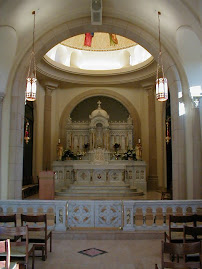
 The main door leads into the church, which makes a profound impression for its sheer beauty.
 Above the High Altar rises the statue of Our Lady of Carmel. Graceful and lonely the Virgin sits enthroned with the Child Jesus in her left arm, her sceptre in her right hand from which hangs a scapular.

 The original statue was carved in 1821 by the Genoese Caraventa, but strange to relate it consisted only of head, hands and feet in wood, the rest was arrayed in rich clothing. In 1933, these were attached to a new statue carved from Lebanese cedar by the sculptor Rieda.
Beneath the altar is a dim grotto supported by two porphyry pillars. This grotto served on many occasions as the dwelling of St Elias.
The original statue was carved in 1821 by the Genoese Caraventa, but strange to relate it consisted only of head, hands and feet in wood, the rest was arrayed in rich clothing. In 1933, these were attached to a new statue carved from Lebanese cedar by the sculptor Rieda.
Beneath the altar is a dim grotto supported by two porphyry pillars. This grotto served on many occasions as the dwelling of St Elias.

 It was near this grotto that the hermits had built the small chapel, during the lifetime of the Virgin. Within the Grotto an altar hewn in the rock is adorned with a statue of St Elias, his arm raised in a threatening gesture.


 Beautiful dome above St Elias Grotto
Thousands of pilgrims flock to Mt Carmel on July 20, the feast of St Elias. From the terrace of the monastery the view is magnificent.
Beautiful dome above St Elias Grotto
Thousands of pilgrims flock to Mt Carmel on July 20, the feast of St Elias. From the terrace of the monastery the view is magnificent.

 You seem to stand on the neck of a lusty giant resting on ancient and solid foundations, embraced by the waters of the Mediterranean. Two powerful forces, two giants, meet face to face. Between these two imposing elements puny man is ruler of all he surveys - how finite and insignificant he feels. It is difficult to decide which of the two elements encroaches upon the other - whether the land abuts on the sea, or the sea threatens the land. But it is Carmel at least that places the frame for the fascinating picture.
Read whole post......
 On reaching the esplanade you are faced with a bronze pillar set in a granite plinth and crowned by a statue of Immaculate Conception, the gift of Chile. To the right is a guest house, Stella Maris, once a villa built by Abdullah Pasha of Acre in 1821 from the ruins of the monastery.
 This building also serves as the base of a lighthouse, whose big white light flashes one minute out over the sea and then back over the mountain. It can be seen at a distance of fifteen miles: surely a Star of the Sea.
To the right is the monastery within which is enclosed the church. In front of the monastery is a stone pyramid built in 1876, a monument to the two thousand dead of Bonaparte.
This building also serves as the base of a lighthouse, whose big white light flashes one minute out over the sea and then back over the mountain. It can be seen at a distance of fifteen miles: surely a Star of the Sea.
To the right is the monastery within which is enclosed the church. In front of the monastery is a stone pyramid built in 1876, a monument to the two thousand dead of Bonaparte.

 The main door leads into the church, which makes a profound impression for its sheer beauty.
 Above the High Altar rises the statue of Our Lady of Carmel. Graceful and lonely the Virgin sits enthroned with the Child Jesus in her left arm, her sceptre in her right hand from which hangs a scapular.

 The original statue was carved in 1821 by the Genoese Caraventa, but strange to relate it consisted only of head, hands and feet in wood, the rest was arrayed in rich clothing. In 1933, these were attached to a new statue carved from Lebanese cedar by the sculptor Rieda.
Beneath the altar is a dim grotto supported by two porphyry pillars. This grotto served on many occasions as the dwelling of St Elias.
The original statue was carved in 1821 by the Genoese Caraventa, but strange to relate it consisted only of head, hands and feet in wood, the rest was arrayed in rich clothing. In 1933, these were attached to a new statue carved from Lebanese cedar by the sculptor Rieda.
Beneath the altar is a dim grotto supported by two porphyry pillars. This grotto served on many occasions as the dwelling of St Elias.

 It was near this grotto that the hermits had built the small chapel, during the lifetime of the Virgin. Within the Grotto an altar hewn in the rock is adorned with a statue of St Elias, his arm raised in a threatening gesture.


 Beautiful dome above St Elias Grotto
Thousands of pilgrims flock to Mt Carmel on July 20, the feast of St Elias. From the terrace of the monastery the view is magnificent.
Beautiful dome above St Elias Grotto
Thousands of pilgrims flock to Mt Carmel on July 20, the feast of St Elias. From the terrace of the monastery the view is magnificent.

 You seem to stand on the neck of a lusty giant resting on ancient and solid foundations, embraced by the waters of the Mediterranean. Two powerful forces, two giants, meet face to face. Between these two imposing elements puny man is ruler of all he surveys - how finite and insignificant he feels. It is difficult to decide which of the two elements encroaches upon the other - whether the land abuts on the sea, or the sea threatens the land. But it is Carmel at least that places the frame for the fascinating picture.








 Posts
Posts



