Friday, July 14, 2006

Carmelite Devotions

Devotion to the Infant Jesus of Prague

In 1628, the Carmelite friars in Prague received a gift of a beautiful statue of the infant Jesus from a devout noblewoman, a Princess Polixena. They placed the statue in their Church in order to venerate the infant Jesus of Prague, their veneration then being the source of numerous and miraculous favors.

In 1631, when enemies of the Church sacked Prague, they mocked the Holy Infant and threw the statue into a heap of trash in an obscure place. Some years later, Ven. Father Cyril of the Mother of God, a Carmeiite of the Prague monastery, found the statue. One day, while praying before the holy image, Father Cyril heard the consoling words, “Have pity on Me and I will have pity on you; restore My hands and I will give you peace; the more you honor Me, the more I will bless you.”

So many graces, blessings, and miraculous cures came to those who embraced this devotion that it spread throughout the Catholic world and continues to be a source of much grace to this day.


Prayer of Ven. Father Cyril, O.C.D.


Infant Jesus,
unto You With a humble trust I pray.

Through Your mother’s sinless heart,
Help me in my need today.

I believe that You are God,
With a power that is divine.
Full of confidence I ask
That You grant this prayer of mine.

Firm my purpose to amend,
I resolve to grieve no more
That most loving heart of Yours
Out of which all mercies pour.

My whole life I give to You,
I will serve You , Infant King,
Suffer for You patiently,
Do Your will in everything.

Little Jesus, for Your sake
I will love my neighbor, too.
I will seek the other’s good
Through the love I bear for You.
Save me through Your mother’s prayers,
And St. Joseph’s, grant me then
With the heavenly choirs to sing
Endless praise to You. Amen!

Source: “The Little Book of Carmelite Spirituality and Practice”

after www.ctocds.com Read whole post......

Thursday, July 13, 2006

O Queen, who art the beauty of Carmel, pray for us

"Dark night of the soul"
CHAPTER X


Of the way in which these souls are to conduct themselves in this dark night.

DURING the time, then, of the aridities of this night of sense (wherein God effects the change of which we have spoken above, drawing forth the soul from the life of sense into that of the spirit—that is, from meditation to contemplation—wherein it no longer has any power to work or to reason with its faculties concerning the things of God, as has been said), spiritual persons suffer great trials, by reason not so much of the aridities which they suffer, as of the fear which they have of being lost on the road, thinking that all spiritual blessing is over for them and that God has abandoned them since they find no help or pleasure in good things. Then they grow weary, and endeavour (as they have been accustomed to do) to concentrate their faculties with some degree of pleasure upon some object of meditation, thinking that, when they are not doing this and yet are conscious of making an effort, they are doing nothing. This effort they make not without great inward repugnance and unwillingness on the part of their soul, which was taking pleasure in being in that quietness and ease, instead of working with its faculties. So they have abandoned the one pursuit, yet draw no profit from the other; for, by seeking what is prompted by their own spirit, they lose the spirit of tranquillity and peace which they had before. And thus they are like to one who abandons what he has done in order to do it over again, or to one who leaves a city only to re-enter it, or to one who is hunting and lets his prey go in order to hunt it once more. This is useless here, for the soul will gain nothing further by conducting itself in this way, as has been said.
2. These souls turn back at such a time if there is none who understands them; they abandon the road or lose courage; or, at the least, they are hindered from going farther by the great trouble which they take in advancing along the road of meditation and reasoning. Thus they fatigue and overwork their nature, imagining that they are failing through negligence or sin. But this trouble that they are taking is quite useless, for God is now leading them by another road, which is that of contemplation, and is very different from the first; for the one is of meditation and reasoning, and the other belongs neither to imagination nor yet to reasoning.
3. It is well for those who find themselves in this condition to take comfort, to persevere in patience and to be in no wise afflicted. Let them trust in God, Who abandons not those that seek Him with a simple and right heart, and will not fail to give them what is needful for the road, until He bring them into the clear and pure light of love. This last He will give them by means of that other dark night, that of the spirit, if they merit His bringing them thereto.
4. The way in which they are to conduct themselves in this night of sense is to devote themselves not at all to reasoning and meditation, since this is not the time for it, but to allow the soul to remain in peace and quietness, although it may seem clear to them that they are doing nothing and are wasting their time, and although it may appear to them that it is because of their weakness that they have no desire in that state to think of anything. The truth is that they will be doing quite sufficient if they have patience and persevere in prayer without making any effort. What they must do is merely to leave the soul free and disencumbered and at rest from all knowledge and thought, troubling not themselves, in that state, about what they shall think or meditate upon, but contenting themselves with merely a peaceful and loving attentiveness toward God, and in being without anxiety, without the ability and without desired to have experience of Him or to perceive Him. For all these yearnings disquiet and distract the soul from the peaceful quiet and sweet ease of contemplation which is here granted to it.
5. And although further scruples may come to them—that they are wasting their time, and that it would be well for them to do something else, because they can neither do nor think anything in prayer—let them suffer these scruples and remain in peace, as there is no question save of their being at ease and having freedom of spirit. For if such a soul should desire to make any effort of its own with its interior faculties, this means that it will hinder and lose the blessings which, by means of that peace and ease of the soul, God is instilling into it and impressing upon it. It is just as if some painter were painting or dyeing a face; if the sitter were to move because he desired to do something, he would prevent the painter from accomplishing anything and would disturb him in what he was doing. And thus, when the soul desires to remain in inward ease and peace, any operation and affection or attentions wherein it may then seek to indulge will distract it and disquiet it and make it conscious of aridity and emptiness of sense. For the more a soul endeavours to find support in affection and knowledge, the more will it feel the lack of these, which cannot now be supplied to it upon that road.
6. Wherefore it behoves such a soul to pay no heed if the operations of its faculties become lost to it; it is rather to desire that this should happen quickly. For, by not hindering the operation of infused contemplation that God is bestowing upon it, it can receive this with more peaceful abundance, and cause its spirit to be enkindled and to burn with the love which this dark and secret contemplation brings with it and sets firmly in the soul. For contemplation is naught else than a secret, peaceful and loving infusion from God, which, if it be permitted, enkindles the soul with the spirit of love, according as the soul declares in the next lines, namely: Read whole post......
Carmelite Devotions

Santa Maria della Bruna

Story of the Miraculous Painting of Our Lady of Mount Carmel

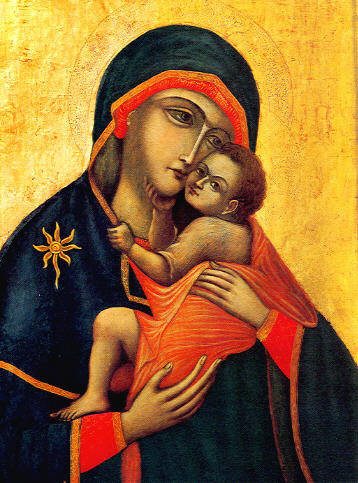
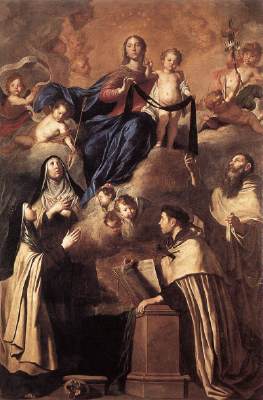
According to legend, St. Luke painted this image of Our Lady of Mount Carmel, who holds the Infant Jesus in her arms. An expression of great tenderness seems to suggest that our Lady is contemplating the great mysteries of redemption. The Infant’s right hand caresses His mother’s face, and the left grasps the edge of her veil. His position and expression seem to speak of His great love for His mother. A crown on top of her large veil, with star ornaments on the veil at the shoulder, is reminiscent of St. Bernard’s words that Mary is a “brilliant star who enlightens us with the splendor of her virtues.” This image was venerated by the hermit Friars of the Blessed Virgin Mary in their original home on Mount Carmel.

In the beginning of the thirteenth century, the religious of the Carmelite Order, forced by Mohammedans to flee their peaceful solitude by the sea, brought the painting from Mount Carmel to Naples. When settled, their first concern was to place the painting above the high altar in their Church, where it secured countless miracles for the people venerating it. It hung there for more than 100 years, until placed in a side chapel at the order of the Empress Margaret. Then, in the jubilee year of 1500, the ancient picture of Our Lady of Mount Carmel was carried in procession to Rome by the pious Neapolitans. During the pilgrimage, several people were miraculously cured, including Thomas Saccone, who had been blind and lame.

Skeptical of these miracles, “King Frederic II of Naples conceived a plan to test the power of the Heavenly Mother. He ordered that all the sick and infirm [of the city] assemble before the image with written documentation of their maladies. High Mass was celebrated and special hymns were sung, and when the miraculous picture was unveiled, a ray of light fell upon the face of the Madonna, reflecting its brilliance on the assembled sick. The instantaneous healing of each person was authenticated” (Cruz, p. 160).

Sources: “The Little Book of Carmelite Spirituality and Practice”, with additional information from Joan Carroll Cruz's “Miraculous Images of Our Lady” (Rockford: TAN Books and Publishers, Inc., 1993).

after www.ctocds.com Read whole post......

Wednesday, July 12, 2006

O Queen, who are the beauty of Carmel, pray for us

ST.JOHN OF THE CROSS
"Dark night of the soul"

CHAPTER IX

Of the signs by which it will be known that the spiritual person is walking along the way of this night and purgation of sense.

BUT since these aridities might frequently proceed, not from the night and purgation of the sensual desires aforementioned, but from sins and imperfections, or from weakness and lukewarmness, or from some bad humour or indisposition of the body, I shall here set down certain signs by which it may be known if such aridity proceeds from the aforementioned purgation, or if it arises from any of the aforementioned sins. For the making of this distinction I find that there are three principal signs.
2. The first is whether, when a soul finds no pleasure or consolation in the things of God, it also fails to find it in any thing created; for, as God sets the soul in this dark night to the end that He may quench and purge its sensual desire, He allows it not to find attraction or sweetness in anything whatsoever. In such a case it may be considered very probable that this aridity and insipidity proceed not from recently committed sins or imperfections. For, if this were so, the soul would feel in its nature some inclination or desire to taste other things than those of God; since, whenever the desire is allowed indulgence in any imperfection, it immediately feels inclined thereto, whether little or much, in proportion to the pleasure and the love that it has put into it. Since, however, this lack of enjoyment in things above or below might proceed from some indisposition or melancholy humour, which oftentimes makes it impossible for the soul to take pleasure in anything, it becomes necessary to apply the second sign and condition.
3. The second sign whereby a man may believe himself to be experiencing the said purgation is that the memory is ordinarily centred upon God, with painful care and solicitude, thinking that it is not serving God, but is backsliding, because it finds itself without sweetness in the things of God. And in such a case it is evident that this lack of sweetness and this aridity come not from weakness and lukewarmness; for it is the nature of lukewarmness not to care greatly or to have any inward solicitude for the things of God. There is thus a great difference between aridity and lukewarmness, for lukewarmness consists in great weakness and remissness in the will and in the spirit, without solicitude as to serving God; whereas purgative aridity is ordinarily accompanied by solicitude, with care and grief as I say, because the soul is not serving God. And, although this may sometimes be increased by melancholy or some other humour (as it frequently is), it fails not for that reason to produce a purgative effect upon the desire, since the desire is deprived of all pleasure and has its care centred upon God alone. For, when mere humour is the cause, it spends itself in displeasure and ruin of the physical nature, and there are none of those desires to sense God which belong to purgative aridity. When the cause is aridity, it is true that the sensual part of the soul has fallen low, and is weak and feeble in its actions, by reason of the little pleasure which it finds in them; but the spirit, on the other hand, is ready and strong.
4. For the cause of this aridity is that God transfers to the spirit the good things and the strength of the senses, which, since the soul's natural strength and senses are incapable of using them, remain barren, dry and empty. For the sensual part of a man has no capacity for that which is pure spirit, and thus, when it is the spirit that receives the pleasure, the flesh is left without savour and is too weak to perform any action. But the spirit, which all the time is being fed, goes forward in strength, and with more alertness and solicitude than before, in its anxiety not to fail God; and if it is not immediately conscious of spiritual sweetness and delight, but only of aridity and lack of sweetness, the reason for this is the strangeness of the exchange; for its palate has been accustomed to those other sensual pleasures upon which its eyes are still fixed, and, since the spiritual palate is not made ready or purged for such subtle pleasure, until it finds itself becoming prepared for it by means of this arid and dark night, it cannot experience spiritual pleasure and good, but only aridity and lack of sweetness, since it misses the pleasure which aforetime it enjoyed so readily.
5. These souls whom God is beginning to lead through these solitary places of the wilderness are like to the children of Israel, to whom in the wilderness God began to give food from Heaven, containing within itself all sweetness, and, as is there said, it turned to the savour which each one of them desired. But withal the children of Israel felt the lack of the pleasures and delights of the flesh and the onions which they had eaten aforetime in Egypt, the more so because their palate was accustomed to these and took delight in them, rather than in the delicate sweetness of the angelic manna; and they wept and sighed for the fleshpots even in the midst of the food of Heaven. To such depths does the vileness of our desires descend that it makes us to long for our own wretched food and to be nauseated by the indescribable blessings of Heaven.
6. But, as I say, when these aridities proceed from the way of the purgation of sensual desire, although at first the spirit feels no sweetness, for the reasons that we have just given, it feels that it is deriving strength and energy to act from the substance which this inward food gives it, the which food is the beginning of a contemplation that is dark and arid to the senses; which contemplation is secret and hidden from the very person that experiences it; and ordinarily, together with the aridity and emptiness which it causes in the senses, it gives the soul an inclination and desire to be alone and in quietness, without being able to think of any particular thing or having the desire to do so. If those souls to whom this comes to pass knew how to be quiet at this time, and troubled not about performing any kind of action, whether inward or outward, neither had any anxiety about doing anything, then they would delicately experience this inward refreshment in that ease and freedom from care. So delicate is this refreshment that ordinarily, if a man have desire or care to experience it, he experiences it not; for, as I say, it does its work when the soul is most at ease and freest from care; it is like the air which, if one would close one's hand upon it, escapes.
7. In this sense we may understand that which the Spouse said to the Bride in the Songs, namely: 'Withdraw thine eyes from me, for they make me to soar aloft.' For in such a way does God bring the soul into this state, and by so different a path does He lead it that, if it desires to work with its faculties, it hinders the work which God is doing in it rather than aids it; whereas aforetime it was quite the contrary. The reason is that, in this state of contemplation, which the soul enters when it forsakes meditation for the state of the proficient, it is God Who is now working in the soul; He binds its interior faculties, and allows it not to cling to the understanding, nor to have delight in the will, nor to reason with the memory. For anything that the soul can do of its own accord at this time serves only, as we have said, to hinder inward peace and the work which God is accomplishing in the spirit by means of that aridity of sense. And this peace, being spiritual and delicate, performs a work which is quiet and delicate, solitary, productive of peace and satisfaction and far removed from all those earlier pleasures, which were very palpable and sensual. This is the peace which, says David, God speaks in the soul to the end that He may make it spiritual. And this leads us to the third point.
8. The third sign whereby this purgation of sense may be recognized is that the soul can no longer meditate or reflect in the imaginative sphere of sense as it was wont, however much it may of itself endeavour to do so. For God now begins to communicate Himself to it, no longer through sense, as He did aforetime, by means of reflections which joined and sundered its knowledge, but by pure spirit, into which consecutive reflections enter not; but He communicates Himself to it by an act of simple contemplation, to which neither the exterior nor the interior senses of the lower part of the soul can attain. From this time forward, therefore, imagination and fancy can find no support in any meditation, and can gain no foothold by means thereof.
9. With regard to this third sign, it is to be understood that this embarrassment and dissatisfaction of the faculties proceed not from indisposition, for, when this is the case, and the indisposition, which never lasts for long, comes to an end, the soul is able once again, by taking some trouble about the matter, to do what it did before, and the faculties find their wonted support. But in the purgation of the desire this is not so: when once the soul begins to enter therein, its inability to reflect with the faculties grows ever greater. For, although it is true that at first, and with some persons, the process is not as continuous as this, so that occasionally they fail to abandon their pleasures and reflections of sense (for perchance by reason of their weakness it was not fitting to wean them from these immediately), yet this inability grows within them more and more and brings the workings of sense to an end, if indeed they are to make progress, for those who walk not in the way of contemplation act very differently. For this night of aridities is not usually continuous in their senses. At times they have these aridities; at others they have them not. At times they cannot meditate; at others they can. For God sets them in this night only to prove them and to humble them, and to reform their desires, so that they go not nurturing in themselves a sinful gluttony in spiritual things. He sets them not there in order to lead them in the way of the spirit, which is this contemplation; for not all those who walk of set purpose in the way of the spirit are brought by God to contemplation, nor even the half of them—why, He best knows. And this is why He never completely weans the senses of such persons from the breasts of meditations and reflections, but only for short periods and at certain seasons, as we have said. Read whole post......
Carmelite Devotions

Mater Gratiae(Our Lady of the Bowed Head)

This miraculous oil painting was rescued from a heap of rubbish and restored in 1610 by Ven. Dominic of Jesus and Mary, Prepositor General of the Order of Discalced Carmelites. According to the testimony of Ven. Dominic, our Lady spoke to him and promised, "'All those who implore my protection, devoutly honoring this picture, will obtain their petitions, and will receive many graces. Moreover, I shall hearken in a special manner to the prayers that shall be addressed to me for the relief of the souls in purgatory'" (Joan Carroll Cruz, Miraculous Images of Our Lady, [TAN Books & Publishers, Inc., 1993) p. 13].

PRAYER

Lord, Jesus, the hour is come:
glorify Thy Mother that Thy Mother may glorify Thee.
Manifest to all her power and efficacious mediation,
and grant us the favors we implore through her intercession.
Hear us for Thy Mother's sake,
hear us for love of Thy Mother,
we beseech Thee, Lord Jesus!
Show Thyself her Son and procure her triumph
which we desire in view of Thine Own.
That Thy Kingdom may come,
may we have the kingdom of Mary, Mother of Grace. Amen.

PRAYER

Virgin most holy,
Mother of the Word Incarnate,
Treasurer of graces,
and Refuge of poor sinners:
we fly to thy motherly affection
with lively faith,
and we beg of thee the grace
ever to do the will of God.
Into thy most holy hands
we commit the keeping of our hearts,
asking thee for health of soul and body,
in the certain hope that thou,
our most loving Mother,
wilt hear our prayer.
Wherefore with lively faith we say:

Hail Mary three times
Prayers taken from a holy card distributed by the Monastary of Discalced Carmelites, New Orleans, LA, with Nihil obstat and Imprimatur dated March 5, 1949.

after www.ctocds.com Read whole post......

Tuesday, July 11, 2006

O Queen, who art the beauty of Carmel, pray for us
"Dark night of the soul"
CHAPTER VIII - ST John of the Cross

In a dark night.

Wherein is expounded the first line of the first stanza, and a beginning is made of the explanation of this dark night.

THIS night, which, as we say, is contemplation, produces in spiritual persons two kinds of darkness or purgation, corresponding to the two parts of man's nature—namely, the sensual and the spiritual. And thus the one night or purgation will be sensual, wherein the soul is purged according to sense, which is subdued to the spirit; and the other is a night or purgation which is spiritual, wherein the soul is purged and stripped according to the spirit, and subdued and made ready for the union of love with God. The night of sense is common and comes to many: these are the beginners; and of this night we shall speak first. The night of the spirit is the portion of very few, and these are they that are already practised and proficient, of whom we shall treat hereafter.
2. The first purgation or night is bitter and terrible to sense, as we shall now show. The second bears no comparison with it, for it is horrible and awful to the spirit, as we shall show presently. Since the night of sense is first in order and comes first, we shall first of all say something about it briefly, since more is written of it, as of a thing that is more common; and we shall pass on to treat more fully of the spiritual night, since very little has been said of this, either in speech or in writing, and very little is known of it, even by experience.
3. Since, then, the conduct of these beginners upon the way of God is ignoble, and has much to do with their love of self and their own inclinations, as has been explained above, God desires to lead them farther. He seeks to bring them out of that ignoble kind of love to a higher degree of love for Him, to free them from the ignoble exercises of sense and meditation (wherewith, as we have said, they go seeking God so unworthily and in so many ways that are unbefitting), and to lead them to a kind of spiritual exercise wherein they can commune with Him more abundantly and are freed more completely from imperfections. For they have now had practice for some time in the way of virtue and have persevered in meditation and prayer, whereby, through the sweetness and pleasure that they have found therein, they have lost their love of the things of the world and have gained some degree of spiritual strength in God; this has enabled them to some extent to refrain from creature desires, so that for God's sake they are now able to suffer a light burden and a little aridity without turning back to a time which they found more pleasant. When they are going about these spiritual exercises with the greatest delight and pleasure, and when they believe that the sun of Divine favour is shining most brightly upon them, God turns all this light of theirs into darkness, and shuts against them the door and the source of the sweet spiritual water which they were tasting in God whensoever and for as long as they desired. (For, as they were weak and tender, there was no door closed to them, as Saint John says in the Apocalypse, iii, 8). And thus He leaves them so completely in the dark that they know not whither to go with their sensible imagination and meditation; for they cannot advance a step in meditation, as they were wont to do afore time, their inward senses being submerged in this night, and left with such dryness that not only do they experience no pleasure and consolation in the spiritual things and good exercises wherein they were wont to find their delights and pleasures, but instead, on the contrary, they find insipidity and bitterness in the said things. For, as I have said, God now sees that they have grown a little, and are becoming strong enough to lay aside their swaddling clothes and be taken from the gentle breast; so He sets them down from His arms and teaches them to walk on their own feet; which they feel to be very strange, for everything seems to be going wrong with them.
4. To recollected persons this commonly happens sooner after their beginnings than to others, inasmuch as they are freer from occasions of backsliding, and their desires turn more quickly from the things of the world, which is necessary if they are to begin to enter this blessed night of sense. Ordinarily no great time passes after their beginnings before they begin to enter this night of sense; and the great majority of them do in fact enter it, for they will generally be seen to fall into these aridities.
5. With regard to this way of purgation of the senses, since it is so common, we might here adduce a great number of quotations from Divine Scripture, where many passages relating to it are continually found, particularly in the Psalms and the Prophets. However, I do not wish to spend time upon these, for he who knows not how to look for them there will find the common experience of this purgation to be sufficient.

after www.ccel.org Read whole post......

Monday, July 10, 2006

O Queen, who art the beauty of Carmel, pray for us

"The Angel of Carmel" - St. Theresa Margaret of the Sacred Heart of Jesus (ANNA MARIA REDI)

Adapted from the Italian “Un Angelo del Carmelo” of Friar Stanislaus of St. Theresa, O.D.C.

V. “Lord, who shall dwell in Thy tabernacle? or who shall rest in Thy holy hill?” Psalm xiv, I

Carmel is the Lord’s living garden. It is the holy mountain, the mountain on which it pleases God to dwell.” It is the delightful solitude in which bloom the gleaming lilies. Thither run souls panting for justice and holiness; there they find peace and joy. Carmelites delight in believing that in foresight of all this Isaias prophesied, “And judgment shall dwell in the wilderness, and justice shall sit in Carmel. And the work of justice shall be peace, and the service of justice quietness, and security forever” (Isaias, xxxii, 16, 17).
Whose tongue shall fitly sing Carmel’s glories? Its origin is lost in the mists of antiquity, but it may boast of having as its founder or organizer Elias the Prophet. Almost immeasurable are its privileges … the Virgin Mary’s tender and special love, her promises to St. Simon Stock, her gift of the scapular, a pledge of eternal salvation. Unique is its dignity ... it is Mary’s own order; in it her splendor fore-shadowed in the Old Testament’s figurative language is reflected in full and forceful light by the chosen children of this Immaculate Queen who is the beauty of Carmel, and of Saron” (Isaias, xxxv., 2). High, noble, even heroic is its purpose ... zeal for the glory of God; on Carmel’s flaming crest is emblazoned Elias’ cry “With zeal have I been zealous for the Lord God of hosts” (Kings, iii., 19). Outstanding have been its victories, ... victories won peacefully, securely, forever, won in the arena of the cloister against the soul’s enemies by means of the double-edged sword of prayer and mortification. Endless shall be its duration ... for that we have the word of Our Lady herself in her promise to St. Peter Thomas. All-compelling is its beauty ... as Mary once told a beloved-soul, “Number the stars, if you can. Like unto them in number and brilliancy shine my Carmelites in Heaven.”

What a garden of saints is Carmel! Cyril of Constantinople, the patriarch gifted with the spirit of prophecy; Brocard, the wise teacher of the hermits on Carmel; Albert of Sicily, the miracle-worker; Simon Stock, well loved by the Queen of Heaven; Mary Magdalen de’ Pazzi, Andrew Corsini, Angelo the Martyr, and countless others, confessors, martyrs, and virgins! The glorious procession comes down through the ages from the pre-Christian time of Elias and his successors, those holy hermits of Carmel, to near our own day, the time of our holy mother, Saint Theresa, who made the sacred mountain bloom anew, made it a garden of delights for the Heavenly Spouse, and peopled it with bands of noblest virgins and with legions of holy youths, all guided by the heroic John of the Cross to the topmost heights of contemplation through the safe paths of mortification, self-effacement, detachment from the world, generosity of soul.

In every age Carmel has had a certain magnetism for the great of soul. The favored children of wealthy and powerful families, frequently even the sons and daughters of kings, have abandoned this world resolutely and fled to the refuge of Carmel. A century and a half ago, the period of our story, Carmel was giving the choicest of flowers to God. While, in France, Louis XV’s daughter was leaving the splendors of a royal court for the life of humility and mortification of a Carmelite nun, under the name of Sister Theresa of St. Augustine, in Italy, Almighty God was deigning to enrich His beloved garden with Anna Maria’s vocation. As a splendid star, the French princess lighted up that garden with the luster of her brilliance, while the Italian girl, like the purest of lilies, embalmed everything that came in contact with her with the sweet perfume of her high virtue.

Anna Maria was sixteen years of age when she first heard God’s clear call to the cloister. In September, 1763, Cecilia Albergotti, one of her young friends,[1] came to the school to tell her of her intention of joining the Discalced Carmelites of Florence immediately. As Cecilia was leaving the reception room, Anna Maria felt, for a brief moment, the urge of some supernatural influence. She seemed to hear a voice saying, “I am Theresa of Jesus and I want you among my daughters.” Surprised and deeply stirred, she ran to the chapel and prostrated herself before the altar of the Blessed Sacrament, and poured out her very soul in prayer. There again the spirit of the Lord invested her and she heard the voice, more clearly this time, saying, “I am Theresa of Jesus, and I now tell you that you shall be in my monastery before long.”[2]

All doubt was banished from her mind. She determined to hasten where God was calling her, there to spend her life, hidden from and forgotten by creatures, ‘solely and wholly in the service of God. The great Reformer’s invitation had been heard and heeded. Anna Maria was to become a Carmelite, one of Theresa’s most faithful daughters. In later life whenever she spoke of her vocation she could not refrain from recalling that day; she would say, “That was a great day for me, that day when Cecilia Albergotti visited me at Saint Apollonia’s!” That was a great day for her, for on that day God’s divine will was clearly and directly manifested to her.

Truly is God “wonderful in His saints.” What means He uses, what wonders He works in the elect that are preordained to be living, flaming torches of ardent holiness and burning zeal, those elect that are destined to make the earth bloom again with grace and virtue! He has “prevented them with blessings of supernatural sweetness” (Psalm xx., 4), He has destroyed in them everything that is not of Him, He has made to mount high within them the flames of divine love. There is not a grace, not a virtue with which He has not clothed and adorned them, that all may see that they are the precious fruition of His love. They respond at once to the divine appeal, they are docile to the words of Christ, they put themselves in accord with Him even in their least desires. God, Who never allows Himself to be matched in generosity, becomes to these souls a friend and father in a special sense. The Lord truly became Anna Maria’s friend and father in this special sense. He was now calling her to His beloved Carmel where, nearer Him, in more intimate communion with Him, she would commence to live here below the life led by the angels in Heaven.

The spirit which Carmel prescribes for its religious is this ... to busy oneself with endless prayer and to await the counsel of the Lord ... it is this spirit that elevates the soul of the religious almost to the outer edge of divinity where it exercises the angelic offices of adoring, loving, and praising God forever, in time and eternity..

The Carmelite lives a hidden life, striving to forget all creatures, for she knows that, to quote the words of St. John of the Cross, “the soul can arrive at union with God only by stripping itself of all love for creatures”; but she knows, too, that she has another mission to carry out in this world, and she knows that that mission is the redeeming of souls by means of prayer and sacrifice. What nobler mission can a soul exercise?

The world errs in thinking that the frequent and various alterations in the affairs of men, of families, of nations, that sudden and unforeseen changes in the lives and morals of individuals are the results of artful eloquence exquisitely employed for the precise purpose of triumphing over hearts and wills; the truth is that these transformations are, oftener than not, the fruit of prayers, of tears, and of sacrifices unknown!

It is the Carmelite’s work, then, to love God, to contemplate, and to redeem souls by prayer and sacrifice. To this work God was calling Anna Maria. For this purpose God had enkindled within her, while she was still a child, that great desire for the hidden life, that attraction towards prayer, which were to make of this virgin, even while hampered by the casing of this mortal flesh, one of the most ardent of the seraphim.

Saint Theresa’s second intimation to her had filled Anna Maria’s heart with peace and the feeling of security. She would now await the opportune moment to acquaint her parents with her great secret. Meanwhile, her thoughts were winging their longing way to that “house of angels,” as she was soon to call it, where she was to devote herself with all her energy to that life of love whose radiant, infinite horizon she was already glimpsing. The white lily was now sighing for the vales of Carmel which soon were to enclose her.


[1] This young woman became a nun in Saint Theresa’s Monastery, Florence, living a most holy life as Sister Theresa of Jesus Crucified.
[2] Canonical Process for Beatification.

after www.ctocds.com Read whole post......

Sunday, July 09, 2006

SAINT THOMAS MORE
Martyr (1480-1535)

SAINT JOHN FISHER
Martyr (1469-1535)


Spiritual Bouquet : Thou shalt love the Lord thy God with thy whole heart, and with thy whole soul, and with thy whole mind, and with thy whole strength. St. Mark 12:30

Saint Thomas More, born in 1480, was the precocious and amiable son of an English magistrate. Very well educated and brilliant, when he was placed at the age of fifteen in the household of the Archbishop of Canterbury, he soon attracted the Archbishop’s attention, and was sent by him to study at Oxford. He debated interiorly for a long time as to whether he should become a priest, but decided otherwise with the approbation of his director.

The practice of civil law was not enough to absorb all his time or energy. The author of the famous satire “Utopia,” wrote poetry while still young, in both English and Latin. He had completely mastered Latin, as he had also the Greek tongue, “by an instinct of genius,” as one of his preceptors said. Saint Thomas in 1505 married a virtuous and beloved wife who, after bearing four children, three daughters and a son, died six years later. His second wife, older than himself, took excellent care of the household and of the children; but it was said she could not grasp the sense of her husband’s subtle humor, which was a characteristic trait of his cheerful disposition.

Saint Thomas came under suspicion by King Henry VII when he strove in the Parliament to reduce the burden of excessive taxes which the people bore, though he never spoke against the king. But his capacities were appreciated, and when Henry VII died, his 18-year-old son, who was to become Henry VIII in 1509, showed him great favor during the first twenty years of his reign. Saint Thomas was knighted in 1521, and was made Speaker of the House of Commons in 1523, High Steward of Cambridge University in 1525, and Chancellor of the Duchy of Lancaster in the same year. Nonetheless, the king’s protege foresaw what could easily happen to anyone who did not agree with his sovereign; he said to his son-in-law in 1525, “If my head could win him a castle in France, it would not fail to go.” In effect, when in 1530 the order was issued to the clergy to acknowledge Henry as “Supreme Head of the Church, insofar as the law of God would permit,” Saint Thomas immediately resigned as Lord Chancellor.

His resignation was not accepted. Two years later, in May 1532, after he had lost the royal favor on several counts — his reticence concerning the king’s divorce, his non-attendance at the king’s illegal marriage, and his formal non-recognition of any future children of Henry and Anne Bolyn as rightful heirs to the throne — he was permitted to retire. The king, the apostate Archbishop Cranmer, and Anne Bolyn were all excommunicated in that year.

Saint Thomas lived in retirement from the age of 52, his revenues considerably diminished, and his health somewhat uncertain. When the king decided to require of the laity, as well as of the clergy, the oath supporting his alleged “supremacy,” he wanted to obtain first of all the signature of Thomas More, to make of him an example. The Saint declined to sign the oath and thereby brought upon himself a sentence of incarceration in the Tower of London, and a short time afterwards, of death. He was beheaded in 1535, after having said, with his ordinary humor, that “he did not consider the severing of his head from his body as a circumstance that should produce any change in the disposition of his mind.”

Saint Thomas while in retirement continued to write a number of religious treatises of great value, including an unfinished one on the Passion. He was beatified by Pope Leo XIII and canonized by Pius XI in 1935, with Cardinal John Fisher, who was martyred like himself in the same year and for the same reasons. That year was the 400th anniversary of their death.

Source: The Catholic Encyclopedia, edited by C. G. Herbermann with numerous collaborators (Appleton Company: New York, 1908).

SAINT JOFH FISHER
Bishop of Rochester
Born at Beverly, 1469
martyred June 22, 1536, Tower of London
Canonized (with Saint Thomas More) 1935


Saint John Fisher studied theology in Cambridge, England and became Bishop of Rochester. His friend Saint Thomas More wrote of him, "I reckon in this realm no one man, in wisdom, learning, and long approved virtue together, meet to be matched and compared with him." Saint John Fisher and his friend Saint Thomas More gave up their lives in testimony to the unity of the Church and to the indissolubility of marriage.

Reply to Bishops Stokesley, Gardiner and Tunstal, sent to the Tower by Thomas Cromwell to persuade Fisher to submit to the King: Methinks it had been rather our parts to stick together in repressing these violent and unlawful intrusions and injuries dayly offered to our common mother, the holy Church of Christ, than by any manner of persuasions to help or set forward the same.

And we ought rather to seek by all means the temporal destruction of the so ravenous wolves, that daily go about worrying and devouring everlastingly, the flock that Christ committed to our charge, and the flock that Himself died for, than to suffer them thus to range abroad.

But (alas) seeing we do it not, you see in what peril the Christian state now standeth: We are besieged on all sides, and can hardly escape the danger of our enemy. And seeing that judgment is begone at the house of God, what hope is there left (if we fall) that the rest shall stand!

The fort is betrayed even of them that should have defended it. And therefore seeing the matter is thus begun, and so faintly resisted on our parts, I fear that we be not the men that shall see the end of the misery.

Wherefore, seeing I am an old man and look not long to live, I mind not by the help of God to trouble my conscience in pleasing the king this way whatsoever become of me, but rather here to spend out the remnant of my old days in praying to God for him.

On the scaffold he said to the people assembled:

Christian people, I am come hither to die for the faith of Christ's Holy Catholic Church, and I thank God hitherto my stomach hath served me very well thereunto, so that yet I have not feared death.

Wheefore I do desire you all to help and assist me with your prayers, that at the very point and instant of death's stroke, I may in that very moment stand steadfast without fainting in any one point of the Catholic faith free from any fear; and I beseech Almighty God of His infinite goodness to save the king and this Realm, and that it may please Him to hold His holy hand over it, and send the king good Counsel.

He then knelt, said the Te Deum, In te domine speravi, and submitted to the axe.

Of all the English bishops, only Bishop John Fisher of Rochester publicly opposed Henry VIII's mandatory Oath of Allegience, which unlawfully declared King Henry the head of the Church of England. The bishop's stand ultimately cost him his life. May his example inspire all Catholics today, especially the bishops on whose [] leadership the Church depends.

after www.wf-f.org/StJohnFisher.html Read whole post......
THREE ADDRESSES
For the First Profession of Sister Miriam of Little St. Therese July 16, 1940 - fragments from "Hidden life" by St Benedicta of the Cross.

"Induit nos, Genetrix Domini, vestimento salutis: et indumento justitiae circumdedit nos, alleluia." "The Mother of the Lord has clothed us in the robe of salvation: and she wraps about us the mantle of justice."

This is how we pray on the feast of the Queen of Carmel, on the solemn feast of our holy Order. For the Mother of God is the mediatrix of all grace. This is how every person, whom merciful love brings home after being lost, receives at her hand the garment of salvation, of sanctifying grace, and so is consecrated as a child of God. But on us who may call ourselves her children and sisters she confers another particular garment of salvation. As the Mother of the Lord, she chooses the souls she wishes to lead to her beloved Son and to bedeck with the bridal robe for his honor and pleasure. She it is who planted her order on the lovely summit of Carmel as a garden of delight for the heavenly King, and then dispersed it throughout the entire world. As the sign of her special favor and her motherly protection, she has given us the holy scapular. She already gave it to Your Charity a year ago along with the holy habit, but it was then only on loan to you for practice in arming yourself for God during the probationary period. Now you are receiving it anew, since you are allowed to enter into a sacred alliance with the Lord of heaven and earth. That this holy celebration is combined with the feast of the Queen of Heaven is evidence of special maternal love, just as it was a special sign of love that the Mother of God gave you her own name.

Such special proofs of being loved oblige one to show special gratitude. When we receive the holy habit of Carmel, we pledge ourselves not only to extraordinary service to our divine Bridegroom, but also to his holy Mother. The garment of salvation is also called the mantle of justice. We are clothed in it with the instruction that we are to put off the old person and put on the new, who is created in the image of God in holiness and righteousness. By righteousness the Scriptures mean perfection, the condition of the justified person, who is made right again as she or he was before the Fall. By taking on the garment of righteousness, we thus oblige ourselves to strive for perfection with all our strength and to preserve the holy garment intact. There is no better way to serve the Queen of Carmel and to show her our gratitude than by contemplating her example and following her on the way of perfection.

Only a few words from the Virgin Mary have come down to us in the Gospels. But these few words are like heavy grains of pure gold. When they melt in the ardor of loving meditation, they more than suffice to bathe our entire lives in a luminous golden glow.

The first word that we hear in the conversation with the angel at the Annunciation to Mary is, "How shall this happen, since I know not man?" It is the simple recognition of her virginal purity. She had consecrated her whole heart and all the strength of her body, soul, and spirit to the service of God in undivided surrender. Thereby she pleased the Almighty. He accepted her surrender and blessed her with wonderful fruitfulness by raising her to be the Mother of God. She looked deeply into the mystery of virginity of which her divine Son later said, "Whoever can accept this, ought to do so." Her heart exulted in glory as she discovered what God had prepared for those who love him. She can give her beloved ones nothing better than a call to follow this way on which they, too, will attain wonderful fruitfulness and a blessedness beyond all imagining. As the symbol of the radiant beauty encompassing a truly virginal soul, she wraps the white mantle around you. It is to remind us always that we are invited to the marriage of the Lamb, called to sing in the choir of virgins that holy hymn of heavenly love that no one else can sing, and to follow the Lamb constantly without ever being separated from him.

As soon as the angel had heard Mary's avowal, he immediately dispelled her hesitation. God was not thinking of dispensing her from her vow. No, it is precisely because of her virginity that she is receptive to the overshadowing of the Holy Spirit that makes her fruitful. She is to become the virgin mother. And now we hear the Virgin's second word, "Behold, I am the handmaid of the Lord. Be it done to me according to your word." This is the most perfect expression of obedience. Being obedient means to listen to the word of someone else in order to submit one's own will to that of another. It is a virtue and in fact a discipline of justice when the other is a superior who is better able than we are ourselves to guide us to what is right.

Here justice [or righteousness] does not mean full perfection, but rather the cardinal virtue which gives to each his own. Truly perfect obedience is the obedience given to the Almighty, the subordination of one's own will to that of God. Jesus has given us the example of this perfect obedience, for he came not to do his own will but the will of him who sent him. And the Virgin practiced this perfect obedience when she called herself a handmaid of the Lord and actually was such, prepared to put all her faculties at the service of the Lord.

To this obedience we, too, oblige ourselves by our holy vow of obedience. We oblige ourselves to subject our own will to that of our superiors in the belief that the Lord himself speaks to us through their mouths and reveals his will to us. And who could know our needs better than he? So the way of obedience is the surest way to our eternal goal. And though full perfection does not lie in it alone, obedience remains the key to it. God, after all, wants our salvation, and when our will is in full unison with his, we can be certain that we will reach perfection. Jesus and Mary are also examples of this subjection of the will to an authority and order given by God: In silent obedience, both of them follow, at the slightest indication, him whom the heavenly Father has given to the Holy Family as a visible superior. They faithfully fulfilled the commands of the law that the Lord had established for his people and observed the regulations of spiritual and civil authorities.

As a sign of such a binding of the will, we receive this cincture, while we are addressed by the words that Christ spoke to St. Peter, "When you were younger, you girded yourself and went where you pleased. When you are older, another will gird you." Whoever allows herself to be led like a child in the harness of holy obedience will reach the kingdom of God which is promised to the little ones.

Obedience led the royal daughter of the house of David to the simple little house of the poor carpenter of Nazareth. Obedience led both of these most holy people away from the secure enclosure of this modest home onto the highway and into the stable at Bethlehem. It laid the Son of God in the manger. In freely chosen poverty the Savior and his mother wandered the streets of Judea and Galilee and lived on the alms of the faithful. Naked and exposed, the Lord hung on the cross and left the care of his mother to the love of his disciple. Therefore, he demands poverty of those who would follow him. The heart must be free of ties to earthly goods, of concern about them, dependence on them, desire for them, if it is to belong to the divine Bridegroom exclusively, if the will intends to follow every suggestion of holy obedience in unreserved readiness.

The three sacred vows supplement one another and require one another. One cannot fulfill any one of them completely without at the same time observing the others. The Mother of God has gone before us on this way and will be our guide on this way. Entrust yourself in childlike surrender to this loving Mother, dear Sister Miriam. Then Your Charity need not be frightened before the exalted immensity of what you have promised. The Lord who has called you and today accepts you as his bride will give you the grace to persevere in your calling and will give it through the hands of his Mother. And there is still another patroness at your side. St. ThÈrËse of the Child Jesus shows you even in the little details of daily life how one can follow him and Mary in Carmel. If you learn from her to depend on God alone and serve him with a wholly pure and detached heart, then you can join with your whole soul in singing the jubilant song of the holy Virgin, "My soul proclaims the greatness of the Lord, and my spirit rejoices in God my Savior. For he has done great things for me, and holy is his name." And like little St. Therese you will be able to say at the end, "I do not regret that I have given myself to love."

Copyright ICS Publications. Permission is hereby granted for any non-commercial use, if this copyright notice is included. Maintained by the Austrian Province of the Teresian Carmel
Read whole post......

Fifth Sunday after Pentecost

fragments from "Devout Instructions" by Fr Goffine

With the priest in the Introit of the Mass, let us implore God's assistance, and say: "Hear. O Lord, my voice, with which I have cried to Thee; be Thou my helper, forsake me not, do not despise me, O God, my Saviour. The Lord is my light and my salvation, whom shall I fear?" (Ps. xxxvi. 7, 9,1.) Glory be to the Father, etc.

Prayer
O God, Who hast prepared invisible goods for them that love Thee, infuse into our hearts the affection of Thy love, that loving Thee in all things and above all, we may obtain Thy promises which surpass every desire. Through Jesus Christ our Lord, etc.

EPISTLE 1. Peter iii. 8-15.

And in fine, be ye all of one mind, having compassion one of another, being lovers of the brotherhood, merciful, modest, humble: Not rendering evil for evil, nor railing for railing, but contrariwise, blessing: for unto this are you called, that you may inherit a blessing. For he that will love life, and see good days, let him refrain his tongue from evil, and his lips that they speak no guile. Let him decline from evil, and do good: let him seek after peace and pursue it: Because the eyes of the Lord are upon the just, and his ears unto their prayers: but the countenance of the Lord upon them that do evil things. And who is he that can hurt you, if you be zealous of good? But if also you suffer any thing for justice' sake, blessed are ye. And be not afraid of their fear, and be not troubled. But sanctify the Lord Christ in your hearts, being ready always to satisfy every one that asketh you a reason of that hope which is in you. For I tell you, that unless your justice abound more than that of the scribes and Pharisees, you shall not enter into the kingdom of heaven.

How may and ought we to sanctify the Lord Jesus in our hearts?
By faithfully imitating Him; for thereby we become His true and faithful disciples, honour Him, sanctify ourselves and edify others, who by our good example are led to admire Christianity, and Christ its founder, and to become his followers.

GOSPEL Matt. v. 20-24.
At thet time Jesus said to his disciples: I tell you, unless your justice aboun more than that of the scribes and Pharisees, you shall not enter into the kingdom of heaven. You have heard that it was said to them of old: Thou shalt not kill. And whosoever shall kill shall be in danger of the judgment. But I say to you, that whosoever is angry with his brother, shall be in danger of the judgment. And whosoever shall say to his brother, Raca, shall be in danger of the council. And whosoever shall say, Thou Fool, shall be in danger of hell fire. If therefore thou offer thy gift at the altar, and there thou remember that thy brother hath any thing against thee; Leave there thy offering before the altar, and go first to be reconciled to thy brother: and then coming thou shalt offer thy gift.

In what did the justice of Pharisees consists?
They were very pious in outward appearance, and avoided those vices which caused temporal disgrace and injury; but, on the other hand, they were full of malice in their heart, and this Christ often reproached them with, calling them hypocrites.

How are we to understand what Christ says about anger and using abusive words?
The meaning of His words is, "You have heard that it was said to them of old: Thou shalt not kill. And whosoever shall kill shall be in danger of the judgment of men; but I say to you, that whosoever is angry with his brother without cause, shall be in danger of the judgment of God. You have heard that whosoever calls his brother fool, shall be brought before the council and punished; but I say to you, that God punishes with hell fire every grievious offence against your neighbour, as also the hatred and enmity of your heart towards Him."

Why must one first be reconciled to his brother before he offers his gift at the altar, or undertakes any good work?
Because no offering, or other good work, can be pleasing to God so long as we are living in enmity, hatred, and strife with our neighbour, and thereby going directly against His will and example.

Remedies for Anger
The first and best means to overcome anger is humility; to become thus humble, gentle, and patient, one must often consider the example of Christ, Who endured so many contradictions, persecutiions, and insults, without reviling again when reviled Himself, and without threatening vengeance to any one for all He suffered. An excellent preventive to anger is, to think over in the morning what causes will be likely to draw us into anger at any time during the day, and to guard ourselves against them beforehand, by a firm resolution to bear everything patiently for the love of God; and then, when anything vexatious occurs and excites our anger, to say and do nothing so long as the anger lasts.

How shall we be reconciled with our enemies?
Not only with the lips but from the heart, and with sincerity and promptness. "Is he absent whom you have wronged," says St. Augustine, "so that you cannot easily reach him? Humble yourself then before God, and ask His pardon before you offer your gift, with a firm resolution to be reconciled with your enemy as soon as possible." Read whole post......

Saturday, July 08, 2006

Precautions by St. John of the Cross

Introduction To The Precautions
John of the Cross wrote the Precautions for the nuns in Beas while he lived at El Calvario (1578-79), after he had escaped from prison in Toledo. These warnings represented some of the fruits of his years as spiritual director in Avila. The nuns, in turn, made copies and sent them to other houses. From the adaptations in gender that appear in some manuscripts, it seems that the friars, too, must have laid hands on the material and made copies for themselves.
The work is brief, with much doctrine condensed into a small amount of space. Written for nuns influenced personally by St. Teresa, the lean statements spoke to women who were ardent in their embrace of the spiritual journey. They wanted to reach poverty of spirit, union with God, and "the peaceful comfort of the Holy Spirit" in a short time. Love has little use for delay. The objective, then, is to overcome any obstacles interfering with rapid progress. People less passionate about their goals have other alternatives. The aspiration to avoid any stumbling blocks accounts for the negative tone of the work. The condensed character and particular objective of this writing, then, require a reading in the doctrinal light of John s other works. In these he describes in detail how union with God comes about not through the observance of precautions but by adapting to God s communication through the theological life of faith, hope, and love. The precautions take any value they may have from their ability to promote this adaptation.
Christian spirituality, rooted in Scripture, spoke commonly of three spiritual enemies: the world, the flesh, and the devil. Within this tradition, John finds the structure for his work: three precautions against each of the three enemies. Building from this framework, he formulates the kind of behavior one must adopt as a precaution with respect to particular areas of life; he describes the harm and dangers that arise from not observing the specific precaution; and extols the advantages and benefits that follow from practicing it. If overlapping occurs in the presentation of the material it is because, as the friar himself points out, vanquishing one enemy means vanquishing the others also, and weakening one means weakening the others as well. The text editors prefer is the autograph copy made by Alonso de la Madre de Dios conserved in the National Library of Madrid.

THE PRECAUTIONS
Instruction and precautions necessary for anyone desiring to be a true religious and reach perfection.
1. The soul must practice the following instructions if it wishes to attain in a short time holy recollection and spiritual silence, nakedness, and poverty of spirit, where one enjoys the peaceful comfort of the Holy Spirit, reaches union with God, is freed of all the obstacles incurred from the creatures of this world, defended against the wiles and deceits of the devil, and liberated from one's own self.
2. It should be noted, then, that all the harm the soul receives is born of its enemies, mentioned above: the world, the devil, and the flesh. The world is the enemy least difficult to conquer; the devil is the hardest to understand; but the flesh is the most tenacious, and its attacks continue as long as the old self lasts.
3. To gain complete mastery over any of these three enemies, one must vanquish all three of them; and in the weakening of one, the other two are weakened also. When all three are overpowered, no further war remains for the soul.
Against the World
4. To free yourself from the harm the world can do you, you should practice three precautions.
The first precaution
5. The first is that you should have an equal love for and an equal forgetfulness of all persons, whether relatives or not, and withdraw your heart from relatives as much as from others, and in some ways even more for fear that flesh and blood might be quickened by the natural love that is ever alive among kin, and must always be mortified for the sake of spiritual perfection.
6. Regard all as strangers, and you will fulfill your duty toward them better than by giving them the affection you owe God. Do not love one person more than another, for you will err;1 the person who loves God more is the one more worthy of love, and you do not know who this is. But forgetting everyone alike, as is necessary for holy recollection, you will free yourself from this error of loving one person more or less than another.
Do not think about others, neither good things nor bad. Flee them inasmuch as possible. And if you do not observe this practice, you will not know how to be a religious, nor will you be able to reach holy recollection or deliver yourself from imperfections. And if you should wish to allow yourself some freedom in this matter, the devil will deceive you in one way or another, or you will deceive yourself under some guise of good or evil.
In doing what we said, you will have security, for in no other way will you be capable of freeing yourself from the imperfections and harm derived from creatures.

The second precaution
7. The second precaution against the world concerns temporal goods. To free yourself truly of the harm stemming from this kind of good and to moderate the excess of your appetite, you should abhor all manner of possessions and not allow yourself to worry about these goods, neither for food, nor for clothing, nor for any other created thing, nor for tomorrow, and direct this care to something higher -- to seeking the kingdom of God (seeking not to fail God); and the rest, as His Majesty says, will be added unto us [Mt. 6:33], for he who looks after the beasts will not be forgetful of you. By this practice you will attain silence and peace in the senses.

The third precaution
8. The third precaution is very necessary so you may know how to guard yourself in the community against all harm that may arise in regard to the religious. Many, by not observing it, not only have lost the peace and good of their souls but have fallen and ordinarily continue to fall into many evils and sins.
It is that you very carefully guard yourself against thinking about what happens in the community, and even more against speaking of it, of anything in the past or present concerning a particular religious: nothing about his or her character or conduct or deeds no matter how serious any of this seems. Do not say anything under the color of zeal or of correcting a wrong, unless at the proper time to whomever by right you ought to tell. Never be scandalized or astonished at anything you happen to see or learn of, endeavoring to preserve your soul in forgetfulness of all that.
9. For, should you desire to pay heed to things, many will seem wrong, even were you to live among angels, because of your not understanding the substance of them. Take Lot's wife as an example: Because she was troubled at the destruction of the Sodomites and turned her head to watch what was happening, God punished her by converting her into a pillar of salt [Gn. 19:26]. You are thus to understand God's will: that even were you to live among devils you should not turn the head of your thoughts to their affairs, but forget these things entirely and strive to keep your soul occupied purely and entirely in God, and not let the thought of this thing or that hinder you from so doing.
And to achieve this, be convinced that in monasteries and communities there is never a lack of stumbling blocks, since there is never a lack of devils who seek to overthrow the saints; God permits this in order to prove and try religious.
And if you do not guard yourself, acting as though you were not in the house, you will not know how to be a religious no matter how much you do, nor will you attain holy denudation and recollection or free yourself of the harm arising from these thoughts. If you are not cautious in this manner, no matter how good your intention and zeal, the devil will catch you in one way or another. And you are already fully captive when you allow yourself distractions of this sort.
Recall what the Apostle St. James asserts: If anyone thinks he is religious, not restraining the tongue, that one's religion is vain [Jas. 1:26]. This applies as much to the interior as to the exterior tongue.

Against the Devil
10. The one who aspires to perfection should use three precautions to be delivered from the devil, one's second enemy. It should be noted that among the many wiles of the devil for deceiving spiritual persons, the most common is deceiving them under the appearance of good rather than of evil, for the devil already knows that they will scarcely choose a recognized evil. Thus you should always be suspicious of what appears good, especially when not obliged by obedience. To do the right thing, and be safe in such a matter, you ought to take the proper counsel.

The first precaution
11. Let, then, the first precaution be that, without the command of obedience, you never take upon yourself any work -- apart from the obligations of your state -- however good and full of charity it may seem, whether for yourself or for anyone else inside or outside the house. By such a practice you will win merit and security, avoid possession, and flee from harm and evils unknown to you, for God will one day demand an account. If you do not observe this precaution in little things as well as big, you will be unable to avoid the devil's deceiving you to a small or great degree, no matter how right you think you are.
Even if your negligence amounts to no more than not being governed by obedience in all things, you culpably err, since God wants obedience more than sacrifice [1 Sm. 15:22]. The actions of religious are not their own, but belong to obedience, and if you withdraw them from obedience, you will have to count them as lost.

The second precaution
12. Let the second precaution be that you always look on the superior as though on God, no matter who he happens to be, for he takes God's place. And note that the devil, humility's enemy, is a great and crafty meddler in this area. Much profit and gain come from considering the superior in this light, but serious loss and harm lie in not doing so. Watch, therefore, with singular care that you not dwell on your superior's character, mode of behavior, ability, or any other methods of procedure, for you will so harm yourself as to change your obedience from divine to human, being motivated only by the visible traits of the superior, and not by the invisible God whom you serve through him.
Your obedience is vain and all the more fruitless in the measure that you allow the superior's unpleasant character to annoy you or his good and pleasing manners to make you happy. For I tell you that by inducing religious to consider these modes of conduct, the devil has ruined a vast number of them in their journey toward perfection. Their acts of obedience are worth little in God's sight, since they allow these considerations to interfere with obedience.
If you do not strive, with respect to your personal feelings, to be unconcerned about whether this one or another be superior, you will by no means be a spiritual person, nor will you keep your vows well.2

The third precaution
13. The third precaution, directly against the devil, is that you ever seek with all your heart to humble yourself in word and in deed, rejoicing in the good of others as if it were your own, desiring that they be given precedence over you in all things; and this you should do wholeheartedly. You will thereby overcome evil with good [Rom. 12:21], banish the devil, and possess a happy heart. Try to practice this more with those who least attract you. Realize that if you do not train yourself in this way, you will not attain real charity or make any progress in it.
And ever prefer to be taught by all rather than desire to teach even the least of all.

Against Oneself and the Shrewdness of Sensuality
14. The other three precautions to be practiced in the wish to conquer one's own self and sensuality, the third enemy.

The first precaution
15. The first precaution is to understand that you have come to the monastery so that all may fashion you and try you. Thus, to free yourself from the imperfections and disturbances that can be engendered by the mannerisms and attitudes of the religious and draw profit from every occurrence, you should think that all in the community are artisans -- as indeed they are -- present there in order to prove you; that some will fashion you with words, others by deeds, and others with thoughts against you; and that in all this you must be submissive as is the statue to the craftsman who molds it, to the artist who paints it, and to the gilder who embellishes it.
If you fail to observe this precaution, you will not know how to overcome your sensuality and feelings, nor will you get along well in the community with the religious or attain holy peace or free yourself from many stumbling blocks and evils. The second precaution
16. The second precaution is that you should never give up your works because of a want of satisfaction and delight in them, if they are fitting for the service of God. Neither should you carry out these works merely because of the satisfaction or delight they accord you, but you should do them just as you would the disagreeable ones. Otherwise it will be impossible for you to gain constancy and conquer your weakness.
The third precaution
17. The third precaution is that the interior person should never set eyes on the pleasant feelings found in spiritual exercises, becoming attached to them and carrying out these practices only for the sake of this satisfaction. Nor should such a person run from the bitterness that may be found in them, but rather seek the arduous and distasteful and embrace it. By this practice, sensuality is held in check; without this practice you will never lose self-love or gain the love of God. Read whole post......

Friday, July 07, 2006

O Queen, who art the beauty of Carmel, pray for us

Flos Carmeli,
vitis florigera,
splendor caeli,
virgo puerpera
singularis.

Mater mitis
sed viri nescia
Carmelitis
esto propitia
stella maris.

Radix Jesse
germinans flosculum
Nos ad esse
tecum in saeculum
patiaris.

Inter spinas
quae crescis lilium
Serva puras
mentes fragiluim
tutelaris.

Armatura
Fortis Pugnantium
Furunt bella
tende praesidium
scapularis.

Per incerta
prudens consilium
Per adversa
iugie solatium
largiaris.

Mater dulcis
Carmeli domina,
plebem tuam
reple laetitia
qua bearis.

Paradisi
clavis et ianua,
fac nos duci
quo, Mater, gloria
coronaris. Amen.

O blessed Virgin, full of grace, Queen of all Saints, how sweet it is for me to venerate thee under the title of Our Lady of Mount Carmel. It takes me back to the days of the prophet Elias, when thou wast prefigured on Mount Carmel under the form of the little cloud, from which, as it increased, there fell a kindly rain, symbolic of the sanctifying grace that come to us from thee. Even from the days of the Apostles, thou hast been honoured under the mystic title: and today I am filled with joy at the thought that we are united with those first client of thine, and in union with them we salute thee, saying: O beauty of Carmel, glory of Libanus, thou purest of lilies, mystic rose in the flowering garden of the Church. Meanwhile, O Virgin of virgins, be mindful of me in my misery, and show thyself my Mother. Shed upon me ever more the living light of that faith which made thee blessed; inflame me with that heavenly love wherewith thou didst love thy dear Son, Jesus Christ. I am filled with miseries both spiritual and temporal. I am straitened by many sorrows in body and soul, and I take refuge, like a child, in the shadow of thy motherly protection. Do thou, Mother of God, who hast such power and might, obtain for me from blessed Jesus the heavenly gifts of humility, chastity, and meekness, which were the fairest ornaments of thine immaculate soul. Do thou grant me to be strong in the midst of the temptations and bitterness, which so often overwhelm my spirit. And when the days of my earthly pilgrimage are accomplished according to God's holy will, grant that my soul may obtain the glory of paradise, through the merits of Christ and thine intercession. Amen

after "The Raccolta"


Nine Day Novena to Our Lady of Mt. Carmel starts Friday 7th July

First Day
O Beautiful Flower of Carmel, most fruitful vine, splendor of heaven, holy and singular, who brought forth the Son of God, still ever remaining a pure virgin, assist us in our necessity! O Star of the Sea, help and protect us! Show us that you are our Mother!
(Mention your request here)
Our Father, Hail Mary and Glory Be

Our Lady of Mount Carmel, pray for us.

Second Day
Most Holy Mary, Our Mother, in your great love for us you gave us the Holy Scapular of Mount Carmel, having heard the prayers of your chosen son Saint Simon Stock. Help us now to wear it faithfully and with devotion. May it be a sign to us of our desire to grow in holiness.
(Mention your request here)
Say: Our Father, Hail Mary and Glory Be

Our Lady of Mount Carmel, pray for us.

Third Day
O Queen of Heaven, you gave us the Scapular as an outward sign by which we might be known as your faithful children. may we always wear it with honor by avoiding sin and imitating your virtues. Help us to be faithful to this desire of ours.
(Mention your request here)
Say: Our Father, Hail Mary and Glory Be

Our Lady of Mount Carmel, pray for us.

Fourth Day
When you gave us, Gracious Lady, the Scapular as our Habit, you called us to be not only servants, but also your own children.
We ask you to gain for us from your Son the grace to live as you children in joy, peace and love. (Mention your request here)
Say: Our Father, Hail Mary and Glory Be

Our Lady of Mount Carmel, pray for us.

Fifth Day
O Mother of Fair Love, through your goodness, as your children, we are called to live in the spirit of Carmel. Help us to live in charity with one another, prayerful as Elijah of old, and mindful of our call to minister to God's people.
(Mention your request here)
Say: Our Father, Hail Mary and Glory Be

Our Lady of Mount Carmel, pray for us.

Sixth Day
With loving provident care, O Mother Most Amiable, you covered us with your Scapular as a shield of defense against the Evil One.
Through your assistance, may we bravely struggle against the powers of evil, always open to your Son Jesus Christ.
(Mention your request here)
Say: Our Father, Hail Mary and Glory Be

Our Lady of Mount Carmel, pray for us.

Seventh Day
O Mary, Help of Christians, you assured us that wearing your Scapular worthily would keep us safe from harm. Protect us in both body and soul with your continual aid. may all that we do be pleasing to your Son and to you.
(Mention your request here)
Say: Our Father, Hail Mary and Glory Be

Our Lady of Mount Carmel, pray for us.

Eighth Day
You give us hope, O Mother of Mercy, that through your Scapular promise we might quickly pass through the fires of purgatory to the Kingdom of your Son. Be our comfort and our hope.
Grant that our hope may not be in vain but that, ever faithful to your Son and to you, we may speedily enjoy after death the blessed company of Jesus and the saints.
(Mention your request here)
Say: Our Father, Hail Mary and Glory Be

Our Lady of Mount Carmel, pray for us.

Ninth Day
O Most Holy Mother of Mount Carmel, when asked by a saint to grant privileges to the family of Carmel, you gave assurance of your Motherly love and help to those faithful to you and to your Son.
Behold us, your children.
We glory in wearing your holy habit, which makes us members of your family of Carmel, through which we shall have your powerful protection in life, at death and even after death.
Look down with love, O Gate of Heaven, on all those now in their last agony!
Look down graciously, O Virgin, Flower of Carmel, on all those in need of help!
Look down mercifully, O Mother of our Savior, on all those who do not know that they are numbered among your children.
Look down tenderly, O Queen of All Saints, on the poor souls!
(Mention your request here)
Say: Our Father, Hail Mary and Glory Be

Our Lady of Mount Carmel, pray for us.

after www.angelfire.com Read whole post......
"Bride of Christ" fragments from 'Elizabeth of the Trinity' by Conrad de Meester published in Elizabeth of the Trinity Centenary Issue of Mount Carmel July-September 2006.

It was during this hard novitiate, and in the context of the future marriage of her sister Guite, that Elizabeth put down on paper a meditation on what it meant to her to become, through her imminent profession, a bride - 'bride of Christ' (IN 13). Only Elizabeth Catez could have written such a piece! However, it remained unknown for a long time....It is not possible to quote it here in full. But here are some extracts: 'To be a bride of Christ!...[that is] the expression of a whole mystery of likeness in union...A 'bride, all that this name suggests of love given and received! of intimacy, of fidelity
of absolute devotion!...To be a bride is to be surrendered as he surrendered Himself...It is a heart to heart for a whole life...It is to live with...always with...it is to have eyes only for Him, your thoughts obsessed by Him, your heart completely taken, completely invaded, as if [you have gone] out of yourself and passed into Him, your soul full of His soul, full of His prayer, you whole being captivated and given...It is, by gazing on Him always, to catch the slightest sign and the least desire; it is to enter into all His joys, to share all His sorrows. It is to be fruitful, a co-redemptress, to bring forth souls to grace....to be taken as a bride, a mystical bride, is to have ravished His heart, to the point that, forgetting all distance, the Word pours Himself into the soul as in the bosom of the Father with the same ecstasy of infinite love! It is the father, the Word and the Spirit invading the soul, deifying it, consuming it in the One through love.' Read whole post......
SAINTS CYRIL(†ca. 867) and METHODIUS(†ca. 887) Apostles to the Slavic Nations

Spiritual Bouquet: The second commandment is like the first: Thou shalt love thy neighbor as thyself. St. Mark 12:31

These two brothers were born in Thessalonica of a senatorial family. Saint Cyril was sent to Constantinople to study, where he became known as the Philosopher; but it was the Holy Church that he desired to serve, and he was ordained a priest. While Cyril was still young, the Patriarch of Constantinople recommended in the year 848 to the reigning Emperor to place him at the head of a mission which was to be sent to the Khazars of the eastern Danube region. Their king desired to learn of Christianity and had requested missionaries. Cyril asked for the time to learn the Turkish language which this people spoke, and after only a short while was ready to preach. The prince of the Khazars received Baptism and the entire nation soon followed his example. Cyril founded churches and furnished them with excellent ministers, then returned to Constantinople, refusing all presents offered him by his converts.

He was next missioned to Bulgaria with his younger brother Methodius, who was a monk of eminent sanctity. This nation, which had migrated like the Khazars from the east, had settled in the Moldavian region and a part of Hungary; they had been exposed to Christianity by some Greek prisoners, and the sister of their king had become a Christian by the good offices of the empress Theodora. When Saint Methodius, an excellent artist, was delegated to paint in the palace for the king, as he requested, a scene which could frighten the beholders, he chose for subject the Last Judgment. The king was so impressed that after being instructed he was baptized, in 865, with forty-eight of his followers. The nation followed their leaders after a brief revolt had been promptly quieted.

The two brothers preached also in Moravia, invited there by the pious king of that nation, whom they baptized with most of his subjects. It was there that Saint Cyril invented a Slavonic alphabet, translating the Bible and other writings from Greek and Latin into the language of the Slavic peoples. In 867 the missionaries went to Rome, where Saint Cyril, who was ill, died soon afterwards.

Saint Methodius was named bishop of Moravia and Pannonia or Hungary. Difficulties were not lacking, but he remained there until 880, when he returned to Rome to justify his conduct, which certain enemies had accused to the Pope. The Pope cleared him before the adversaries, and settled some questions regarding the language to be used in worship. He permitted the Mass to be said in the Slavic language, not to the exclusion, however, of Latin. Saint Methodius also baptized the king of the Bohemians, and again many of the king’s subjects followed his example. The Saint lived for about 20 years after his brother’s decease; the exact date of his death is unknown.

Source: Les Petits Bollandistes: Vies des Saints, by Msgr. Paul Guérin (Bloud et Barral: Paris, 1882), Vol. 3.

after www.magnificat.ca Read whole post......

Thursday, July 06, 2006

Octave Day of Ss Peter and Paul after Roman Breviary

Matt ch.14; 22-24
And forthwith Jesus obliged his disciples to go up into the boat, and to go before him over the water, till he dismissed the people. And having dismissed the multitude, he went into a mountain alone to pray. And when it was evening, he was there alone. But the boat in the midst of the sea was tossed with the waves: for the wind was contrary.

A Homily by St. Jerome the Priest
The Lord commanded his disciples to cross over to the other side, and constrained them to get into a ship.  By these expressions we perceive that they were unwilling to leave the Lord, the love of their Teacher making them desire not to lose a moment of his company.  And when he had sent the multitudes away, he went up into a mountain apart to pray.  Perchance, if Peter, and James, and John, who had seen him in the glory of the Transfigurátion, had been with him, they would have gone up into the mountain with him, but the common herd could not follow him, save when he taught them on the sea shore, or fed them in the wilderness.He went up into a mountain apart to pray, not as he who, with five loaves had satisfied five thousand men, besides women and children, but as he, who when he heard of the death of John, departed into a desert place apart.  Not that we make two Persons in the Lord ; but some of his works he did as God, and some as man.  But the ship was now in the midst of the sea, tossed with waves.  The Apostles were right to be slow and unwilling to leave the Lord, for, when he was not with them, they were in peril of shipwreck.Whilst the Lord abode alone upon the top of the mountain, a contrary wind arose, and the sea raged, and the Apostles were endangered ; and yet the threatening shipwreck held off, until Jesus came.  And in the fourth watch of the night, Jesus went unto them, walking on the sea.  The watches of soldiers are divided into three.  When therefore it is said that the Lord came unto them in the fourth watch, it appeareth that they had been in peril all night, and that it was at the end of the night, as it will again be at the end of the world, that he came to the rescue of his disciples.

The Lesson is taken from a Sermon by St. John Chrysostom

O blessed Apostles, who have toiled so much for us, what thanks shall we give you?  When I remember thee, O Peter, I am lost in amazement.  O Paul, when I think of thee, my heart overwhelmeth me, and I weep.  When I look at your sufferings I know not what to say or what to speak.  How many prisons have ye made holy?  How many fetters have ye made honourable?  How many torments have ye endured?  How many reproaches have ye borne?  How have ye carried Christ?  How have ye made the Churches glad by your preaching?  Verily, your tongues were blessed instruments ; it was for the Church's sake that your limbs were bloody.  Ye have been made in all things followers of Christ.  Your sound is gone out through all the earth, and your words to the end of the world. Rejoice, O Peter, who hast been gladdened by the wood of the Cross of Christ.  It was a shewing forth of thy Teacher that thou didst will to be crucified, not like the Lord Christ, standing upright, but with thine head toward the earth, as one that made a way from earth to heaven.  Blessed are the nails which pierced thine holy limbs.  With sure and certain hope didst thou commend thy spirit into the hands of the Lord, thou who hadst been a faithful servant to him and to his Bride the Church, thou who in thy warm heart hadst loved the Lord more loyally than all the Apostles. Rejoice thou also, O blessed Paul, whose head was cut off by the sword, thou whose fearless devotion no words can express.  What sword was that which divided thine holy neck, that instrument of the Lord's work, worthy that heaven should wonder at it, and earth worship it?  What place was that which drank in thy blood, that appeared like drops of milk upon the raiment of him who smote thee, and made the savage and his comrades to become strangely gentle and faithful?  Would that I could have that sword for a crown, and the nails of Peter set therein as the jewels of the diadem Read whole post......

Wednesday, July 05, 2006

FROM THE EUCHARIST TO THE TRINITY
fragments from "Divine intimacy" by Fr Gabriel of St.Mary Magdalen, OCD

PRESENCE OF GOD - O Jesus, lead me to the Trinity; help me to live with the Trinity.

MEDITATION
1. Jesus came to us from the bosom of the Father to bring us to the Trinity; this was the purpose of the Incarnation and it is also that of the Eucharist, which prolongs the mystery of the Incarnation in time. In the Eucharist Jesus continues to be the Mediator between the three divine Persons and ourselves, holding out His hand to lead us to Them. It is by coming to us in Holy Communion that He continually puts us in more direct contact with the Blessed Trinity; for He then comes in the integrity of His Person as God and Man, humanity and divinity; and as God, as the Word, he is always indissolubly united to the Father andd to the Holy Spirit. Jesus can repeat from the consecrated Host what he once said while he was on earth: "He that sent me is with Me, and He hath not left Me alone," and more explicitly: "I am in the Father and the Father [is] in Me" (Jn 8,29-14,11). Therefore, when He comes to us in Holy Communion, He does not come alone, but with Him come the Father and the Holy Spirit, because the three divine Persons, although distinct one from another, are inseparable. The presence of the Trinity in our soul is not limited to the moments when Jesus is sacramentally present within us, for the three divine Persons dwell permanently in a soul that is in the state of grace. It is true, however, that the Trinity is present in a very special way in Christ, the Incarnation Word, the one Man personally united to the Trinity and in whom dwells all the fullness of the divinty: "In quo habitat omnis plenitudo divinitas"(Litany of the Sacred Heart). Hence, it is certain that wherever Christ is - and therefore in our soul at the time of Communion - there the Trinity is also present in a very special way.

COLLOQUY
"O Most Holy Trinity, You instituted this Sacrament in order to obtain the object of Your love, that is, to attract to Yourself the soul of Your creature, and detaching it from all earthly things, to unite it to Yourselves, the uncreated God. In doing this, You make it die to sin and give it spiritual life, eternal life. O Blessed Trinity, this Sacrament was instituted by Your infinite goodness that we might be united to You and You to us; that we might receive You into ourselves and be received by You; that at the same time we might hold You within ourselves and be held by You. Read whole post......

Tuesday, July 04, 2006

Sixth Day in the Octave of Ss. Peter and Paul

The Lesson is taken from the Commentary on the Epistle to the Romans by St. John Chrysostom

Since the Apostle Paul maketh his prayer that we may have the grace of our Lord Jesus Christ (from which same cometh all good things), it remaineth for us to shew ourselves worthy of such a protection, that like as we heed the voice of Paul in this life, even so we may pass out of this world and find ourselves made worthy to see this athlete of Christ.  Yea, if we listen to him here, we shall certainly see him there, even though we may not be worthy to stand close to him.  But we shall at least see him nigh the shining throne of the divine Majesty, where the Cherubim glorify God, and round which the six-winged Séraphim make their flight.  There we shall see Paul, standing with Peter, the prince and leader of the choir of Saints ; and we shall take delight in their brotherly love.When he was here in this life, he so loved mankind that, although he desired to depart and be with Christ, he nevertheless chose to remain on earth.  How much more, therefore, doth he now in heaven burn with fraternal charity!  It is for this reason that I do love Rome, even though I could praise her on other grounds ; to wit, her antiquity, her beauty, her greatness of population and empire, her wealth, her bravery in war.  But I pass over such things, and hail her rather as blessed for this one reason : that Paul during his lifetime felt so kindly disposed towards her people ; that he so much loved them ; that there in person he preached to them ; and that at last he ended his life among them.  They still possess his holy body, and by this alone that city is made more renowned than by its worldly glories.  For like as a noble and mighty bodily frame is chiefly known by its two shining eyes, even so Rome is made known for its beauty by the relicks of two Saints who were Apostles. The sky is not more resplendent, with the shining sun, than is this Roman city, with its two shining lights which do still shine over all the earth.  From this city Paul will rise from the dead, and here Peter also will rise up.  Consider and tremble at that sight which Rome shall see!   Paul, with Peter, on a sudden shall rise from the tomb, and be borne on high to meet the Lord.  What a flower of glory will Rome then offer to Christ!  Yea, what twin crowns do already adorn that City!  Wherefore I marvel, not because of her wealth, nor for any of the great beauties which the world seeth in her, but because of those two pillars of the Church which are her special possession!  Would that I could even now embrace the corpse of Paul, that I could cling to his grave, that I could see the dust of that body, which filled up those things that were behind of the sufferings of Christ, which bore about in it the marks of the Lord Jesus and which went everywhere carrying the seed of the

Matt. ch 19, 27-29
Then Peter answering, said to him: Behold we have left all things, and have followed thee: what therefore shall we have? And Jesus said to them: Amen, I say to you, that you, who have followed me, in the regeneration, when the Son of man shall sit on the seat of his majesty, you also shall sit on twelve seats judging the twelve tribes of Israel. And every one that hath left house, or brethren, or sisters, or father, or mother, or wife, or children, or lands for my name's sake, shall receive an hundredfold, and shall possess life everlasting.

Gospel Homily by St. Venerable Bede the Priest

At the judgement to come, the elect will be in two classes.  One class are they who have forsaken all, and followed the Lord : and these shall judge along with him.  The other class are they who have not equally forsaken all that they had, but who have been careful daily to give alms of their goods to the poor of Christ : these shall be the subjects of judgement, and these are they who shall then hear these words : Come, ye blessed of my Father, inherit the kingdom prepared for you from the foundation of the world ; for I was an hungered, and ye gave me meat ; I was thirsty, and ye gave me drink. Of the reprobate also we gather, from the words of the Lord, that there will be two classes.  One class are they who, being made partakers in the mystery of the Christian Faith, have neglected to shew their faith by their works.  These are they to whom it will be said at the judgement : Depart from me, ye cursed, unto everlasting fire, prepared for the devil and his angels : for I was an hungered, and ye gave me no meat.  The other class are they who either have never received the faith and mysteries of Christ, or who, having received, have apostátised, and abandoned it : and touching these it is said : But he that believeth not is condemned already, because he hath not believed in the Name of the only-begotten Son of God. And now that we have touched for a moment, with fear and just dread, upon these things, let us rather turn our hearing to the right joyful promises of our Lord and Saviour.  Let us see what, in his great mercy, he will give to such as follow him ; not the eternal rewards of life hereafter only, but gifts exceeding precious in this life also.  Everyone, saith he, that hath forsaken houses, or brethren, or sisters, or father, or mother, or wife, or children, or lands, for my Names' sake, shall receive an hundredfold, and shall inherit everlasting life.  For every one that shall forsake earthly affections and goods, to go and be Christ's disciple, the further he goeth on in Christ's love, the more shall he find who will rejoice to give him a place in their hearts, and to minister to him of their substance.

after Roman Breviary Read whole post......