Monday, September 07, 2020

Nativity of the Blessed Virgin Mary and Carmel devotion


Domenico Ghirlandaio - Birth of the Blessed Virgin Mary

[St John of the Cross] in his prison cell…. after nine months of severe privation, was asked what he was thinking of. He replied, 'I was thinking that tomorrow is the feast of our Lady and that it would give me great joy to say Mass.' The sight of an image of the Mother of God brought love and brightness to his soul. Once, on seeing an image of our Lady while he was preaching to the nuns in Caravaca, he could not conceal his love for her and exclaimed: "How happy I would be to live alone in a desert with that image."After 'The Collected Works of S John of the Cross'. 

St Benedicta of the Cross on her Carmelite vocation: 'I need Carmel . . . with its perfection and way of perfection, Carmel with its purity, its apostolate, its martyrdom; Carmel with its special love for the sacred humanity of our Lord and its veneration of the Blessed Virgin without being restricted to one of her states or mysteries.' After Edith Stein, Collected Works. 

Little Flower's consecration to the Blessed Virgin: During the afternoon I read the act of consecration to Our Lady, for myself and my companions. I was chosen probably because I had been deprived of my earthly Mother while still so young. With all my heart I consecrated myself to the Blessed Virgin Mary, and asked her to watch over me. She seemed to look lovingly on her Little Flower and to smile at her again, and I thought of the visible smile which had once cured me, and of all I owed her. St Theres of Lisieux, The Story of a Soul


Read whole post......

Monday, August 31, 2020

St. Teresa Margaret of the Most Sacred Heart, OCD, memoria

Excerpts from "Divine Intimacy"- by Fr. Gabriel of St. Mary Magdelen- fragments relating to St Teresa Margaret spirituality

"The Proof of Love" St Teresa Margeret of the Sacred Heart of Jesus

Presence of God - O Jesus Crucified, make me understand that the Cross is the greatest proof of love.

Meditation

1. After the Incarnation, the Cross of Jesus is the greatest proof of His love for man. Similarly, mortification, which is suffering eagerly accepted for the love of God, is one of the greatest proofs of love that we can give Him. It means freely giving up a satisfaction or a pleasure in order to impose on ourselves, for love of God, something which is contrary to our own natural inclinations; we thus prove that we prefer to satisfy God rather than ourselves. Every act of voluntary mortification, whether physical or moral, says to God, “Lord, I love You more than myself!” And since a soul in love has an ardent desire to give proof of its love, it is very vigilant not to miss a single opportunity for renunciation. It was in this sense that St. Teresa Margaret of the Heart of Jesus resolved “not to let a single occasion for suffering escape, as far as she was able - and always in silence between God and herself.” In fact, she made every effort to find at each moment some occasion for suffering or bodily pain, so as never to satisfy the slightest appetite or desire, and she sought ways to make even what was necessary, painful and wearying to her body” (Spirituality). Her ardent love for God found an outlet in this generous, untiring exercise of mortification. Using a different expression, St. Thérèse of the Child Jesus called this practice “scattering flowers”, that is, profiting by every least opportunity to suffer in order to give God a proof of her love. Knowing that the value of mortification depends upon the generosity of the dispositions with which it is done, the Saint said, “I shall always sing, even should my flowers be gathered from the midst of thorns” (Story of a Soul, 13).

2. The value of voluntary mortification consists much more in the good will with which it is practiced than in the intensity of the suffering which is imposed, although the latter may contribute to it in the sense that a more painful mortification requires more good will. The amount of suffering must be wisely proportioned, and limited to the physical strength of each one; but what must never be limited is the love, the spirit of generosity with which we perform each act of sacrifice. From this point of view, a slight mortification done with all the love of which a soul is capable has greater value than a painful penance performed in a material way, with no interior spirit. Hence before performing an act of mortification, especially when it concerns certain customary practices such as those which are used in Religious Institutes, it is necessary to arouse our good will and our sincere desire to suffer willingly for the love of God. This will prevent a mere mechanical performance of the act that has little or no value. Loving contemplation of the Crucified was the soul of all the austerities of St. Teresa Margaret. “This humiliated, suffering God, of whom she was constantly thinking, was the One who gave her the interior strength to overcome every difficulty, however arduous, and to take on spontaneously so many labors and works of charity and mortification; it was He who gave her an insatiable desire for suffering “ (St Teresa Margaret, Spirituality). Contemplating Jesus Crucified, the soul feels that, even if’ it is mortifying itself much for love of Him, its sacrifices and renunciations amount to very little, and instead of conceiving sentiments of vain complacency for the mortifications already practiced, it feels the need of humbling itself and of always doing more. “Have great love for suffering,” says St. John of the Cross, “and consider it very little to attain the favor of the Spouse, who hesitated not to die for thee” (Spiritual Maxims II, 15).
Colloquy

O my Beloved, how shall I show my love, since love proves itself by deeds? I have no other means of proving my love than to strew flowers, and these flowers will be each word and look, each little daily sacrifice. I wish to make profit out of the smallest actions and to do them all for Love. For Love’s sake I wish to suffer and to rejoice: so shall I strew my flowers. Not one that I see but, singing all the while, I will scatter its petals before You. Should my roses be gathered from amid thorns, I will sing notwithstanding; and the longer and sharper the thorns, the sweeter will grow my song” (St Thérèse of the Child Jesus, Story of a Soul, 13 ).O Lord, dispose of me according to Your will, for I am content with everything if only I am following You on the road to Calvary. The more thorns there are on this road and the heavier the Cross is, the more consoled shall I be, for I desire to love You with an effective love, with a patient love, with a love which is dead to self and entirely surrendered to You. O Lord, You on the Cross for me and I on the Cross for You! Oh! if I could but once understand how sweet and precious it is to suffer: to suffer in silence for You, O Jesus! O dear suffering! O good Jesus!” (St Teresa Margaret, Spirituality). Yes, suffering is dear to me because it permits me to give God proofs of my love; because in the darkness of faith, in which I must live here below, it gives me the assurance of loving not only in words, but with a strong, effective love. O Jesus, now I understand why St. Teresa of Avila asked for only one thing: to die or to suffer,” professing to have no other reason for living except to suffer for love of You (Life, 40).
O Lord, may I too have such strong, true, and ardent love! Grant it to me, You who can give me all things, and who can, in one instant, transform this dry, cold heart into a furnace of charity.

"Devotion to the Sacred Heart of Jesus"

Presence of God
- O Sacred Heart of Jesus, teach me how to know You and to love You.

Meditation

1. The object of devotion to the Sacred Heart is, properly speaking, the physical Heart of Jesus which is worthy of adoration, because it is a part of His sacred Humanity, hypostatically united to the Word. However, the ultimate object of this devotion is the love of Jesus, the symbol of which is His Heart. In other words, beneath the symbolic image of the Heart, we contemplate and venerate our divine Redeemer’s immense charity and generous love” (Pius VI). This is the real meaning of the devotion to the Sacred Heart by which the Church asks us to honour the Heart of Jesus as the visible representation of His invisible love.Your charity has allowed You to be wounded by the visible blow of the lance,” the liturgy of the feast sings, “so that we may venerate the wounds of Your invisible love” (Roman Breviary). Therefore, the principle object of this devotion is the love of Jesus, an uncreated love with which He, as the Word, together with the Father and the Holy Spirit, loved us from all eternity, and from all eternity willed to become incarnate for our salvation. It is also the created love of charity with which, as Man, He loved us even to the death of the Cross, meriting for us by His love that same charity by which we are enabled to love Him in return. Here we find the most profound significance of the devotion to the Sacred Heart. St Teresa Margaret of the Heart of Jesus had such a thorough understanding of this meaning that she made this devotion the centre of her life. The process of her canonization says that the Saint “saw the Heart of Jesus as the centre, the source of the love with which the divine Word, in the bosom of the Father, loved us from all eternity, and merited for us in time the power to love Him in return, on earth and in heaven, by our sharing in this love.”


"The Love of Esteem"

Presence of God
- O my God, sovereign and infinite Good, grant that I may esteem nothing more than You and prefer nothing to You.

Meditation
2. A further effect of this great love of esteem for God is “that the greatest sufferings and trials of which [the soul] is conscious in this night are the anguished thoughts that it has lost God, and the fears that He has abandoned it.” (St John of the Cross, Dark Night of the Soul, II, 13, 5). Just as it is not concerned about acquiring any possession except the possession of God, neither is the soul concerned about any loss, if it be not the loss of God. Everything can be taken from it: health, riches, honours, esteem, trust, the affection of the most cherished creatures, and these creatures themselves; but never could the soul endure that God should be taken from it, or that it should be prevented from loving Him. Thus have the saints thought and acted. In her immense desire to love God, St Teresa Margaret Redi declared that she was ready to suffer even the pains of hell to obtain that grace; and to one who asked how she would be able to support such unspeakable torments she replied: “I think that love would render them bearable for me and perhaps even sweet, for of itself love makes all things else seem as naught.” (St Teresa Margaret of the Heart of Jesus, Spirituality). That is also what St Teresa of Jesus thought when she wrote to her daughters these beautiful lines: “Let your desire be to see God; your fear, that you may lose Him; your sorrow, that you are not having fruition of Him; your joy, that He can bring you to Himself.” (Maxims For Her Nuns) Such is the characteristic of true love: to create but one preoccupation in the soul, one fear, one desire and one joy — all of which are concentrated on God alone.

Read whole post......

Friday, August 28, 2020

St John the Baptist

The BEHEADING of SAINT JOHN the BAPTIST (†31 A.D.) Spiritual Bouquet: All power in heaven and on earth has been given to Me. St. Matthew 28:18 Saint John the Baptist was called by God to be the precursor of His divine Son. In order to preserve his innocence spotless, and to improve upon the extraordinary graces which he had received in his earliest infancy, he was directed by the Holy Spirit to lead an austere and contemplative life in the wilderness. There he devoted himself to the continuous exercise of devout prayer and penance. When Saint John was thirty years old, the faithful minister of the Lord began to discharge his mission. Clothed with the garments of penance, he announced to all men the obligation weighing upon them of washing away their iniquities with the tears of sincere compunction. He proclaimed the Messiah, who was of his own age but whom he had never seen, when one day Jesus came to be baptized by him in the Jordan. Saint John was received by the poor folk as the true herald of the Most High God, and his voice was, as it were, a trumpet sounding from heaven to summon all men to avert the divine judgments. Souls were exhorted by him to prepare themselves to reap the benefit of the mercy offered them. When the tetrarch Herod Antipas, in defiance of all laws divine and human, married Herodias, the wife of his brother Philip who was yet living, Saint John the Baptist boldly reprimanded the tetrarch and his accomplice for so scandalous an adultery. Herod, motivated by his lust and his anger, cast the Saint into prison. About a year after Saint John had been made a prisoner, Herod gave a splendid entertainment to the official world of Galilee. Salome, a daughter of Herodias by her lawful husband, pleased Herod by her dancing, to the point that he made her the foolish promise of granting whatever she might ask. Salome consulted with her mother as to what to ask, and that immoral woman instructed her daughter to demand the death of John the Baptist, and that the head of the prisoner should be immediately brought to her on a platter. This barbaric request startled the tyrant himself; but governed by human respect he assented and sent a soldier of his guard to behead the Saint in prison. Thus died the great forerunner of our blessed Saviour, some two years after his entrance upon his public ministry, and a year before the death of the One he announced. Reflection: All the signal graces with which Saint John was favored sprang from his humility; in that virtue all his other virtues were founded. If we desire to form ourselves to solid virtue, we must, above all things, labor to lay the same deep foundation. Source: Little Pictorial Lives of the Saints, a compilation based on Butler’s Lives of the Saints and other sources by John Gilmary Shea (Benziger Brothers: New York, 1894).
Read whole post......

Tuesday, August 25, 2020

St Teresa of Avila's Transverberation, memoria

Brethren: the word of God is living and affectual, and more piercing than any two-edged sword; and reaching unto the division of the soul and the spirit, of the joints also and the marrow, and is a discerner of the thought and intents of the heart (Hebreew 4). Amid the other virtues of Teresa, the love of God shone forth with particular lustre. It burned in her heart so strongly that the confessors of Theresa marvelled thereat, and extolled it as the love belonging to the Cherubim rather than to man. Our Lord Jesus Christ increased it, in a wonderful manner, by many visions and revelations, for once he adopted her as His spouse, giving to her His right hand, and holding forth to her a nail. He moreover vouchsafed to speak to her in these words: "Henceforth thou shalt be zealous for my honour like a true Spouse; now I am wholly thine, and thou art wholly mine". At another time she saw an angel, who pierced her heart with a fiery dart. She herself narrates the vision as follows: "I saw an angel standing at my left hand in bodily shape. He was not large, but small, and most beautiful in form. His countenance was so bright and shining that he seemed to belong to the highest choir of angels, who are all on fire, or, in other words, to those who are called Seraphim. I saw that he carried in his hands a long golden dart, even to my entrails, which he seemed to me to carry away with him when he drew forth the dart, thus leaving me all on fire with the love of God. The pain of the would was so violent that it forced me to break forth into repeated groans; and yet so excellent is the sweetness to which this intense pain gives rise, that one desires not to be freed from it, and naught is pleasing to the soul save God Himself". In consequence of these heavenly gifts, the flames of divine love burned in her heart so strongly that, under God's guidance, she made a very difficult vow. She bound herself always to do that which she should see to be the more perfect, and that which might tend to the greater glory of God. After her death, moreover, she made known to a certain nun, in a vision, that she had died of the unbearable burning of divine love, and not from the attacks of illness. Her heart, which was incorrupt and adorned with the marks of the piercing, was placed in the Church of the Most Holy Incarnation, belonging to the nuns of the Order of Barefooted Carmelites in Alva, and it has been venerated down to the present day by the large and devout crowds of Christian who flock thither. All these things having been carefully examined, the Sovereign Pontiff Benedict the Thirteenth, in order to recall the remembrance of this great miracle, permitted the celebration of this feast each year in that Order. The text after Traditional Carmelite Breviary Matins Lessons (1887 edition)
to view the previous post commemorating the Feast please follow the LINK
Read whole post......

Monday, August 24, 2020

Bl Mary of Jesus Crucified and her prayer for virtue, optional memoria - click to read more about her life


I saw a large flowerbed formed of several concentric circles. The first circle was planted with roses; the rose signifies charity and its thorns vigilance.
The second was covered with vines; the grape signifying love and the leaf mildness.
The third was sown with wheat, which signifies hope and confidence.
The center was all of violets, which signify true humility.
And in the center I made a throne, and I set Jesus upon it. And from under His feet comes a spring which says "Everything passes, everything flows by like water."
Beside the throne I plant pansies and ivy. The ivy says to me: "Cling to Jesus unceasingly." And the pansy says to me: "Think only of Jesus."

Lord Jesus, plant all these virtues in the depths of my heart, and by Your own power make them grow."

From "The Thoughts of Sister Mary of Jesus Crucified"
Read whole post......

Tuesday, August 18, 2020

Blessed John-Baptist, Michael Aloysius and James, optional memoria


Fr. Leonard Duverneuil (b. 1737 at Limoges), Fr. Michel-Louis Brulard (b. 1758 at Chartres), and Fr. Hubert of Saint Claude (b. 1753 at Frolois), were among a group of 64 Martyrs beatified 1st October 1995, victims of the French Revolution who came from 14 French dioceses and from various religious Orders. In their loyalty to God, the Church and the Pope, they refused to take the oath of the Civil Constitution for the Clergy imposed by the Constituent Assembly of the Revolution. As a result, they were imprisoned, massed like animals, on a slave-trader ship in Rochefort Bay, waiting in vain to be deported into slavery. During 1794, the first two Carmelites died on board ship: Fr. John-Baptist on 1st July, and Fr. Michael-Aloysius on 25th July, both being buried on the island of Aix. After the plague broke out on the ship, those remaining disembarked on the island of Madame, where Fr. James died and was buried on 10th September. Noted for their loving ministry to their fellow prisoners and their patience in accepting every type of outrage, privation, and cruelty, not to mention the vicissitudes of weather, hunger and sickness, our three Discalced Carmelite priest martyrs and their companions in martyrdom gave unsurpassed Christian witness to their faith and love. After Carmelite Breviary.

Concluding Prayer: 

Lord God to the martyrs Blessed John-Baptist, Michael-Aloysius, James, and their companions, you gave the grace to remain faithful and to pardon while suffering hardship. Through their intercession grant also to us, to be always willing to remain faithful to your Church and to be reconciled with one another. We ask this through our Lord.


Read whole post......

Saturday, August 08, 2020

Feast of St Benedicta of the Cross, Discalced Carmelite and Martyr, Patroness of Europe - click for Vatican link


 St Benedicta of the Cross on her Carmelite vocation: 'I need Carmel . . . with its perfection and way of perfection, Carmel with its purity, its apostolate, its martyrdom; Carmel with its special love for the sacred humanity of our Lord and its veneration of the Blessed Virgin without being restricted to one of her states or mysteries.' After Edith Stein, Collected Works. 

To read The History of Carmel - from the notes made by Edith Stein, please follow links below:
Part 1
Part 2


Photo of the entrance to Auschwitz camp where St Benedicta of the Cross was martyred. The sign above the entrance reads: 'Work makes free"


Read whole post......

Thursday, August 06, 2020

St Albert of Trapani, memoria, click to read more

St Albert of Trapani

Albert degli Abbatti was born at Trapani, Sicily, in the 13th century, and entered the Carmelite Order as a youth. He became renowned as a fervent preacher of the Gospel and a worker of miracles. He was provincial of Sicily in 1296, and died at Messina, probably in 1307, with a reputation for purity and prayer.

 Lord God, you made Saint Albert of Trapani a model of purity and prayer, and a devoted servant of Our Lady. May we practice these same virtues and so be worthy always to share the banquet of your grace. Grant this through our Lord. Concluding prayer of the Morning prayer, text after Discalced Carmelite Proper Offices.

Read whole post......

Wednesday, August 05, 2020

Transfiguration


Raphael, Transfiguration

    One cannot advance in faith without closing one’s eyes to everything pertaining to the senses and to clear, particular knowledge. Though St Peter was truly certain of his vision of Christ glory in the transfiguration, yet after relating the fact in his second canonical epistle (2 Pt 1:16-18) he did not want anyone to take this as the chief testimony for certitude. But leading them on to faith he declared: We have a more certain testimony than this vision of Tabor: the saying and words of the prophets bearing testimony to Christ which you must make good use of, as a candle shining in a dark place (2 Pt 1:19)

    Reflecting on this comparison, we discover the doctrine we are teaching here. Telling us to behold the faith spoken of by prophets as we would a candle shining in a dark place, he asserts that we should live in darkness, with our eyes closed to all other lights, and that in this darkness faith alone – which is dark also -  should be the light we use. If we want to employ these other bright lights of distinct knowledge, we cease to make use of faith, the dark light, and we cease to be enlightened in the dark place mentioned by St Peter. This place (the intellect – the holder on which the candle of faith is placed) must remain in darkness until the day, in the next life, when the clear vision of God dawns upon the soul; and in this life, until the daybreak of transformation in and union with God, the goal of a person’s journey.  (St John of the Cross, Ascend of Mt Carmel Book 2 ch 16)
Read whole post......

Monday, August 03, 2020

St John Baptist Marie Vianney, Cure of Ars, memoria


                   The body of Saint John Mary Vianney, entombed above the main altar in Ars Basilica, France

St John Mary Baptist Vianney was born on 8 May 1786 in Dardilly and baptised on the same day. His parents, Matthieu Vianney and Marie Beluze, had six children, of whom John was the third. The Vianneys were traditional Catholics who helped the poor and gave hospitality to those in need. By 1790, the French Revolution forced many loyal priests to hide from the government in order to carry out the sacraments in their parish. The Vianneys continued attending Mass, even though it was illegal. In order to attend Mass, the Vianneys travelled to distant farms where they would pray in secret. In 1802, the Catholic Church was re-established in France, resulting in religious peace throughout the country. By this time, St John Vianney was concerned about his future vocation and longed for an education. He was 20 when his father allowed him to leave the farm to be taught at Father Balley's "presbytery-school" in the neighbouring village of Ecully. The school taught arithmetic, history, geography, and Latin. He struggled, especially with Latin, since his past education had been interrupted by the French Revolution. If it wasn't for Vianney's deepest desire to be a priest - and Father Balley's patience - he would have given up his struggle to continue. In autumn of 1813, he was sent to major seminary at Lyons. At the end of his first term he left to be privately tutored by Fr Balley. He received minor orders and the subdiaconate on 2 July 1814, was ordained deacon in June 1815, and was ordained priest on 12 August 1815. He said his first Mass the next day, and was appointed assistant to Fr Balley. Shortly after the death of Father Balley, Jean-Marie Vianney was appointed pastor of the parish of Ars, a town of 230. As the pastor of Ars, Vianney realized that the Revolution's aftermath resulted in religious ignorance, due to many years of the destruction of the Catholic Church in France. At the time, Sundays in rural areas were spent in the fields working, or spent dancing and drinking in taverns. Vianney was astonished, especially since Sundays were meant to be reserved for religion. He resolved, for a time being, to commit his pastoral care to resolve the matter and he succeded. Soon he came to be known internationally, and people from distant places began traveling to consult him as early as 1827. By 1855, the number of pilgrims had reached twenty thousand a year. During the last ten years of his life, he spent sixteen to eighteen hours a day in the confessional. Even the bishop forbade him to attend the annual retreats of the diocesan clergy because of the souls awaiting him yonder". He spent at least 11 or 12 hours a day in the confessional during winter, and up to 16 in the summer. St John Vianney had a great devotion to St. Philomena. He looked at her as his guardian and erected a chapel and shrine in honour of the saint. During May 1843, he fell so ill he thought that his life was coming to its end. He asked St Philomena to cure him and promised to say 100 Masses at her shrine. Twelve days later, he was cured and attributed his healing to her intercession. St John yearned for the contemplative life of a monk, and four times ran away from Ars, the last time in 1853. He died on 4 August 1859 at age 73. Biographers recorded miracles performed throughout his life, obtaining money for his charities and food for his orphans; he also had supernatural knowledge of the past and future, and could heal the sick, especially children. On 3 October 1874 Pope Pius IX proclaimed him Venerable; on 8 January 1905, Pope Pius X declared him Blessed and proposed him as a model to the parochial clergy; in 1925 Pope Pius XI canonized him, and assigned 8 August as his feast day. This feast was inserted in the General Roman Calendar in 1928 with the rank of Double. He was made patron saint of parish priests in 1929. The rank was changed to that of third-class feast in 1960, and it is thus celebrated in the extraordinary form of the Roman Rite. In the ordinary form Vianney is commemorated by a memorial on 4 August. In 1959, Pope John XXIII issued Sacerdotii Nostri Primordia, an encyclical on Vianney. In honour of the 150th anniversary of Vianney's death, Pope Benedict XVI declared a year for priests, running from the feast of the Sacred Heart between 2009 and 2010. St John Vianney became internationally notable for his priestly and pastoral work in the parish of Ars because of the radical spiritual transformation of the community and its surroundings. Catholics attribute this to his saintly life, mortifications offered to God for the conversion of his flock and persevering ministry in the sacrament of confession. St John Vianney pray for us, that merciful God will grant us many holy priests for the glory of His Church.

Read whole post......

Wednesday, July 29, 2020

Feast of St Martha - click to read

The cult of St. Martha began about the year 1200. She was the person for whom Jesus was like family, and therefore, a powerful one in the presence of God. Jesus told Martha that Mary had chosen "the best part". In this way Our Lord gently reminds us the good prayer is proper nourishment for the soul. We can see Martha again at the tomb of her brother Lazarus, where she pronounces words of faith: "I know He will rise again in the resurrection on the last day." Jesus' answer was: "I am the resurrection and the life: whoever believes in me, though he should die, will come to life;...Do you believe this?" "Yes Lord", she replied, "I have come to believe that you are the Messiah, the Son of God; he who is to come into the world." 


2 Cor. 10:17-18,11:1-2. But he that glorieth, let him glory in the Lord. For not he who commendeth himself is approved: but he, whom God commendeth. Would to God you could bear with some little of my folly! But do bear with me. For I am jealous of you with the jealousy of God. For I have espoused you to one husband, that I may present you as a chaste virgin to Christ.

Luke 10:38-42.
Now it came to pass, as they went, that he entered into a certain town: and a certain woman named Martha received him into her house. And she had a sister called Mary. who, sitting also at the Lord's feet, heard his word. But Martha was busy about much serving. Who stood and said: Lord, hast thou no care that my sister hath left me alone to serve? Speak to her therefore, that she help me. And the Lord answering, said to her: Martha, Martha, thou art careful and art troubled about many things: But one thing is necessary. Mary hath chosen the best part, which shall not be taken away from her.

Novena prayer to St Martha
O glorious Saint Martha,
I have recourse to your protection and aid,
And as proof of my affection and faith
I promise faithfully to complete this novena.

Comfort me in my difficulties
And intercede for my family
With your intimate friend, Our Saviour,
That we may always hold God in our hearts
And be provided for in our necessities.

I beg your supplications
Especially in behalf of the favour
I ask of you in this novena.

(mention your request).

I ask you, Saint Martha,
By your intercession to help me
In overcoming all my difficulties
And to teach me to become great
In the Kingdom of Heaven
By becoming as humble as you
In this world. Amen.

Our Father
Hail Mary
Glory Be

Picture represent a copy of Tintoretto painting, depicting Christ in the house of Martha and Mary.


Read whole post......

Monday, July 27, 2020

Blessed Titus Brandsma, Priest and Martyr, Optional Memoria, click to read

Good reading for reflection how truly and deeply Marian is and should always be the Order Carmelites.


The last part of Bl Titus Brandsma lecture "The Brothers of Our Lady"

Mary in Us as Living Through Us.
There is, however, yet another profound idea in the devotion to Mary on Carmel. It is based on the former indeed, and we cannot say that it was unknown in the first stages of our Order's history, even though it was more prominent in later times. I have called it the union with Mary. If we wish to conform ourselves to Mary in order to enjoy more fully the intercourse with God, by following her example, we should obviously become other Marys. We ought to let Mary live in us. Mary should not stand outside the Carmelite, but he should live a life so similar to Mary that he should live with, in, through, and for Mary. Even in the Middle Ages, in the first period of the Order's history, the idea was propagated that we should be serfs of Mary; in those days, even a stronger term, "slave," was used. In the 18th century, Blessed Grignion de Montfort drew attention again to this most vigorous Marian devotion. He wrote a work on True Devotion to Mary but it remained hidden during his lifetime and even for years after his death. It was not until 1842 that it was discovered, published and spread to all countries. It is a glorious utterance of Marian life. However, it is not new. Not only did the idea exist even in the Middle Ages, but also in later times it was brilliantly elaborated in the mystic school of Carmel. The admirers of the True Devotion to Mary by Blessed Grignion de Montfort admit willingly that the Saint had a remarkable prototype in the mystic writings of one of the dominant figures of later Carmelite mysticism, the Provincial of the Dutch Calced Carmelites, Michael of St. Augustine (Ballaert), in the middle of the 17th century. His treatise on Devotion to Mary was printed two years before Blessed Grignion de Montfort was born and was reprinted during the latter's life in Latin and Dutch. As he sees in Mary the Mediatrix of all graces, he says that just as the grace of God or of the Holy Ghost, is communicated to those who are susceptible of it, makes them active and excites divine life in them, so all graces, received through Mary and the spirit of Mary, will excite in us a truly Marian life. He wants the spirit of Mary to dwell in us so that we all may live in that spirit. As we should live in God, work and labour in Him, live and die in Him, so we can live in Mary because of the intimate union of Mary with God and because of her election to the office of Mediatrix of all graces.

Carmelite - Another Mary.
However beautiful the description of the devotion to Mary in the works of Fr. Michael of St. Augustine may be, there is yet another representation of that devotion living in the tradition of Carmel, which in the above-mentioned work is indeed touched upon but not elaborated. Still, in order to sound the deepest depths of the school of Carmel, it is necessary to see its characteristic features. We should attain similarity to Mary, especially in that we recognise her as the highest perfection which human power by the grace of God has attained. This perfection can also be developed in us to a considerable extent, if we reflect ourselves in Mary and unite ourselves to her. This ought to be the aim of our devotion to Mary, that we be another mother of God, that God should be conceived in us also, and brought forth by us. The mystery of the Incarnation has revealed to us how valuable man is to God, how intimately God wants to be united to man. This mystery draws the attention of our minds to the eternal birth of the Son from the Father as the deepest reason for this mystery of Love. In the celebration of the three Holy Masses on Christmas, the birth from the Father is first celebrated, secondly from the Holy Virgin Mary, thirdly God's birth in ourselves. This is not done without significance and this threefold birth must be understood to be a revelation of one eternal Love. It should be ever Christmas to us and we should always remember that threefold birth as phases of one great process of love. Mary is the daughter of God the Father, Mother of God the Son and Spouse of God the Holy Ghost. In her that threefold birth has been realised. We also have been chosen by the Holy Trinity for a dwelling, to share the privileges which we admire in Mary, but which God is willing to bestow on us also. Seen in this way, I should like to say that "the mystery of the Incarnation is another summary of Carmelite mysticism, Carmelite spiritual life."

Sunflowers in the Garden of Carmel.
The devotion to Mary is one of the most delightful flowers in Carmel's garden. I should like to call it a sunflower. This flower rises up high above the other flowers. Borne aloft on a tall stem, rich in green leaves, the flower is raised yet higher from among the green foliage. It is characteristic of this flower to turn itself towards the sun and moreover it is an image of the sun. It is a simple flower; it can grow in all gardens and it is an ornament to all. It is tall and firm and has deep roots like a tree. In the same way, no devotion is firmer than that to Mary. The fresh foliage, the green leaves point to the abundance of virtues, with which the devotion to Mary is surrounded. The flower itself represents the soul created after God's image in order to absorb the sunlight of God's bounty. Two suns shining into each other, one radiant with an unfathomable light, the other absorbing that light, basking in that light and glowing like another sun, but so enraptured by the beams of the Sun which shines on it, that it cannot turn itself away from Him, but can only live for Him and through Him. Such a flower was Mary. Like her, so may we, flowers from her seed, raise our flower-buds to the Sun, Who infused Himself into her, and will transmit to us also the beams of His light and warmth.

Read whole post......

Sunday, July 26, 2020

St Joachim and St Anne, parents of the Blessed Virgin Mary

           Francisco Zurbaran, The Immaculate Conception with St Joachim and St Anne, National Galleries of Scotland

"Joachim and Anne, how blessed a couple! All creation is indebted to you. For at your hands the Creator was offered a gift excelling all other gifts: a chaste mother, who alone was worthy of him... Joachim and Anne, how blessed and spotless a couple! You will be known by the fruit you have borne, as the Lord says: By their fruit you will know them." From a sermon by St John Damascene, bishop, after Spiritual Reading, Universalis
Read whole post......

Saturday, July 25, 2020

St. James the Greater, Apostle

Two of the twelve apostles were named James. St. James the Greater is the brother of the apostle St. John and son of Zebedee and Mary Salome. He is "the Greater" because he was called to the apostolate earlier than St. James the Less, the "Brother of Jesus" who led the Christians of Jerusalem until that city's destruction in 70 AD. A tradition in late antiquity held that the apostles divided up the world into territories to be evangelized, with Spain falling to St. James. In the ninth century a Galician monk announced that a star had led him to a field where he found the remains of the saint. This "field of the star" became the city of Compostela, one of the most important medieval pilgrimage destinations.

Many images of St. James the Greater represent him as a well-equipped medieval pilgrim with an ample cape, sturdy boots, a broad-brimmed hat, and a walking stick with a hook for hanging a drinking gourd. The hat will be adorned with a scallop shell, which is in the nature of a heraldic device for the St. James; Compostela pilgrims have used it to identify themselves for more than a thousand years. Less literal portraits of the pilgrim saint may show him in the kind of antique garb associated with apostles, with the walking stick as his one irreducible attribute. A second iconographic type presents St. James as Santiago Matamoros -- St. James the Moor Slayer. This image recalls Ramiro of Castile's victory over the Muslims at the Battle of Clavijo (ca. 844). Christian participants in the battle said they saw St. James riding with them, slaying the enemy on every side. Santiago Matamoros became the patron saint of Christian Spain, and an iconography developed in which the horseback saint raises his sword in the midst of the fray, with dead and dying Moors at his feet.

More details about St James the Greater and pilgrimages to Santiago di Compostela in Spain on the website of Confraternity of St James


Read whole post......

Friday, July 24, 2020

Blessed Maria Pilar, Teresa, and Maria Angeles, Blessed Maria Mercedes Prat, Virgin and Martyrs, optional memoria

“We shall weave these garlands flowering in your love and bound with one hair of mine.” 

This verse most appropriately refers to Christ and the Church, for in it, the Church, the Bride of Christ, addresses Him saying: let us weave garlands (understanding by garlands, all the holy souls engendered by Christ in the Church). Each holy soul is like a garland adorned with the flowers of virtues and gifts, and all of them together form a garland for the head of Christ, the Bridegroom. The loving garlands can refer to what we call aureoles; these are also woven by Christ and the Church and are of three kinds: The first kind is made from the beautiful flowers of all the virgins. Each virgin possesses her own aureole of virginity, and all these aureoles together will be joined into one and placed on the head of Christ, the Bridegroom. The second aureole contains the resplendent flowers of the holy doctors. All these aureoles will be entwined into one and set upon the head of Christ over that of the virgins. The third is fashioned from the crimson carnations of the martyrs. Every martyr has an aureole of martyrdom, and these red aureoles woven together will add the final touch to the aureole of Christ the Bridegroom. So beautiful and fair will Christ the Bridegroom be with these three garlands when He is seen in heaven. Therefore, we shall weave these garlands, the soul says, flowering in your love. St John of the Cross, taken form the Spiritual Canticle, after Discalced Carmelite Proper Offices.
Read whole post......

Blessed John Soreth, optional memoria, click to read


Blessed John Soreth was elected the General of Carmelites unanimously in 1451

This great man was one of the most prominent Priests of the Church. During his generalship, he reformed the Order and organized the Carmelite Sisterhoods. The first Convent of Carmelite nuns was formally founded at Guelder, Holland, on October 14, 1453. It must be mentioned here, however, that long before this time, pious women were affiliated with the order of Carmel, as, for example, Blessed Angela of Bohemia, Blessed Jeanne of Tulouse, in 1268, and her companion, Anne of Tulouse. Bl John Soreth soon established another Convent of Carmelite nuns in Liege, in 1463, over which he placed Blessed Frances d'Amboise, former Duchess of Brittany, who shed new lustre on the Order of Carmel, by the holiness of her life. Another contemporary of Blessed Frances, was Blessed Joan Scopelli, who died in the odour of sanctity, on July 9, 1491, in Italy.
All in all, Blessed John Soreth founded five Carmels for nuns. He was a true servant of the Blessed Virgin Mary of Mount Carmel, and when death approached, his last words were directed to his Heavenly Mother: "O Queen of my heart, I am going to see thee, to posess thee!"
"Not to be led astray by blandishments is to love 'with all your heart'; not to be seduced by falsehoods is to love 'with all your soul'; and not to let your spirit be broken by difficulties is to love 'with all your strength'." Fragment taken from the 'Exhortation on the Carmelite Rule' by Bl John Soreth, after Discalced Carmelite Proper Offices.
Read whole post......

Thursday, July 23, 2020

Our Lady, Mother of Divine Grace, Memoria


God of eternal wisdom, in your providence you willed that the Blessed Virgin Mary should bring forth the Author of Grace and take part with Him in the mystery of man's redemption. May she obtain for us grace in abundance and bring us to the heaven of everlasting salvation. We ask this through our Lord. Concluding prayer, after Discalced Carmelite Proper Office.

Read whole post......

Wednesday, July 22, 2020

Feast of St Mary Magdalene

                          El Greco, St Mary Magdalene, The Barton Galleries reproductive work. 

The strength and vehemence of love has this trait: Everything seems possible to it, and it believes everyone is occupied as it is; it does not believe anyone could be employed in any other way or seek anyone other then him whom it seeks and loves; it believes there is nothing else to desire or to occupy it and that everyone is engaged in seeking and loving him When the bride went searching for her Beloved in the plazas and suburbs, she thought that others were doing the same and told them that if the found him they should tell him she was suffering for love of him (Sg. 3:2, 5:8). Mary’s love was so ardent that she thought she would go and take Jesus away, however great the impediment, if the gardener would tell where he was hidden. (After St John of the Cross, ‘The Dark Night’ book 2 ch 13).

Read whole post......

Monday, July 20, 2020

Feast of St Elijah, Prophet, click to read more

 Guercino, Elijah fed by ravens, National Gallery, London

Scripture presents the prophet Elijah as a man of God, walking continually in God’s presence and fiercely defending the worship of the one true God. He stood up for God’s rights in a solemn contest on Mt Carmel. Later, on Mount Horeb he was granted an intimate experience of the living God. The hermits who instituted a form of monastic life in honour of Our Lady of Mt Carmel in the twelfth century followed monastic tradition in turning also to Elijah as their model. St Elijah is a patron of the Carmelite order. 

Then the prophet Elijah arose like a fire
and his word burned like a torch. 
He brought a famine upon them, 
and by his zeal he made them few in number. 
By the word of the Lord he shut up the heavens, 
and also three times brought down a fire. 
How glorious you were, O Elijah, in your wondrous deeds! 
And who has the right to boast which you have? 
You have raised a corpse from death 
and from Hades, by the word of the Most High; 
who brought kings down to destruction, 
and famous men from their beds; 
who heard rebuke at Sinai 
and judgement of vengeance at Horeb; 
who anointed kings to inflict retribution, 
and prophets to succeed you. 
You who were taken up by a whirlwind of fire, 
in a chariot with horses of fire; 
you who are ready at the appointed time, it is written, 
to calm the wrath of God before it breaks out in fury, 
to turn the heart of the father to the son, 
and to restore the tribes of Jacob. 
Blessed are those who saw you, 
and those who have been adorned in love; 
for we also shall surely live. (Sir 48:1-11). 

(Text after Discalced Carmelite Proper Offices).
Read whole post......

Friday, July 17, 2020

Bl Therese of St Augustine and Companions, memoria, click to read more

   
  These Discalced Carmelite nuns lived in a town of Compienge, France, in the Monastery of Incarnation, offering intercessory prayers for those in need. In 1789, their community numbered 20, with their prioress Therese of St Augustine. In the same year, in the midst of the French Revolution, the french National Assembly declared all religious vows null and void, assuming that most religious men and women were held in religious life against their will. The Assembly believed their act would "liberate" religious who would gratefully leave to enter the workforce. In August 1790, a government official visited the monastery of Compiegne and was surprised that each member of the community refused the "ridiculous freedom" that was being offered. The nuns were given a two-year ultimatum after which they would have to leave religious life. Under the leadership of Mother Therese the community prepared for the ordeal to come, praying and appealing to God for help and offering themselves as an instrument for the peace between France and their Church. They resolved to follow Jesus in his crucifixion and resurrection. Following their expulsion from the monastery, the community split into groups of four, living separately, adopting secular dress and continuing their simple and prayerful life. 
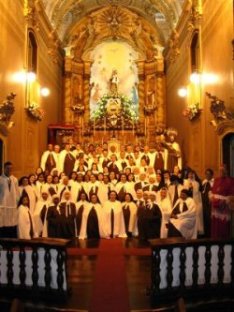
    Soon after, sixteen of the sisters were arrested for living religious life in violation of the constitution. They were taken to Paris, where they were all found guilty of being religious fanatics and supporters of King, they all were sentenced to death on the 17th July. On the night before their execution, the sisters arrived at the guillotine singing the Veni Creator Spiritus. Therese of St Augustine asked to be the last to die, so that she could encourage her sisters in their commitment, in the midst of the pointless violence. By the end of the same month the terror opf the French Revolution had come to an end. Text after Universalis 

   It all seems very hard work, this business of perfection - and so it is: we are waging war on ourselves! But as soon as we get down to it God becomes so active in our souls and showers so many mercies on them that whatever has got to be done in this life seems insignificant. And as we nuns do so much already, giving up our freedom for love of God and subjecting it to someone else, what excuse have we got for holding back when it comes to interior mortification? ....If you have started serving God seriously, the least you can offer him is, your life! If you have given him your will, what are you afraid of? If you are a real religious, a real 'pray-er', and want to enjoy God's favours, you obviously can't afford to shy away from wanting to die for him, and undergo martyrdom. Don't you realise, sisters, that the life of a good religious - a person who wants to be one of God's really close friends - is one long martyrdom? I say 'long' because in comparison with those whose heads have been chopped off in a trice one can call it long, but all our lives are short, very short in some cases. And we don't even know whether our own won't be so short that it will come to an end in an hour, or even a second, after we have made up our mind to serve God fully. That could happen. 
    We have just got to make no account of anything that will come to an end, least of all life, for we can't count on a single day. If we remember that every hour might be our last, is there a single one of us who will feel inclined to shirk? 
    Well, there is nothing you can be more certain of, believe me! So we must train ourselves to thwart our own wills in every way; then, if you try hard, as I have said, though you won't get there all of the sudden, you will gradually arrive, without realising it, at the peak of perfection. The fragments of the second reading from The Office of Readings, Discalced Carmelite Proper offices, after 'The Way of Perfection' by St Teresa of Avila

Read whole post......