Friday, October 13, 2006

SAINT EDWARD III,
King of England, Confessor (1001-1066)

Spiritual Bouquet: If I were still trying to please men, I should not be a servant of Christ. Gal. 1:10

EDWARD was unexpectedly raised to the throne of England at the age of forty years, twenty-seven of which he had passed in exile. On the throne, the virtues of his earlier years, simplicity, gentleness, lowliness, but above all his angelic purity shone with new brightness. By a rare inspiration of God, though he married to content his nobles and people, he preserved perfect chastity in the wedded state. So little did he set his heart on riches, that thrice when he saw a servant robbing his treasury he let him escape, saying the poor fellow needed the gold more than he. He loved to stand at his palace-gate, speaking kindly to the poor beggars and lepers who crowded about him, and many of whom he healed of their diseases. The long wars had brought the kingdom to a sad state, but Edward's zeal and sanctity soon wrought a great change. His reign of twenty-four years was one of almost unbroken peace, the country grew prosperous, the ruined churches rose under his hand, the weak lived secure, and for ages afterwards men spoke with affection of the "laws of good St. Edward." The holy king had a great devotion to building and enriching churches. Westminster Abbey was his latest and noblest work. He died January 5th, 1066.

REFLECTION.-David longed to build a temple for God's service. Solomon reckoned it his glory to accomplish the work. But we, who have God made flesh dwelling in our tabernacles, ought to think no time, no zeal, no treasures too much to devote to the splendor and beauty of a Christian church.

Miracle of the ring
Many legends sprang up about Edward the Confessor both during his lifetime and after his death. One that has stood the test of time happened towards the end of his life.Legend has it that Edward was riding to a ceremony at a chapel dedicated to St John the Evangelist in Essex when a beggar asked for alms. Edward had no money with him so he took off his ring and handed it to the poor man instead.A few years later two English pilgrims were travelling through the Holy Land and became stranded. They were helped by an old man who told them he was St John the Evangelist.He was carrying the ring Edward had given to the beggar some years previously. He asked the pilgrims to return it to the king telling him that in six months he would meet St John in heaven.
Read whole post......

Tuesday, October 10, 2006

SCRIPTURE CORNER

CHARITY AND THE CONTRARY VICES
fragments from "Scripture by Topic" - Originally titled "The Divine Armory of Holy Scripture" - 1943 edition - Angelus Press 2006

DUTY OF PRACTISING CHARITY part two

Be ye followers of God, as most dear children: and walk in love, as Christ also hath loved us, and hath delivered himself for us, an oblation and a sacrifice to God, for an odour of sweetness. Eph. 5:1f
If thou meet thy enemy's ox or ass going astray, bring it back to him. If thou see the ass of him that hateth thee lie underneath his burden, thou shalt not pass by, but shalt lift him up with him. Ex. 23:4f
Thou shalt not molest a stranger, nor afflict him: for yourself also were strangers in the land of Egypt. Ex. 22:21
Thou shalt not pass by, if thou seest thy brother's ox or his sheep go astray, but thou shalt bring them back to thy brother. Deut. 22:1
When thou hast besieged a city a long time, and hath compassed it with bulwarks to take it, thou shalt not cut down the trees that may be eaten of, neither shalt thou spoil the country round about with axes. Deut. 20:19
When thou shalt reaped the corn in thy field, and hast forgot and left a sheaf, thou shalt not suffer the starnger and the fatherless and the widow to take it away: that the Lord thy God may bless thee in all the works of thy hands. Deut. 24:19
If thou brother be impoverished and weak of hand, and thou hast receive him as a stranger and sojourner. and he live with thee, take not usury of him, nor more than thou gavest: fear thy God, that thy brother may live with thee. Lev. 25:35f
If thou lend money to any of my people that is poor that dwelleth with thee, thou shalt not be hard upon them as an extortioner, nor opress them with usuries. Ex. 22:35
Be not wanting in comforting them that weep, and walk with them that mourn. Be not slow to visit the sick: for by these things thou shalt be confirmed in love. Ecclus. 7: 38f
All things, therefore, whatsoever you would that men should do to you, do you also to them: for this is the law and the prophets. Mat. 7:12
I say to you: Love your enemies; do good to them that persecute and calumniate you. For if you love those that love you, what reward shall you have? Mat. 5: 44-46. Read whole post......

Sunday, October 08, 2006


EIGHTEENTH SUNDAY AFTER PENTECOST
from "Divine Instructions" by Fr. Goffine

In the Introit of the Mass the Church prays for the peace which God has promised through His prophets. "Give peace, O Lord, to them that patiently wait for Thee, that Thy prophets may be found faithful; hear the prayers of Thy servants, and of Thy people Israel. I rejoiced at the things that were said to me: we shall go into the house of the Lord." Glory be the the Father, etc.

Prayer
We beseech Thee, O Lord, that the work of Thy mercy may direct our hearts; for without Thy grace we cannot be pleasing to Thee. Through Our Lord Jesus Christ, etc.

EPISTLE I Cor. i. 4-8
BRETHREN: I give thanks to my God always for you, for the grace of God that is given you in Christ Jesus. That in all things you are made rich in him, in all utterance, and in all knowledge; As the testimony of Christ was confirmed in you, so that nothing is wanting to you in any grace, waiting for the manifestation of our Lord Jesus Christ. 8 Who also will confirm you unto the end without crime, in the day of the coming of our Lord Jesus Christ.

BRIEF LESSONS.
St. Paul shows in this epistle that he possess the true love of his neighbour, by rejoicing and thanking God that He had bestowed on the Corinthians manifold gifts and graces, and thereby confirmed the testimony of Christ in them. By this we learn that we should rejoice over the gifts and graces of our neighbours; should thank God for them, and pray Him to fill all who are in the darkness of error with knowledge, and love, and all virtues.

GOSPELMatt. ix. 1-8
At that time Jesus, entering into a boat, he passed over the water and came into his own city. And behold they brought to him one sick of the palsy lying in a bed. And Jesus, seeing their faith, said to the man sick of the palsy: Be of good heart, son, thy sins are forgiven thee. And behold some of the scribes said within themselves: He blasphemeth. And Jesus seeing their thoughts, said: Why do you think evil in your hearts? Whether is easier, to say, Thy sins are forgiven thee: or to say, Arise, and walk? But that you may know that the Son of man hath power on earth to forgive sins, (then said he to the man sick of palsy, Arise, take up thy bed, and go into thy house. And he arose, and went into his house. And the multitude seeing it, feared, and glorified God that gave such power to men.

EXPLANATION
The charity of those who brought the sick man to Christ was so full of faith, so pleasing to Him, that, out of regard for it, he forgave the palsied man his sins, and healed him. Christ did not heal the man sick with the palsy until He had forgiven him his sins. By this He teaches us that sins are often the cause of the sickness and evils that pursue us; and that if we sincerely repent of our sins, God would be likely to remove these evils from us. This is also intimated by the words of Jesus to him who had been eight-and-thirty years: "Sin no more, lest some worse thing happen to thee"(John v.14). This should be kept in mind by those who so impetuously beseech God to free them from the sins which may be the cause of them, by the sincere repentance and by leading a Christian life. "He blasphemeth." Thus, in their perverted minds, the Jews thought of Christ; supposing that, by forgiving the sick man his sins, He had committed an encroachment on the prerogative of God, and thereby done Him great wrong; for it is blasphemy against God to attempt to wrong Him, or to think, speak, or do anything insulting to Him or to His saints.
"And Jesus seeing their thoughts, said: Why do you think evil in your hearts?" This is something to be considered by those who suppose their thoughts to be free from scrutiny, and to whom it does not even occur to make their evil thoughts matter of confession. God, the most holy and most just, will no more leave unpunished impure, proud, angry, revengeful, envious thoughts, than He will an idle word (Matt. xii. 36). Do not, therefore, give yourself us to evil thoughts; and in order to repel them, remember each time that God sees and punishes them. Would you not drive them away if men saw them? Why not, then, on account of God? Read whole post......

Saturday, October 07, 2006


SATURDAY FOLLOWING THE SEVENTHEENTH SUNDAY AFFTER PENTECOST

EPISTLE Hebrews ix 2-12

BRETHREN: For there was a tabernacle made the first, wherein were the candlesticks, and the table, and the setting forth of loaves, which is called the holy. And after the second veil, the tabernacle, which is called the holy of holies: Having a golden censer, and the ark of the testament covered about on every part with gold, in which was a golden pot that had manna, and the rod of Aaron, that had blossomed, and the tables of the testament. And over it were the cherubims of glory overshadowing the propitiatory: of which it is not needful to speak now particularly. Now these things being thus ordered, into the first tabernacle the priests indeed always entered, accomplishing the offices of sacrifices. But into the second, the high priest alone, once a year: not without blood, which he offereth for his own, and the people's ignorance: The Holy Ghost signifying this, that the way into the holies was not yet made manifest, whilst the former tabernacle was yet standing. Which is a parable of the time present: according to which gifts and sacrifices are offered, which can not, as to the conscience, make him perfect that serveth, only in meats and in drinks, And divers washings, and justices of the flesh laid on them until the time of correction. But Christ, being come an high priest of the good things to come, by a greater and more perfect tabernacle not made with hand, that is, not of this creation: Neither by the blood of goats, or of calves, but by his own blood, entered once into the holies, having obtained eternal redemption

GOSPEL Luke xiii. 6-17

At that time Jesus spoke also this parable: A certain man had a fig tree planted in his vineyard, and he came seeking fruit on it, and found none. And he said to the dresser of the vineyard: Behold, for these three years I come seeking fruit on this fig tree, and I find none. Cut it done therefore: why cumbereth it the ground? But he answering, said to him: Lord, let it alone this year also, until I dig about it, and dung it. And if happily it bear fruit: but if not, then after that thou shalt cut it down. And he was teaching in their synagogue on their sabbath. And behold there was a woman, who had a spirit of infirmity eighteen years: and she was bowed together, neither could she look upwards at all. Whom when Jesus saw, he called her unto him, and said to her: Woman, thou art delivered from thy infirmity. And he laid his hands upon her, and immediately she was made straight, and glorified God. And the ruler of the synagogue (being angry that Jesus had healed on the sabbath) answering, said to the multitude: Six days there are wherein you ought to work. In them therefore come, and be healed; and not on the sabbath day. And the Lord answering him, said: Ye hypocrites, doth not every one of you, on the sabbath day, loose his ox or his ass from the manger, and lead them to water? And ought not this daughter of Abraham, whom Satan hath bound, lo, these eighteen years, be loosed from this bond on the sabbath day? And when he said these things, all his adversaries were ashamed: and all the people rejoiced for all the things that were gloriously done by him.

Practice
This parable was a call to the Jews to do penance; thet they who, as St. Jerome says, had been warned three times - through the law of Moses, through the prophets, and finally through Christ Himself - might not at last go to destruction. At the same time it was a threat of approaching judgment. Let us learn hence to make good use of the days of God's long-suffering mercy, that we may not, like the unfruitful tree, be cut down and cast into the fire.

Prayer
O almighty, eternal God, Who by salutary abstinence doth heal both our bodies and souls, we humbly entreat Thy majesty that, appeased by the pious prayers of those who fast, Thou wouldst grant us present and future support. Through Christ our Lord, etc. Read whole post......
SCRIPTURE CORNER

QUEEN OF APOSTLES PRAY FOR US

What did the Apostles do? St Paul gives the answer: "...For we preach not ourselves, but Jesus Christ our Lord; and ourselves your servants through Jesus." (2Cor 4,5), but Mary was the only one "of whom was born Jesus, who is called Christ" (Matt 1,16). Because of this, she is as much above Apostles as deeds are above words. In the Apostles own considerations: "Let a man so account of us as of the ministers of Christ, and the dispensers of the mysteries of God." (1 Cor 4,1), but Mary was Christ's mother who kept Him in her womb for nine months. The Apostle's work was to: "give ourselves continually to prayer, and to the ministry of the word.Acts 6,4), but Mary was to the Apostles the best teacher who could give them the best instructions about Mystery of Incarnation, birth and life of Jesus. In the Acts of Apostles we read, that after Our Lord's Ascension all of them: "were persevering with one mind in prayer with the women, and Mary the mother of Jesus " (Acts 1, 14). This short passage explains, why the Holy Ghost descended on the Apostles with such strength and plenitude of graces. For the Bride of the Holy Ghost was praying with them.
If St Paul assures us: "For we forecast what may be good not only before God but also before men. " (2Cor 8, 21), then the most holy Virgin Mother, full of graces and virtues, was the most radiant example given to them to follow. Then the Most Holy Virgin is truly the Queen of the Apostles. Let us follow her, let us become secular apostles of her guild, serving the Church in every corner of Catholic life, in the parishes, helping those in need, in poverty, helping Catholic publishers and Societies, and professing without hesitation our Catholic faith and values in religious processions and pilgrimages etc. For our Redeemer states clearly: "And I say to you - Whosoever shall confess me before men, him shall the Son of man also confess before the angels of God. " (Luke 12, 8).
"
Read whole post......
OUR LADY OF THE ROSARY

fragments taken from daily commentaries by Prof. Plinio Corra de Oliveira (www.traditionincation.org)

The feast day of Our Lady of the Rosary was instituted by St. Pius V in commemoration of the victory of the Battle of Lepanto on October 7, 1571 against the Turks who were threatening Europe. In 1716, the feast was extended to the entire Church in thanksgiving for the defeat of the Muslim Crescent in Hungary.
The devotion of the rosary was revealed to St. Dominic by Our Lady. It was born, therefore, in a private revelation. And we know that such revelations are abhorred by the enemies of the Church internal and external. Although it came from a private revelation, the praying of the Rosary was extended to the entire Catholic Church, and was considered by St. Louis Grignion de Montfort as the characteristic devotion of predestined souls.
Before Vatican II, the habits of many religious Orders had rosaries that hung on their cinctures, and good Catholics used to carry the rosary with them all day. It was considered not only an item for counting the Hail-Marys, but a blessed object, the seal of a special liaison of the person with Our Lady. Many times, the mere physical presence of the rosary would repel the Devil and attract special graces. It became the classic religious object to fight against the Devil.
What is the rosary? The rosary is a series of mediations on the mysteries from the lives of Our Lord and Our Lady. These mysteries are simultaneously prayers that one says vocally and meditations that one makes mentally. This mixture of vocal prayer and meditation is a splendid thing, because while the lips pronounce a plea, the mind concentrates on a point of the mystery. It is a dual activity that intimately unites one with God.
The practice of praying the rosary to beg a grace from God supposes the theological truth that Our Lady is the Universal Mediatrix of all graces. It is, therefore, a small masterpiece of spirituality and Catholic doctrine as they should be understood. The rosary is not a religious custom relying on emotions, but rather a serious, solid, and meditative pious practice, which explains why the rosary has obtained so many graces.
Each mystery of the Rosary has its special graces that correspond to the meditation. It is very beautiful and valuable to meditate on the mysteries of the rosary, because for each decade, one contemplates a different thing with its special graces: There are particular graces for the mystery of the Annunciation, others for the Agony in the Garden, yet others associated with the Ascension of Our Lord. Each one of the decades has its special graces, and the person who meditates on all of them attracts to his soul the ensemble of graces from the lives of Our Lord and Our Lady. It is a complete circumnavigation that brings a supernatural plenitude to the soul of the person, which helps us to better understand the salutary influence of the rosary.
A Catholic, thinking and reflecting on things of the Faith, should draw conclusions that build upon each other and constitute a kind of architectural construct. This should be the spiritual life of a Catholic. It follows in accordance with the way God governs the universe. He wisely judges the weight and measure of everything. This is another reason why the rosary is an excellent devotion.
We know that the victory of the Battle of Lepanto was achieved when St. Pius V interrupted a meeting with Cardinals at the Vatican and went to a window and started to pray the rosary. He was deeply concerned about the future of the Church and Christendom that was being decided in those Mediterranean waters. After the Pontiff finishing praying the rosary, he returned to the meeting and told the Cardinals that the Catholic fleet had been victorious. That is, he had a revelation while he was praying the rosary. It was the way Our Lady showed him that she linked that victory to his praying of the rosary. Understanding this, St. Pius V instituted the feast of Our Lady of the Rosary, which was extended to the whole Church in commemoration for another great victory over the Mohammedans in 1716.
The fact that this devotion is specially linked to victories over the enemies of the Church and Christendom induces us to think that it will protect all those who fight against the enemies of the Catholic cause. It is a devotion that most probably will endure until the end time, when the enemies of the Church will be more dangerous than ever.
Therefore, also during the chastisement predicted at Fatima, the assiduous recitation of the holy rosary should be a decisive factor of victory for those who would be defending the Catholic cause. The historical antecedents of the value of the rosary are a pledge of analogous future victories.
When St. Alphonsus of Liguori was already old, sick, and in a wheelchair, a lay brother used to wheel him around the cloister of his monastery in the evening so he could take some fresh air. Engaging the brother in conversation, St. Alphonsus asked him:
Did you pray your rosary today?
I dont remember, the brother answered,
Then, let us pray it now, the Saint said.
But you are already so tired. What difference does it make if we dont pray the rosary for one day? protested the brother.
St. Alphonsus answered: If I did not pray my rosary for even one day, I would fear for my eternal salvation.
This is what a Saint said. I like this episode because it teaches us that we should do precisely the same. The daily rosary is a great guarantee of final perseverance and fidelity for the times ahead when the prophecies of Fatima will be fulfilled. The victory in our everyday Lepanto is linked to the recitation of the rosary.

Let us ask Our Lady of the Rosary to bless this intention of saying the Rosary daily and give us the grace to carry it out.

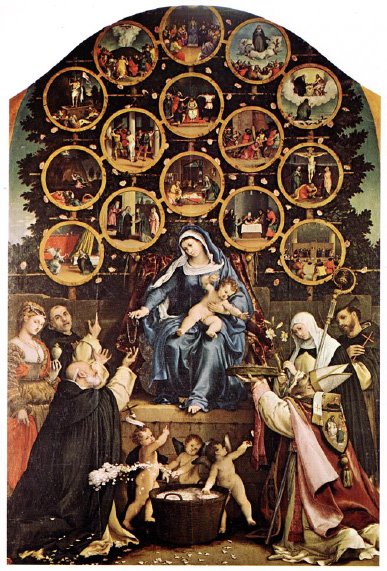
Today's picture depicts the Fifteen Mysteries of the Rosary above the Madonna, the Glorious Mysteries at top, the Sorrowful Mysteries in the middle, and the Joyous Mysteries at the bottom. The Blessed Virgin is shown giving the Rosary to Saint Dominic, surrounded by other saints.

I also highly recommend to those who wish to read more on today's Feast to follow the link: www.sspx.ca and look for The Angelus, February 2003 Volume XXVI,  Number 2 Read whole post......
SCRIPTURE CORNER

CHARITY AND THE CONTRARY VICES

fragments from "Scripture by Topic" - Originally titled "The Divine Armory of Holy Scripture" - 1943 edition - Angelus Press 2006

DUTY OF PRACTISING CHARITY part one

Show ye mercy and compassion every man to his brother. Zach. 7:9
Let love be without dissimulation: loving one another with the charity of brotherhood, with honour preventing one another. Rom. 12:9f
Bear ye one another's burdens; and so you shall fulfill the law of Christ. Gal. 6:2
I, a prisoner in the Lord, beseech you that you walk worthy of the vocation in which you are called, with all humility and mildness, with patience, spporting one another in charity. Eph. 4:1f Read whole post......

Friday, October 06, 2006

SCRIPTURE CORNER

CHARITY AND THE CONTRARY VICES

fragments from "Scripture by Topic" - Originally titled "The Divine Armory of Holy Scripture" - 1943 edition - Angelus Press 2006

CHARITY TOWARD OUR NEIGHBOUR part four

By charity of the Spirit serve one another. For all the law is fulfilled in one sentence: Thou shalt love thy neighbour as thyself. Gal. 5:13f
May the Lord multiply you, and make you abound in charity towards one another and towards all men. 1 Thess. 3:12
Let fraternal charity abide in you. Heb. 13:1
If you fulfil the royal law, according to the scriptures: Thou shalt love thy neighbour as thyself, you do well. Jas. 2:8
Greater love than this no man hath, that a man lay down his life for his friends. John 15:13
In this we have known the charity of God, because he hath laid down his life for us: and we ought to lay down our lives for the brethren. 1 John 3:16 Read whole post......

Thursday, October 05, 2006

SCRIPTURE CORNER

CHARITY AND THE CONTRARY VICES

fragments from "Scripture by Topic" - Originally titled "The Divine Armory of Holy Scripture" - 1943 edition - Angelus Press 2006

CHARITY TOWARD OUR NEIGHBOUR part three

He said to them: take heed what you hear. In what measure you shall mete, it shall be measured to you again, and more shall be given to you. Mark 4:24
A new commandment I give unto you: That you love one another, as I have loved you. that you also love one another. John 13:34
These things I command you, that you love one annother. John 15:17
Concerning fraternal charity we have no need to write to you; for yourselves have learned of God to love one another. We entreat you, brethren, that you abound more. 1 Thess. 4:9f
Loving one another with brotherly love love; in honour preventing one another. Rom. 12:10
he love of the neighbour worketh no evil. Love, therefore, is the fulfilling of the law. Rom. 13:10
See thou never do to another what thou woulst hat to have done to thee by another. Tob. 4:16
Charity covereth all sins. Prov. 10:12 Read whole post......
SAINTS OF CARMEL TEACHING

CHAPTER V
VOCATION OF THÉRÈSE
part five

fragments form "The Story of a Soul (L'Histoire d'une Âme): The Autobiography of St. Thérèse of Lisieux With Additional Writings and Sayings of St. Thérèse. Free download available from www.gutengerg.org


How many souls might attain to great sanctity if only they were directed aright from the first! I know God has not need of anyone to help Him in His work of sanctification, but as He allows a clever gardener to cultivate rare and delicate plants, giving him the skill to accomplish it, while reserving to Himself the right of making them grow, so does He wish to be helped in the cultivation of souls. What would happen if an ignorant gardener did not graft his trees in the right way? if he did not understand the nature of each, and wished, for instance, to make roses grow on peach trees? This reminds me that I used to have among my birds a canary which sang beautifully, and also a little linnet taken from the nest, of which I was very fond. This poor little prisoner, deprived of the teaching it should have received from its parents, and hearing the joyous trills of the canary from morning to night, tried hard to imitate them. A difficult task indeed for a linnet! It was delightful to follow the efforts of the poor little thing; his sweet voice found great difficulty in accommodating itself to the vibrant notes of his master, but he succeeded in time, and, to my great surprise, his song became exactly like the song of the canary.
Oh, dear Mother, you know who taught me to sing from the days of my earliest childhood! You know the voices which drew me on. And now I trust that one day, in spite of my weakness, I may sing for ever the Canticle of Love, the harmonious notes of which I have often heard sweetly sounding here below. But where am I? These thoughts have carried me too far, and I must
resume the history of my vocation. On October 31, 1887, alone with Papa, I started for Bayeux, my heart full of hope, but also excited at the idea of presenting myself at the Bishop's house. For the first time in my life, I was going to pay a visit without any of my sisters, and this to aBishop. I, who had never yet had to speak except to answer questions addressed to me, would have to explain and enlarge on my reasons for begging to enter the Carmel, and so give proofs of the genuineness of my vocation. It cost me a great effort to overcome my shyness sufficiently to do this. But it is true that Love knows no such word as "impossible," for it deems "all things possible, all things allowed." Nothing whatsoever but the love of Jesus could have made me face these difficulties and others which followed, for I had to purchase my happiness by heavy trials. Now, it is true, I think I bought it very cheaply, and I would willingly bear a thousand times more bitter suffering to gain it, if it were not already mine. When we reached the Bishop's house, the floodgates of Heaven seemed open once more. The Vicar-General, Father Révérony, who had settled the date of our coming, received us very kindly, though he looked a little surprised, and seeing tears in my eyes said: "Those diamonds must not be shown to His Lordship!" We were ledthrough large reception-rooms which made me feel how small I was, and I wondered what I should dare say. The Bishop was walking in a corridor with two Priests. I saw the Vicar-General speak a few words to him, then they came into the room where we were waiting. There were three large armchairs in front of the fireplace, where a bright fire blazed. As his Lordship entered, my Father and I knelt for his blessing; then he made us sit down. Father Révérony offered me the armchair in the middle. I excused myself politely, but he insisted, telling me to show if I knew how to obey. I did so without any more hesitation, and was mortified to see him take an ordinary chair while I was buried in an enormous seat that would comfortably have held four children like me-- more comfortably in fact, for I was far from being at ease. I hoped that Papa was going to do all the talking, but he told me to explain the reason of our visit. I did so as eloquently as I could, though I knew well that one word from the Superior would have carried more weight than all my reasons, while his opposition told strongly against me. The Bishop asked how long I had wanted to enter the Carmel. "A very long time, my Lord!" "Come!" said the Vicar-General, laughing, "it cannot be as long as fifteen years." "That is true," I
answered, "but it is not much less, for I have wished to give myself to God from the time I was three." The Bishop, no doubt to please Papa, tried to explain that I ought to remain some time longer with him; but, to his great surprise and edification, my Father took my part, adding respectfully that we were going to Rome with the diocesan pilgrimage, and that I should not hesitate to speak to the Holy Father if I could not obtain permission before then. However, it was decided that, previous to giving an answer, an interview with the Superior was absolutely necessary. This was particularly unpleasant hearing, for I knew his declared and determined opposition; and, in spite of the advice not to allow the Bishop to see any diamonds, I not only showed them but let them fall. He seemed touched, and caressed me fondly. I was afterwards told he had never treated any child so kindly. "All is not lost, little one," he said, "but I am very glad that you are going to Rome with your good Father; you will thus strengthen your vocation. Instead of weeping, you ought to rejoice. I am going to Lisieux next week, and I will talk to the Superior about you. You shall certainly have my answer when you are in Italy." His Lordship then took us to the garden, and was much interested when Papa told him that, to make myself look older, I had put up my hair for the first time that very morning. This was not forgotten, for I know that even now, whenever the Bishop tells anyone about his "little daughter," he always repeats the story about her hair. I must say I should prefer my little secret to have been kept. As he took us to the door, the Vicar-General remarked that such a thing had never been seen--a father as anxious to give his child to God as the child was to offer herself. We had to return to Lisieux without a favourable answer. It seemed to me as though my future were shattered for ever; the nearer I drew to the goal, the greater my difficulties became. But all the time I felt deep down in my heart a wondrous peace, because I knew that I was only seeking the Will of my Lord. Read whole post......

Wednesday, October 04, 2006

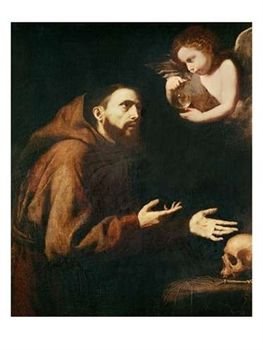
OF THE THIRD CONSIDERATION OF THE SACRED HOLY STIGMATA

Fragments from "Little flowers of St. Francis"

We are come now to the third consideration, namely, of the seraphical apparition, and the impression of the sacred, holy stigmata.

As the Feast of the Holy Cross then drew nigh, in the month of September, Brother Leo went one night at his accustomed hour to say Matins with St Francis. When he came to the bridge, he said, as he was wont to do, Domine labia mea aperies; but St Francis made no answer. Yet Brother Leo turned not back as he had been commanded to do, but with a good and holy intention, he passed the bridge and went straight into the cell; but there he found not St Francis. Thinking, therefore, that he was gone to pray in some solitary place, he went softly through the wood, seeking him in the moonlight. At last he heard his voice, and drawing near, beheld him kneeling in prayer with his face and hands lifted up towards heaven, and crying, in fervour of spirit: Who art thou, my dearest Lord? and who am I, a most vile worm and thy most unprofitable servant? and these words he repeated over and over again, adding nothing more. At this Brother Leo, greatly marvelling, lifted up his eyes to heaven and beheld a torch of most intense and glorious fire, which seemed to descend and alight upon the head of St Francis; and from the flame there seemed to issue forth a voice which spake with him, but Brother Leo knew not the words which were spoken. Hearing this, and accounting himself unworthy to stand in that holy place, and fearing also to offend St Francis and to disturb him by his presence, he went away silently, and stood afar off to behold what would follow; and looking earnestly upon St Francis, he saw him thrice spread forth his hands to the flame, and after a long time he beheld it mount again to heaven. Then he turned joyfully to go back to his cell, being greatly consoled by the visitation. But, as he turned, St Francis heard the rustling of the leaves under his feet, and commanded him not to stir, but to await his coming. And Brother Leo in obedience stood still, and waited in so great fear that, as he afterwards told his companions, he would have wished that the earth might swallow him up rather than wait for St Francis, whose anger he feared exceedingly; for he took great heed always not to offend him, lest he should be deprived of his company.

When St Francis, then, came up to him, he said: Who art thou? and Brother Leo, in fear, and trembling, answered: Father, I am Brother Leo. And St Francis said to him: Wherefore hast thou come hither, dear brother? did I not forbid thee to observe me? Tell me now, by holy obedience, whether thou hast seen or heard anything? And Brother Leo replied: Father, I heard thee speak and say many times, Who art thou, my dearest Lord and who am I, a most vile worm and thy most unprofitable servant? And then, kneeling before St Francis, Brother Leo accused himself of disobedience to his command, and besought him to expound to him the meaning of the words which he had heard, and to tell him also those which he had not heard. Then St Francis, seeing that, for his simplicity and purity, God had revealed so much to Brother Leo, condescended to reveal and expound also that which he desired further to know; and thus he spoke to him: Know, dearest brother, that when I said those words which thou didst hear, two great lights were before my soul, the one the knowledge of myself, the other the knowledge of the Creator. When I said: Who art thou, my dearest Lord? I was in a light of contemplation, in which I beheld the abyss of the infinite goodness and wisdom and power of God; and when I said: Who am I?I was in light of contemplation wherein I say the lamentable abyss of my own vileness and misery: wherefore I said: Who are thou, the Lord of infinite wisdom and goodness, who dost vouchsafe to visit me, a vile worm and abominable? and in that flame which thou didst behold was God, who under that appearance spake to me, as of old he spake to Moses. And among other things which he said to me, he asked of me three gifts; and I made answer: O Lord, I am all thing; thou knowest full well that I have nothing else but my cord and my tunic, and even these are thing; what, then, can I offer or give to thy Majesty? Then he said to me: Search in thy bosom, and offer me what thou shalt find there. And searching, I found there a golden ball, and I offered it to God; and the like I did three times, even as God commanded me; and then I knelt down thrice, and blessed and gave thanks to God, who had thus given me something to offer him. And immediately it was given to me to understand that these three offerings signified holy obedience, most entire poverty, and most pure chastity, which God by his grace has enabled me so perfectly to observe that I have nothing to reproach myself thereupon. And whereas thou didst see me put my hand into
my bosom and offer to God those three virtues, signified by these three golden balls which God had placed in my bosom, so God has infused such virtue into my soul, that for all the gifts and graces which of his sovereign bounty he has bestowed upon me, I should always with heart and voice praise and magnify him. These are the words which thou didst hear when
thou didst see me thrice lift up my hands. But take heed, brother little lamb, that thou observe me no more, but return to thy cell with the blessing of God; and take heed to my words, for yet a few days, and God will work such strange and marvellous things upon this mountain as shall astonish the whole world; for he will do a new thing which he hath never done before to any creature upon this earth. And when he had said these words, he bade him bring the book of the Gospels, because God had put it into his mind that, by thrice opening that book, he should learn what God would be pleased to do with him. And when the book was brought to him, St Francis went to prayer; and when he had prayed, he caused Brother Leo to open the book three times in the name of the most holy Trinity; and, by the divine disposal, it opened each time at the Passion of
Christ. And by this it was given him to understand that, even as he had followed Christ in the actions of his life, so should he follow and be confirmed to him in the sufferings and afflictions of his Passion, before he should pass out of this life. And from that day forward St Francis began to taste more abundantly the sweetness of divine contemplation, and of divine
visitations, among which he had one, preparatory to the impression of the sacred, holy stigmata, after the following manner. The day before the Feast of the most Holy Cross, as St Francis was praying secretly in his cell, an angel of God appeared to him, and spake to him thus from God: I am come to admonish and encourage thee, that thou prepare thyself to receive in all
patience and humility that which God will give and do to thee. St Francis replied: I am ready to bear patiently whatsoever my Lord shall be pleased to do to me; and so the angel departed. On the following day - being the Feast of the Holy Cross - St Francis was praying before daybreak at the entrance of his cell, and turning his face towards the east, he prayed in these words: O Lord Jesus Christ, two graces do I ask of thee before I die; the first, that in my lifetime I may feel, as far as possible,
both in my soul and body, that pain which thou, sweet Lord, didst endure in the hour of thy most bitter Passion; the second, that I may feel in my heart as much as possible of that excess of love by which thou, O Son of God, wast inflamed to suffer so cruel a Passion for us sinners. And continuing a long time in that prayer, he understood that God had heard him, and that, so far as is possible for a mere creature, he should be permitted to feel these things. Having then received this promise, St Francis began to contemplate most devoutly the Passion of Jesus Christ and his infinite charity; and so greatly did the fervour of devotion increase within him, that he was all transformed into Jesus by love and compassion. And being thus inflamed in that contemplation, on that same morning he beheld a seraph descending from heaven with six fiery and resplendent wings;
and this seraph with rapid flight drew nigh unto St Francis, so that he could plainly discern him, and perceive that he bore the image of one crucified; and the wings were so disposed, that two were spread over the head, two were outstretched in flight, and the other two covered the whole body. And when St Francis beheld it, he was much afraid, and filled at once with joy and grief and wonder. He felt great joy at the gracious presence of Christ, who appeared to him thus familiarly, and looked upon him thus lovingly, but, on the other hand, beholding him thus crucified, he felt exceeding grief and compassion. He marvelled much at so stupendous and unwonted a vision, knowing well that the infirmity of the Passion accorded ill with the immortality of the seraphic spirit. And in that perplexity of mind it was revealed to him by him who thus appeared, that by divine providence this vision had been thus shown to him that he might understand that, not by martyrdom of the body, but by a consuming fire of the soul, he was to be transformed into the express image of Christ crucified in that wonderful apparition. Then did all the Mount Alvernia appear wrapped in intense fire, which illumined all the mountains and valleys around, as it were the sun shining in his strength upon the earth, for which cause the shepherds who were watching their flocks in that country were filled with fear, as they themselves afterwards told the brethren, affirming that this light had been visible on Mount Alvernia for upwards of an hour. And because of the brightness of that light, which shone through the windows of the inn where they were tarrying, some muleteers who were travelling in Romagna arose in haste, supposing that the sun had risen, and saddled and loaded their beasts; but as they journeyed on, they saw that light disappear, and the visible sun arise. In this seraphical apparition, Christ, who appeared under that form to St Francis, spoke to him certain high and secret things, which in his lifetime he would never reveal to any person, but after his death he made them known to one of the brethren, and the words were these: Knowest thou, said Christ, what I have done to thee? I have given thee the stigmata which are the insignia of my Passion, that thou mayest be my standard-bearer; and as on the day of my death I descended into limbo, and by virtue of these my stigmata delivered thence all the souls whom I found there, so do I grant to thee that every year on the anniversary of thy death thou mayst go to Purgatory, and take with thee to the glory of Paradise all the souls of thy three Orders, the Friars Minor, the Sisters, and the Penitents, and likewise all others whom thou shalt find there, who have been especially devout to thee; that so thou mayst be conformed to me in death, as thou hast been like
to me in life. Then, after long and secret conference together, that marvellous vision disappeared, leaving in the heart of St Francis an excessive fire and ardour of divine love, and on his flesh a wonderful trace and image of the Passion of Christ. For upon his hands and feet began immediately to appear the figures of the nails, as he had seen them on the Body of Christ crucified, who had appeared to him in the likeness of a seraph. And thus the hands and feet appeared pierced through the midst by the nails, the heads whereof were seen outside the flesh in the palms of the hands and the soles of the feet, and the points of the nails stood out at the back of the hands, and the feet in such wise that they appeared to be twisted and bent back upon themselves, and the portion thereof that was bent back upon themselves, and the portion thereof that was bent back or twisted stood out free from the flesh, so that one could put a finger through the same as through a ring; and the heads of the nails were round and black. In like manner, on the right side appeared the image of an unhealed wound, as
if made by a lance, and still red and bleeding, from which drops of blood often flowed from the holy breast of St Francis, staining his tunic and his drawers. And because of this his companions, before they knew the truth from himself, perceiving that he would not uncover his hands and his feet, and that he could not set the soles of his feet upon the ground, and finding traces of blood upon his tunic when they washed it, understood of a certainty that he bore in his hands and feet and side the image and similitude of our Lord Jesus Christ crucified. And although he laboured hard to conceal these sacred stigmata holy and glorious, thus clearly impressed upon his flesh, yet finding that he could with difficulty hide them from his familiar
companions, and fearing at the same time to reveal the secrets of God, he was in great doubt and trouble of mind whether or not he should make known the seraphical vision and the impression of the sacred, holy stigmata. At last, being pricked in conscience, he called together certain of the brethren, in whom he placed the greatest confidence, and proposing to them
his doubt in general terms, asked their counsel on the matter. Now among these friars there was one of great sanctity, called Brother Illuminato; and he, being truly illuminated by God, understood that St Francis must have seen something miraculous, and said thus to him: Know, Brother Francis, that not for thyself alone, but for others, doth God reveal to thee his secrets, and therefore thou hast cause for fear lest thou be worthy of censure if thou conceal that which, for the good of others, has been made known to thee. Then St Francis, being moved by these words, with great fear and reverence told them the manner of the aforesaid vision, adding that Christ, who had thus appeared to him, had said to him certain things which he might never make known so long as he should live. Now although these sacred wounds, which had been impressed upon him by
Christ, gave great joy to his heart, yet they caused unspeakable pain to his body; so that, being constrained by necessity, he made choice of Brother Leo, for his great purity and simplicity, to whom he revealed the whole matter, suffering him to touch and dress his wounds on all days except during the time from Thursday evening till Saturday morning, for then he would not by any human remedy mitigate the pain of Christ's Passion, which he bore in his body, because at that time our Saviour Jesus Christ was taken and crucified, died and was buried for us. And it came to pass sometimes that when Brother Leo was removing the bandage from the wound in the side, St Francis, because of the pain caused thereby, would lay his hand on
Brother Leo's breast, and at the touch of that holy hand Brother Leo felt such sweetness of devotion as well-nigh made him to fall fainting to the ground. To conclude, so far as concerns this third consideration, St Francis, having completed the Lent of St Michael the Archangel, prepared himself by divine revelation to return with Brother Leo to St Mary of the Angels; and calling to him Brother Masseo and Brother Angelo, he commended that holy mount unto their care, and blessing them in the name of Jesus crucified, he suffered them, at their earnest prayer, to see, touch, and kiss his sacred hands adorned with those holy, glorious, and sacred stigmata; and so leaving them in great joy and consolation, he parted from them and came down from the holy mountain. Read whole post......
ST. FRANCIS OF ASSISI
Founder of the Franciscan Order, born at Assisi in Umbria, in 1181.

after www.catholic.org/saints/

In 1182, Pietro Bernadone returned from a trip to France to find out his wife had given birth to a son. Far from being excited or apologetic because he'd been gone, Pietro was furious because she'd had his new son baptized Giovanni after John the Baptist. The last thing Pietro wanted in his son was a man of God -- he wanted a man of business, a cloth merchant like he was, and he especially wanted a son who would reflect his infatuation with France. So he renamed his son Francesco -- which is the equivalent of calling him Frenchman.
Francis enjoyed a very rich easy life growing up because of his father's wealth and the permissiveness of the times. From the beginning everyone -- and I mean everyone -- loved Francis. He was constantly happy, charming, and a born leader. If he was picky, people excused him. If he was ill, people took care of him. If he was so much of a dreamer he did poorly in school, no one minded. In many ways he was too easy to like for his own good. No one tried to control him or teach him.
As he grew up, Francis became the leader of a crowd of young people who spent their nights in wild parties. Thomas of Celano, his biographer who knew him well, said, "In other respects an exquisite youth, he attracted to himself a whole retinue of young people addicted to evil and accustomed to vice." Francis himself said, "I lived in sin" during that time.
Francis fulfilled every hope of Pietro's -- even falling in love with France. He loved the songs of France, the romance of France, and especially the free adventurous troubadours of France who wandered through Europe. And despite his dreaming, Francis was also good at business. But Francis wanted more..more than wealth. But not holiness! Francis wanted to be a noble, a knight. Battle was the best place to win the glory and prestige he longed for. He got his first chance when Assisi declared war on their longtime enemy, the nearby town of Perugia.
Most of the troops from Assisi were butchered in the fight. Only those wealthy enough to expect to be ransomed were taken prisoner. At last Francis was among the nobility like he always wanted to be...but chained in a harsh, dark dungeon. All accounts say that he never lost his happy manner in that horrible place. Finally, after a year in the dungeon, he was ransomed. Strangely, the experience didn't seem to change him. He gave himself to partying with as much joy and abandon as he had before the battle.
The experience didn't change what he wanted from life either: Glory. Finally a call for knights for the Fourth Crusade gave him a chance for his dream. But before he left Francis had to have a suit of armor and a horse -- no problem for the son of a wealthy father. And not just any suit of armor would do but one decorated with gold with a magnificent cloak. Any relief we feel in hearing that Francis gave the cloak to a poor knight will be destroyed by the boasts that Francis left behind that he would return a prince.
But Francis never got farther than one day's ride from Assisi. There he had a dream in which God told him he had it all wrong and told him to return home. And return home he did. What must it have been like to return without ever making it to battle -- the boy who wanted nothing more than to be liked was humiliated, laughed at, called a coward by the village and raged at by his father for the money wasted on armor.
Francis' conversion did not happen over night. God had waited for him for twenty-five years and now it was Francis' turn to wait. Francis started to spend more time in prayer. He went off to a cave and wept for his sins. Sometimes God's grace overwhelmed him with joy. But life couldn't just stop for God. There was a business to run, customers to wait on.
One day while riding through the countryside, Francis, the man who loved beauty, who was so picky about food, who hated deformity, came face to face with a leper. Repelled by the appearance and the smell of the leper, Francis nevertheless jumped down from his horse and kissed the hand of the leper. When his kiss of peace was returned, Francis was filled with joy. As he rode off, he turned around for a last wave, and saw that the leper had disappeared. He always looked upon it as a test from God...that he had passed.
His search for conversion led him to the ancient church at San Damiano. While he was praying there, he heard Christ on the crucifix speak to him, "Francis, repair my church." Francis assumed this meant church with a small c -- the crumbling building he was in. Acting again in his impetuous way, he took fabric from his father's shop and sold it to get money to repair the church. His father saw this as an act of theft -- and put together with Francis' cowardice, waste of money, and his growing disinterest in money made Francis seem more like a madman than his son. Pietro dragged Francis before the bishop and in front of the whole town demanded that Francis return the money and renounce all rights as his heir.
The bishop was very kind to Francis; he told him to return the money and said God would provide. That was all Francis needed to hear. He not only gave back the money but stripped off all his clothes -- the clothes his father had given him -- until he was wearing only a hair shirt. In front of the crowd that had gathered he said, "Pietro Bernadone is no longer my father. From now on I can say with complete freedom, 'Our Father who art in heaven.'" Wearing nothing but castoff rags, he went off into the freezing woods -- singing. And when robbers beat him later and took his clothes, he climbed out of the ditch and went off singing again. From then on Francis had nothing...and everything.
Francis went back to what he considered God's call. He begged for stones and rebuilt the San Damiano church with his own hands, not realizing that it was the Church with a capital C that God wanted repaired. Scandal and avarice were working on the Church from the inside while outside heresies flourished by appealing to those longing for something different or adventurous.
Soon Francis started to preach. (He was never a priest, though he was later ordained a deacon under his protest.) Francis was not a reformer; he preached about returning to God and obedience to the Church. Francis must have known about the decay in the Church, but he always showed the Church and its people his utmost respect. When someone told him of a priest living openly with a woman and asked him if that meant the Mass was polluted, Francis went to the priest, knelt before him, and kissed his hands -- because those hands had held God.
Slowly companions came to Francis, people who wanted to follow his life of sleeping in the open, begging for garbage to eat...and loving God. With companions, Francis knew he now had to have some kind of direction to this life so he opened the Bible in three places. He read the command to the rich young man to sell all his good and give to the poor, the order to the apostles to take nothing on their journey, and the demand to take up the cross daily. "Here is our rule," Francis said -- as simple, and as seemingly impossible, as that. He was going to do what no one thought possible any more -- live by the Gospel. Francis took these commands so literally that he made one brother run after the thief who stole his hood and offer him his robe!
Francis never wanted to found a religious order -- this former knight thought that sounded too military. He thought of what he was doing as expressing God's brotherhood. His companions came from all walks of life, from fields and towns, nobility and common people, universities, the Church, and the merchant class. Francis practiced true equality by showing honor, respect, and love to every person whether they were beggar or pope.
Francis' brotherhood included all of God's creation. Much has been written about Francis' love of nature but his relationship was deeper than that. We call someone a lover of nature if they spend their free time in the woods or admire its beauty. But Francis really felt that nature, all God's creations, were part of his brotherhood. The sparrow was as much his brother as the pope.In one famous story, Francis preached to hundreds of birds about being thankful to God for their wonderful clothes, for their independence, and for God's care. The story tells us the birds stood still as he walked among him, only flying off when he said they could leave.
Another famous story involves a wolf that had been eating human beings. Francis intervened when the town wanted to kill the wolf and talked the wolf into never killing again. The wolf became a pet of the townspeople who made sure that he always had plenty to eat.
Following the Gospel literally, Francis and his companions went out to preach two by two. At first, listeners were understandably hostile to these men in rags trying to talk about God's love. People even ran from them for fear they'd catch this strange madness! And they were right. Because soon these same people noticed that these barefoot beggars wearing sacks seemed filled with constant joy. They celebrated life. And people had to ask themselves: Could one own nothing and be happy? Soon those who had met them with mud and rocks, greeted them with bells and smiles.
Francis did not try to abolish poverty, he tried to make it holy. When his friars met someone poorer than they, they would eagerly rip off the sleeve of their habit to give to the person. They worked for all necessities and only begged if they had to. But Francis would not let them accept any money. He told them to treat coins as if they were pebbles in the road. When the bishop showed horror at the friars' hard life, Francis said, "If we had any possessions we should need weapons and laws to defend them." Possessing something was the death of love for Francis. Also, Francis reasoned, what could you do to a man who owns nothing? You can't starve a fasting man, you can't steal from someone who has no money, you can't ruin someone who hates prestige. They were truly free.
Francis was a man of action. His simplicity of life extended to ideas and deeds. If there was a simple way, no matter how impossible it seemed, Francis would take it. So when Francis wanted approval for his brotherhood, he went straight to Rome to see Pope Innocent III. You can imagine what the pope thought when this beggar approached him! As a matter of fact he threw Francis out. But when he had a dream that this tiny man in rags held up the tilting Lateran basilica, he quickly called Francis back and gave him permission to preach.
Sometimes this direct approach led to mistakes that he corrected with the same spontaneity that he made them. Once he ordered a brother who hesitated to speak because he stuttered to go preach half-naked. When Francis realized how he had hurt someone he loved he ran to town, stopped the brother, took off his own clothes, and preached instead.
Francis acted quickly because he acted from the heart; he didn't have time to put on a role. Once he was so sick and exhausted, his companions borrowed a mule for him to ride. When the man who owned the mule recognized Francis he said, "Try to be as virtuous as everyone thinks you are because many have a lot of confidence in you." Francis dropped off the mule and knelt before the man to thank him for his advice.
Another example of his directness came when he decided to go to Syria to convert the Moslems while the Fifth Crusade was being fought. In the middle of a battle, Francis decided to do the simplest thing and go straight to the sultan to make peace. When he and his companion were captured, the real miracle was that they weren't killed. Instead Francis was taken to the sultan who was charmed by Francis and his preaching. He told Francis, "I would convert to your religion which is a beautiful one -- but both of us would be murdered."
Francis did find persecution and martyrdom of a kind -- not among the Moslems, but among his own brothers. When he returned to Italy, he came back to a brotherhood that had grown to 5000 in ten years. Pressure came from outside to control this great movement, to make them conform to the standards of others. His dream of radical poverty was too harsh, people said. Francis responded, "Lord, didn't I tell you they wouldn't trust you?"
He finally gave up authority in his order -- but he probably wasn't too upset about it. Now he was just another brother, like he'd always wanted.
Francis' final years were filled with suffering as well as humiliation. Praying to share in Christ's passion he had a vision received the stigmata, the marks of the nails and the lance wound that Christ suffered, in his own body.
Years of poverty and wandering had made Francis ill. When he began to go blind, the pope ordered that his eyes be operated on. This meant cauterizing his face with a hot iron. Francis spoke to "Brother Fire": "Brother Fire, the Most High has made you strong and beautiful and useful. Be courteous to me now in this hour, for I have always loved you, and temper your heat so that I can endure it." And Francis reported that Brother Fire had been so kind that he felt nothing at all.

How did Francis respond to blindness and suffering? That was when he wrote his beautiful Canticle of the Sun that expresses his brotherhood with creation in praising God.
Francis never recovered from this illness. He died on October 4, 1226 at the age of 45. Francis is considered the founder of all Franciscan orders and the patron saint of ecologists and merchants.


Copyright 1996-2000 by Terry Matz. All Rights Reserved. Read whole post......
SCRIPTURE CORNER

CHARITY AND THE CONTRARY VICES

fragments from "Scripture by Topic" - Originally titled "The Divine Armory of Holy Scripture" - 1943 edition - Angelus Press 2006

CHARITY TOWARD OUR NEIGHBOUR part two

To love one's neighbour as oneself is a greater thing than all holocausts and sacrifices.Mark 12:33
Say not: I will do to him as he hath done to me: I will render to every one according to his work. Prov. 24:29
Remember not any injury done thee by thy neighbour, and do thou nothing by deeds of injury. Ecclus 10:6
Forgive thy neighbour if he hath hurt thee; and then shall thy sins be forgiven thee when thou prayest. Ecclus.28:2
Hast thou heart a word against thy neighbour? Let it die within thee. Ecclus. 19:10
Love thy neigbour, and be joined to him with fidelity. Ecclus. 27:18
Thou shalt love thy neighbour as thyself. Matt. 22:39
As you would that men should do to you, do you also to them in like manner. And if you love them that love you, what thanks are to you? for sinners also love those that love them. And if you do good to them who do good to you, what thanks are to you? for sinners also do this. And if you lend to them of whom you hope to receive, what thanks are to you? for sinners also lend to sinners, for to receive as much. But love ye your enemies; do good, and lend, hoping for nothing thereby: and your reward shall be great, and you shall be the sons of the Highest; for he is kind to the unthankful and to the evil. Luke 6: 31-35 Read whole post......

Tuesday, October 03, 2006

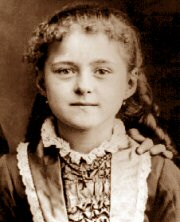
SAINT THÉRÈSE of the CHILD JESUS
Carmelite (1873-1898)

Spiritual Bouquet: Let no one seek his own interests, but those of his neighbor. I Cor. 10:24

Few Saints have aroused so much admiration and enthusiasm immediately after their death; few have acquired a more astonishing popularity everywhere on earth; few have been so rapidly raised to the altars as was this holy young Carmelite. Marie Françoise Thérèse Martin, known as the Little Flower of Jesus, was born January 2, 1873 at Alençon in Normandy, France, of very Christian parents. The Martins, who lost four of their little ones in early infancy or childhood, regarded their children as gifts from heaven and offered them to God before their birth. Thérèse was the last flower of this blessed stem, which gave four Sisters to the Carmel of Lisieux, still another to the Visitation of Caen. The five sisters were left without their mother, a victim of cancer, when Thérèse was only four years old; but her two oldest sisters were of an age to take excellent care of the household and continue the Christian character formation of the younger ones, which their mother had initiated. Their saintly father was soon to see his little flock separated, however, when one after the other they left to enter religious life. He blessed each one and gave them all back to God, with humble gratitude to God for having chosen his daughters.
From childhood Thérèse had manifested a tender piety which her naturally lively temperament could not alter. Her mother’s death affected her profoundly, however, and at the age of nine she was visited with a severe trial in the form of an illness the doctors could not diagnose, and which seemed incurable. She was instantly restored to her ordinary good health by the Virgin Mary, in answer to her desolate sisters’ prayers; Thérèse saw Her statue become animated, to smile at her with an ineffable tenderness as she lay on her bed of suffering.

Before the age of fifteen Thérèse already desired to enter the Carmel of Lisieux, where her two eldest sisters were already nuns; a trip to Rome and a petition at the knees of the Holy Father Leo XIII gave her the inalterable answer that her Superiors would regulate the matter. Many prayers finally obtained an affirmative reply to her ardent request, and four months after her fifteenth birthday she entered Carmel with an ineffable joy. She could say then, “I no longer have any desire but to love Jesus even to folly.”

She adopted flowers as the symbol of her love for her Divine Spouse and offered all her little daily sacrifices and works as rose petals at the feet of Jesus. Divine Providence gave to the world the autobiography of this true Saint, whose little way of spiritual childhood was described in her own words in her Story of a Soul. She could not offer God the macerations of the great soldiers of God, only her desires to love Him as they had loved Him, and to serve Him in every way possible, not only as a cloistered nun, but as a missionary, a priest, a hero of the faith, a martyr. She chose “all” in spirit, for her beloved Lord. Later she would be named patroness of missions. Her spirituality does not imply only sweetness and light, however; this loving child of God passed by a tunnel of desolate spiritual darkness, yet never ceased to smile at Him, wanting to serve Him, if it were possible, without His even knowing it.

When nine years had passed in the Carmel, the little flower was ready to be plucked for heaven; and in a slow agony of consumption, Thérèse made her final offering to God. She suffered so severely that she said she would never have believed it possible, and could only explain it by her desire to save souls for God. She died in 1897, was beatified in 1923 and canonized in 1925. And now, as she foretold, she is spending her heaven in doing good upon earth. Countless miracles have been attributed to her intercession.

Sources: Lives of the Saints for Every Day of the Year. (Reprint of the work of John Gilmary Shea, with Appendix including recently canonized Saints) (Benziger Brothers: New York, 1955. Third Edition: Tan Books and Publishers: Rockford, Ill., 1995); Vie des Saints pour tous les jours de l’année, by Abbé L. Jaud (Mame: Tours, 1950). Read whole post......
SCRIPTURE CORNER

CHARITY AND THE CONTRARY VICES

fragments from "Scripture by Topic" - Originally titled "The Divine Armory of Holy Scripture" - 1943 edition - Angelus Press 2006

CHARITY TOWARD OUR NEIGHBOUR part one

Before all things have a constant mutual charity among yourselves: for charity covereth a multitude of sin. 1Pet. 4:8
We know that we have passed from death to life, because we love the brethren. He that loveth not, abideth in death. 1 John 3:14
Every one that loveth is born of God, and knoweth God. 1 John 3:14
If we love one another, God abideth in us, and his charity is perfected in us. 1 John 4:12
By this shall all men know that you are my disciples, if you have love one for another. Jas. 13:35
He that loveth his brother abideth in the light, and there is no scandal in him.1 John 2:10
Let us not love in word nor in tongue, but in deed and in truth. In this we know that we are in the truth, and in his sight shall persuade our hearts. 1 John 3:18f. Read whole post......

Monday, October 02, 2006

SCRIPTURE CORNER

CHARITY AND THE CONTRARY VICES

fragments from "Scripture by Topic" - Originally titled "The Divine Armory of Holy Scripture" - 1943 edition - Angelus Press 2006

PRECEPTS OF CHARITY; PUNISHMENT OF SINNING AGAINST CHARITY

Jesus said to him: Thou shalt love the Lord thy God with thy whole heart, and with thy whole soul, and with thy whole mind. This is the greatest and the first commandment. Matt. 22: 37.
With al thy strength love him that made thee, and forsake not his ministers. Ecclus. 7: 32
Love God all thy life, and call upon him for thy salvation. Ecclus. 13:18
If any man love not our Lord Jesus Christ, let him be anathema, Maranatha. 1Cor. 16:22
If any one abide not in me he shall be cast forth as a branch, and shall wither: and they shall gather him up, and cast him into the fire, and he burneth. John 15:6 Read whole post......

Sunday, October 01, 2006

SCRIPTURE CORNER

CHARITY AND THE CONTRARY VICES

fragments from "Scripture by Topic" - Originally titled "The Divine Armory of Holy Scripture" - 1943 edition - Angelus Press 2006

3.THE KEEPING OF GOD'S COMMANDMENTS THE PROOF OF OUR LOVE FOR HIM


He that keepeth his word, in him in very deed the charity of God is perfected; and by this we know that we are in him. 1 John 2:5
God is charity; and he that abideth in charity abideth in God, and God in him. 1 John 4:14
If you love me, keep my commandments. John 14:15
This is the charity of God, that we keep his commandments; and his commandments are not heavy. 1 John 5:3
This is charity, that we walk according to his commandments. 2 John 6
They that love God will keep his way. Ecclus. 2:18
You that love the Lord, hate evil. Ps. 96:10

4. FRUITS AND REAWARDS OF CHARITY

He that abideth in me, and I in him, the same beareth much fruit: for without me you can do nothing. John 15:6
He that hath my commandments, and keepeth them, he it is that loveth me; he that loveth me shall be loved of my Father: and I will love him, and will manifest myself to him. John 14:21
If any one love me, he will keep my word, and my Father will love him: and we will come to him, and will make our abode with him John 14:23
I love them that love me; and they that in the morning early watch for me shall find me. Prov. 8:17
They that love God shall be filled with his law. Ecclus. 2:19
The love of God is honourable wisdom. Ecclus. 1:14
The eyes of God are upon them that love him.Ecclus. 34:15
He that loveth God shall obtain pardon for his sins by prayer, and shall refrain himself from them, and shall be heard in the prayer of days. Ecclus. 3:4
He loveth God that made him, and he gave him power over his enemies; and he will not utterly take away the seed of him that loveth the Lord. Ecclus. 47: 10, 24 Read whole post......

Saturday, September 30, 2006

SCRIPTURE CORNER

QUEEN OF PROPHETS, PRAY FOR US!


Our Immculate Mother was always in prophetic visions. The great prophets: Elias and Elisseus, Isaiah, Jeremiah, Ezechiel, Daniel and the twelve minor ones: Osee, Joel, Amos, Abdias Jonas, Michaes, Nahum, Habacuc, Sofonias, Aggeus, Zacharias and Malachias, followed by David, Moses and John the Baptist - all of them were longing for the Messiah born of virgin mother. People of Israel were constantly asking God together with them: "Drop down dew, ye heavens, from above, and let the clouds rain the just: let the earth be opened, and bud forth a saviour: "(Isa 45, 8). Mary was 'the earth'!
Mary brought forth, fed and raised Jesus Our Redeemer. The Prophets were severely persecuted by the Jews, as St. Stephen said to them: "Which of the prophets have not your fathers persecuted? " (Acts 7, 52). Mary was predestined by God to suffer even more according to prophecy: "And Simeon blessed them, and said to Mary his mother: Behold this child is set for the fall, and for the resurrection of many in Israel, and for a sign which shall be contradicted; And thy own soul a sword shall pierce, that, out of many hearts, thoughts may be revealed." (Luke 2, 34.35). She was long awaited by Prophets, and shared all their suffering. She IS their Queen. God instructed His Prophets to describe Immaculate Mother with more and more detail to make us venerate the Queen of Prophets. Let us not be discouraged by difficulties, let us be patient in adversity with the help of Our Lady: "every creature groaneth and travaileth in pain " (Rom, 8.22) Read whole post......
PRAYER TO OUR LADY, QUEEN OF ANGELS

Remedy against the "Spirits of Darkness" and the forces of hate and fear


August Queen of Heaven, heavenly sovereign of the Angels, thou who from the beginning received from God the power to crush the head of Satan, we humbly beseech thee to send thy holy Legions so that under thy command and through thy power, the may pursue the demons and combat them everywhere, supress their boldness and drive them back into the abyss. Read whole post......
SCRIPTURE CORNER

CHARITY AND THE CONTRARY VICES

fragments from "Scripture by Topic" - Originally titled "The Divine Armory of Holy Scripture" - 1943 edition - Angelus Press 2006

1. The perfection and excellence of charity in general.


The end of the commandment is charity from a pure heart, and a good conscience, and an unfeigned faith 1 Thess. 1:5
All the law is fulfilled in one word: Thou shalt love thy neighbour as thyself. Gal. 5:14
He that loveth his neighbour hath fulfilled the law. For thou shalt not commit adultery; thou shalt not kill; thou shalt not steal; thou shalt not bear false witness; thou shalt not covet; and if there be any other commandment, it is comprised in this word: Thou shalt love thy neighbour as thyself. The love of our neighbour worketh no evil; love, therfeore, is the fulfiling of the law. Rom. 13:8-10
Charity is patient, is kind; charity envieth not, dealeth not perversely; is not puffed up; is not ambitious; seeketh not her own; is not provoked to anger; thinketh no evil; rejoiceth not in iniquity, but rejoiceth with the truth; beareth all things, believeth all things, hopeth all things, endureth all things. 1 Cor. 13:4-7
Love is strong as death; jelousy as hard as hell. Many waters cannot quench charity, neither can the floods drown it. Cant. 8; 6f.
If I speak with the tongues of men and of angels, and have not charity, I am become as sounding brass or a tinkling cymbal. And if I should have prophecy, and should know all mysteries and all knowledge, and if I should have all faith, so that I could remove mountains, and have not charity, I am nothing. And if I should distribute all my goods to feed the poor, and if I should deliver my body to be burned, and have not charity, it profiteth me nothing. 1 Cor. 13: 1-3
Charity never falleth away, whether prophecies shall be made void, or tongues shall cease, or knowledge shall be destroyed. 1 Cor. 13.8
In Christ Jesus neither circumcision availeth anything nor uncircumcision, but faith that worketh by charity. Gal. 5;6
Above all these things have charity, which is the bond of perfection. Col. 3:14 Read whole post......