Saturday, November 27, 2010

How to Attend Mass with Devotion and Reverence - hints from St. Leonard of Port Maurice


"Then, holy Mass being ended, make an act of thanksgiving to God in the words, Agimus tibi gratias; and leave the church with a contrite heart, as if you were coming down from Calvary." (St. Leonard of Port Maurice 'The Hidden Treasure: Holy Mass')

Meditation:
To listen to the advice of the Franciscan saint, Leonard of Port Maurice, and to leave the church as though one were coming down from Calvary, is to leave Church with the disposition of Our Lady of Sorrows. In the book The Hidden Treasure, Saint Leonard offers many reflections to encourage reverent attendance at Mass.

I. First part of the Mass from the beginning to the Gospel

1. "Humble yourself with Jesus, and plunge yourself down in thought into the depth of your nothingness; confess sincerely how wretched and how merely nothing you are before so immense a majesty;

2. "Pursue the exercise of forming many such internal acts of joy, that God should thus be infinitely honored. Repeat, over and over again: ‘Yes, my God, I delight in the infinite honor which results to Thy Majesty from this Holy Sacrifice."

II. From the Gospel to the Elevation

1. Contrition for past sins

2. "O dearest Jesus, give me the tears of Peter, the contrition of Magdalene, and the grief of those saints who, once sinners, were afterward true penitents, in order that in this Mass I may obtain a general pardon of my sins."

III. From the Elevation to Communion

1. "Stir your soul to wonder at the overflowing torrent of great and good gifts either bestowed on you or designed for you by God, and then offer to Him in return a gift of infinite value, that is, the body and blood of Jesus Christ. Then invite all the angels also, and all the saints, to thank God in your behalf…"

IV. From Communion to the end

1. Make a spiritual communion

2. "Look upon God Who is within you, and then summon up holy courage to ask of Him many graces, … do not ask things of small importance, but ask great graces…"

3. "Offer petitions also again and again for yourself, your children, your friends, relations, and acquaintance; ask help for all your needs, both spiritual and temporal; ask also the fullness of all good, and relief from all evils for holy Church: and do not ask any of these things with lukewarmness, but rather with a great confidence, making sure that your prayers, united with those of Jesus, shall indeed be heard. Then, holy Mass being ended, make an act of thanksgiving to God in the words, Agimus tibi gratias, etc.; and leave the church with a contrite heart, as if you were coming down from Calvary." St. Leonard of Port Maurice, The Hidden Treasure: Holy Mass, (Tan Books: 1952), 57-61.

Following St Leonard, pray to the Blessed Virgin Mary:
"O Most Holy Virgin, already I am at hand and about to receive thine and my Jesus. From thy hands, I propose to receive Him. Hold Him forth to me as thou didst to the shepherds, and the holy kings, and to St. Simeon prepare me to receive Him with love. Give Him to me quickly and pray to Him to fill me with His dearest benediction; and do thou accompany it with thine." (St. Leonard of Port Maurice)

And give her your holy resolution:
The next opportunity I have to attend Mass, I will bring these suggestions along with me and I will try to leave Church remembering Our Lady of Sorrows. For today, I will make a spiritual Communion and read through the prayers of this great saint.

Be thankful to God for graces received.

The picture represents the Mass at the RC Church in Oxford St in Manchester. Several times in the past I have attended FSSP celebrated Traditional Mass at this Church while visiting relatives and it brings me a lot of good memories.

Adopted from Mary's Vitamin 


Read whole post......

St Therese and her remedy for dark night of the soul


I will hear what the Lord will speak to me (Ps 84)

Happy is that soul which heareth the Lord speaking within her, and from His mouth receiveth the word of comfort! Happy ears, which receive the accents of the divine whisper, and take no notice of the whisperings of the world. Happy ears, indeed, which hearken to Truth itself teaching within, and not to the voice which soundeth without. (Imitation of Christ, Book 3)

When I was seventeen and eighteen I found much light in the writings of St John of the Cross, and he was my principal guide, but later on all spiritual writers left me in great dryness of spirit, and do so still. However beautiful and moving a book may be, as soon as I begin to read I am incapable of taking it in, and my heart is troubled; or if I do understand, my mind is unable to meditate further. In this state of helplessness the Scriptures and the Imitation come to my assistance, and in them I find a hidden manna, pure and sustaining.
The Gospel is my chief support in prayer, and I find in it all that my poor little soul needs. I am always finding new light there, and hidden, mysterious meanings; I learn by experience that the kingdom of God is within us (Luke 17: 21). The divine Master has no needs of books or rather teachers to do His work; He instructs the soul silently, without words. I have never heard Him, but i know that He is within me, inspiring and prompting me at the moment I need it most. it is not usually at my prayer that I see this new light, but when doing my ordinary work during the day. (St Therese 'Histoire d'une Ame')


Read whole post......

Saturday, November 20, 2010


I do not serve Thee, Lord, for gain,
That were a hireling's way!
Love does not wait with outstretched hand
For payment day by day.
My heart's love is my only wealth,
And this I bring to Thee;
I only ask that to the end
Thy handmaid I may be.
St Therese 'Poems'

Picture represents painting displayed in the choir of the Discalced Carmelite Church of Our Lady of the Brown Scapular and St Elijah in Czerna Friary where St Raphael Kalinowski was a prior. To visit photogalery of the Church and the cloister click here

Read whole post......

Saturday, November 13, 2010

'Saints For Sinners' - click to read online great classic by Archb Alban Goodier, SJ


For a long time I wondered why God has His preferences, and why souls did not all receive the same measure of grace. I was astonished that great sinners like St Paul, St Augustine and St Mary Magdalen should be granted such extraordinary favours, and almost forced to accept them. When reading the Lives of the Saints I could not understand why our Lord treated some as privileged souls even in their cradles, removing any obstacles that might keep the from Him, and preserving unspotted their baptismal innocence, whilst on the other hand innumerable savages died without ever hearing the name of God.
Jesus Himself taught me this mystery. He laid open before me the book of Nature, and I understood that all the flowers He has created are beautiful; that the loveliness of the rose and the purity of the lily in no way lessen the sweet scent of the hidden violet of the appealing simplicity of the daisy. I understood that if all the little flowers wanted to be roses, Nature would lose her garb of Spring, and the fields would no longer be starred with little blossoms. It is the same in the domain of souls, the living garden of the Lord. (St Therese 'Story of the Sols')

Read whole post......

Saturday, October 30, 2010

Feast of Christ the King - click to read Quas Primas,On the Feast of Christ the King


You, my God, are an eternal King, and Yours is no borrowed Kingdom....When the Credo says: 'of Your Kingdom there shall be no end' this phrase nearly always makes me feel particularly happy. Yes, I praise you, Lord, and bless You, for Your Kingdom will endure forever" (Teresa of Jesus, Way of Perfection, 22)

....Do we not read throughout the Scriptures that Christ is the King? He it is that shall come out of Jacob to rule, who has been set by the Father as king over Sion, his holy mount, and shall have the Gentiles for his inheritance, and the utmost parts of the earth for his possession. In the nuptial hymn, where the future King of Israel is hailed as a most rich and powerful monarch, we read: "Thy throne, O God, is for ever and ever; the scepter of thy kingdom is a scepter of righteousness." (Ps 44) There are many similar passages, but there is one in which Christ is even more clearly indicated. Here it is foretold that his kingdom will have no limits, and will be enriched with justice and peace: "in his days shall justice spring up, and abundance of peace...And he shall rule from sea to sea, and from the river unto the ends of the earth.... (From the encyclical of Pope Pius XI, Quas Primas)


Read whole post......

Three great Feasts of Christ the King, the Holy Souls and All Saints coming! Queen of All Saints, pray for us!


"O saints of heaven, I am the least of all creatures. I know my worthlessness, but I also know how noble and generous hearts love to do good. Therefore, O blessed inhabitants of the heavenly City, I entreat you to adopt me as your child. All the glory you may help me to acquire will be yours; deign, then, to hear my prayer and obtain for me...your love...(St Therese "Story of a Soul")


Read whole post......

Saturday, October 23, 2010

Ireland and the Rosary


With the victory of Cromwell’s armies, Ireland entered a period of harsh persecutions during which it became more and more difficult for Catholic priests to meet the spiritual needs of the faithful. From that time dates the very special importance the Irish attribute to the Rosary, among the devotions in honor of the Blessed Virgin.

When a priest couldn’t be there to celebrate the Holy Sacrifice for the faithful, the assembly would pray the Rosary as a form of public prayer. It is not an exaggeration to affirm that, for more than three hundred years, the Rosary has been the most characteristic form of devotion of the Irish people. In each Catholic home, the recitation of the Rosary has become a daily, scrupulously observed ritual.

If sailors were setting sail to cross the seas and expose their lives, a pubic Rosary was offered before the ship hoisted the anchor. Fishermen used to recite it before lifting their nets. It is the traditional prayer at Catholic funerals; the one also that families recite when they gather at the bedside of one of their beloved who is dying. During the 19th century, when emigration dispersed Irish Catholics throughout the world in faraway countries often deprived of Catholic priests, the Rosary was the most efficient support for the poor exiles. (A. Gwynn, SJ 'Our Lady of Ireland')


credit: after 'A Moment with Mary'
picture represents colonial style painting of 'Our Lady of the Rosary and Saints', Brooklyn Museum, NJ 

Read whole post......

Thursday, October 07, 2010

Feast of Our Lady of the Rosary - click to visit the shrine of Our Lady of Pompeii


Today we remember and reflect on the conversion and works of charity of
Bl Bartolo Longo
and his devotion to the Holy Rosary of the Blessed Virgin Mary.  Above is the miraculous image of Our Lady of the Rosary that was given to Bl Bartolo by the nuns who were in custody of the image for some time. He restored the image and placed it in the Church built in the valley of Pompeii, the place where he built the shrine of Our Lady of the Most Holy Rosary of Pompeii.


The story of Bl Bartolo may tell us a lot about grace of God and good work of one faithful friend. Bartolo was born into a wealthy middle class family and was trained to become a lawyer. He fall under the influence of bad companion, entered the satanic sect, became a satanic priest and staunch enemy of the Catholicism who would publicly ridicule Catholic religion. However, he had a good and devout friend who had not abandoned him in this misery but prayed for him and managed to help Bartolo to convert and return to Catholicism. He put Bartolo in touch with devout Dominican priest who was instrumental in helping Bartolo to develop deep devotion to Our Lady and the Holy Rosary. Bartolo entirely abandoned his past and decided to do all he could in reparation the sins he committed through good works with the poor living in the Valley of Pomepii, which was the place of utter desolation, crime and poverty. After many attempts he managed to convert people living there back to Catholicism, built the shrine of Our Lady of the Holy Rosary of Pompeii and established Confraternity of the Holy Rosary. No need to say how much the lives of the Valley of Pompeii inhabitants was changed through the work of Bl Bartolo and his wife. 
There is a Petition Prayer composed by Bl Bartolo and I encourage all who have devotion to the Holy Rosary to pray this prayer.


Read whole post......

Sunday, October 03, 2010

The Holy Rosary, click to read more on this devotion


The Holy Rosary, the Carmelite Devotion - read more Here

Why pray the Rosary today? Certainly, to grow in holiness and in one's prayer life. The following are a few others reasons why the Rosary should be prayed often, even daily:

"Among all the devotions approved by the Church none has been so favored by so many miracles as the devotion of the Most Holy Rosary" (Pope Pius IX).

"Say the Rosary every day to obtain peace for the world" (Our Lady of Fatima).

"There is no surer means of calling down God's blessings upon the family . . . than the daily recitation of the Rosary" (Pope Pius XII).

"We do not hesitate to affirm again publicly that we put great confidence in the Holy Rosary for the healing of evils of our times" (Pope Pius XII).

"No one can live continually in sin and continue to say the Rosary: either they will give up sin or they will give up the Rosary" (Bishop Hugh Doyle).

"The Rosary is a magnificent and universal prayer for the needs of the Church, the nations and the entire world" (Pope John XXIII).

"The Rosary is the compendium of the entire Gospel" (Pope Paul VI quoting Pope Pius XII).

"Meditation on the mysteries of the Rosary . . . can be an excellent preparation for the celebration of those same mysteries in the liturgical actions [i.e. the Mass] and can also become a continuing echo thereof" (Pope Paul VI).

"My impression is that the Rosary is of the greatest value not only according to the words of Our Lady at Fátima, but according to the effects of the Rosary one sees throughout history. My impression is that Our Lady wanted to give ordinary people, who might not know how to pray, this simple method of getting closer to God" (Sister Lucia, one of the seers of Fátima).

"How beautiful is the family that recites the Rosary every evening" (Pope John Paul II).


Pope John Paul II has called the Rosary his "favorite prayer," after the Mass and the Liturgy of the Hours.

St. Louis de Montfort warns us against both the ignorant and scholars who regard the Rosary as something of little importance..."the Rosary is a priceless treasure inspired by God."

and more quotes:


"What actually is the Rosary? A compedium of the Gospel. It brings us back again and again to the most important scenes of Christ's life, almost as if to let us''breathe' his mystery. The Rosary is the privileged path to contemplation. It is, so to speak, Mary's way. Is there anyone who knows and
loves Christ better?" John Paul II, Pastoral Visit to the shrine of Our Lady of the Rosary in Pompeii

"It is a solemn custom of the faithful during the month of October to weave the prayers of the Rosary into mystical garlands for the Mother of Christ." Pope Paul VI Christi Matri

"Yet another excellent fruit follows from the Rosary, exceedingly opportune to the character of our times. This we have referred to elsewhere. It is that, whilst the virtue of Divine Faith is daily exposed to so many dangers and attacks, the Christian may here derive nourishment and strength for his faith. Now Christ stands forth clearly in the Rosary. We behold in meditation His life, whether His hidden life in joy, or His public life in excessive toil and sufferings unto death, or His glorious life from His triumphant resurrection to His eternal enthronement at the right hand of the Father." Pope Leo XIII, Fidentem Piumque Animum

"We exhort them, citing Our own example, not to let even one day pass without saying the Rosary, no matter how burdened they may be with many cares and labors." Pope Pius XI Ingravescentibus Malis (On the Rosary)

"We would like to repeat one admonition from [Pope Leo XIII's encyclical Ingruentium Malorum] Turn in spirit with ever greater confidence to the Virgin Mother of God, the constant refuge of Christians in adversity, since she 'has been made a source of salvation for the human race.'" Bl. Pope John XXIII Grata Recordatio (On Pope Leo XIII's encyclicals Ingruentium Malorum)


Read whole post......

Wednesday, September 29, 2010

Dedication of St Michael, Michaelmas Day - click to read more


Their angels in heaven always look on the face of my heavenly Father (Mt 18:10)
 
The angels are our shepherds, because they carry not only our messages to God but also those of God to our souls, feeding them with sweet inspirations and divine communications. As good shepherds they protect us and defend us from wolves, which are the evil spirits. Through the secret inspirations which the angels convey to the soul, they effect a deeper knowledge of God and make it love him the more, till they leave it wounded with love...The light of God, which illumines angels, enlightening and setting them on fire with love as pure spirits disposed for that inflowing, ordinarily illumines people in darkness, pain and distress because of their impurity and weakness...
 
When a person has become spiritualized and refined in the fire of divine, purifying love, he is then within the union and inflowing of that loving illumination with the same sweetness as angels receive them...Consider what utter vanity it is to rejoice in anything but in the service of God, how dangerous and how fatal. How ruinous it proved to those angels who rejoiced and were complacent in their own beauty and natural endowments; for this they fell, deformed, into the abyss. (St John of the Cross, Spiritual Maxims)
Read whole post......

Sunday, September 19, 2010

Bl John Henry Newman - click to read the story of his life written by William Henry Barry

Bl John Henry Newman's spiritual autobiography Apologia pro vita sua


Read whole post......

Tuesday, September 14, 2010

Seven Sorrows of the Blessed Virign Mary


Drink of the chalice of thy Lord lovingly, if thou desirest to be His friend, and to have part with Him. (Imitation, Bk2) 

Upon the accidental death of his holy wife, Jacopone da Todi experienced a profound conversion. He realized the hair shirt worn under his dear wife’s garments was worn as penance for him. He completely renounced his former way and lived a life of "foolish poverty." He became a Third Order Franciscan. In his last years he composed the Stabat Mater and would cry out to all:

O thou Mother! fount of love!
Touch my spirit from above;
Make my heart with thine accord.

Make me feel as thou hast felt;
Make my soul to glow and melt
With the love of Christ our Lord.

Holy Mother! pierce me through;
In my heart each wound renew
Of my Saviour crucified.


After 'Mary's Vitamin'

During her long agony which lasted twelve hours, she cried out: "O my God, O sweet Virgin Mary, come to my help! My chalice is overflowing; I could not have thought it possible to suffer so much....I can only explain it by my great longing to save souls, O my God, Thy will be done, only have pity on me!" (St Therese, Story of the Soul)

Read whole post......

Sunday, September 12, 2010

His Holiness Pope Benedict XVI visit to the UK - click to see the itinerary


Excerpts from the Message from the Holy Father for his Visit to the United Kingdom.

I am very much looking forward to my visit to the United Kingdom in a week's time and I sent heartful greetings to all people of GB. I am aware that a vast amount of work has gone into the preparations for the visit, not only by the Catholic community but by the Government, the local authorities in Scotland, London and Birmingham, the communications media and the security services, and I want to say how much I appreciate the efforts that have been made to ensure that the various events planned will be truly joyful celebrations. Above all I thank the countless people who have been praying for the success of the visit and for a great outpouring of God's grace upon the Church and the people of your nation.

It will be a particular joy for me to beatify the Venerable John Henry Newman in Birmingham on Sunday 19th September. This truly great Englishman lived an exemplary priestly life and through his extensive writings made a lasting contribution to Church and society both in his native land and in many other parts of the world. It is my hope and prayer that more and more people will benefit from his gentle wisdom and be inspired by his example of integrity and holiness of life.

...While I regret that there are many places and people I shall not have the opportunity to visit, I want you to know that you are all remembered in my prayers. God bless the people of the United Kingdom!

Benedictus PP XVI


Read whole post......

Saturday, September 11, 2010

On the eve of Papal visit to England, the words of Cardinal Newman on the Immaculate Conception of Mary, the second Eve.


She holds, as the Fathers teach us, that office in our restoration which Eve held in our fall: - now, in the first place, what were Eve's endowments to enable her to enter upon her trial? She could not have stood against the wiles of the devil, though she was innocent and sinless, without the grant of a large grace. And this she had; - a heavenly gift, which was over and above and additional to that nature of hers, which she received from Adam, a gift which had been given to Adam also before her, at the very time (as it is commonly held) of his original formation. This is Anglican doctrine, as well as Catholic ;

....If Eve was raised above human nature by that indwelling moral gift which we call grace, is it rash to say that Mary had even a greater grace? And this consideration gives significance to the Angel's salutation of her as "full of grace," - an interpretation of the original word which is undoubtedly the  right one, as soon as we resist the common Protestant assumption that grace is a mere external approbation or acceptance, answering to the word "favour," whereas it is, as the Fathers teach, a real inward condition or superadded quality of soul.
Suppose Eve had stood the trial, and not lost her first grace; and suppose she had eventually had children, those children from the first moment of their existence would, through divine bounty, have received the same privilege that she had ever had; that is, as she was taken from Adam's side, in a garment, so to say, of grace, so they in turn would have received what may be called an immaculate conception. They would have then been conceived in grace, as in fact they are conceived in sin. What is there difficult in this doctrine? What is there unnatural? Mary may be called, as it were, a daughter of Eve unfallen.


And if Eve had this supernatural inward gift given her from the first moment of her personal existence, is it possible to deny that Mary too had this gift from the very first moment of her personal existence? I do not know how to resist this inference: - well, this is simply and literally the doctrine of the Immaculate Conception. I say the doctrine of the Immaculate Conception is in its substance this, and nothing more or less than this (putting aside the question of degrees of grace); and it really does seem to me bound up in the doctrine of the Fathers, that Mary is the second Eve.
Suppose Eve had stood the trial, and not lost her first grace; and suppose she had eventually had children, those children from the first moment of their existence would, through divine bounty, have received the same privilege that she had ever had; that is, as she was taken from Adam's side, in a garment, so to say, of grace, so they in turn would have received what may be called an immaculate conception. They would have then been conceived in grace, as in fact they are conceived in sin. What is there difficult in this doctrine? What is there unnatural? Mary may be called, as it were, a daughter of Eve unfallen. (Cardinal John Henry Newman, from the letter to Pusey, 1866)


Read whole post......

Thursday, September 02, 2010

Little Way of St Therese - virtue of obedience


(Christ) Son, thou hast many things still to learn, which thou hat not yet well learned.
(Disciple) What are these things, O Lord?
(Christ) That thou conform in all things thy desire to My good pleasure; and that thou be not a lover of thyself, but earnestly zealous that My will may be done. Desires often inflame thee, and violently hurry thee on; but consider whether it be for My honour or thy own interest that thou art more moved. (Imitation of Christ Bk 3)

My year of novitiate, which had seemed so long, at last come to an end, but Mother Prioress told me that my Profession was out of question, as our ecclesiastical Superior would not allow it. I was obliged, therefore, to wait for another eight months.
At first I found it hard to make the sacrifice, but soon God enlightened my soul. I was meditating at the time on P. Surin's Foundations of the Spiritual Life. One day during prayer I understood how much self-love there was in my longing to make my vows. If I belonged to Jesus as His little plaything, to rejoice and comfort Him, I ought not to force Him to do my will instead of His own. I also understood that a bride should be adorned with jewels on her wedding day, and i had not thought of this. I therefore said to Our Lord: I will no longer ask to make my Profession; I am content to wait, but I do not want our union to be put off through my fault, so I will prepare a bridal dress resplendent with diamonds and precious stones. When it is rich enough, Thou wilt take me for Thy bride. (St Therese of Child Jesus)

Read whole post......

Tuesday, August 31, 2010

August - the month of devotion to the Immaculate Heart of Mary


In August we celebrate the great Marian feast dedicated to Our Lady, the feast of Assumption. The prayers recommended for August are the prayers to Our Lady's Immaculate Heart, the Novena prayer to the Immaculate Heart of Mary and prayer of Consecration.
Read whole post......

Thursday, August 26, 2010

Feast of Our Lady of Czestochowa - click to visit Sanctuary website


The Polish people often call the Blessed Virgin « Mother of my heart » (serdeczna Matke), but this tender love never becomes an indiscreet familiarity. The Mother of Hearts never ceases for a moment to enjoy in the people’s consciousness the unutterable prerogatives of her divine motherhood. She is “our mother” only because she is first of all the “Mother of God” (Matka Boska).

For a long period of time, in some provinces, this respect kept people from naming their daughters after Mary. By antonomasia they would be named Maria-Anna. While negotiating the marriage of Marie of Gonzague with the Polish King Ladislas IV, the French ambassador, Count of Brégyn, wrote in July 1645: “The royal fiancée will have to change her name during the celebrations of the coronation, because the Polish do not admit any other Queen Mary beside the One whose protecting vision sometimes protects their army from on high beyond the clouds.”

Later, Maria-Josephina of Saxony just refused the title of Queen of Poland in the rite of coronation, saying that “this title belongs only to Mary, the Queen of Heaven.” The attribution of that royalty must have been quite exclusive to force royal princesses and their spokespersons to think twice about claiming it! Indeed, from times immemorial, the Polish people recognize only one “Queen of Poland,” Mary, and they jealously ensure that no one usurps this title. 
  
The sense of Mary’s royalty was so anchored in the Polish soul that the occupying forces felt offended by it. In the Russian zone it was severely forbidden to invoke her under this title. Angry Prussians recorded some impressive answers coming from very young children in their files of complaints against schools “for refusing to learn the catechism and pray in German.”

“Do you think that Poland will rise again?” an inspector asked the children of Wrzesnia.
“Yes, we believe it.”
“And who will be the king?” he continued, smelling a conspiracy.
“We don’t know who the king will be, but we already have a queen.”
“Who is she?”
“Our Lady.” (In the text: « the Mother of God. »)


Pressured by schism, heresy and Islam, for centuries Poland had to defend her territory in order to defend her faith. Any Tartar or Turkish invasion transformed the churches into mosques and planted the crescent instead of the cross. Any Christian victory brought back Christ to the ravaged regions.

Thus Our Lady had a direct interest in the affairs of her Son, and the people who had elected her Queen didn’t fail to remind her of it. Polish literature is replete with naive and exquisite allusions to the military exploits of the Warrior Virgin.

It is a common theme in popular poetry: “You have arranged your army for battle. You have destroyed the forces of Islam. You have crushed the presumptuous Turks. You have sheltered us under your mantle. Defend your kingdom O mighty Virgin. Do not forget that you are our Queen...”

(Marie Winoska, The Marian Cult in Poland, In Maria – Studies about the Virgin Mary –Volume 4)


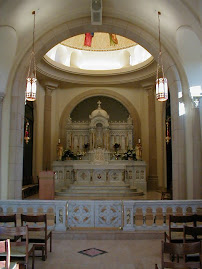
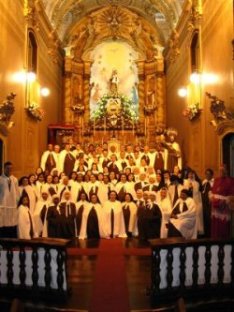
The pictures represent the altar with Black Madonna painting in the Chapel at Jasna Gora Basilica and the photo of Pauline Monastery at Jasna Gora in Czestochowa, 100km north of Cracow. Third picture shows the main altar in the Basilica.


credit: after A Moment with Mary


Read whole post......

Sunday, August 22, 2010

Sunday, God's own feast-day


...Although big feasts did not often occur, there was one, very dear to me, that each week brought round - Sunday. It was the day of rest, God's own feast-day. The happy day was over all too soon, and so was tinged with melancholy. Until Compline my happiness was complete, but as soon as the evening office had been said, my heart grew sad. i thought of the morrow, when ordinary life would begin again, with work to be done and lessons to be learnt. This world seemed a land of exile and I longed for eternal rest, for the Sunday which would have no sunset in our own true home-land... (St Therese)

Picture represents colonial style painting of Our Lady of Mt Carmel with the Saints - Brooklyn Museum

Read whole post......

Friday, August 20, 2010


"If a man take away thy coat, let go thy cloak also unto him (Matt. 5:40).

To let go one's cloak must surely mean to give up all rights, to consider oneself the servant and slave of others. It is easier to walk or run without a cloak, so Jesus adds: Whosoever will force thee one mile, go with him other two (ibid, 41). It is not enough to give what is asked of me, I must foresee another's meed, show that she does me an honour by asking a service of me; and if anything is taken from me, appear glad to be rid of it.
It is not always possible to obey this passage from the Gospel literally; sometimes I am obliged to refuse. But where charity has taken deep root in a soul, it shows outwardly: a refusal may be so gracious that it gives as much pleasure as a gift. An obliging person is, of course, being made use of continually, but that is no reason for avoiding those whom one might have to refuse, for Our Lord says: From him that would borrow of thee, turn not away (ibid, 42). Nor must I be obliging merely to appear so, or in the hope of getting some little service in return, for Our Lord has said: If you lend to them of whom you hope to receive, what thanks are to you? for sinners also lend to sinners, for to receive as much, Do good, and lend, hoping for nothing thereby: and your reward shall be great (Luke 6: 34, 35) (St Therese "Story of the Soul")


Read whole post......

Wednesday, August 18, 2010

Excerpts from the great encyclical of Pope Pius XII, Munificentissimus Deus


...[T]he scholastic Doctors have recognized the Assumption of the Virgin Mother of God as something signified, not only in various figures of the Old Testament, but also in that woman clothed with the sun whom John the Apostle contemplated on the Island of Patmos (Rev 12:1). Similarly they have given special attention to these words of the New Testament: "Hail, full of grace, the Lord is with you, blessed are you among women,"(Lk 1:28) since they saw, in the mystery of the Assumption, the fulfillment of that most perfect grace granted to the Blessed Virgin and the special blessing that countered the curse of Eve....

....Among the holy writers who at that time employed statements and various images and analogies of Sacred Scripture to Illustrate and to confirm the doctrine of the Assumption, which was piously believed, the Evangelical Doctor, St. Anthony of Padua, holds a special place. On the feast day of the Assumption, while explaining the prophet's words: "I will glorify the place of my feet"(Is 61:13) he stated it as certain that the divine Redeemer had bedecked with supreme glory his most beloved Mother from whom he had received human flesh. He asserts that "you have here a clear statement that the Blessed Virgin has been assumed in her body, where was the place of the Lord's feet. Hence it is that the holy Psalmist writes: 'Arise, O Lord, into your resting place: you and the ark which you have sanctified."' And he asserts that, just as Jesus Christ has risen from the death over which he triumphed and has ascended to the right hand of the Father, so likewise the ark of his sanctification "has risen up, since on this day the Virgin Mother has been taken up to her heavenly dwelling."(St Anthony of Padua, Sermons)...

....When, during the Middle Ages, scholastic theology was especially flourishing, St. Albert the Great who, to establish this teaching, had gathered together many proofs from Sacred Scripture, from the statements of older writers, and finally from the liturgy and from what is known as theological reasoning, concluded in this way: "From these proofs and authorities and from many others, it is manifest that the most blessed Mother of God has been assumed above the choirs of angels. And this we believe in every way to be true."(St Albert the Great, Mariale). And, in a sermon which he delivered on the sacred day of the Blessed Virgin Mary's annunciation, explained the words "Hail, full of grace"- words used by the angel who addressed her-the Universal Doctor, comparing the Blessed Virgin with Eve, stated clearly and incisively that she was exempted from the fourfold curse that had been laid upon Eve (St Albert the Great, Sermons)...

....Following the footsteps of his distinguished teacher, the Angelic Doctor, despite the fact that he never dealt directly with this question, nevertheless, whenever he touched upon it, always held together with the Catholic Church, that Mary's body had been assumed into heaven along with her soul (St Thomas Aquinas, Sermons)....

....Along with many others, the Seraphic Doctor held the same views. He considered it as entirely certain that, as God had preserved the most holy Virgin Mary from the violation of her virginal purity and integrity in conceiving and in childbirth, he would never have permitted her body to have been resolved into dust and ashes (St Bonaventure, Sermons). Explaining these words of Sacred Scripture: "Who is this that comes up from the desert, flowing with delights, leaning upon her beloved?"(Songs 8:5) and applying them in a kind of accommodated sense to the Blessed Virgin, he reasons thus: "From this we can see that she is there bodily...her blessedness would not have been complete unless she were there as a person. The soul is not a person, but the soul, joined to the body, is a person. It is manifest that she is there in soul and in body. Otherwise she would not possess her complete beatitude"(St Bonaventure, Sermons)...

...In the fifteenth century, during a later period of scholastic theology, St. Bernardine of Siena collected and diligently evaluated all that the medieval theologians had said and taught on this question. He was not content with setting down the principal considerations which these writers of an earlier day had already expressed, but he added others of his own. The likeness between God's Mother and her divine Son, in the way of the nobility and dignity of body and of soul-a likeness that forbids us to think of the heavenly Queen as being separated from the heavenly King- makes it entirely imperative that Mary "should be only where Christ is."(St Bernardine of Siena, Sermons). Moreover, it is reasonable and fitting that not only the soul and body of a man, but also the soul and body of a woman should have obtained heavenly glory. Finally, since the Church has never looked for the bodily relics of the Blessed Virgin nor proposed them for the veneration of the people, we have a proof on the order of a sensible experience (ibid)...

....St. Francis of Sales, after asserting that it is wrong to doubt that Jesus Christ has himself observed, in the most perfect way, the divine commandment by which children are ordered to honor their parents, asks this question: "What son would not bring his mother back to life and would not bring her into paradise after her death if he could?" (St Francis de Sales, Sermons). And St. Alphonsus writes that "Jesus did not wish to have the body of Mary corrupted after death, since it would have redounded to his own dishonor to have her virginal flesh, from which he himself had assumed flesh, reduced to dust."(St Alphonsus Liquori, The Glories of Mary)...

....All these proofs and considerations of the holy Fathers and the theologians are based upon the Sacred Writings as their ultimate foundation. These set the loving Mother of God as it were before our very eyes as most intimately joined to her divine Son and as always sharing his lot. Consequently it seems impossible to think of her, the one who conceived Christ, brought him forth, nursed him with her milk, held him in her arms, and clasped him to her breast, as being apart from him in body, even though not in soul, after this earthly life. Since our Redeemer is the Son of Mary, he could not do otherwise, as the perfect observer of God's law, than to honor, not only his eternal Father, but also his most beloved Mother. And, since it was within his power to grant her this great honor, to preserve her from the corruption of the tomb, we must believe that he really acted in this way....

....It is to be hoped that all the faithful will be stirred up to a stronger piety toward their heavenly Mother, and that the souls of all those who glory in the Christian name may be moved by the desire of sharing in the unity of Jesus Christ's Mystical Body and of increasing their love for her who shows her motherly heart to all the members of this august body. And so we may hope that those who meditate upon the glorious example Mary offers us may be more and more convinced of the value of a human life entirely devoted to carrying out the heavenly Father's will and to bringing good to others. Thus, while the illusory teachings of materialism and the corruption of morals that follows from these teachings threaten to extinguish the light of virtue and to ruin the lives of men by exciting discord among them, in this magnificent way all may see clearly to what a lofty goal our bodies and souls are destined. Finally it is our hope that belief in Mary's bodily Assumption into heaven will make our belief in our own resurrection stronger and render it more effective....

Read whole post......