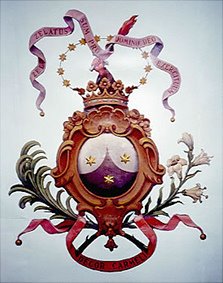
We cannot live, we cannot look at the truth about ourselves without letting ourselves be looked at and generated by Christ in daily Eucharistic Adoration, and the Stabat of Mary, "Woman of the Eucharist," beneath her Son's Cross, is the most significant example of contemplation and adoration of the divine Sacrifice that has been given to us. ...the Holy Mother of God remains an indispensable foundation of the whole of priestly life. The relationship with her cannot be resolved in pious devotional practice but is nourished by ceaseless entrustment to the arms of the ever Virgin of the whole of our life, of our ministry in its entirety. Mary Most Holy also leads us, like John, beneath the Cross of her Son and Our Lord in order to contemplate, with her, God's infinite Love: "He who for us is Life itself descended here and endured our death and slew it by the abundance of his Life" (St Augustine, Confessions, IV, 12)....Pope St Pius X said: "Every priestly vocation comes from the heart of God but passes through the heart of a mother." This is true with regard to obvious biological motherhood but it is also true of the "birth" of every form of fidelity to the Vocation of Christ. We cannot do without a spiritual motherhood for our priestly life: Let us entrust ourselves confidently to the prayer of the whole of Holy Mother Church, to the motherhood of the People, whose pastors we are but to whom are entrusted our custody and holiness; let us ask for this fundamental support. ( Pope Benedict XVI's Message on the Day of Prayer for Priests for the Feast of the Sacred Heart of Jesus, May 30, 2008.)
Saturday, June 12, 2010
Sunday, June 06, 2010
Beatification of Fr Jerzy Popieluszko - click for link
Fr Jerzy Popiełuszko was a Polish priest who was a staunch anti-communist and associated with the strikers of the Solidarity Union. In his sermons, he interwove spiritual exhortations with political messages, criticizing the Communist system and motivating people to protest. During the period of martial law in Poland, the Catholic church was the only force that could voice protest comparatively openly, with the regular celebration of Mass presenting opportunities for public gatherings in churches. Fr Popiełuszko's sermons were routinely broadcast by Radio Free Europe, and thus became famous throughout Poland for their uncompromising stance against the regime. Communist secret police (SB) tried to silence and intimidate him. When those techniques did not work, they fabricated evidence against him; he was arrested in 1983, but soon released on intervention of the clergy and pardoned by an amnesty.
Several months later, in October 13th, 1984, a car accident was set up to kill Jerzy Popiełuszko but he managed to escaped it. The alternative plan was to kidnap him, and it was carried out on October 19th, 1984. The priest was brutally beaten to death by three Security Police officers. Then, his body was dumped into the Vistula Water Reservoir near Włocławek from where it was recovered on October 30, 1984. The cult of Fr Popieluszko developed rapidly in Poland soon after his tragic death and he is venerated as a martyr. To read the post commemorating him click HERE
Read whole post......
The Invitation to the Banquet - Second Sunday after Pentecost
"A certain man made a great supper, and invited many" (Lk 14:16-24). This is God who makes the supper, the great supper is His Kingdom where souls will find full abundance of spiritual blessings while on earth, and eternal happiness in the next life. This is the real meaning of the parable, but we may also see in the supper and in the man preparing it, the figure of the Eucharistic banquet and of Jesus, inviting men to partake of His Flesh and Blood. The Church sings: "The table of the Lord is set for us, Wisdom [the Incarnate Word] has prepared the wine and laid the table" (Roman Breviary). Jesus Himself, when announcing the Eucharist, addressed His invitation to all: "I am the Bread of life! He that cometh to Me shall not hunger, and he that believeth in Me, shall never thirst...Your fathers did eat manna in the desert, and are dead. This is bread which cometh down from heaven; that if any man eat of it, he may not die" (Jn 6:35.49.50). St John Chrysostom says: "He whom the angels look upon with fear, and dare not gaze upon steadfastly because of His dazzling splendour, becomes our Food; we are united to Him, and are made one body and one flesh with Christ" (Roman Breviary). Jesus could not offer man a more precious banquet than the Eucharist, yet, how do men answer His invitation? Many just shrug their shoulders, with skeptical smile on their lips: "How can this man give us his flesh to eat?" (Jn 6:53), others are too attached to earthly goods or pre-occupied with business affairs and refuse His invitation: "I have bought a farm and I must needs go out and see it; I pray thee, hold me excused" "I have bought five yoke of oxen, and I go to try them; I pray thee, hold me excused" they say. Others are so immerse in pleasures of senses, that they lost their taste for the things of the spirit, and go their way, not even asking to be excused.
All these excuses are for things that in the end vanish as quickly as mist before the sun and still are preferred to Christ's Gift, the Bread of Angels and the pledge of eternal life. But even those who follow Christ's invitation but accept it coldly, almost through force of habit, and they are those whom Christ has invited to follow Him and whom He has called by the sweet name of friend. How often Jesus finds the hearts of His friends filled with thousands thoughts, trifles, and wordily affections, while there is so little room for Him, the divine Guest! Yet, everything should be reserved for Him. Let us say sorry to our Beloved for every unnecessary and useless thought and trifle that took our heart and make us forget Him even while approaching the Banquet Table. And let us say how much we desire to love him and have Him always imprinted in our hearts.
Let us pray with St Augustine: "O Sacrament of mercy! O seal of unity! O bond of charity! He who wishes to live, finds the home and the dwelling where he can live. O Lord, I approach Your table with faith, there to become incorporated in You in order to be vivified by You" and "Grant, O Lord, that I may be inebriated with the riches of Your house, and let me drink from the torrent of Your delights. Since You are the fountain of life, there with You, and not elsewhere, is the source of my life. I will drink of it in order to live; I will not rely upon myself and be lost; I will not be satisfied with what I have and die of thirst; I will approach the source of the spring where the water never fails".
Based on 'Divine Intimacy' meditations.
Saturday, June 05, 2010
On Prayer With Our Lady
"God will never forget us and there is something you and I can always do. We can keep the joy of loving Jesus and his Holy Mother in our hearts, and share that joy with all we come in contact with." (Mother Teresa of Calcutta, 1994)
It is beautiful to gather and pray together. Perhaps you know two or three people who might be willing to pray the Holy Rosary in a group with you. You could sing as part of your praying, or rest in silence in contemplative prayer between decades. Group prayer does not require everyone to be spontaneous with prayer intentions or to pray aloud. "For where two or three come together in my name, there am I with them" (Mt 18:20).
After 'A Moment with Mary'
Picture of Mary in prayer by Albrecht Durer
Thursday, June 03, 2010
...Our Lady accompanies us every day in our prayer. In his last Encyclical, Ecclesia de Eucharistia, our beloved Pope John Paul II presented her to us as "Woman of the Eucharist" throughout her life (cf. 53).
"Woman of the Eucharist" through and through, beginning with her inner disposition: from the Annunciation, when she offered herself for the Incarnation of the Word of God, to the Cross and to the Resurrection; "Woman of the Eucharist" in the period following the Pentecost, when she received in the Sacrament that Body that she had conceived and carried in her womb... (Pope Benedict XVI "Marian Thoughts")
Credits: text after 'A Moment with Mary', the picture represents main altar in St James' Cathedral in Innsbruck with miraculous image of Our Lady with the Child by Lucas Cranach .
Feast of Corpus Christi - click to read
Devotion to the Sacred Heart should bring us to a life of intimate union with Jesus who, we know, is truly present and living in the Eucharist. The two devotions - to the Sacred Heart and to the Eucharist - are closely connected. The Sacred Heart explains the mystery of the love of Jesus by which he becomes bread in order to nourish us with His substance, while in the Eucharist we have the real presence of the same Heart living in our midst. It is wonderful to contemplate this Heart of Jesus as the symbol of His infinite love, but it is even more wonderful to find Him always near us in the Sacrament of the altar. Jesus lives not only in heaven where His sacred humanity dwells in glory, but He lives also on earth wherever the Eucharist is reserved. In speaking of the Eucharist, Our Lord says to us: "Behold, I am with you all days, even to the consummation of the world" (Mt 28:20). In Holy Communion, then, this Heart beats within us, it touches our heart; through the love of this Heart, we are fed with His Flesh and with His Blood, so that we may abide in Him and He in us. "In the Eucharist," says Benedict XV, "this divine Heart governs us and loves us by living and abiding with us, so that we may live and abide in Him, because in this Sacrament.....He offers and gives Himself to us as victim, companion, viaticum and the pledge of future glory." Jesus said: "He that eateth My Flesh and drinketh my Blood abideth in Me and I in him" (Jn 6:57). The word "abideth" means that our union with the divinity of Christ does not cease after the sacred species are consumed. The three divine Persons dwell continually in souls in the state of grace; but there is also a certain enduring union with Jesus' sacred humanity, even when Christ is no longer substantially present in the one who has received Holy Communion, He is there by the influence of His operative presence and by the effusion of His grace. (Fragments from "The Sacred Heart and the Eucharist" - Ven Gabriel of St Mary Magdalene, OCD)
Encyclicals on the Holy Eucharist were written by Pope Leo XIII Mirae Caritatis and Pope Paul VI Mysterium Fidei
Homilies of Pope Benedict XVI on the solemnity of the Corpus Christ may be read HERE and HEREMonday, May 31, 2010
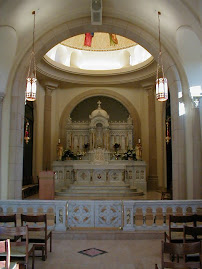
May and devotions to Our Blessed Lady
St John Berchmans SJ, when asked what devotion would be most agreeable to Our Blessed Lady, replied: 'Any devotion, however small, provided it is constant'
St Louis de Montfort says: If we desire a ripe and perfectly formed fruit, we must possess the tree that bears it. If we desire the fruit of life, Jesus Christ, we must possess the tree of life which is Mary. If we desire to have the Holy Spirit working within us, we must possess his faithful and inseparable spouse, Mary the divinely- favoured one whom, as I have said elsewhere, he can make fruitful. (Treatise on True Devotion to Mary)
After 'Mary's Vitamin' and 'A Moment with Mary', respectively
Vintage holy card, circa 1700, from Westfries Museum collection, Belgium
Feast of the Queenship of Mary with St Mary Magdalene dei Pazzi
O Mary, anyone who looks at you is comforted in any anxiety or tribulations or pain, and is victorious over any temptation. Anyone who does not know something about God, let him have recourse to you, O Mary. Anyone who does not find mercy in God, let him have recourse to you, O Mary. Anyone whose will is not in conformity, let him have recourse to you, O Mary. Anyone who falters on account of weakness, let him have recourse to you who are all strong and powerful. Anyone in constant struggle, let him have recourse to you who are a tranquil sea...Whoever is tempted,...let him have recourse to you, who are the mother of humility, and nothing drives away the devil more than humility. Let them, one and all, have recourse to you, O Mary! (Colloquies)
To read previous post dedicated to St Mary Magdalene dei Pazzi, please click HERE
Read whole post......
Sunday, May 30, 2010
The Mystery of the Trinity
"O incomprehensible God, Your greatness is eternal, and Your goodness ineffable. I see the three divine Persons flowing one into another in an indescribable, inscrutable way, and I rejoice in this sight. The Father flows into the Son, the Son into the Father, and the Father and the Son flow into the Holy Spirit. Eternal God, You are unspeakably good, You who, out of goodness, communicate to a creature, aware of its nothingness, some knowledge of Your eternal Being; but although this communication is wonderful, it might be called in all truth a mere nothing, in comparison with what You really are. " (St Mary Magdalen dei Pazzi)
The mystery of the Most Holy Trinity is the mystery of God's intimate life, and as creatures we had no right to know it. However, God in His goodness, has willed to raise us to the dignity of sons, of friends, therefore, He made it known to us, not by the Prophets, but by His only begotten Son, Our Lord Jesus Christ, who is one with Him. The Son of God said: "I will not now call you servants; for the servant knoweth not what his lord doth. But I have called you friends, because all things whatsoever I have heard of My Father, I have made known to you" (John 15:15). The "all things" is precisely the mystery of the Most Blessed Trinity which Jesus, the Son of God, has seen and heard in the bosom of the Father. The Evangelist says: "No man hath ever seen God at any time, but the only begotten Son, who is in the bosom of the Father, He hath declared Him" (John 1:18). Jesus came to reveal to us the mystery of the intimate life of God; He spoke of Himself as the Son of God, equal to the Father in all things: "He that sees me, seeth the Father also," because "I am in the Father and the Father [is] in Me" (John 14: 9,11). He spoke to us of the Holy Spirit, without Whom we cannot attain eternal life: "Unless a man be born again of the water and the Holy Spirit, he cannot enter the Kingdom of God" (John 3:5), and He promised us that He Himself, with the Father, would send us the Spirit who proceeds both from Him, the Word, and from the Father: "It is expedient to you that I go, For...if I go, I will send Him to you" (John 16:7); "I will ask the Father and He shall give you another Paraclete....the Spirit of truth" (John 14:16). By repeating these words, Jesus teaches us that it is good for us to fix our gaze on the sublime mystery of the Blessed Trinity: to admire, to praise, and to return love to this One Triune God, who loves us so much that he wishes to bring us into the secrecy of His own intimate life.
Let us pray with St Catherine of Siena: "O Eternal Trinity! Who can reach You to thank You for the incomprehensible gifts and unlimited favours You have showered upon me, as well as for the doctrine of the truth You have taught me? Answer me, O Lord!...Enlighten me with Your grace, so that by this very light, I may thank You."
Friday, May 21, 2010
The Holy Spirit, sweet Guest of the Soul
In the encyclical 'Mystici Corporis' Pope Pius XII says 'the Holy Spirit is the soul of the Church', and because soul means 'principle of life', therefore, the divine Paraclete is the One who gives life to the Church. As the soul is the principle of life in the body, so the Holy Spirit is the principle of life in the Church, the Mystical Body of Christ. The Holy Spirit was in Christ's soul to direct Him in accomplishment of His redemptive mission, because Jesus wished the Church to participate in it. Since the Church continues Christ's work, she needs the same impetus which guided His soul; she needs the Holy Spirit. Jesus merited His Spirit for us on the Cross; by His death, He atoned for all sin, the obstacle to the action of the Holy Spirit, and when He had ascended into heaven, He sent Him to the Apostles, who represented the whole Church. Now, seated in glory at the right hand of the Father, He intercedes continually for us, he is always sending the Holy Spirit to the Church, as He promised. The Holy Spirit operates in the Church, just as He once did in the blessed soul of Christ. He gives her impulse, moves her, and drives her to accomplish God's will, thus enabling her to fulfill His mission, the continuation down through the ages of the redemptive work of Christ. As we read in the encyclical Mystici Corporis, the Holy Spirit "is communicated to the Church abundantly, so that she herself and each one of her members may become, day by day, more like our Redeemer". Thus, the Holy Spirit exercises His influence not only in the Body of the Church, but also in each soul in which He dwells as the "sweet Guest". But if the Holy Spirit is an impulse of love that comes into us to sanctify us and bring us to God, why do we not all become saints? The Holy Spirit, with the Father and the Son, has created us free beings and he wishes us so; therefore, in coming to us, He respects our liberty and does no violence to it. He enters our soul and posses it only when we give Him free access. As St Teresa of Jesus liked to insists: "God does not force anyone, He takes what we give Him, but He does not give Himself wholly to us, until we give ourselves wholly to Him" (Way, 28). If our will would open the doors wide, the Holy Spirit would take us under His direction, and, with His help, we would become saints.
Let us pray with St John Eudes: "O Divine Spirit, I give myself entirely to You. Take possession of my soul. direct me in everything, and grant that I may live as a true child of God; grant that, born of You, I may totally belong to You, be totally possessed, animated, and directed by You"
credit: based on 'Divine Intimacy' meditaitons
Wednesday, May 19, 2010
The Holy Spirit
In God there are three Persons, equal and distinct: the Father, the Son, and the Holy Spirit. The Holy Spirit is the effusion of the reciprocal love of the Father and the Son, an effusion so substantial and perfect that it is a Person, the third Person of the Most Holy Trinity, to whom the Father and the Son, by the sublime fruitfulness of their love, communicate their very own nature and essence, without losing any of it Themselves. Because the Holy Spirit is the effusion of divine love, He is called "Spirit" according to the Latin sense of the word which means air, respiration, the vital breath. In us, respiration is a sign of life; in God, the Holy Spirit is the expression, the effusion of the life and love of the Father and the Son, but a substantial personal effusion, which is a Person.
Let us reflect with St Mary Magdalen de Pazzi on the Holy Spirit, the breath life and love of God: "O Holy Spirit, You come to us by a loving operation of grace....like an overflowing fountain in the soul, wherein the soul is submerged. As two rivers join and unite their waters so that the smaller one loses its name and takes that of the larger, so do You, O divine Spirit, come into the soul to unite Yourself to it. But it is necessary that the soul, which is the lesser, lose its name and leave it to You, O Holy Spirit, so as to become one spirit with You.
Holy Spirit, I see You coming down into the soul like the sun which, finding no obstacle, no impediment, illumines everything; I see You descending like a fiery thunderbolt which, in falling, goes to the lowest place it finds and there it reposes, never stopping on the way nor resting on the mountainous or high places but rather in the center of the earth. Thus you, O Holy Spirit, when You come down from heaven with the fiery dart of Your divine love, You do not repose in proud hearts or in arrogant spirits, but You make Your abode in souls that are humble and contemptible in their own eyes"
Read whole post......
Saturday, May 15, 2010
Waiting - Sunday after Ascension
This Sunday is like a prolongation of the Feast of Ascension. We may see in our hearts Our Lady, the Apostles, all gathered in the Upper room, united in fervent prayers while awaiting for the descend of the Holy Spirit: "Hear, O Lord, my voice calling to You....I seek Your face, O Lord, do not hide Your face from me". As long as we are on our earthly pilgrimage, far from God, He must be a constant yearning of our souls. St Peter teaches us what we must do in our life to be well prepared for our meeting with God: "Watch in prayers. But before all things, have a constant mutual charity among yourselves" (1Pt 4:7-11). This is what the Apostles did as they waited for the Holy Spirit; together in the Cenacle they were persevering in prayers in the unity of fraternal charity. God will look with favour on the prayers and sacrifices of a charitable person. Jesus has said expressly: "If therefore thou offer thy gift at the altar, and there thou remember that thy brother hath anything against thee; leave there thy offering...and go first to be reconciled to thy brother" (Mt 5:23-24). As long as we live on earth we are liable to fall; all of us, therefore, need pardon; and "charity covers a multitude of sin" (1Pt). Let us pray with St Therese of Child Jesus: "O Lord, make me worthy to give testimony of You, not only in words, but especially in deeds, in spite of the difficulties and sufferings I may encounter. The Apostles gave testimony of You to the extent of facing death for love of You; grant that I may give testimony of You at least by a life worthy of You" (Story of the Soul, 13).
To Jesus through Mary - our best guide and teacher
Charity is one in its essence, because of the oneness of its object: God loved in Himself, God loved in the neighbour. Hence, the more soul loves God, so much the more does it love its neighbour. Such was the characteristic of Mary's charity and she teaches us that when our love of God is really perfect, it flows at once into generous love of our neighbour, because as St Tomas says, one who loves God, love all that God loves. If then, we have to recognize that in dealing with our neighbour, we are not very charitable, nor very kind to him, nor attentive to his needs, we must conclude that out love of God is still very weak. St Bernard says: "With how much virtue, O Mary, did not infinite Goodness fill your heart during nine months He reposed within you! I know infinite Goodness filled your heart before entering your womb, and even when He left it, He did not leave your soul. If we hold in our hand a fragrant fruit for a half a day, does not our hand retain the fragrance for the rest of the day? O holy Virgin, it is just this charity, the fruit of your intimate union with God, which you pour out upon all mankind, condescending to receive them in the wide embrace of your immense love."
In Mary, we find the most perfect model for the souls aspiring to intimacy with God; at the same time, she is the surest guide for them. She leads us to Jesus and teaches us to concentrate all our affections on Him, to give ourselves entirely to Him, until we are completely lost and transformed in Him. Then through Jesus, she guides us to the life of union with the Trinity. By reason of sanctifying grace, our soul is also a temple of the Trinity, and Mary teaches us how to abide in this temple as a perpetual adorer of the three divine Persons who dwell therein. St Elizabeth of the Trinity says: "I do not need to make any effort to enter into the mystery of the divine indwelling in the soul of Our Lady; my soul seems to abide there habitually, in the same attitude that was hers: adoring the God hidden within me" (Letters). May it also be given to us to live, under Mary's direction, in this attitude of continual adoration of the Trinity dwelling within our soul.
Let us continue to pray with St Elizabeth of the Trinity: "O Mary, I can imagine how you must have felt when, after the Incarnation, you had within you the Word made flesh, the Gift of God! In what silence, what adoring recollection, must you have withdrawn into the depths of your soul to embrace the God whose Mother you were! Your attitude, O Blessed Virgin, during the months preceding the Nativity of Jesus, seems to be the model for interior souls...What peace and recollection accompanied your every action! You made ordinary things divine, because through them all, you remained the adorer of the Gift of God" (Letters, 1:10)
Vintage Holy card depicting Blessed Virgin with the Child Jesus from Westfries Museum collection in Belgium
Wednesday, May 12, 2010
Mary's joy at the Ascension
If Mary felt a great joy when her Son lived next to her bodily, and as much joy when that same Son, after destroying death, re-emerged from the underworld, would she have had less joy when, before her eyes, her son rose to heaven in flesh and blood, which she well knew, he had taken from her?
Who would ever say such a thing, or has ever believed that her happiness at that moment could be compared to all the joys that preceded it?
Good mothers in this world are accustomed to experience great joy when their children receive earthly honors, and this mother-without a doubt a good mother-would she not have rejoiced with unutterable joy when she saw her only Son penetrate all heaven with power and dominion, rising and reaching the throne of God the Father Almighty? (St Eadmer of Canterbury)
after 'A Moment with Mary'
Read whole post......
Labels:
Ascension of Christ
Sunday, May 09, 2010
Sunday before Ascension - Carmelite reflection
In today's Gospel Jesus announces His Ascension, saying: "I came forth from the Father, and am come into the world, again I leave the world, and I go to the Father." He presents the time spent on earth as a long journey, a pilgrimage. Every Christian should consider his own life, as St Teresa put it, "a night spent in a bad inn" (Way of Perfection, 40) during which his heart should be focused on eternal life. Jesus continues: "the hour cometh when I will no more speak to you in proverbs, but will show you plainly of the Father." Here He refers to the coming Pentecost, to the intervention of the Holy Spirit by whom He will enlighten the Apostles, giving them a clear understanding of the divine mysteries, so that the Father will no longer be unknown to them. If the Holy Spirit does not enlighten us, all that we can study and learn about the things of God is a dead letter, nothing. Yet, another important subject is brought today to our attention. Many times before, Jesus had spoken to the Apostles about prayer and the way they should pray; today he reveals the secret of efficacious prayer, saying: "If you ask the Father anything in My Name, He will give it you." With these words, Jesus gives the Apostles an unfailing means of approaching the Father, to present themselves in His own Name, the Name of the God Man who, because He sacrificed Himself for the glory of His Father and for our salvation, deserves to be "heard for His reverence" (Heb 5:7). Therefore, it is clear, that our prayer, as well as all our good works, have no value unless they are founded on the infinite merits of Jesus. We have no sufficiency in ourselves for we are "unprofitable servants" (Luke 17:10), but all our sufficiency comes from the Crucified Lord. Therefore, looking at Him, the first condition of prayer made in His Name is humility, the realistic sense of our nothingness. The second condition, is the boundless confidence in the merits of Our Lord, which surpass all our poverty, misery, necessities, needs. In view of Jesus' infinite merits, we can never ask too much in His Name; we can never be too bold in imploring the plenitude of divine grace for our souls, in aspiring to the sanctity. There is no fault, no want of fidelity, no evil tendency, no sin, which, if sincerely detested, cannot be cleansed, purified, and pardoned by the Blood of Jesus; there is no weakness which He cannot cure, strengthen, and transform. Moreover, there is no creature of good will, no matter how weak and insignificant, who, in the Name of Jesus, cannot aspire to sanctity. However, there is the third condition to make the prayer efficacious. Our life MUST correspond to our prayer, our faith MUST be translated into good works: "Be you doer of the word and not hearers only, deceiving your own selves. For if a man be a hearer of the word and not a doer, he shall be compared to a man beholding his own countenance in a glass. For he beheld himself, and went his way, and presently forgot what manner of man he was." (James 1:22-27). These words of St James reminds us strongly of the practical character of Christian life. Vain is our prayer, vain our confidence in God, if we do not add our generous efforts to perform all our duties, to live up to our high vocation. We can, and we should hope for everything in the Name of Jesus, but we need to make an effort on our part to be entirely faithful to Him, and He expect this from us.
Let us pray with St Augustine: "Grant, O God, that [Your Son's] goodness may overcome my wickedness, that His meekness may atone for my perversity, that His mildness may dominate my irascibility. May His humility make amends for my pride; His patience, for my impatience; His benignity, for my harshness; his obedience for my disobedience; His tranquility, for my anxiety, His sweetness, for my bitterness; may His charity blot out my cruelty!"
Read whole post......
Saturday, May 08, 2010
How to practice the Presence of God - Carmelite Saints tell it is worth to try, it will change our prayer lives forever.
St Teresa of Jesus strongly recommends the practice of the presence of God for souls aspiring to divine intimacy: 'We must retiring within ourselves even during our ordinary occupations...if I can recall the companionship I have within for so much as a moment, that is of great utility' (Way of Perfection, 29). In other words, devotion to the presence of God aims at engaging our soul in making strong effort to keep God always present in our mind and heart, even when we are engaged in our daily tasks. We can do this in various ways: we can use external objects, such as an image or a crucifix which we wear or put on our worktable, the sight of which will often remind us of God; we can also use our imagination to picture 'interiorly' the Lord near us. For, if the humanity of Jesus is not physically present, it is nevertheless always exercising an influence over us - even a physical one - in the communication of grace; so we can truly 'represent to ourselves' this action of Jesus within us. We can also keep a very vivid remembrance of God by using some truth of faith. For example, I can cultivate the thought of the continual presence of the Trinity within me, and try to perform all actions in honour of my divine Guests, or else I can consider my duties as so many manifestations of the will of God, and unite myself to this divine will as I perform them. Further, I can make it a practice to view all the circumstances of my life in the light of faith, and therefore, arranged by divine Providence for my good. This will incline me to accept them and to repeat continually to my heavenly Father: "I am content with everything You do for me". One might object that this method is more suitable for those who live in solitude than for those who are in constant contact with others; yet St Teresa applies it, simply and practically to the latter: "If one is speaking, he must try to remember that there is One within him to whom he can speak; if he is listening, let him remember that he can listen to One who is nearer to him than anyone else. Finally, let him realize that, if he likes, he need never withdraw from this good companionship, and let him grieve when he has left his Father, alone for so long, though his need of Him is so sore (Way of Perfection, 29). Anyone, who works, either manually or mentally, can adopt this method in all his relations with his neighbour. Nothing can hinder him from using it even inversely, that is, by applying it to the presence of God in the soul of others. If, unfortunately, God is not present at all times in all men by grace, He is present in essence, as the creator and conserver of their being. Thus a teacher may consider God present in his students, a doctor or a nurse, in their patients; a merchant or a dressmaker in their customer, and so on. This will inspire in us sentiments of kindness, charity, and respect for all those with whom we are in contact; it will lead us to be interested in them and to serve them, neither for an advantage which we may reap by so doing, nor solely from a sentiment of duty, but as homage to God whom we recognize as present in them. It means, in practical terms, to seek, serve and love God present in our brethren. This practice will be very effective in maintaining our contact with God, whether we think of Him as present in our own soul, or in that of our neighbour. "If you become accustomed to having Him at your side" says St Teresa, "and if He sees that you love Him there and are always trying to please Him, you will never be able, as we put it, to send Him away" (Way, 26).
Let us reflect for a moment on the words of St Elizabeth of the Trinity and pray with her:
"Lord, may my motto be: Thou in me and I in Thee! How beautiful is Your presence within me, in the inmost sanctuary of my soul. May my continual occupation be to retire into myself, that I may lose myself in You, and live with You. I feel You so vividly in my soul, that I have only to become recollected to find You there within me, and in that I find all my happiness"
"O Lord, let me live with You as my friend! Help me to live in the awareness of faith always, in order that I may be united to You no matter what happens. I bear heaven in my soul, since You, who satiate the blessed in the Beatific Vision, give Yourself to me in faith and mystery."
"Grant, O my God, that my soul may be a little heaven wherein You can rest with delight. In order that I may attain this end, help me to remove everything that might offend Your divine eyes, and then permit me to live always with You in this little heaven. Wherever I am or whatever I do, You never leave me alone; grant that I, too, may always remain with You. At every hour of the day and night, in joy or sorrow, in every work or action, may I always know how to find You within me!"
"O my God, Blessed Trinity, be my dwelling, my rest, my Father's house which I shall never leave. Let me abide in You, not, not for a few minutes or hours, but permanently, habitually. may I pray in You, adore in You, love in You, suffer in You, work and act in You alone. Let me remain in You to offer myself to others through You, to attend to all my duties, while always penetrating further into Your divine depths. O Lord, grant that every day I may advance along the path of the abyss that leads me to You, that lets me slide down this slope aith a confidence full of love" (Letters, First Retreat, 1)
To read Carmelite classic "The Practice of the Presence of God" by Br Lawrence of the Resurrection click HERE
Read whole post......
Wednesday, May 05, 2010
Aid to the Church in Need upcoming Birmingham Oratory meeting
I have got an email from Michael Cowie who is Area Coordinator for Aid to the Church in Need organisation. He asked me to post the link to their website where is posted information about upcoming Birmingham Oratory meeting on June 27th at 2pm: Aid to the Church in Need Birmingham Event: The Light of the World.
Read whole post......
Sunday, May 02, 2010
St Athanasius - On the Incarnation, De Incarnatione Verbi Dei - click to read online
Today is the feast of St Athansius, Father of the Church, bishop of Alexandria, champion of orthodoxy, best remembered for his role in fighting the heresy of Arianism, which became the work of his life. Arianism was the first heresy that aroused within and rocked Catholic Church, this heresy denied Christ Divinity. Let us read excerpts from St Athanasius classic, 'On the Incarnation' of Christ. Athanasian Creed - the summary of Catholic doctrine, can be read HERE
....But, as we have already seen, men, foolish as they are, thought little of the grace they had received, and turned away from God. They defiled their own soul so completely that they not only lost their apprehension of God, but invented for themselves other gods of various kinds. They fashioned idols for themselves in place of the truth and reverenced things that are not, rather than God Who is, as St. Paul says, "worshipping the creature rather than the Creator." Moreover, and much worse, they transferred the honor which is due to God to material objects such as wood and stone, and also to man; and further even than that they went, as we said in our former book. Indeed, so impious were they that they worshipped evil spirits as gods in satisfaction of their lusts. They sacrificed brute beasts and immolated men, as the just due of these deities, thereby bringing themselves more and more under their insane control. Magic arts also were taught among them, oracles in sundry places led men astray, and the cause of everything in human life was traced to the stars as though nothing existed but that which could be seen. In a word, impiety and lawlessness were everywhere, and neither God nor His Word was known. Yet He had not hidden Himself from the sight of men nor given the knowledge of Himself in one way only; but rather He had unfolded it in many forms and by many ways....What, then, was God to do? What else could He possibly do, being God, but renew His Image in mankind, so that through it men might once more come to know Him? And how could this be done save by the coming of the very Image Himself, our Savior Jesus Christ? Men could not have done it, for they are only made after the Image; nor could angels have done it, for they are not the images of God. The Word of God came in His own Person, because it was He alone, the Image of the Father Who could recreate man made after the Image.n order to effect this re-creation, however, He had first to do away with death and corruption. Therefore He assumed a human body, in order that in it death might once for all be destroyed, and that men might be renewed according to the Image. The Image of the Father only was sufficient for this need. Here is an illustration to prove it. You know what happens when a portrait that has been painted on a panel becomes obliterated through external stains. The artist does not throw away the panel, but the subject of the portrait has to come and sit for it again, and then the likeness is re-drawn on the same material. Even so was it with the All-holy Son of God. He, the Image of the Father, came and dwelt in our midst, in order that He might renew mankind made after Himself, and seek out His lost sheep, even as He says in the Gospel: "I came to seek and to save that which was lost. This also explains His saying to the Jews: "Except a man be born anew . . .", He was not referring to a man's natural birth from his mother, as they thought, but to the re-birth and re-creation of the soul in the Image of God. Nor was this the only thing which only the Word could do. When the madness of idolatry and irreligion filled the world and the knowledge of God was hidden, whose part was it to teach the world about the Father? Man's, would you say? But men cannot run everywhere over the world, nor would their words carry sufficient weight if they did, nor would they be, unaided, a match for the evil spirits...
Read whole post......
Saturday, May 01, 2010
No greater love - documentary on the lives of Discalced Carmelite nuns in Notting Hill Monastery, London
...'After ten years of correspondence, Michael Whyte was given unprecedented access to the monastery of the Most Holy Trinity, in London’s Notting Hill. The monastery, which was founded in 1878, is home to the Discalced Order of Carmelite Nuns. The nuns lead a cloistered life dedicated to prayer and contemplation, rarely leaving the monastery except to visit a doctor or dentist. Silence is maintained throughout the day with the exception of two periods of recreation.
No Greater Love gives a unique insight into this closed world where the modern world’s materialism is rejected; they have no television, radio or newspapers. The film interweaves a year in the life of the monastery with the daily rhythms of Divine Office and work. Centered in Holy Week, it follows a year in which a novice is professed and one of the senior nuns dies. Though mainly an observational film there are several interviews, which offer insights into their life, faith, moments of doubt and their belief in the power of prayer in the heart of the community.'...
To visit the movie producer's website clickHERE
After Vivificat blog
To read excerpts from the book 'In the silence of Mary - the life of Mother Mary of Jesus, Carmelite Prioress and Foundress 1851-1940' who was the Prioress of Notting Hill Carmel click HERE
In the words of Mother Mary of Jesus: 'Like Mary, we have to be mothers of souls. Where will we learn this maternity, the love which it asks, the mission which it constitutes, the life of sacrifice the true prayer of union with God, which it imposes? In Mary - in her silence.'
...more on the foundation of Notting Hill Carmel soon to follow...
To Jesus through Mary - click to read Louis de Montfort classic, 'True Devotion to Mary'
...The reading of this book marked a turning point in my life. I say "a turning point" although it was actually a long interior journey, coinciding with my clandestine preparation for priesthood. At this point in time this singular treatise came into my hands; it is one of those books that is not enough to have only just "read". I remember that I carried it for long time in my pocket, even taking it with me to the factory where I worked, so that its beautiful cover became stained with lime. I often thought about the passages and went back over them again and again. I quickly realized that there was something fundamental beyond the archaic manner of the book.
From then onward, the Marian devotion of my childhood and even of my youth made way to a new attitude: a devotion that came from the deepest part of my faith, from the heart of a Trinitarian and Christological reality. Whereas before I always held back my love for the Virgin Mary in fear that my devotion to the Mother of God might mask Christ instead of yielding the way to Him, I came to understand in the light of the Treatise of Saint Louis de Montfort that it was actually the contrary. Our interior relationship with the Mother of God results organically from our bond to the mystery of Christ. It is therefore out of the question that one could prevent the other. (...) It is even possible to say that one who endeavors to know and love Jesus Christ designates Mary as his own Mother just as the disciple John did at Calvary (Andre Frossard in conversation with Pope John Paul II).
Subscribe to:
Posts (Atom)