Friday, November 06, 2009

Montligeon Sanctuary - prayer for the Holy Souls in Purgatory - click to visit

The Sanctuary of Our Lady of Montligeon is a pilgrimage-shrine and world center of prayer for the dear departed


Our Lady of Poor Souls


Mary loves the Poor Souls in Purgatory because she has also gone through a kind of purgatory of tribulation - not indeed, in punishment of her sins, for she had none - but that she might have more compassion on us, and be more fully entitled to the name by which she is so well know, "Comforter of the Afflicted. For this reason she descended into a sea of sorrow, into the depths of tribulation, into the furnace of poverty, exile, persecution. For this reason she suffered those pains of mind and soul, which were caused by the loss of her Son, and by His absence during the years she lived after His death. All those sufferings were a real purgatory to her. Its flames but increased her love for the poor souls, and made her more truly the Mother of the Poor Souls in Purgatory.

While we still sojourn in this valley of tears, let us beg Mary to increase daily our ardour, and give us perseverance in good works, to obtain for us a happy death and assure us of her advocacy at the judgment-seat of God. Saint Alphonsus tells us that if we truly venerate Mary and faithfully serve her during life, we can certainly hope, when we die, to be led by her at once into Heaven without having to undergo the pains of purgatory. One of the best means to find God's favor is to imitate Mary's love for the Poor Souls. Pray often to the Mother of Mercy for these suffering souls; those of parents, relatives, friends, acquaintances gone before. Above all, say the Rosary for these holy souls. Our compassion will be most pleasing to the Mother of Mercy, and when our hour shall come, she will remember us and show herself a true mother. That which was but vain conceit among the ancients, is truth and reality among Christians; for the spiritual rose of the Rosary can and do help the souls of the departed.

In the Revelations of Saint Bridget we read that Mary said, "I am the Mother of all those who are in the place of expiation... My prayers wipe away the punishments inflicted on them for their faults."

Saint Peter Damien tells us that each year, on the day of the Assumption, Mary delivers several thousand souls from Purgatory. The more we place ourselves in Mary's care, the more quickly will she lead us to God. Let us call on Mary constantly for our suffering ones; we can feel confident that her tender, loving heart will reach out to those poor, afflicted, helpless ones, free them from their place of exile and lead them to their eternal destiny, the face to face vision of Heaven.
(After 'A Moment with Mary)

To visit the shrine and learn more about history of the shrine, the founder, Fr Paul Bouget click HERE


Montligeon Sanctuary air-view

Please, visit the Sisters of New Alliance affiliated with Montligeon Sanctuary via their BLOG


Read whole post......

Sunday, November 01, 2009

Upon the image of death - A Poem by English Jesuit priest and martyr, St Robert Southwell, SJ


BEFORE my face the picture hangs
That daily should me put in mind
Of those cold names and bitter pangs
That shortly I am like to find:
But yet, alas ! full little I
Do think hereon that I must die.

I often look upon a face,
Most ugly, grisly, bare and thin ;
I often view the hollow place
Where eyes and nose had sometime been ;
I see the bones across that lie,
Yet little think that I must die.

My ancestors are turned to clay,
And many of my mates are gone ;
My youngers daily drop away,
And can I think to 'scape alone ?
No, no, I know that I must die,
And yet my life amend not I.

If none can 'scape Death's dreadful dart,
If rich and poor his beck obey ;
If strong, if wise, if all do smart,
Then I to 'scape shall have no way.
Oh ! grant me grace, O God, that I
My life may mend, sith I must die.


St. Robert Southwell, S.J.  (1561-1595) was English Jesuit priest and poet, who was hanged, drawn and quartered at Tyburn for preaching the Catholic Faith under the reign of Queen Bess. He belongs to the number of English Catholic priests who were determined not to abandon the Catholic laity during persecution of Catholics from 1535 to 1713, but to be with them and for the ultimate price of their own life to provide for them as long as possible the consolation of Catholic Sacraments. Robert joined the Jesuits in 1578 and after ordination left Rome for England with Henry Garnet. Both were arrested almost immediately upon landing but escaped capture and went on to work with the Catholics in London. Robert's writings were extremely popular with his contemporaries and the best known of his poems are The Burning Babe  and Saint Peter's Complaint  (1595), in which he made experiments with verse that were further developed by other poets, including Shakespeare. Robert spent six years in zealous and successful missionary work and moved under various disguises traveling from one Catholic house to another. Finally he was betrayed in 1592. Robert never gave any information about other priests or Catholics, even though for three years he was interrogated ten times under atrocious torture. He was transferred to Newgate prison where he was confined in a dungeon swarming with vermin and frequently chained in such a way that he could neither stand, sit nor lie down. His jailers were exasperated at his answers. When asked his age he would reply: "near that of our Blessed Savior." He was martyred at Tyburn on February 21, 1595. He was beatified in 1929 and canonized by Pope Paul VI as one of the Forty Martyrs of England and Wales on 25 October 1970.  


..."Though the resistance of the English as a people to the Reformation compares badly with the resistance offered by several other nations, the example given by those who did stand firm is remarkably instructive.
(1)They suffered the extreme penalty for maintaining the unity of the Church and the Supremacy of the Apostolic See, the doctrines most impugned by the reformation in all lands, and at all times.
(2) They maintained their faith almost entirely by the most modern methods, and they were the first to so maintain it, i.e., by education of the clergy in the seminaries, and of Catholic youth in colleges, at the risk, and often at the cost of life.
(3) The tyranny they had to withstand was, as a rule, not the sudden violence of a tyrant, but the continuous oppression of laws sanctioned by the people in Parliament, passed on the specious plea of political and national necessity, and operating for centuries with an almost irresistible force which the law acquires when acting for generations in conservative and law-abiding counties. 
(4) The study of their causes and their acts is easy. The number of martyrs are many; their trials are spread over a long time. We have in many cases the papers of the prosecution as well as those of the defense, and the voice of Rome is frequently heard pronouncing on the questions of the debate, and declaring that this or that matter is essential, on which no compromise can be permitted; or by her silence she lets it be understood that some other formula may pass"....(after Catholic Encyclopedia). 

More about English Martyrs and Confessors in Penal times (1534-1729) HERE


Read whole post......

FEAST OF ALL SAINTS

Thoughts from St Teresa on Saints:

'O blessed heavenly souls! Help our misery and be our intercessors before the divine mercy that we may be given some of your joy and a share in this clear knowledge you posses' 

'I say, daughters, that we should set our eyes on Christ, our Good, and on His saints. There we shall learn true humility, the intellect will be enhanced, as I have said, and self-knowledge will not make one base and cowardly'

'Look at the multitude of souls God draws to Himself by means of one. He is to be greatly praised for the thousands converted by the martyrs: for a young girl like St Ursula; for those the devil must have lost through St Dominic, St Francis, and other founders of religious orders' 


Why has the Church appointed this feast?
To honor God in His saints, in whom He has shown Himself so wonderful, and to thank Him, as the author of all sanctity, for the benefits He has bestowed upon them.
To put us in lively remembrance of the communion of saints; that is, of all true children of the Church, whether they belong to the Church militant on earth, to the Church suffering in purgatory, or to the Church triumphant in heaven; but more particularly to cause us to consider, with earnestness, the communion of the saints in heaven with us, who are yet combating on earth.
To encourage us to strive for the like sanctity with them, and to teach us that it is by no means impossible; for if thousands of men could become saints, why should not we, who can do all things through Him Who strengthens us, and has sent the Holy Ghost for our sanctification?
To pay honor to those saints to whom no particular day in the year is dedicated.
That, in consideration of so many intercessors, God may grant us perfect reconciliation, may give us a share in their merits, and may grant us the grace of one day sharing in their joy in heaven.


By whom was this feast instituted?
By Pope Boniface IV, who, in the year 610, appropriated the Pantheon (that is, the temple of all gods) to the divine service of Christians, dedicated it to the Blessed Virgin and saints, and commanded this feast in honor of all saints to be celebrated at Rome every year. Gregory IV, in the year 840, extended this feast to the whole Church, and transferred it to the 1st of November.


Gospel: Matthew 5:1-12
At that time: Jesus seeing the multitudes, went up into a mountain, and when He was set down, His disciples came unto Him. And opening His mouth, He taught them, saying: Blessed are the poor in spirit, for theirs is the kingdom of heaven. Blessed are the meek, for they shall possess the land. Blessed are they that mourn, for they shall be comforted. Blessed are they that hunger and thirst after justice, for they shall have their fill. Blessed are the merciful, for they shall obtain mercy. Blessed are the clean of heart, for they shall see God. Blessed are the peace-makers, for they shall be called the children of God. Blessed are they that suffer persecution for justice' sake, for theirs is the kingdom of heaven. Blessed are ye when they shall revile you, and persecute you, and speak all that is evil against you, untruly, for My sake; be glad and rejoice, for your reward is very great in heaven. This gospel is read to-day because it is by practising what it contains that the saints have gained the eternal kingdom.

Explanation of the Eight Beatitudes which are the 'law of entrance' into Heaven:


"Blessed are the poor in spirit, for theirs is the kingdom of heaven."  
The poor in spirit are: Those who, like the apostles, readily forsake all earthly things, and for Christ's sake become poor. Those who, happening to lose their property by misfortune or in justice, suffer the loss patiently, in resignation to the will of God. Those who, like Jesus (Matthew 8:20), are content with their poor and humble position, seek no higher or happier one, and would rather suffer want than enrich themselves by unlawful acts, by fraud or theft. The rich and noble who set not their hearts upon the riches and greatness of the world (Psalm 61:11; 1Corinthians 7:30), but who use their riches and influence to relieve the misery of the needy and oppressed. Finally, the truly humble, who, convinced of their weakness, their helplessness and misery, think lowly of themselves, and regard themselves but as beggars, who are always in need of the grace of God. To all these, therefore, in whose hearts the world has no place, there is assured, as their inheritance, the kingdom of heaven; here the kingdom of grace, there the kingdom of glory.


"Blessed are the meek, for they shall possess the land." 
 That man is meek who does not murmur against God for sending afflictions upon him, who is not angry at men who do him injury, but who rather suppresses impatience, anger, envy, and revenge, nay, who seeks to recompense the evil done him by his neighbor with good. Such a one is greater than he who takes by storm fortified cities (Proverbs 16:32); he possesses an unfailing fountain of peace, quiet, and cheerfulness; by his meekness prevails over the most hostile minds, is by such means truly a ruler upon earth, and will one day, for his portion, obtain heaven, the land of the living, there to enjoy eternal peace.


"Blessed are they that mourn, for they shall be comforted."  
By them that mourn we are not to understand such as grieve and lament over a death, a misfortune, a loss of worldly goods, or the like; but those who are grieved that God should be in so many ways offended by themselves and by others that His Church should be so heavily oppressed, and thereby so many souls lost that have been redeemed with the precious blood of Christ. The only evil really to be grieved for is sin, and the tears shed on account of sin are the only tears that are profitable, for they shall be recompensed with everlasting joy.


"Blessed are they that hunger and thirst after justice, for they shall have their fill." 
 Hunger and thirst denote the most ardent longing after those virtues which constitute Christian perfection; such as humility, meekness, the love of God and of our neighbor, penance. Whoever longs for these virtues as the hungry man does for food and drink, and prays to God for them with perseverance and earnestness, shall have his fill; that is, he shall be enriched with them, and one day shall be satisfied with eternal happiness.


"Blessed are the merciful, for they shall obtain mercy."  
The merciful here spoken of are: 1. Those who willingly forgive the injuries done to them. 2. Those who have compassion on their poor neighbors, and, according to their ability, sustain them by alms. These shall obtain mercy; that is, God will forgive them their sins and endow them abundantly with the goods of this world and of the world to come. Thus God deals with us as we deal with others. (Matthew 7:2)


"Blessed are the clean of heart, for they shall see God."  
The clean of heart are those who preserve with care the innocence with which they are invested at holy Baptism, or seek to regain it, when lost, by penance; those who keep their hearts and consciences unspotted from all sinful thoughts, particularly from all unchaste thoughts, desires, words, and acts, and who endeavor in all things to have a pure intention directed to God alone. They shall see God, that is, they shall know Him even here upon earth, for as the eye that is to see must be clean, so only souls that are pure and unstained can behold God. But further, our knowledge is like our hearts; the purer the heart the clearer and greater is the knowledge of God. But in the world above they shall see, know, and possess Him as He is. What blessedness! Strive, therefore, to keep your heart clean.


"Blessed are the peace-makers, for they shall be called the children of God." 
By peace-makers we are to understand those who have peace with themselves, that is, a quiet conscience, and who endeavor to maintain peace among others, or to restore it when broken. Such are called the children of God, because they follow God, Who is a God of peace (Romans 15:33), and Who even gave His only Son to reconcile the world with Him (Romans 5:10), and to bring down upon earth that peace which the world itself could not give (Luke 2:14; John 14:27).


"Blessed are they that suffer persecution for justice' sake, for theirs is the kingdom of heaven."  
Hereby all those are declared blessed who, on account of the true faith, of virtue, of the fear of God, of purity, are persecuted, calumniated, and even put to death, and who bear all this with Christian patience and constancy, nay, with joy. Thus have the saints done, and thereby they have gained the heavenly crown. Do we desire to be crowned with them, we must also suffer with them. And in truth, if we would apply ourselves zealously to virtue, occasions will not be wanting to us, for all that will live godly in Christ Jesus shall suffer persecution. (2Timothy 3:12)

after Goffine's Devout Instructions
Top of the post painting is 'All Saints' by Albrecht Dürer (1471-1528).


Read whole post......

All Saints Day


“After this I had a vision of a great multitude, which no one could count, from every nation, race, people, and tongue. They stood before the throne and before the Lamb, wearing white robes and holding palm branches in their hands.... [One of the elders] said to me, ‘These are the ones who have survived the time of great distress; they have washed their robes and made them white in the blood of the Lamb’” (Revelation 7:9,14).


Read whole post......

Saturday, October 31, 2009

QUEEN OF THE MOST HOLY ROSARY - PRAY FOR US!


If one carefully reads the encyclicals of the Holy Pontiffs on the Rosary and, in particular, those of Leo XIII (Octobri Mense) and his successors, one is struck by the insistence with which they like to emphasize the value of the Rosary for Christian formation. If, for them, the Rosary is an excellent prayer, a commendable devotion in many respects, it seems that its most eminent title in their eyes, the one which gives it exceptional value, is that it is not only a privileged prayer, nor even in the words of Pope Leo XIII, the highest Marian devotion that seems to condense in itself all the cult we owe to Mary, but it is a true method of Christian initiation and formation, a school which trains the mind and manners, a divine method, a very efficient school of Christian life. If we had to synthesize the thoughts of the popes in a concise manner on the remarkable pedagogical value of the Rosary, we could condense them this way: It is the role of the mother to form and educate her children. Now the chief mission of Mary is to be a mother, the Mother of Jesus Christ, but also the mother of mankind. The Rosary is precisely the privileged way by which Mary initiates and forms her children to the Christian life. (Benoit Thierry D'Argenlieu "The Theology of the Rosary" - after 'A Moment with Mary)
 
Please visit also the Holy Cross Family Ministries and read Holy Rosary Daily Reflection both for today and from the archives.


Information on the Indulgences attached to Recitation of the Holy Rosary according to the "Enchiridion on Indulgences (1968)"


Our Lady with Dominican Saints - photo by Fr Lawrence of 'Godz Godz - English Dominican Studentate' blog

Thus saith the Lord to me: Make thee bands and chains: and thou shalt put them on thy neck (Jer 27:2)
Put thy feet into her fetters, and thy neck into her chains. Bow down thy shoulder and bear her, and be not grieved with her bands. Come to her with all thy mind, and keep her ways with all thy power. Search for her and she shall be made known to thee, and when thou hast gotten her let her not go; for in the latter end thou shalt find rest in her, and she shall be turned to thy joy. The shall her fetters be a strong defence for thee and a frim foundation, and her chains a robe of glory, for in her is the beauty of life, and her bands are a healthful binding. (Ecclus 6:25-31)


Why does our Lady so love the Rosary? Because in it we call to mind the greatest things her divine Son has done for her and for mankind. How disappointing when we receive a signal kindness from any one to find that others do not seem to appreciate or value it at its true worth! How our hearts, overflowing with gratitude, are burning that all should recognize the generosity of the act, the thoughtfulness that prompted it, the delicacy with which it has been carried out, etc; and when we find some sympathizing friend who seems to grasp the matter in all its bearing, and proportionately to praise our benefactors, do we not rejoice as if we had found a treasure? So does Mary watch with loving gratitude her children who ponder over the mysteries of the Rosary, seeking to understand them and finding, ever more and more, cause for wonder, praise and thankfulness. In the Annunciation we turn over in our minds that most astonishing proof of God's love for man, the incarnation, and His wonderful condescension in choosing to have a Mother. In the Visitation we see Him selecting that mother's salutation as an instrument for working miracles of grace in the soul of the Baptist, and we re-echo Mary's cry that He hath done great things for her, thereby giving unspeakable joy to her heart. In the third mystery we bend lovingly over her infant Son, praising, loving, consoling Him by our presence and sympathy. The sorrowful decades bring before us the excess to which her divine Offspring carried His generosity and burning love for man, and the glorious ones record His victory over death and the honours He bestowed the Mother who had been so true to Him in life. What wonder that Mary loves the Rosary, and obtains such striking graces for those who say it with devotion! What marvel that our Holy Father the Pope holds it in such esteem! It is a summary of God's goodness to us, and makes us bear in mind the great things He has done in order to win our love and save us from eternal ruin. "Bless the Lord, O my soul and forget not all He hath done for thee," might be our cry after telling our beads: "For He that is mighty hath done great things for me, and holy is His name."
Then, apart from the considerations that occupy chief thoughts during its recitation and supply the colouring to the words we say, there are words themselves, than which we can scarce conceive any more pleasing to God. The "Our Father," given by our Lord Himself to His disciples when they asked Him to teach them to pray. The "Hail Mary," said in the first place by an archangel, that archangel having been sent on a special mission by God, and therefore delivering the message with which he had been charged by the Almighty, and to whose words we add those of St Elizabeth, uttered when the Lord had just worked a miracle of grace within her. If, in the Rosary, we did nothing else but say fifty, as we do: "Blessed is the fruit of thy womb, Jesus," we could understand it filling the heart of Mary with exultation and gratitude. For if there are few sorrows greater than hearing those we love reviled and maligned - and in her case there could have been none greater,for Him whom she loved with her whole being was her God - so she can have no higher joy than listening to His praises. Willingly, then, does she hearken to the last part of the "Hail Mary," when the first has been said with reverence, and many are the graces she will obtain for us, now and at the hour of our death, if we are constant and faithful in the use of the devotion. The "Gloria," with which each decade ends, is a reminder that the chief duty of a creature towards Creator is praise; and if we have pondered well the mystery we have been contemplating, we shall not be at loss for motives to excite ourselves to the spirit of praise in the highest degree.

Queen of the Most Holy Rosary, pray for us!


Read whole post......

Wednesday, October 28, 2009

Efficacious Novena to St Jude, patron of desparate cases - click for link

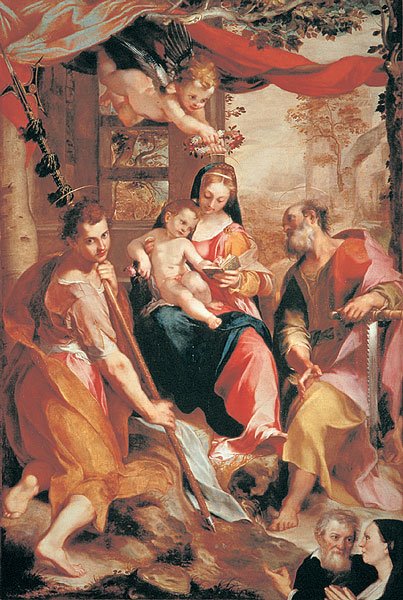
Today is the Feast of St Simon and Jude, the picture below shows both of the Apostles with Our Lady and Child Jesus and below is some information to read and reflect upon.

It is God who works in you both to will and to accomplish. Phil. 2:13
Simon was a simple Galilean, and one of Our Lord’s four first cousins, with James the Less, Jude and Joseph, all sons of Mary, the wife of Cleophas, who was the brother of Saint Joseph, according to tradition. All the sons of this family were raised at Nazareth near the Holy Family (Matt 13:53-58). Simon, Jude and James were called by Our Lord to be Apostles, pillars of His Church, and Joseph the Just was His loyal disciple. Saint Simon the Zealot or the Zealous, was the name this Apostle bore among the twelve. He preached in Egypt, Spain, and Libia, leaving behind him the fertile hills of Galilee, where he had been engaged in the cultivation of the vineyards and olive gardens. He later rejoined his brother, Saint Jude, in Persia, where they labored and died together. Tradition has it, that at first they were respected by the king, for they had manifested power over two ferocious tigers who had terrorized the land. With the king, sixty thousand Persians became Christians, and churches rose over the ruins of the idolatrous temples. However, when the two went elsewhere the pagans commanded them to sacrifice to the sun. Both Apostles, just before that time, had seen Our Lord amid His Angels. Simon said to Jude, “One of the Angels said to me, I will take you out of the temple and bring the building down upon their heads. I answered him, Let it not be so; perhaps some of them will be converted.” They prayed for mercy for the people and offered their lives to God. Saint Simon told the crowd that their gods were only demons, and ordered them to come out of the statues, which they did, revealing themselves under hideous forms. But idolaters fell on the Apostles and massacred them, while they blessed God and prayed for their murderers.Saint Jude has left us a short but powerful epistle, written after the death of his brother James, bishop of Jerusalem, and addressed to the new Christians being tempted by false brethren and heretics.

Reflection: Zeal is an ardent love which makes a man fearless in defense of God’s honor, and earnest to make known the truth at all costs. If we desire to be children of the Saints, we must be zealous for the Faith.


Read whole post......

Monday, October 26, 2009

Why men do not pray, several most common excuses re-visited - click to read


"And very often, for some years, I was more anxious that the hour I had determined to spend in prayer be over than I was to remain there, and more anxious to listen for the striking of the clock than to attend to other good things. And I don’t know what heavy penance could have come to mind that frequently I would not have gladly undertaken rather than recollect myself in the practice of prayer" (St. Teresa of Avila 'The Autobiography', pp. 97-98).

...Far from being a dreamer’s escape, prayer requires a good deal of mettle, which many of us lack. Again, without courage we won’t get very far in the Christian life, even in something as basic as prayer.

Prayer is a Christian duty, to be sure, but even more it is a privilege. Our God is not an unapproachable legislator or a distant, indifferent watchmaker, but a Father personally interested in his children. Christ revealed to us a God who listens, a God who has counted every hair on your head, a God who hastens to give good things to those who ask him. The same almighty Lord who spoke a single word and all things came to be, now bends his ear to listen to every word that you utter. Let us take to heart the words so often repeated in the liturgy: Let us pray! There is simply no better use of our time....


Diptych of young man praying before the image of Our Lady with the Infant Jesus who is blessing him, by unknown Flemish master.


Read whole post......

Thursday, October 22, 2009

Feast of Our Lady of the Rock (Rocamadour, France) - click for link to visit the shrine


Today is a day dedicated to Our Lady of the Rock, enshrined in Rocamadour in France. Tradition has it, Rocamadour was the home of an early Christian hermit named Zaccheus of Jericho. It is believed that he had conversed with Jesus himself, and that he died around 70 AD. This Zaccheus is said to have been the husband of St Veronica, who wiped the face of Jesus as he climbed to Calvary.

At some point after the hermit's death and burial in Rocamadour, the site became a place of pilgrimage. Some claim the town was named for the hermit because he was a "lover of rock" (roc amator). Zaccheus is also said to have brought a statue of the Black Virgin to Rocamadour, though the statue is generally dated to the 9th century. Due to the double attraction of the tomb of Zaccheus and the statue of the Virgin, pilgrims began to flock to Rocamadour. Many reported experiencing miraculous healings and conversions at the shrine. The Shrine of Our Lady of Rocamadour itself can be traced back to the twelfth century. Over the next few centuries, the numbers of pilgrims continued to increase. Many notable people came on pilgrimages to Rocamadour, including St Dominic and St Louis IX of France, and possibly even Charlemagne, on his way to battle the Moors in Spain.

The shrine eventually became so famous that kings and bishops began granting special privileges to those who made the pilgrimage. As an act of penance, pilgrims would regularly make the entire climb on their knees, as some still do today; 216 steps lead to the top of the rocky plateau on which the Chapel of Our Lady is located. The town suffered with the general decline of pilgrimages in the 17th and 18th centuries, but it was heavily restored and revitalized in the 19th century.

One recent notable pilgrim to Rocamadour was the French composer Francis Poulenc (d. January 30, 1963), who stayed in the city after a religious conversion he experienced there, and in honor of which he composed his Litanies of the Black Virgin (Litanies à la Vierge Noire). Today, the tomb of the ancient saint as well as the ancient image of Our Lady make the shrine at Rocamadour a popular destination; the site receives thousands of devout pilgrims each year.


The altar of Our Lady of Rocamadour


The situation of the shrine is extraordinary, amid medieval religious fortifications giddily perched atop a precipice, surrounded by a spectacular expanse of barren countryside. The miraculous statue is equally remarkable. Our Lady appears to be resting her weight on her hands, which are supported on the arms of her chair; the Child is balanced on her left knee.


A major event occurred in 1166, when an ancient grave and sepulcher containing an undecayed body was discovered on the cliff of Rocamadour, near the Chapel of Our Lady. This was believed to be the early Christian hermit St Amadour, who is often equated with Zaccheus. It is said that Amadour, a faithful servant of the Blessed Virgin, came to Gaul and built the first chapel of the Blessed Virgin Mary on French soil.

Text adopted after "A Moment with Mary"

Story of Rocamadour from Mary's Pages

Info and directions from Sacred Destinations"


Read whole post......

Sunday, October 18, 2009

Carmelite Friars report on the huge crowds draw to venerate the relics of St Therese across UK - click to read

"I will spend my heaven in doing good upon earth" (Story of the Soul)
"If my wishes are granted, my heaven will be spent on earth until the end of the world" (Complete Spiritual Doctrine of St Therese by F. Jamart, OCD)


From the homily of Abp Vincent Nichols  preached at Westminster Cathedral in London at the Farewell Mass upon return of the relics of St Therese to Lisieux:


"Over the past twenty-five days, thousands upon thousands of people have thronged to pray in the presence of these precious relics of St Therese. Today, as we prepare to return these relics to Lisieux , we thank God for the graces and blessings we have received. This has been a time of such wonderful expressions of faith and love in which we have been strengthened and filled with joyful encouragement.
This outpouring of faith had baffled many people. Some secular commentators were not able to make sense of it at all. I have found their incomprehension quite intriguing. Other reports have simply described what was there to be seen: so many people finding encouragement, perseverance and hope through the example and prayers of this most remarkable young woman. But surely they can see, unless they refuse to do so, her testimony to the spiritual dimension of human living, a dimension which takes us beyond that which can be measured and lifts human reasonableness to new levels, and flowers in heroism, sacrifice and perseverance." To read full text click
HERE

Full photo coverage on Catholic Church (England and Wales) photostream


Read whole post......

Twentieth Sunday after Pentecost - click to read

Today we meditate with St Teresa on sin, repentance and life-giving Sacrament of Penance:

Many times the feeling of my great faults is tempered by the happiness experienced in the thought that the multitude of Your mercies may be known (I:65)

I found great consolation in sinners whom, after having been sinners, the Lord brought back to Himself. It seemed to me I could find help in them and that since the Lord had pardoned them he could also pardon me. (I:103)


Oh, what a good friend You make, my Lord! How you proceed by favouring and enduring...You take into account, my Lord, the times when they Love You, and in one instant of repentance You forget their offences. (I:97)


O my Jesus! What a sight it is when You through Your mercy return to offer Your hand and raise up a soul that has fallen in sin....How such a soul knows the multitude of Your grandeurs and mercies and its own misery! (I: 166, 67)


Read whole post......

Thursday, October 15, 2009

Special treat for the Feast of St Teresa - Carmelite Rite Mass, 1960 - Aylesford Calced Carmelite Priory, Kent, UK

Carmelite rite is the rite which hermits of Mt Carmel brought to Europe from the Holy Land and the Masses of this rite are offered in the Church of the Holy Sepulcher.

Introit, Kyrie, Gloria.


Credo, Offertory


Read whole post......

Tuesday, October 13, 2009

Commemoration of the 7th Apparition in Fatima - miracle of the sun, Portugal 1917


On October 13, when the crowds saw the ball of fire leave its orbit and race down towards them, their reaction was immediate. They didn't go into a subtle exegesis to convince themselves that this 'sign in the sky' was purely symbolic. Instead, they realized that this fire, if it approached only a second longer, would annihilate them. Just as the people of Israel had seen the fire from heaven race down over Elijah as its holocaust and consume him in the blink of an eye, these people fell on their knees and cried out: 'My God, I believe in you! ' And they asked for forgiveness, pity and mercy.

In their own way they were saying anew: 'It is Yahveh who is God! It is Yahveh who is God! ' (1 Kings 18: 39). Through their conversion and their supplication, they obtained that the chastisement be averted: the sun resumed its place in the sky. And they found, along with faith, the peace and the joy of being reconciled with God.

"The Virgin of Mount Carmel" by Joseph Lethielleux (after 'A Moment with Mary')


Read whole post......

Monday, October 12, 2009

Relics of St Therese to visit England - click to read more


2 Kings 13:21
And as a man was being buried, lo, a marauding band was seen and the man was cast into the grave of Elisha; and as soon as the man touched the bones of Elisha, he revived and stood on his feet.

Acts 19:11-12
Meanwhile, God worked extraordinary miracles at the hands of Paul. When handkerchiefs or cloths which had touched his skin were applied to the sick, their diseases were cured and evil spirits departed from them.

Dates and venues
Little Flower will bring grace to England


Read whole post......

Sunday, October 11, 2009

Annual Rosary Crusade of Reparation 2009 - walk from Westminster Cathedral to London Brompton Oratory

It took place on Saturday for 25th time in reparation for the sins of the world. As usual it was great spiritual experience and I will share some pictures I have taken there:


The participants gathered in Cathedral square and after traffic was closed we proceeded towards London Oratory led by the statue of Our lady of Fatima with the clergy leading the Rosary prayer.


After one and a half hour we have reached the Oratory


We have prayed there and listened to a great sermon on the power of Rosary prayers. This year which is the year of St John Vianney, the Rosary's Crusade intentions were dedicated for all priests. On the side altar the reliquary with collection of relics of the Cure of Ars was displayed for veneration and it was the greatest surprise:


We could also pray the Rosary at the beautiful Altar of Our Lady:


or pray Divine Mercy chaplet at the Altar of Mater Boni Consilii adorned with many ex-voto's placed there in thanksgiving for petitions granted:


As always it was a great day, and please pray for those who organised the Crusade that they will obtain all graces of perseverance to continue this great devotion.


Read whole post......

Friday, October 02, 2009

Feast of the Holy Guardian Angels


Ex. 23:20-23.
Behold I will send my angel, who shall go before thee, and keep thee in thy journey, and bring thee into the place that I have prepared. Take notice of him, and hear his voice, and do not think him one to be contemned: for he will not forgive when thou hast sinned, and my name is in him. But if thou wilt hear his voice, and do all that I speak, I will be an enemy to thy enemies, and will afflict them that afflict thee. And my angel shall go before thee, and shall bring thee in unto the Amorrhite, and the Hethite, and the Pherezite, and the Chanaanite, and the Hevite, and the Jebusite, whom I will destroy.


Mt 18:1-10.
At that hour the disciples came to Jesus, saying: Who, thinkest thou, is the greater in the kingdom of heaven? And Jesus, calling unto him a little child, set him in the midst of them. And said: amen I say to you, unless you be converted, and become as little children, you shall not enter into the kingdom of heaven. Whosoever therefore shall humble himself as this little child, he is the greater in the kingdom of heaven. And he that shall receive one such little child in my name, receiveth me. But he that shall scandalize one of these little ones that believe in me, it were better for him that a millstone should be hanged about his neck, and that he should be drowned in the depth of the sea. Woe to the world because of scandals. For it must needs be that scandals come: but nevertheless woe to that man by whom the scandal cometh. And if thy hand, or thy foot, scandalize thee, cut it off, and cast it from thee. It is better for thee to go into life maimed or lame, than having two hands or two feet, to be cast into everlasting fire. And if thy eye scandalize thee, pluck it out, and cast it from thee. It is better for thee having one eye to enter into life, than having two eyes to be cast into hell fire. See that you despise not one of these little ones: for I say to you, that their angels in heaven always see the face of my Father who is in heaven.

Seven Archangels, Spanish Colonial religious artwork, Mexico, 19th century.


Read whole post......

St Therese - thoughts and resolutions


The Virgin Mary Rushes to My Side.
When I receive Holy Communion, I sometimes imagine my soul as if it were the soul of a three or four year-old child, dinted by play, with my clothes all soiled and my hair disheveled. - These misfortunes befall me whilst I wrestle with souls. - But the Virgin Mary rushes to my side in haste. No sooner has she rid me of my soiled, little apron, tied back my hair with a beautiful ribbon or just a little flower... and this is enough to make me lovely again and allow me sit down at the feast of the Angels without blushing.

After 'A Moment with Mary'


Read whole post......

Novena Prayer to St Therese of Child Jesus starts 24th September - click to read


Read whole post......

Thursday, October 01, 2009

St Therese - thoughts and resolutions


From the last poem written by St. Therese:
"Soon, soon, to heaven that waits for us, my soul shall swiftly fly.
O Thou who cam'st to smile on me at dawn of life's beginning!
Come once again to smile on me.... Mother! the night is nigh.
I fear no more thy majesty, so far, so far above me,
For, I have suffered sore with thee; now hear my heart's deep cry!
Oh! let me tell thee face to face, dear Virgin! how I love thee;
And say to thee forevermore:
thy little child am I."

“Sometimes I find my self saying to the Holy Virgin: “Do you know, O cherished Mother, that I think myself more fortunate than you? I have you for Mother and you have not, like me, the blessed Virgin to love … You are, it is true, the Mother of Jesus but you have given Him to me, and He, from the Cross gave you to us as our Mother, so we are richer than you. Of old it was your desire that you might be the little handmaiden of the Mother of God; and I, poor little creature, I am, not your servant, but your child: you are the Mother of Jesus and you are my Mother.” (Thoughts of Saint Therese, 154-5)

“O Mary, if I were Queen of heaven and thou wert Therese, I fain would be Therese to see thee Queen of Heaven!” - September 8, 1897

After Mary's Vitamin


Read whole post......

Novena Prayer to Holy Guardian Angel starts on 23rd of September - click to read


Read whole post......