Wednesday, September 13, 2006

SAINTS OF CARMEL TEACHING

fragments from the "Way of Perfection" by St Teresa, chapter 28,

4. Although only vocal, yet this form of prayer recollects mind much more quickly than any other kind, and has many advantages. It is called 'recollection' because by its means the soul collects together all the faculties and enters within itself to be with God. The divine master thus come more speadily than He otherwise would to teach it and to grant the prayer of quiet. For being retired within itself, the spirit can meditate on the Passion and can there picture in its thoughts the Son, and can offer Him to the Father without tiring the mind by journeying to find Him on Mount Calvary, or in the garden, or at the column.

5. Those who are able to enclose themselves within the little heaven of their souls where dwells the Creator of heaven and earth, and who can accustom themselves not to look at anything nor remain in any place which would preoccupy their exterior senses, may feel sure that they are travelling by an excellent way, and that they will certainly attain to drink of the water from the fountain, for they will journey far in a short time. They resemble a man who goes by sea, and who, if wind is favourable, gets in a few days to the end of voyage which would have taken far longer by land. These souls may be said to have already put out to sea, and though they have not quite lost sight of land, still they do their best to get away from it by collecting their faculties Read whole post......

Tuesday, September 12, 2006

Which order is better?

A Franciscan and Jesuit were debating which order was the greatest. So, they decided to ask for a sign from God. This is what they received falling down from heaven:


My sons,
Please stop bickering about such trivial matters,
GOD, O.P. Read whole post......

Feast of the Holy Name of Mary

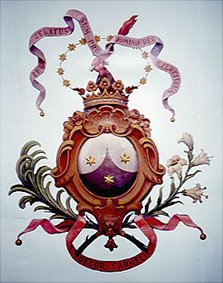
Sancta Maria
Holy Mary

Dic mihi, quo appellaris nomine? Genesis 32
"Tell me what name shall I give you?"

The answer is: "And the name is Virgin," followed by the flower monogram "M" signifying Mary.

The two little angels proclaim, "Your name is like spreading perfume" Canticle 1, 3 and, "The Lord has named you a beautiful olive tree" Jeremiah 11:16.

Two cantors sing, "ora pro nobis," that is: pray for us! while the devil cries out, "Terrifying is his (her) name" Psalm 111.

"Praised be the Lord, who today has magnified your name so that it will never disappear from the mouth of the people" Judith 15.

The text and the image is after www.udayton.edu/mary/ prayers/sanctamaria.html Read whole post......
DEVOTION CORNER
"On the Fifth Dolour - Of the Death of Jesus"
fragments from "The Glories of Mary" by St. Alphonsus Liguori

We have now to witness a new kind of martyrdom - a Mother condemned to see an innocent Son, and one whom she loves with the whole affection of her soul, cruelly tormented and put to death before her own eyes: "There stood by the cross of Jesus His Mother." Jn. xix.25 Saint John believed that in these words he had said enough of Mary's martyrdom. Consider her at the foot of the cross in the presence of her dyeing Son, and then see if there be sorrow like unto her sorrow. Let us remain for a while this day on Calvary, and consider the fifth sword which, in the death of Jesus, transfixed the heart of Mary.
As soon as our agonized Redeemer had reached the Mount Calvary, the executioners stripped him of His clothes, and piercing His hands and feet with 'not with sharp but with blunt nails' as Saint Bernard says, to torment Him more, they fastened Him on the cross. Having crucified Him, they planted the cross, and thus left Him; but not so Mary. She then draw nearer to the cross to be present at His death: "I did not leave Him' (thus the Blessed Virgin revealed to Saint Bridget), 'but stood nearer to the cross.'Rev.1.i.c.35. 'But what did it avail thee, O Lady,' says St. Bonaventure, 'to go to Calvary , and see this Son expire? Shame should have prevented thee; for His disgrace was thine, since thou wert His Mother. At least, horror of witnessing such a crime as the crucifixion of a God by His own creatures, should have prevented thee from going there.' But the same Saint answers, 'Ah, thy heart did not then think of its own sorrows, but of the sufferings and death of thy dear Son,' and therefore thou wouldst thyself be present, at least to compassionate Him. 'Ah, true Mother, says the Abbot William, 'most loving Mother, whom not even the fear of death could separate from thy beloved Son.' But, O God, what a cruel sight as it there to behold this Son in agony on the cross, and as its foot this Mother in agony, suffering all the torments endured by her Son! Listen to the words in which Mary revealed to Saint
Bridget the sorrowful state in which she saw her dying Son on the cross: 'My dear Jesus was breathless, exhausted, and in His last agony on the cross; His eyes were sunk, half-closed, and lifeless; His lips hanging, and His mouth open; His cheeks hollow and drawn in; His face elongated, His nose sharp, His countenance sad: His head had fallen on His breast, His hair was black with blood, His stomach collapsed, His arms and legs stiff, and His whole body covered with wounds and blood.' Rev. lib. i. cap. 10, lib. iv. cap. 70.....But if Mary's lips were silent, her heart was not so, for she incessantly offered the life of her Son to the Divine Justice for our salvation. Therefore we know that by the merits of her dolours she cooperated in our birth to the life of grace; and hence we are the children of her sorrows.

PRAYER

Ah, Mother of Mercy, I hope, first, through the death of my Redeemer, and then through thy sorrow, to obtain pardon and eternal salvation. Amen. Read whole post......

Monday, September 11, 2006

SAINTS OF CARMEL TEACHING

fragments from the "Way of Perfection" by St Teresa, chapter 28,

1. ...You know that God is everywhere, which is a great truth. Now the place where the king dwells is called his court: so, wherever God dwells there is heaven, and you may feel sure that all which is glorious is near His Majesty.

2. Remember what St. Augustine tells us -...how he sought God in many places and at last found the Almighty within himself. Do you consider it of slight importance for a soul given to wandering thoughts to realize this truth and see that it has no need to go to heaven in order to speak to the eternal Father or enjoy His company: nor is it requisite to raise the voice to address Him, for He hears every whisper however low.....with utter humility, talk to Him as to your Father: ask for what you want as from a father; tell Him your sorrows and beg Him for relief, realizing at the same time that you are unworthy to be called His daughter.

3....Humility would not lead you to refuse a favour from the king, but would make you accept and take pleasure in it although you recognize how little it was your due....Do not be foolish: remind Him that he has promised to be your Bridgeroom, and treat Him as He were. [Be convinced of your need of realizing that God dwells within you, and that you may remain there with Him].

Today's image is by Claudio Coello "Communion of St Teresa of Avila" Read whole post......
DEVOTION CORNER
"On the Fourth Dolour - Of the Meeting of Mary with Jesus, when He was going to Death"

fragments from "The Glories of Mary" by St. Alphonsus Liguori

Saint Bernardine says, that to form an idea of the greatness of Mary's grief in losing her Jesus by death, we must consider the love that this Mother bore to her Son. All mothers feel the sufferings of their children as their own. Hence, when the Canaanitish woman entreated our Saviour to deliver her daughter from the devil that tormented her, she asked Him rather to pity her, the mother, than her daughter:"Have mercy on me, O Lord, Thou Son of David, my daughter is grievously troubled by a devil"Matt. xv.22. But what mother ever loved her son as Mary loved Jesus? He was her only Son, reared amidst so many troubles; a most amiable Son, and tenderly loving His Mother; a Son who, at the same time that He was her Son, was also her God, who had come on earth to enkindle in the hearts of all the fire of Divine love, as He Himself declared: "I am come to cast fire on the earth, and what will I but that it be kindled?"Luke xii.49. Let us only imagine what a flame he must have enkindled in that pure heart of His holy Mother, void as it was of every earthly affection. In fine, the Blessed Virgin herself told Saint Bridget , 'that love had rendered her heart and that of her Son but one'. That blending together of Servant and Mother, of Son and God, created in the heart of Mary a fire composed of a thousand flames. But the whole of this flame of love was afterwards, at the time of the Passion, changed into a sea of grief, when Saint Bernardine declares, 'that if all the sorrows of the world were united, they would not equal that of the glorious Virgin Mary. Yes, because, as Richard of St. Lawrence writes, 'the more tenderly this Mother loved, so much the more deeply was she wounded.' The greater was her love for Him, the greater was her grief at the sight of His sufferings; and especially when she met her Son, already condemned to death, and bearing His cross to the place of punishment. This is the fourth sword of sorrow which we have this day to consider. The Blessed Virgin revealed to Saint Bridget, that when the time of the Passion of our Lord was approaching, her eyes were always filled with tears, as she thought of her beloved Son, whom she was about to lose on earth, and that the prospect of that approaching suffering caused her to be seized with fear, and a cold sweat to cover her whole body. Behold, the appointed day at length came, and Jesus, in tears, went to take leave of His Mother, before going to death. Saint Bonaventure, contemplating Mary on that night, says: "Thou didst spent it without sleep, and whilst others slept thou didst remain watching." In the morning the disciples of Jesus Christ came to the afflicted Mother, the one to bring her one account, the other another; but all were tidings of sorrow, verifying in her the prophecy of Jeremias: "Weeping, she hath wept in the night, and her tears are on her cheeks; there is none to comfort her of all them that were dear to her." Some then came to relate to her the cruel treatment of her Son in the house of Caiphas; and others, the insults He had received from Herod. Finally - to come to our point, I emit all the rest - Saint John came, and announced to Mary, that the most unjust Pilate had already condemned Him to die on the cross. I say the most unjust Pilate; for, as Saint Leo remarks, 'This unjust judge condemned Him to death with the same lips with which he had declared Him innocent.... Mary goes with St. John, and by the blood with which the way is sprinkled, she perceives that her Son had already passed. This she revealed to Saint Bridget: 'By the footsteps of my Son, I knew where He had passed: for along the way the ground was marked with blood.' Saint Bonaventure represents the afflicted Mother taking a shorter way, and placing herself at the corner of a street, to meet her afflicted Son as He was passing by. 'The most sorrowful Mother, met her most sorrowful Son'. While Mary was waiting in that place, how much must she have heard said by the Jews, who soon recognised her, against her beloved Son, and perhaps even words of mocking against herself. Alas, what a scene of sorrows then presented itself before her! - the nails, the hammers, the cords, the fatal instruments of the death of her Son, all of which were borne before Him. And what a sword must the sound of that trumpet have been to her heart, which proclaimed the sentence pronounced against her Jesus! But behold, the instruments, the trumpeter, and the executioners, have already passed; she raised her eyes, and saw, O God! a young man covered with blood and wounds from head to foot, a wreath of thorns and two heavy beams on His shoulders. She looked at Him and hardly recognised Him, saying, with Isaias "and we have seen Him, and there was no slightliness."Isa liii. 2 Yes, for the wounds, the bruises, and the clotted blood, gave Him the appearance of a leper:"we have thought Him as it were a leper,"Isa liii. 4 so that He could no longer be known: "and His look was, as it were hidden and despised; whereupon we esteemed Him not."Isa. liii.3. But at length love revealed Him to her, and as soon as she knew that it indeed was He, ah what love and fear must then have filled her heart! as Saint Peter of Alcantara says in his meditations. On the one hand she desired to behold Him, and on the other she dreaded so heart-rending a sight. At length they looked at each other. The Son wiped from His eyes the clotted blood, which, as it was revealed to St Bridget, prevented Him from seeing, and looked at His Mother, and the Mother looked at her Son.....Mary at the sight of her Son, on His way to Calvary, did not faint...nor did she die, for God reserved her for greater grief: but though she did not die, her sorrow was enough to have cause her a thousand deaths. The Mother would have embraced her Son, as St Anselm says, but the guards thrust her aside with insults, and urged forward the suffering Lord; and Mary followed Him. Ah, holy Virgin, whither goest thou? To Calvary. And canst thou trust thyself to behold Him, who is thy life, hanging on a cross?"And thy life shall be, as it were, hanging before thee."Deut xxviii. 86...But although the sight of her dying Jesus was to cost her such bitter sorrow, the loving Mary will not leave Him: the Son advanced, and the Mother followed, to be also crucified with her Son, as the Abbot William says: 'the Mother also took up her cross and followed to be crucified with Him'. 'We even pity wild beasts' as St John Chrysostom writes; and did we see a lioness following her cub to death, the sight would move us to compassion. And shall we not also be moved to compassion on seeing Mary follow her immaculate Lamb to death? Let us, then, pity her, and let us also accompany her Son and herself, by bearing with patience the cross which our Lord imposes on us. Saint Chrysostom asks why Jesus Christ, in His other sufferings, was pleased to endure them alone, but in carrying His cross was assisted by the Cyrenean? He replies, that it was 'that thou mayest understand that the cross of Christ is not sufficient without thine.'

PRAYER
Ah, immaculate Virgin, from thee do I hope for help to accept and to bear all the crosses with patience. Amen.

In attempt to improve the structure of the blog let me arrange all devotional posts under the name of 'Devotion corner'. Read whole post......

Sunday, September 10, 2006

DEVOTION CORNER
"On the Third Dolour -
Of the Loss of Jesus in the Temple"
fragments from "The Glories of Mary" by St. Alphonsus Liguori

The Apostle Saint James says that our perfection consists in the virtue of patience. "And patience hath a perfect work and entire, failing in nothing" Jam i. 4 Our Lord having, then, given us the blessed Virgin Mary as a model of perfection, it was necessary that she should be laden with sorrows, that in her we might admire heroic patience, and endeavour to imitate it. The sorrow which we have this day to consider was one of the greatest that Mary had to endure in her life, - the loss of her Son in the temple. He who is born blind feels little the privation of the light of day; but he who has once enjoyed it, and loses it by becoming blind, indeed suffers much. Thus it is also with those unhappy souls who, blinded by the mire of this world, have but little knowledge of God - they suffer but little knowledge of God - they suffer but little at not finding Him; but, on the other hand, he who, illumined by celestial light, has become worthy to find by love the sweat presence of the supreme good, O God, how bitterly does he grieve when he finds himself deprived of it! Hence let us see how much Mary must have suffered from this third sword of sorrow which pierced her heart, when, having lost her Jesus in Jerusalem for three days, she was deprived of His most sweet presence, accustomed as she was constantly to enjoy it.
St. Luke relates, in the second chapter of his Gospel, that the Blessed Virgin, with her spouse St. Joseph, and Jesus, was accustomed every year at the paschal solemnity to visit the temple. When her Son was twelve years of age, she went as usual, and Jesus remained in Jerusalem. Mary did not at once perceive it, thinking He was in company with others. When she reached Nazareth, she inquired for her Son; but not finding Him, she immediately returned to Jerusalem to seek for Him, and only found Him after three days. Now let us imagine what anxiety this afflicted Mother must have experienced in those three days during which she was seeking everywhere for her Son, and inquiring for Him with the spouse in the Canticles: "Have you seen him whom my soul loveth?"Cant. iii. 3. But she could have no tidings of Him. O, with how far greater tenderness must Mary, overcome by fatigue, and having not yet found her beloved Son, have repeated those words of Ruben, concerning his brother Joseph: "The boy doth not appear, and whither shall I go?"Gen. xxxvii. 30 'My Jesus doth not appear, and I no longer know what to do to find Him; but where shall I go without my treasure?' Weeping continually, with how much truth did she repeat with David, during those three days, "My tears have been my bread day and night, whilst it is said to me daily: Where is thy God?" Ps xli. 4. Wherefore Pelbart, with reason, says, that 'during those nights the afflicted Mary did not sleep; she was constantly weeping, and entreating God that He would enable her to find her Son.' Frequently during that time, according to St. Bernard, she addressed her Son in the words of the spouse in the Canticles: "Show me where thou feedest, where thou liest in the mid-day, lest I begin to wander."Cant. i. 6 My Son, tell me where Thou art, that I may no longer wander, seeking Thee in vain.
There are some who assert, and not without reason, that this dolour was not only one of the greatest, but the greatest and most painful of all. For, in the first place, Mary, in her other dolours, had Jesus with her: she suffered when Saint Simeon prophesied to her in the temple; she suffered in the flight into Egypt; but still in company with Jesus; but in this dolour she suffered far from Jesus, not knowing where He was: "And the light of my eyes itself is no longer with me."Ps. xxxvii.11. Thus weeping she then said, 'Ah, the light of my eyes, my dear Jesus, is no longer with me; He is far from me, and I know not whither He is gone.' Origen says that through the love which this holy Mother bore her , 'she suffered more in this loss of Jesus than any martyr ever suffered in the separation of his soul from his body.' Ah, too long indeed were those three days for Mary; they seemed three ages; they were all bitterness, for there was none to comfort her. And who can ever comfort me, she said with Jeremias, who can console me, since He who alone could do so is far from me? And therefore my eyes run down with water: because the Comforter....is far from me." And with Tobias she repeated, "What manner of joy shall be to me who sit in darkness, and see not the light of heaven?"Tob. v. 12.....
This sorrow of Mary ought, in the first place, to serve as a consolation to those souls who are in desolate, and no longer enjoy, as they once enjoyed, the sweet presence of their Lord. They may weep, but they should weep in peace, as Mary wept the absence of her Son; and let them take courage, and not fear that on this account they have lost the Divine favour; for God Himself assured Saint Teresa, that 'no one is lost without knowing it; and that no one is deceived without wishing to be deceived'. If our Lord withdraws Himself from a soul which loves Him, He does not, therefore, depart from the heart; he often conceals Himself from a soul, that she may seek Him with a more ardent desire and greater love. But whoever wishes to find Jesus, must seek Him, not amidst delights and the pleasures of the world, but amidst crosses and mortifications, as Mary sought Him: "we sought Thee sorrowing," as Mary said to her Son. 'Learn, then, from Mary,'says Origen, 'to seek Jesus.'

PRAYER
O Blessed Virgin...Thou art the gate through which all find Jesus; through thee I also hope to find Him. Amen. Read whole post......
FOURTEENTH SUNDAY AFTER PENTECOST.
fragments from "Divine Instructions" by Fr Goffine

At the Introit of the Mass, join with the priest in awaking in your heart a fervent desire for heaven by these words: "Behold, O God, our protector, and look on the face of Thy Christ; for better is one day in Thy courts above thousands. How lovely are Thy tabernacles, O Lord of hosts! My soul longeth and fainteth for the courts of the Lord"Ps lxxxiii

PRAYER
Preserve Thy Church, we beseech Thee, O Lord, with perpetual mercy, and since without Thee mortal man goes astray, may we be ever withheld by Thy grace from what is hurtful, and directed to what is profitable. Through Our Lord Jesus Christ, etc.

EPISTLE Gal. v. 16-24
Brethren: I say then, walk in the spirit, and you shall not fulfill the lusts of the flesh. For the flesh lusteth against the spirit: and the spirit against the flesh; for these are contrary one to another: so that you do not the things that you would. But if you are led by the spirit, you are not under the law. Now the works of the flesh are manifest, which are fornication, uncleanness, immodesty, luxury, idolatry, witchcrafts, enmities, contentions, emulations, wraths, quarrels, dissensions, sects, envies, murders, drunkenness, reveling, and such like. Of the which I foretell you, as I have foretold to you, that they who do such things shall not obtain the kingdom of God. But the fruit of the Spirit is, charity, joy, peace, patience, benignity, goodness, longanimity, mildness, faith, modesty, continency, chastity. Against such there is no law. And they that are Christ's, have crucified their flesh, with the vices and concupiscences.

What is to walk in the spirit?
It is, in all things, to follow the inspirations of the Holy Spirit; and not merely to abstain from the works of the flesh, but rather to crucify the flesh and its lusts, and earnestly to aspire after those fruits which the Holy Spirit produces in men, such as charity, peace, and joy. So shall we belong to Christ, and become partakers of eternal life. It is not wonderful that while all Christians desire to belong to Christ, and to be heirs of His kingdom, they are unwilling to crucify the flesh with its vices and concupiscenses, and to destroy its lusts, as though they believed this to be required only for the clergy, whereas it is to all Christians that Christ says:"If any man will come after Me, let him deny himself and take up his cross and follow Me"? Matt. xvi. 24

GOSPEL Matt. vi. 24-33
No man can serve two masters. For either he will hate the one, and love the other: or he will sustain the one, and despise the other. You cannot serve God and mammon. Therefore I say to you, be not solicitous for your life, what you shall eat, nor for your body, what you shall put on. Is not the life more than the meat: and the body more than the raiment? Behold the birds of the air, for they neither sow, nor do they reap, nor gather into barns: and your heavenly Father feedeth them. Are not you of much more value than they? And which of you by taking thought, can add to his stature by one cubit? And for raiment why are you solicitous? Consider the lilies of the field, how they grow: they labour not, neither do they spin. But I say to you, that not even Solomon in all his glory was arrayed as one of these. And if the grass of the field, which is today, and tomorrow is cast into the oven, God doth so clothe: how much more you, O ye of little faith? Be not solicitous therefore, saying, What shall we eat: or what shall we drink, or wherewith shall we be clothed? For after all these things do the heathens seek. For your Father knoweth that you have need of all these things. Seek ye therefore first the kingdom of God, and his justice, and all these things shall be added unto you.

What is meant by serving God?
Doing the will of God in all things which He requires of us, in whatever state of life we may be placed, and doing this with fidelity, with unwearied zeal, and out of love for Him.

Who are the two masters whom we cannot serve at the same time?
God and inordinate desire for wordly gain. One cannot serve both, because they demand things that are contradictory.

Who are they that serve mammon, or worldy wealth?
The avaricious, who, impelled by their longing for riches, offend God by manifold transgressions of His commandments.

Why does Christ refer us to the birds of the air and the lilies of the field?
To awaken in us confidence in Divine Providence. If God feeds the young ravens (Ps.cxlvi. 9) and the birds of the air; if He decks so beautifully the flowers of the field, how much more will He not care for men, who He has created after His own image, and adopted as His children.

Are we, then, to use no care or labour?
That by no means follows, from what has been said. The Saviour forbids only that anxiety, proceeding from little faith, which, in striving for a maintenance, neglects God's honour and commandments, and the good of one's soul. For the rest, God Himself has commanded man to labour (Gen. iii. 17-19); and St. Paul says, "If any man will not work, neither let him eat"(II Thess. iii.10)

What should preserve us from excessive anxiety?
A firm and living faith that God can and will help us. That He can is clear, because he is almighty; that He will is certain, for the reason that He is love - that he has promised it to us, more than once, most expressly, and that He is faithful in keeping His promises. Let us, then, trust in God, and daily renew our confidence in Him, particularly when we say the Creed, or when, in the Our Father, we pray, "Give us this day our daily bread"

Consolation in Poverty

In your misery and poverty, say often, with Job: "The Lord gave, and the Lord hath taken away; as it hath pleased the Lord so it is done; blessed be the name of the Lord"(Job i 21). Or seek comfort in these words: "We lead indeed a poor life, but we shall have many good things if we fear God and depart from all sin, and do that which is good" (Job iv. 23)

Warning against Usury
Usury is the mortal sin which takes advantage of our neighbour's poverty and need to extort from him what is justly his own. Would that userers might bear in mind what the Lord says: "What doth it profit a man if he gain the whole world and suffer the less of his own soul?"(Matt. xvi. 26).

Today's image is engraving "Jesus preaching" by Rembrandt

after http://www.netserves.com/moca/lectures/booremb.htm Read whole post......

Saturday, September 09, 2006

SCRIPTURE CORNER -
The other nine, where they are?

after "With the Church - Meditations on the Topcs from Missal and Breviary" ed. by Fr M. Goossens OFM, 1962 by Gottmer-Gobrevi Publishing, Switzerland.

SATURDAY IN THE THIRTEENTH WEEK AFTER THE OCTAVE OF PENTECOST

Jesus asked a question of the leper who came back, but received no answer; perhaps because such a question required none! He had come back to bring his own thanksgiving; was it his business to bring the nine others with him? Yet Christ's question seems to include a gentle rebuke. Does he not ask it also of us?
The were cleansed; one thanked. All men are saved; do even a tenth part thank God for their salvation? Is the percentage of those who are grateful even lower than that of the just in Sodom and Gomorrha? Jesus, in the course of centuries, has often asked the same question. It proves that he really holds us responsible for those who do not thank him, who despise him, turn their backs on him and go their own way, forgetful of the wonders of his love.
He is still as much pained by their behaviour as he was by that of the nine lepers. He asks us to thank him in the name of those who forget to do so; better still, to bring them with us that they may thank him in person. He cleansed us all together; he would have us thank him all together. The one who came back had not yet done all he should, by representing the ten; he ought to have used every effort to bring them with him. Even if he had not succeeded, his thanksgiving at least must not be lacking, if he would hear his Lord say: "Arise and go on thy way, thy faith has brought thee recovery."(Luke 17, 19)
O Jesus, I will try to bring you that which is lacking in mankind's love and gratitude. Make me understand and feel what you desire, and never spare myself, as long as I have not, by word and example and practical acts of charity, brought others back to you. O Source of all love and goodness! You show us how reasonable gratitude is. May I never be lacking in it towards my fellow-men who render me service. They have a right to it and are consoled by it. My first act will be to command them to your love.
Who thanked Jesus? A Samaritan, one of those to whom the Good News was not sent in the first instance. The nine others were the figure of the Jewish nation; thus it seems as if the Israelites were the first of those who are entrusted to our care.
St Paul writes to Romans: "I tell you of the great sorrow, the continual anguish I feel in my heart, and how it has ever been my wish that I myself might be doomed to separation from Christ, if that would benefit my brethren, my own kinsmen by race." (Rom. 9.2,3). The Israelites are the labourers who were hired first, and who were bore the burden and heat of the day (see Matt. 20, 1-16. It is that which makes St. Paul's words so pathetic: "Let me remind you, brethren, of this. Our fathers were hidden, all of them, under the cloud, and found a path, all of them, through the sea....For all that, God was ill pleased with most of them."(I Cor. 10, 1,2,5.)
Yet because of the promise made by Abraham, salvation is of the Jews: "They are Israelites, adopted as God's sons; the visible presence, and the covenant, and the giving of the law, and the Temple worship, and the promises, are their inheritance; the patriarchs belong to them, and theirs is the human stock from which Christ came."(Rom. 9. 4,5).
There were the first whom Christ cleansed from the leprosy of sin; but Israel, wherever its dignity, did not react to God's benefit. Jesus looked down with pleasure on the stranger who lay at his feet, adoring and thanking him. But his disappointed love finds utterance in the words of Isaias: "Outstreched these hands of mine, all the day long, to a nation of rebels, straying this way and that as the mood takes them, openly defying me." (Isaias 65.2.)
Finally, those chosen ones were marked with the blood of their Saviour, as Cain was marked with the blood of Abel; a curse, and yet a sign of protection.
What love should we not have for the nation thus marked by God? We are the new cutting, grafted on the old stem by Christ himself, who loved his own race so dearly, and for whom we are the new Israel his Church the new Sion.
St. Paul, speaking of Israel says: "Brethren, they have all the good will of my heart, all my prayers to God, for their salvation."(Rom. 10.1) Let us, with all our hearts, join our prayers to his!
"Listen, Gentiles, to the Lord's promise....he who scattered Israel will gather Israel in, will guard it faithfully as a shepherd guards his flock....The exiles will return, greeting mount Sion with cries of gladness, thronging in to take possession of the Lord's gifts....Revived their spirits shall be, like a garden when the stream flows full; they shall hunger no more....I will return all their sorrow into joy, comfort and cheer their sad hearts."(Jer. 31. 10-13)
"Grant, Lord, we beseech thee, that all inhabitants of this world, without exception, may become sons of Abraham, and share in the dignity of Israel!" (Collect for Easter Eve). Read whole post......
DEVOTION CORNER
"On the Second Dolour
- Of the Flight of Jesus into Egypt"fragments from "The Glories of Mary" by St. Alphonsus Liguori

As the stag, wounded by an arrow, carries the pain with him wherever he goes, because he carries with him the arrow which has wounded him, so did the Divine Mother, after the sad prophecy of Saint Simeon, as we have already seen in the consideration of the first dolour, always carry her sorrow with her in the continual remembrance of the Passion of her Son. Hailgrino, explaining this passage of the Cantilcles, "The hairs of thy head, as the purple of the king, bound in the channel." Cant. vii.5 says that these purple hairs were Mary's continual thoughts of the Passion of Jesus, which kept the blood which was one day to flow from His wounds always before her eyes: 'Thy mind, O Mary, and Thy thoughts, steeped in the blood of our Lord's Passion, were always filled from His wounds always before her eyes...Let us consider the second sword of sorrow which wounded Mary, in the flight of her Infant Jesus into Egypt from the persecution of Herod. Herod, having heard the expected Messias was born, foolishly feared that He would deprived him of his kingdom. ...
Any one can imagine what Mary must have suffered on this journey. To Egypt the distance was great. Most authors agree that it was three hundred miles; so that it was a journey of upwards of thirty days. The road was, according to Saint Bonaventure's description of it, 'rough, unknown, and little frequented' De Vitae Christi, cap. xii.
It was in the winter season; so that they had to travel in snow, rain, and wind, through rough and dirty roads. Mary was then fifteen years of age - a delicate young woman, unaccustomed to such journeys. They had no one to attend upon them. Saint Peter Chrysologus says, 'Joseph and Mary have no male or female servants; they were themselves both masters and servants.'
O God, what a touching sight must it have been to have behold that tender Virgin with her new-born Babe wandering through the world!......They resided in Egypt, according to Brocard and Jansenius, in a district called Maturea; though Saint Anselm says that they lived in the city of Heliopolis, or at Memphis, now called old Cairo. Here let us consider the great poverty they must have suffered during the seven years which, according to Saint Antoninus, Saint Thomas, and others, they spent there. They were foreigners unknown, without revenues, money, or relations, barely able to support themselves by their humble efforts. 'As they were destitute', says saint basil, 'it is evident that they must have laboured much to provide themselves with the necessities of life.' ....After the death of Herod, Saint Matthew relates, the angel appeared again to Saint Joseph in a dream, and directed him to return to Judea. Saint Bonaventura, speaking of this return, considers how much greater the Blessed Virgin's sufferings must have been on account of the pains of Jesus being so much increased, as He was then about seven years of age - an age, remarks the Saint, at which 'He was too big to be carried, and not strong enough to walk without assistance.
The sight then, of Jesus and Mary wandering as fugitives through the world teaches us that we also must live as pilgrims here below, detached from the goods which the world offers us, and which we must soon leave to enter eternity: "We have not here a lasting city, but seek one that is to come." Heb xiii, 14 To which Saint Augustine adds: 'Thou art a guest; thou givest a look, and passest on.' It also teaches us to embrace crossess, for without them we cannot live in this world. Blessed Veronica da Binasco, an Augustinian nun, was carried in spirit to accompany Mary with the Infant Jesus on their journey into Egypt; and after it the Divine Mother said, 'Daughter, thou hast seen with how much difficulty we have reached this country; now learn that no one receives graces without suffering.' Whoever wishes to feel less the sufferings of this life must go in company with Jesus and Mary; Take the Child and His Mother Matt. ii, 13All sufferings become light, and even sweet and desirable, to him who by his love bears this Son and this Mother in his heart. Let us, then, love them; let us console Mary by welcoming in our hearts her Son, whom men even now continue to persecute by their sins.

PRAYER
O sorrowful Mother...by the sufferings thou didst endure in thy journey to Egypt, assist me in the journey in which I am now engaged towards eternity; that thus I may at length be united with thee in loving my persecuted Saviour in the kingdom of the blessed. Amen. Read whole post......

Friday, September 08, 2006

SCRIPTURE CORNER NATIVITY OF THE BLESSED VIRGIN MARY

JOY OF THE WHOLE WORLD

"Today is the birthday of the holy Virgin Mary, whose glorious life sheds light on all Churches."
"With joy, let us celebrate the birthday of blessed Mary, that she may intercede for us with our Lord Jesus Christ."


Such are two of the antiphons for this feast. The joy and happiness of which these texts are full are the mark are the mark proper to all devotion to our Lady, not only in the liturgical texts, but in the many prayers and hymns by which Christian tradition, from generation to generation, has honoured her.
Mary, whose heart like no other, was full of the "good news", is the source of our happiness, the cause of our joy. "O joyful Maid, glory of all those who rejoice, obtain for me a share in the bliss of your Son, the bliss that never ceases, through all eternity".Organum Mariae of 1440.
The feast of the Nativitiy of Our Lady bears, more than any other, the mark of joy. The reason is given us in the antiphon for the Magnificat: "Thy birth, O Virgin Mary, proclaimed joy for the whole world, for them thee did dawn the Sun of Justice"
St. John Damascene, in a sermon for today's feast, says, "Now the salvation of the world begins, Let the whole world rejoice in the Lord. Sing and jubilate, and let the cords of the cithar resound. The Mother of God is born, who will bring forth the Lamb that takes away the sins of the world!"
The extension of this feast in the West is founded on a legend, as rich in meaning as in joy. For a long time, the date of Mary's birth was unknown. For several consecutive years, a holy man in his meditation on September 8th became aware of an extraordinary joy among angels in heaven. he humbly prayed that bthe cause of that joy might be revealed to him, and was answered that it was the day of Mary's birth, and was hidden to tell mankind that on this day earth must share in the jjoy of heaven.
Denis the Carthusian shed a joyous light over the feast when, on this same day, recalling the legend, he said, "The Church celebrates three birthdays: that of John the Bptist, that of Mary, and that of Christ. John, who first preached Christ openly, was the morning star whichh precedes the rising of the sun, Mary was the dawn, Christ, in whom the glory of the Father appeared, was the sunrise."
What in Mary was the cause of our joy was also the cause of her own. That is why all Marial hymns and antiphons repeat,"Gaudate et laetare!" Rejoice and be glad
Mary herself confessed her joy when in her Magnificat she sang, "My spirit has found joy in God my Saviour." The Church follows her: "Glorious Virgin, joy to thee!" "O Queen of heaven, rejoice; thou the joy of Israel"

REJOICE, MOTHER OF GOD AND IMMACULATE VIRGIN.
REJOICE, YOU WHO BORE HIM WHO IS THE JOY OF ANGELS.
REJOICE, YOU WHO GIVEN BIRTH TO LIGHT ETERNAL!
REJOICE, O MOTHER! REJOICE, O MAID!

Many texts in the Eastern Liturgy ended in a call to rejoice. The "Organum Mariae sings:

REJOICE, THOU FULL OF GRACE!
REJOICE, FOUNTAIN OF THE WATER OF LIFE!
REJOICE, BRANCH OF THE VINE ON WHICH THE BLESSED GRAPE RIPENED, THE FRUIT OF GLORY!
REJOICE, TABERNACLE OF LIGHT!
REJOICE, GOLDEN CENSER, THAT WAS FILLED WITH THE FIRE OF THE DIVINITY!
REJJOICE, O HEAVEN, THRONE OF THE SUN OF JUSTICE!
REJOICE, FIELD OF GOD, IN WHICH THE SEED GERMED.

O Mary, happiest and most joyful of mothers, with what fervour we celebrate your birthday, rejoicing in your jjoy. Cause of our joy, let us share in yours here on earth; obtain for us, by your intercession, the jjoy that is eternal, through Jesus Christ our Lord. Amen.

after "With the Church - Meditations on Topics from Missal and Breviary" edited by Fr Mathias Goossens, OFM Read whole post......
The NATIVITY of the BLESSED VIRGIN (ca. 15 B.C.)

Spiritual Bouquet: For those who love God, all things work together unto good. Rom. 8:28

The birth of the Blessed Virgin Mary announced joy and the approaching salvation of a lost world. Mary was brought into the world not like other children of Adam, infected with the contagion of sin, but pure, holy, beautiful, and glorious, adorned with all the most precious graces fitting for the One predestined to be the Mother of the Saviour. Never did She have the slightest inclination towards anything other than the absolute and immediate Will of God. She appeared indeed in the weak condition of all mortals, but in the eyes of Heaven She already transcended the highest seraphim in purity, humility, charity, and the richest ornaments of grace. God had created Her in the original grace, as in the beginning Adam and Eve had enjoyed that ineffable privilege; after original sin, it was lost for all Adam’s posterity, until the time of the Redemption dawned in Mary. (Cf. I Cor. 15:21-23)

The nations celebrate, often too noisily, the birthdays of the great ones of this earth... How then ought we, Christians, to rejoice in that of the Virgin Mary, Mother of our Salvation, and to present publicly to God the homage of our best praises and thanksgiving for the great mercies He has shown in Her, imploring Her mediation with Her Divine Son! Jesus of Nazareth will not reject the supplications of His most holy Mother, through whom He chose to descend from Heaven; She, the Spouse of the Canticle, is all beautiful and is the One He was pleased to obey while on earth. Her love, care, and tenderness for Him, the title and qualities which She bears, the charity and graces with which She is adorned, and the crown of glory with which She is honored, incline Him readily to receive Her recommendations and petitions.

Reflection: The Angelical Salutation is the prayer which most pleases Mary; but when time is short we can invoke Her constantly by short ejaculatory prayers, such as the one She entrusted to Catherine Labouré in 1830 with the Miraculous Medal: O Mary conceived without sin, pray for us who have recourse to Thee! or, shorter yet: My Mother, my confidence!

after www.magnificat.ca

picture is by Murillo Read whole post......

Thursday, September 07, 2006

SINCERITY
fragments from "Divine Intimacy" by Fr Gabriel of St Mary Magdalen OCD

PRESENCE OF GOD - Give me, O Lord, an open, sincere heart, loving the truth, seeking and desiring it at any cost.


MEDITATION
1. "Lord, who shall dwell in Thy tabernacle, or who shall rest in Thy holy hill?" asks the Psalmist. And he gives the answer: "He that walketh without blemish, and worketh justice"Ps 14; 1,2God is truth, and no one can be admitted to His intimacy who does not as much as he can, to live in truth and to be sincere in all his actions. First of all, we must seek to possess truth in the depths of our heart, that we may know ourselves as we really are in the eyes of God, stripped of all disguise and artificiality. To do this we must accept, not only the truth which please us, but also those which are painful and wound our pride to the quick, revealing our faults and evil tendencies. A person who is sincere never closes his eyes to these truths, but values them, even if they are humiliating, knowing that humiliation which reveals the truth is worth more than illusion which flatters pride and keeps us in error. Sometimes God permits difficult circumstances which are especially hard and trying for the practice of virtue, that we may see the truth and know ourselves as we really are. Under the onset of contradiction, we experience movements, hitherto unknown, surging up within us: movements of anger, rebellion, selfishness, from which perhaps we had had the illusion that we are free. In such cases, instead of turning our gaze away, it is necessary to have courage to recognize these faults and confess them, humbly and frankly. St John of the Cross speaks of certain pious souls who, in confession, "palliate [their sins] and make them appear less evil, and thus...excuse themselves rather than accuse themselves" Dark Night I, 2,4 . A soul that loves the truth is very far from acting in this way; even if it has only venial sins and imperfections of which to accuse itself in confession, it exposes the all very sincerely, without magnifying or minimizing them, never blaming circumstances, but only itself for all that is faulty. Sincerity in confessing our faults is the first step toward freeing ourselves from them.

2. .....Sincerity does not require us to reveal all that we think or know to everyone; this would be contrary to prudence and to other virtues. It does, however, demand that everything we do reveal, by word or act, or even by silence, correspond to truth.

COLLOQUY
....Teach me, O Lord, to admire Thy eternal truth, and to despise my own vileness" Imit. iii; 4, 2-4

Our Lady with Child Jesus - Discalced Carmelite Convent, Cracow Read whole post......

Wednesday, September 06, 2006

GRATITUDE
fragments from "Divine Intimacy" by Fr Gabriel of St Mary Magdalen OCD

PRESENCE OF GOD-O my God, give me a grateful heart, that I may sing Your praises forever.

MEDITATION
1. Incapable as we are of paying our debts to God according to justice, we should at least try to supply for them by our gratitude. Even the poorest beggar, having nothing to give in return for the alms he has received, can always acknowledge a kindness by showing gratitude to his benefactor. This is our position in regard to God: we have nothing of our own; all that we are and have comes from Him, and in return for His infinite generosity, we can do nothing but use His gifts to express our gratitude to Him. "In all things give thanks: for this is the will of God in Christ Jesus concerning you all"Thes 5, 18 God who showers blessings upon us with infinite generosity, has a perfect tight to expect gratitude from us. Yet this, a natural need of a humble, delicate soul, is a duty so often neglected even by good people, even by those who have received the most favours from God. Jesus complained of this neglect when only one of the ten lepers whom He had cured returned to thank Him: "And where are the nine? Is there no one found to return and give glory to God, but this stranger?"Luke 17; 17,18It is significant that the nine ungrateful ones were the nine Jews has called to be His close friends, those upon whom He has bestowed a privilaged vocation, are the very ones who show Him the least gratitude. It is almost as thought the multiplicity of the graces which they have received dulls their sensitiveness to the divine gifts; it seems they no longer regard the greatness of these gifts, nor the fact that they are totally gratuitous; gratitude seems to have dried up in their hearts. "Oh!" exclaims St. Teresa, "how the very greatness of His favours condemns those who are ungrateful!"Exclamaition of the soul to God - St Teresa of Jesus. Ingratitude always redounds to the disadvantages of the soul. Let us think, for example, of the irreparable loss of the nine lepers who, not returning to give thanks for the healing they had received, forefeited the joy the one grateful leper had of hearing Jesus say: Their want of gratitude deprived them of health of soul, a grace immeasurably more precious than the health of the body.

COLLOQUY
....Thanks be to You, O eternal, most high Trinity! I am she who is not and You are He who is. Glorify Yourself by en`bling me to praise You. Pardon me, O Father, pardon me who am miserable, and ungrateful to You for the immense benefits I have received. I confess that Your goodness has preserved me, Your spouse, although because of my many defects I have often been unfaithul to You" (St Catherine of Siena"). Read whole post......

Tuesday, September 05, 2006

SCRIPTURE CORNER

A FATHER'S PITY

We are all sinners, who can do nothing good, but "for his own workshippers, the Lord has a father's pity; does he not know the stuff of which we are made, can he forget that we are only dust?" Ps. 102, 13,14
With God's help, we can and must persevere to the end. When at last we stand before him, it will avail us nothing to say: "My God, the obstacle in my way were too great; it was impossible to overcome them. My innumerable falls deprived me of all courage." The Lord will have the right to answer: "Had you been alone, it would have been true enough, but I sent you my Son who expiated all your sins, paid for them all. His sacrifice gave me the satisfaction I had a right to demand, for the crimes of the whole world. You had but to lean on him and on his merits."
Beginnings are easy enough; the difficulty is to hold out until the prize is won, or, as St. Paul puts it, to "press on with the goal in view, eager for the prize" Phil. 3, 13
We must persevere, notwithstanding mischance, faults and imperfections, none of which we can completely avoid as long as we are on earth. None, save Our Lady, was ever spared them. The fault committed, we have but to regret it, to beg for pardon
and to satisfy for it by an act of love. Our human faults and shortcommings must never be a cause of discouragement; they do no lasting harm to the soul, since they can be effaced by an act of charity.
Even the great Apostle was forced to cry: "Pitiable creature that I am, who is to set me free from a nature thus doomed to death?" and he answers: "Nothing else than the grace of God, through Jesus Christ our Lord."Rom. 7. 24, 25.
Whatever our frailties, they should never dishearten us. If the fault is onvoluntary, it only gives us a greater right to God's mercy. St. Paul, who describes our condition so perfectly, adds: "Nothing is beyond my powers, thanks to the strength God gives me."Phil 4, 13.
There is thus no difficulty that we cannot overcome, no suffering that we cannot bear, no trial that we cannot support, no temptation we cannot resist, thanks to the grace Christ merited. His greatest triumph is that He makes the weak strong. No temptation is to be feared, provided we resist it. On the contrary, it will profit us greatly; the victory gained will strengthen our love for the God who is love....We must learn to be patient with ourselves and others, to go on our way, unhurried and peaceful. Even our striving after perfection must be calm and unflustered; we know that our very weakness is our strength, because it makes us lean on the power of Christ. The more discoregement threatens, the more we will trust him. So we will go steadily forward, knowing that we cannot stop without sliding back, and that Christ's all-conquering might dwells in us. Life is short; we must work while it is yet day. "The night is coming, when there is no working any more."John 9,4

fragments from "With the Church - meditations on topics from Missal and Breviary" ed by Fr M. Goossens, OFM, JH Gottmer-Gobrevi, 1962. Read whole post......

Monday, September 04, 2006

SCRIPTURE CORNER

GOD, THE ALMIGHTY

Christ said one day to His disciples, "What is impossible to man's powers is possible to God."Luke 18, 27. Because God's being is infinite, His power, like all His other attributes, is limitless. When we say God is almighty, we mean that He can do whatever He wills. By His almighty power, He created the world and all that is in it. "I look up at those heavens of thine, the work of thy hands, at the moon and the stars, which thou hast set in their places."Ps 8,4, Lauds on Sunday.
Almighty God, give us grace to know Thee better, that we may love Thee more.
Whoever believes in God, believes that He is almighty, and founds his belief on the creation of the world. The Book of Genesis tells us that God, by an act of will, drew from nothingness heaven and earth, with all the wonders, all the beauty they contain. To create so much as a grain of sand requires the power of the Almighty. As God created this world by the power of His will, so by the same power He can annihilate it, and call into being thousands of other worlds yet more beautiful and wonderful. "What power girds thee about! In thy strength the mountains stand firm.". Ps 64, 7
In the Apostles' Creed we say: "I believe in God, the Father Almighty." It is because He is almighty that God is the Father of all living creatures. ""It is in Him that we live and move and have our being."Acts 17, 28.
All creation is full of Him; from Him it comes, to Him it will return; therefore it must love and praise Him. St Francis knew it when he sang: "All created things in heaven, on earth, in the sea or in the abyss, give God praise, honour, and blessing!"
Almighty God, we acknowledge, with King David, that we hold our lives from you: "His we are, he has made us!"
We belong to Him, to Him only; therefore we are bound to use all the powers of our soul, all our intellectual faculties, all our senses, according to His holy will. If we contemplate our own weakness, our courage will fail, but we must never forget that God's almighty power works within us, enabling us to do his will.
God was not almighty only when thousands of years ago He created world. Hi IS almighty when He sanctifies us, as He was almighty when he created us. Do we always remember it?
We do not sanctify ourselves by our own activities; if we imagine that we can do so, no wonder every fault, every failure, discourages us! That which sanctifies us is the grace of God, provided we co-operate with it. Our faith in God's power must be unshakable: "O God, you are almighty! Make a saint of me - EVEN of me!"
We must live humbly in the presence of Him without whom we can do nothing. The more we contemplate His infinite perfection, the humbler we shall become. If we thought more of God's majesty and less of ourselves, who cannot even pronounce His name without His help, no thought of pride in ourselves could ever enter our mind. Even if the aptitudes and talents that we imagine we possess were real, it is God who has given them to us. Of ourselves we are but misery and sin.
We have been chosen, by God's infinite and all-powerful love, to be His brides, thus increasing the nobility of our origin. Are we thankful enough for our vocation, and do we show it by by our fidelity to the duties it imposes? If so, a great reward awaits us in heaven. "Keep faith with me to the point of death, and I will crown thee with life."Apoc. 2, 10.
Almighty and everlasting God, we kneel humbly and reverently before your infinite majesty, imploring you that, by your grace, we may know you better and love you more; through our Lord Jesus Christ. Amen.
Mary, whose prayer is all-powerful, obtain for us the grace we desire so fervently.

After "With the church - Meditations on topics from the Missal and Breviary" Ed. by Fr Matthias Goosens OFM, Gothmer-Gobrevi 1962 Read whole post......

Sunday, September 03, 2006

THIRTEENTH SUNDAY AFFTER PENTECOST
After "Divine Instructions" by Fr Goffine

Unite your voice with the Church in the Introit of the Mass, and pray for assistance against her enemies. "Have regard, O Lord, to Thy covenant, and forsake not, unto the end, the souls of Thy poor: Arise, O Lord, and judge Thy cause, and forget not the voices of them that seek Thee. O God, why hast Thou cut us off unto the end? Why is Thy wrath enkindled against the sheep of Thy pasture?" Glory be to the Father, etc.

PRAYER

O almighty and eternal God, grant to us an increase of faith, hope and charity; and that we may deserve to obtain what Thou promisest, make us love what Thou commandest. Through Our Lord Jesus Christ, etc.

EPISTLE Gal. iii. 16-22

Brethren: To Abraham were the promises made and to his seed. He saith not: And to his seeds, as of many: but as of one: And to thy seed, which is Christ. Now this I say, that the testament which was confirmed by God: the law which was made after four hundred and thirty years, doth not annul, to make the promise of no effect. For if the inheritance be of the law, it is no more of promise. But God gave it to Abraham by promise. Why then was the law? It was set because of transgressions, until the seed should come, to whom he made the promise, being ordained by angels in the hand of a mediator. Now a mediator is not of one: but God is one. Was the law then against the promises of God? God forbid. For if there had been a law given which could give life, verily justice should have been by the law. But the scripture hath concluded all under sin, that the promise, by the faith of Jesus Christ, might be given to them that believe.

Explanation

St. Paul shows the Galatians that they could not be justified by the Mosaic law, but only by active faith. The promise, he says, which God gave to Abraham, that all nations should be saved through faith in one of his seed, pointed to Christ. Even the Scriptures tell us that, notwithstanding the law and its sacrifices, the Jews remained sinners; it could not, therefore, by itself, justify man. It follows, therefore, that salvation was to be gained only through Jesus, Who delivered men from the Jewish law. Let us, then, by active faith in Him, make use of tis grace for eternity.

GOSPEL Luke xvii 11-19

And it came to pass, as he was going to Jerusalem, he passed through the midst of Samaria and Galilee. And as he entered into a certain town, there met him ten men that were lepers, who stood afar off; And lifted up their voice, saying: Jesus, master, have mercy on us. Whom when he saw, he said: Go, shew yourselves to the priests. And it came to pass, as they went, they were made clean. And one of them, when he saw that he was made clean, went back, with a loud voice glorifying God. And he fell on his face before his feet, giving thanks: and this was a Samaritan. And Jesus answering, said, Were not ten made clean? and where are the nine? There is no one found to return and give glory to God, but this stranger. And he said to him: Arise, go thy way; for thy faith hath made thee whole.

What, in spiritual sense, does leprosy mean?
In a spiritual sense leprosy means sin, especially the sin of impurity. The Jewish law divided leprosy into three kinds, namely, that of the flesh, that of garments, and that of houses. The leprosy of the flesh may be likened to the impure, who easily corrupt others; the leprosy of garments, to luxury of dress and scandalous fashions, by which not only souls are seduced into sin, but many families and communities are brought to poverty and plunged into eternal ruin; the leprosy of houses, to places where wicked and immoral servants are kept; where immodest dances and plays occur, where licentious acts are committed, where meetings are allowed and encouraged to the imjury of virtue and of our neighbour's honour, where assistance or advice is given in wicked undertakings of any sort.

Why did the lepers stand afar off?
Because it was thus commanded by the Jewish law, so that no one might catch contagion from them. From this we learn that we must as carefully shun scandalous person, companies, and houses, as we would the plague. He that toucheth pitch shall be defiled with it, and he that hath fellowship with the proud shall put on pride"(Ecclus. xiii. 1)

Why did Jesus ask for the nine others whho also were made clean?
To show how greatly ingratitude displeases Him. Injuries to Himself He generally submitted to in silence; but this ingratitude He would not suffer to pass uncondemned. So great a sin is ingratitude. On this account St. Bernard says, "Ingratitude is an enemy of the soul that destroys merit, corrupt virtue, and prevents grace. It is a scorching wind that dries up the fountain of the goodness and the mercy of God."

Why does God require us to be grateful?
This question St. Chrysostom answers very beautifully by saying: God requires gratitude of us only that He may confer on us new graces." Then let us not forget to thank Him morning and evening; before and after meals; as often as you recognize His blessing in your house, in your children, in your property, your cattle, your fields, your fruits. St. Augustine says: We cannot think, speak, or write anything better or more acceptable than, 'Thanks be to God!' "

Aspiration

O Jesus Christ, Who, while upon earth, didst for our example and encouragement give thanks to Thy Heavenly Father for all things, by Thy thankfulness I beseech of Thee grace to give thanks through Thee to our Father in heaven, at all times, for all things. Read whole post......

Saturday, September 02, 2006

SCRIPTURE CORNER

Consolatrix afflictorum - Ora pro nobis!
Comfort of the afflicted - pray for us!

God is " the Father of mercies, and the God of all comfort."2 Cor 1,3
These words are great consolation to us for we live in the valley of tears. Since the first cry of the newborn child up to his last hour, the life is like a steep, narrow and dangerous road: "heavy yoke is upon the children of Adam, from the day of their coming out of their mother's womb, until the day of their burial into the mother of all "Ecclesiasticus 40,1.
But in all difficulties of our earthly existence we have, by our side, God of all consolations. He gave us Mary, Mother of the afflicted. We read in the Scriptures: "He that hath not been tried, what manner of things doth he know?"Ecclesiasticus 34,11. Our Blessed Lady was afflicted the most by many trials. That is why she is the best comforter for those in need. Let us turn to her in our difficulties, sorrows and desolations - she is always ready to help us. In time like this, go to church, kneel before Our Lady's statue and pray fervently imploring her help in simplest words - like a child to his mother. Remembering this, let us also, in her name, be comfort to our afflicted neighbour. Read whole post......
PERFECT JUSTICE
from "Divine Intimacy" by Fr Gabriel of St. Mary Magdalen OCD

PRESENCE OF GOD
O Lord, You who are just and love what is just, teach me how to practice justice perfectly

MEDITATION
1. The justice of the soul aspiring to perfection is not cold and dry, not insistent about receiving all that is its due, but it is broad, liberal, generous, and vivified by the expansive breath of charity. Hence it reaches far beyond material justice, which does not come from the heart but limits itself to exterior acts. Primarily, the former is interior justice, that is, uprightness of heart and mind, justice in thoughts, desires, feelings, and intentions. The soul who possess it has not listened in vain to the words of Jesus: Unless your justice abound more than that of the scribes and Pharisees, you shall not enter into the Kingdom of Heaven (Mt 5,20). The justice of the Pharisees was insufficient, because it was limited to a purely exterior observance of the law. They had no scruples about secretly trampling upon their most sacred religious duties. These men covered their public conduct with the cloak of justice, without troubling themselves to make it the motive of their private conduct, their afflictions and the desires of their hearts. What good, then, is the outer display of justice if its interior spirit is lacking? For example, what use is it to pose in public as a defender of the rights of the people, if in private life a man does not pay workmen a just wage, or is dishonest in commerce, in business, in exercising his profession? What use is it to pour out fine words and promises - or even gifts - on anyone, when we are not willing to recognise and respect his rights?
The soul that thirsts for justice has a horror of all such proceedings, and, far from being satisfied to appear just in acts which can be judged by others, wants to be just in all actions, even those which are not seen by others, but are known only to God. He seeks above all justice of heart and of mind, for exterior justice proceeds solely from interior justice.

2. If we ourselves should fulfill justice rigorously in all our actions, interior as well as exterior, this does not give us the right to demand justice from our neighbour. More than anyone, Jesus brought justice into the world, yet no one was more gentle and kind than He. Even when it is our duty to safeguard or establish justice in specific circumstances, we should be careful not to be severe, but to act with kindness, trying to persuade rather than to impose. If we attempt to administer justice by force, we shall obtain nothing, or at most, a strained situation which will soon collapse. Following the example of Jesus, we must try to make justice penetrate into souls and into society by means of charity, love, and an understanding of the weakness of others. If we want to be realistic, we must remember that, no matter how much we do, we shall never, even under the best of circumstances, obtain absolute justice in this world. Perfect justice is found only in heaven; even Jesus bore with the unjust acts of Judas and the Pharisees. Although He could have acted otherwise, He did not wish to the cockle to be uprooted from the field until the time of the harvest. We then, must be very patient and merciful, especially when the justice is aimed against ourselves. For a soul aspiring to sanctity, it can well be said that the greatest justice consists in bearing patiently and humbly all the injustices of which it is the target, for it would be absurd to think of reaching perfection without following in the footsteps of Christ. If He, Innocence itself, suffered so much injustice without complaining, it is not just that we who are sinners should, at least, suffer something without posing as victims, but remaining calm and serene? Justice itself, then, urges us to bear injustices. Thus, this virtue which begins by enjoining us to give everyone his due, reaches its culmination in making us enter fully upon the path of sanctity and union with God.

COLLOQUY
....."A soul who looks upon You, O Incarnate Word, see that You are so just that, rather than fail in justice, You preferred to take on Yourself the punishment for all our sins; therefore, this soul also wishes to do justice to itself for all its faults. But it sees, too, that justice and mercy are united in You, so much so that You give Yourself, O Christ, ad Food to Your redeemed; You nourish them with Your words, Your deeds, Your example, but still more with Your Precious Blood" (St Mary Magdalen de Pazzi). Read whole post......

Friday, September 01, 2006

"Dark night of the soul" - St John of the Cross

CHAPTER XII

4. And here we must note another excellent benefit which there is in this night and aridity of the desire of sense, since we have had occasion to speak of it. It is that, in this dark night of the desire (to the end that the words of the Prophet may be fulfilled, namely: 'Thy light shall shine in the darkness'), God will enlighten the soul, giving it knowledge, not only of its lowliness and wretchedness, as we have said, but likewise of the greatness and excellence of God. For, as well as quenching the desires and pleasures and attachments of sense, He cleanses and frees the understanding that it may understand the truth; for pleasure of sense and desire, even though it be for spiritual things, darkens and obstructs the spirit, and furthermore that straitness and aridity of sense enlightens and quickens the understanding, as says Isaias. Vexation makes us to understand how the soul that is empty and disencumbered, as is necessary for His Divine influence, is instructed supernaturally by God in His Divine wisdom, through this dark and arid night of contemplation, as we have said; and this instruction God gave not in those first sweetnesses and joys.
5. This is very well explained by the same prophet Isaias, where he says: 'Whom shall God teach His knowledge, and whom shall He make to understand the hearing?' To those, He says, that are weaned from the milk and drawn away from the breasts. Here it is shown that the first milk of spiritual sweetness is no preparation for this Divine influence, neither is there preparation in attachment to the breast of delectable meditations, belonging to the faculties of sense, which gave the soul pleasure; such preparation consists rather in the lack of the one and withdrawal from the other. Inasmuch as, in order to listen to God, the soul needs to stand upright and to be detached, with regard to affection and sense, even as the Prophet says concerning himself, in these words: I will stand upon my watch (this is that detachment of desire) and I will make firm my step (that is, I will not meditate with sense), in order to contemplate (that is, in order to understand that which may come to me from God). So we have now arrived at this, that from this arid night there first of all comes self-knowledge, whence, as from a foundation, rises this other knowledge of God. For which cause Saint Augustine said to God: 'Let me know myself, Lord, and I shall know Thee.' For, as the philosophers say, one extreme can be well known by another.
6. And in order to prove more completely how efficacious is this night of sense, with its aridity and its desolation, in bringing the soul that light which, as we say, it receives there from God, we shall quote that passage of David, wherein he clearly describes the great power which is in this night for bringing the soul this lofty knowledge of God. He says, then, thus: 'In the desert land, waterless, dry and pathless, I appeared before Thee, that I might see Thy virtue and Thy glory.' It is a wondrous thing that David should say here that the means and the preparation for his knowledge of the glory of God were not the spiritual delights and the many pleasures which he had experienced, but the aridities and detachments of his sensual nature, which is here to be understood by the dry and desert land. No less wondrous is it that he should describe as the road to his perception and vision of the virtue of God, not the Divine meditations and conceptions of which he had often made use, but his being unable to form any conception of God or to walk by meditation produced by imaginary consideration, which is here to be understood by the pathless land. So that the means to a knowledge of God and of oneself is this dark night with its aridities and voids, although it leads not to a knowledge of Him of the same plenitude and abundance that comes from the other night of the spirit, since this is only, as it were, the beginning of that other.
7. Likewise, from the aridities and voids of this night of the desire, the soul draws spiritual humility, which is the contrary virtue to the first capital sin, which, as we said, is spiritual pride. Through this humility, which is acquired by the said knowledge of self, the soul is purged from all those imperfections whereinto it fell with respect to that sin of pride, in the time of its prosperity. For it sees itself so dry and miserable that the idea never even occurs to it that it is making better progress than others, or outstripping them, as it believed itself to be doing before. On the contrary, it recognizes that others are making better progress than itself.
8. And hence arises the love of its neighbours, for it esteems them, and judges them not as it was wont to do aforetime, when it saw that itself had great fervour and others not so. It is aware only of its own wretchedness, which it keeps before its eyes to such an extent that it never forgets it, nor takes occasion to set its eyes on anyone else. This was described wonderfully by David, when he was in this night, in these words: 'I was dumb and was humbled and kept silence from good things and my sorrow was renewed.' This he says because it seemed to him that the good that was in his soul had so completely departed that not only did he neither speak nor find any language concerning it, but with respect to the good of others he was likewise dumb because of his grief at the knowledge of his misery.
9. In this condition, again, souls become submissive and obedient upon the spiritual road, for, when they see their own misery, not only do they hear what is taught them, but they even desire that anyone soever may set them on the way and tell them what they ought to do. The affective presumption which they sometimes had in their prosperity is taken from them; and finally, there are swept away from them on this road all the other imperfections which we noted above with respect to this first sin, which is spiritual pride. Read whole post......