Friday, September 01, 2006

September - Month of the Holy Cross

SCRIPTURE CORNER

Thou shalt love the Lord thy God with thy whole heart, and with thy whole soul, and with all thy strength, and with all thy mind: and thy neighbour as thyself. Luke 10, 27.
To love God is to love the neighbour for God's sake. This is most important command both in Old and New Testament. Keeping this command promptly would keep entire world in peace and all social issues would be resolved for it is command of justice. In the Gospel of St Luke (6, 31), Our Saviour says: " as you would that men should do to you, do you also to them in like manner."And in the Gospel of St Matthew we read: All things therefore whatsoever you would that men should do to you, do you also to them. For this is the law and the prophets Mt 7, 12. We like to be treated with understanding and sympathy, then we need to be like this to others. It is our neccessity and duty for it makes us worthy in God's eyes. This is God's will that we love Him in our neighbour: "as long as you did it to one of these my least brethren, you did it to me. Mt 25, 40. That is why the beloved disciple writes: " If any man say, I love God, and hateth his brother; he is a liar. For he that loveth not his brother, whom he seeth, how can he love God, whom he seeth not? 1 Jn 4, 20
No matter how many good deeds we do, no matter how often we receive Holly Communion, or how much time we spend on prayers or pilgrimiges - it is all to no account if we have no love for our neighbour! "But above all these things have charity, which is the bond of perfection" Coll 3, 14
Without it all our efforts come to nothing in God's eyes: "Every man's work shall be manifest; for the day of the Lord shall declare it, because it shall be revealed in fire; and the fire shall try every man's work, of what sort it is. 1 Cor 13, 3.
This is neccessity, and on it depends our First Judgement. We will not be asked about the prayers, confessions, Mass attendance, and Holy Communions received but Our Saviour will say: "For I was hungry, and you gave me to eat; I was thirsty, and you gave me to drink; I was a stranger, and you took me in: Naked, and you covered me: sick, and you visited me: I was in prison, and you came to me." Mt 25, 35.36
Charity will be our primary judgement. With heart filled with charity we will be OK even if we failed many times before in other matters. Active charity above all!" We know that we have passed from death to life, because we love the brethren. He that loveth not, abideth in death".1 Jn 3, 14.


---------- Read whole post......

Thursday, August 31, 2006

"Dark night of the soul" - St John of the Cross

CHAPTER XII

Of the benefits which this night causes in the soul.

THIS night and purgation of the desire, a happy one for the soul, works in it so many blessings and benefits (although to the soul, as we have said, it rather seems that blessings are being taken away from it) that, even as Abraham made a great feast when he weaned his son Isaac, even so is there joy in Heaven because God is now taking this soul from its swaddling clothes, setting it down from His arms, making it to walk upon its feet, and likewise taking from it the milk of the breast and the soft and sweet food proper to children, and making it to eat bread with crust, and to begin to enjoy the food of robust persons. This food, in these aridities and this darkness of sense, is now given to the spirit, which is dry and emptied of all the sweetness of sense. And this food is the infused contemplation whereof we have spoken.
2. This is the first and principal benefit caused by this arid and dark night of contemplation: the knowledge of oneself and of one's misery. For, besides the fact that all the favours which God grants to the soul are habitually granted to them enwrapped in this knowledge, these aridities and this emptiness of the faculties, compared with the abundance which the soul experienced aforetime and the difficulty which it finds in good works, make it recognize its own lowliness and misery, which in the time of its prosperity it was unable to see. Of this there is a good illustration in the Book of Exodus, where God, wishing to humble the children of Israel and desiring that they should know themselves, commanded them to take away and strip off the festal garments and adornments wherewith they were accustomed to adorn themselves in the Wilderness, saying: 'Now from henceforth strip yourselves of festal ornaments and put on everyday working dress, that ye may know what treatment ye deserve.' This is as though He had said: Inasmuch as the attire that ye wear, being proper to festival and rejoicing, causes you to feel less humble concerning yourselves than ye should, put off from you this attire, in order that henceforth, seeing yourselves clothed with vileness, ye may know that ye merit no more, and may know who ye are. Wherefore the soul knows the truth that it knew not at first, concerning its own misery; for, at the time when it was clad as for a festival and found in God much pleasure, consolation and support, it was somewhat more satisfied and contented, since it thought itself to some extent to be serving God. It is true that such souls may not have this idea explicitly in their minds; but some suggestion of it at least is implanted in them by the satisfaction which they find in their pleasant experiences. But, now that the soul has put on its other and working attire—that of aridity and abandonment—and now that its first lights have turned into darkness, it possesses these lights more truly in this virtue of self-knowledge, which is so excellent and so necessary, considering itself now as nothing and experiencing no satisfaction in itself; for it sees that it does nothing of itself neither can do anything. And the smallness of this self-satisfaction, together with the soul's affliction at not serving God, is considered and esteemed by God as greater than all the consolations which the soul formerly experienced and the works which it wrought, however great they were, inasmuch as they were the occasion of many imperfections and ignorances. And from this attire of aridity proceed, as from their fount and source of self-knowledge, not only the things which we have described already, but also the benefits which we shall now describe and many more which will have to be omitted.
3. In the first place, the soul learns to commune with God with more respect and more courtesy, such as a soul must ever observe in converse with the Most High. These it knew not in its prosperous times of comfort and consolation, for that comforting favour which it experienced made its craving for God somewhat bolder than was fitting, and discourteous and ill-considered. Even so did it happen to Moses, when he perceived that God was speaking to him; blinded by that pleasure and desire, without further consideration, he would have made bold to go to Him if God had not commanded him to stay and put off his shoes. By this incident we are shown the respect and discretion in detachment of desire wherewith a man is to commune with God. When Moses had obeyed in this matter, he became so discreet and so attentive that the Scripture says that not only did he not make bold to draw near to God, but that he dared not even look at Him. For, having taken off the shoes of his desires and pleasures, he became very conscious of his wretchedness in the sight of God, as befitted one about to hear the word of God. Even so likewise the preparation which God granted to Job in order that he might speak with Him consisted not in those delights and glories which Job himself reports that he was wont to have in his God, but in leaving him naked upon a dung-hill, abandoned and even persecuted by his friends, filled with anguish and bitterness, and the earth covered with worms. And then the Most High God, He that lifts up the poor man from the dunghill, was pleased to come down and speak with him there face to face, revealing to him the depths and heights of His wisdom, in a way that He had never done in the time of his prosperity. Read whole post......
SCRIPTURE CORNER

"Thou shalt love the Lord thy God with thy whole heart" Luke 10, 27. New Testament is Good News about God's love for us. We should respond to His love with child-like hearts. What does it mean? Some serve God with their mind. They treat religion like scientific system and never attain peace in these 'investigations'. Others serve God with their will. For them religion is like collection of rules. They jump from one conflict to another and also in vain look for inner peace. There are also those who want to serve God with their sense of aesthetical beauty. They admire the religious forms found in liturgy. But it does not satisfy their hearts for longer. What is the essence of our religion then? It is deep conviction that God is our Father and we are His children! And only with childlike simplicity we can comprehend this truth. That is why Lord Jesus gave thanks saying: "thou hast hid these things from the wise and prudent, and hast revealed them to the little ones" Matt 11, 25.
This attitude makes us to accept religious dogmas without any doubt, like little children and bring us peace and joy. Proud man will never find peace like this. Learned scientist would have difficulty explaining how Jesus redeemed us. Simple soul however would say: Christ showed us that His Father loves us: "Father himself loveth you" Jn 16, 27. Lord Jesus died on the Cross to finally prove how strong this love is. Childlike simplicity is the best way to find God, it gives the best insight into mysteries of faith, brings happiness and peace to the soul. That is why Lord Jesus said: Amen I say to you, unless you be converted, and become as little children, you shall not enter into the kingdom of heaven. Matt 18, 3 Read whole post......

Wednesday, August 30, 2006

SCRIPTURE CORNER

LOOKING FOR GOD

"Thou shalt love the Lord thy God with thy whole heart" Luke 10, 27.
How to find God? With childlike simplicity we can look toward the Father in Heaven. We can find Him in His creation,"The heavens shew forth the glory of God, and the firmament declareth the work of his hands"Ps 18, 2.
We can find God in our neighbour.The man of strong will is the picture of God's faithfulness and unchangeability. Good people remind us of His goodness. Even in lost sheep we can find God's mercy and grace, which one day may bring them conversion. We can find God in our souls and with gratitude say -Deo Gratias- for the grace of conversion, for the strength to endure suffering, for each answered prayer. We can find God in Christ who said:"No man cometh to the Father, but by me" Jn 14, 6, and, "he that seeth me seeth the Father also" Jn 14, 9. We can receive Jesus into our heart with Holy Communion or by reading Scriptures. But first, we need to remember to banish from our lives little idols, like love of honours or love of riches, and give way to the Father and see Him - Lord, shew us the Father Jn 14, 8. Read whole post......

Tuesday, August 29, 2006

SCRIPTURE CORNER

ON THE DUTIES OF THE STATE part four

Purity of life is the principal duty of the state -" Take heed to keep thyself, my son, from all fornication" Tob 4, 12.
For the sins of lust, flood and brimstone destroyed Sodom and Gomorrah, sudden death met Onan and his offspring, Cham and his children were cursed. Our Lord warns seducers:"it were better for him that a millstone should be hanged about his neck, and that he should be drowned in the depth of the sea" Mt 18, 6.
Debauchery is the punishment on its own inflicted on those enslaved. They are deprived of genuine inner peace and joy. In time they can develop hatred for their lives and for themselves. Sometimes suicide is the sad end. The rule is simple: avoid thinking and doing shameful things for the holy fear of God. For God made horrific announcement to unrepentant sinners" Because I called, and you refused: I stretched out my hand, and there was none that regarded. You have despised all my counsel, and have neglected my reprehensions. I also will laugh in your destruction, and will mock when that shall come to you which you feared" Prov 1, 24-26. Read whole post......

Monday, August 28, 2006

SAINT AUGUSTINE Bishop of Hippo and Doctor of the Church (354-430)

Spiritual Bouquet: Blessed are they who have not seen, and yet have believed. St. John 20:29

Saint Augustine was born in 354 at Tagaste in Africa. He was brought up in the Christian faith but did not receive baptism, result of the practice, common in the first centuries, of deferring it until adulthood. An ambitious schoolboy of brilliant talents and violent passions, he early lost both his faith and his innocence. He pursued with ardor the study of philosophy. He taught grammar, rhetoric and literature for nine years in his native town of Tagaste, and in Carthage. He persisted in his irregular life and doctrinal errors until he was thirty-two. Then one day, stung to the heart by the account of some sudden conversions, he cried out, “The unlearned rise and storm heaven, and we, with all our learning, for lack of courage lie inert!” The great heart of this future bishop was already evident.

When as a genial student of rhetoric, he was at Milan, where Saint Ambrose was bishop, Augustine tells us later in his autobiography, the Catholic faith of his childhood regained possession of his intellect, but he could not as yet resolve to break the chains of bad habit. His mother helped him to separate from the mother of his son, Adeodatus, who had died as a young man; and she, after this painful separation, retired for life to a convent, regretting that she had long enchained this soul of predilection. Augustine’s mother, Saint Monica, died soon afterwards.

Urged also by a friend who had decided to adopt a celibate life, Saint Augustine took up a book of the Holy Scriptures, and read the Epistles of Saint Paul in a new light. A long and terrible conflict ensued, but with the help of grace the battle was won; he went to consult a priest and received baptism, returned to Africa and gave all he had to the poor. At Hippo, where he settled, he was consecrated bishop in 395. For thirty-five years he was the center of ecclesiastical life in Africa, and the Church’s strongest champion against heresy. His writings, which compose many volumes, have been everywhere accepted as a major source of both Christian spirituality and theological speculation. The great Doctor died, deeply regretted by the entire Christian world, in 430.

Reflection: Read the lives of the Saints, and you will find yourself living amid company to whose standards you will be forced to raise, at least in some measure, your own in your daily life.

Sources: Les Petits Bollandistes: Vies des Saints, by Msgr. Paul GuĂ©rin (Bloud et Barral: Paris, 1882), Vol. 10; Little Pictorial Lives of the Saints, a compilation based on Butler’s Lives of the Saints and other sources by John Gilmary Shea (Benziger Brothers: New York,

after www.magnificat.ca Read whole post......
SCRIPTURE CORNER

ON THE DUTIES OF THE STATE part three

God blessed marriage, it is then sin to abuse it God blessed them, saying: Increase and multiply, and fill the earth Genesis 1, 28
Marriage was blessed again by Christ Jesus who made it a Sacrament What therefore God hath joined together, let no man put asunder. Matt 19, 6
Marriage abuse is against Christ's love for the Church which is to be mirrored in the sincerity of married couple mutual love for each other Being subject one to another, in the fear of Christ. Let women be subject to their husbands, as to the Lord: Because the husband is the head of the wife, as Christ is the head of the church. He is the saviour of his body. Therefore as the church is subject to Christ, so also let the wives be to their husbands in all things. Husbands, love your wives, as Christ also loved the church, and delivered himself up for it Eph 5, 21-25
Abuse of the marriage is the sin against conscience: Then the angel Raphael said to him: Hear me, and I will shew thee who they are, over whom the devil can prevail. For they who in such manner receive matrimony, as to shut out God from themselves, and from their mind, and to give themselves to their lust, as the horse and mule, which have not understanding, over them the devil hath power Tb 6, 16.
The same can be said as a warning those who opt for abortionThou shalt not kill Exodus 20, 13
This is sin against humankind and is condemned by God: Woe to him that saith to his father: Why begettest thou? and to the woman: Why dost thou bring forth? Isa 45, 10.
The sanctity of marriage is the will of God and His word Marriage honourable in all, and the bed undefiled. For fornicators and adulterers God will judge.Heb 13, 4.
But also, the word of God is the source of consolation Yet she shall be saved through childbearing; if she continue in faith, and love, and sanctification, with sobriety. 1 Tim 2, 15 Read whole post......

Sunday, August 27, 2006

TWELFTH SUNDAY AFTER PENTECOST
After Fr Goffine "Divine Instructions"
The Introit of the Mass today is the prayer of an afflicted soul entreating God of assisstance. "Incline to my aid, O God; O Lord , make haste to help me; let my enemies be counfounded and ashamed who seek my soul. Let them be turned backwards, and blush for shame, who desire evils to me." Glory be to the Father, etc.

Prayer
O almighty and merciful God, from Whose gift it comes thaat Thou art worthily and laudably served by the faithful, grant us, we beseech Thee, to run without offence to the of Thy promises. Through Christ our Lord, etc.

EPISTLE
Brethren: Such confidence we have, through Christ, towards God. Not that we are sufficient to think any thing of ourselves, as of ourselves: but our sufficiency is from God. Who also hath made us fit ministers of the new testament, not in the letter, but in the spirit. For the letter killeth, but the spirit quickeneth. Now if the ministration of death, engraven with letters upon stones, was glorious; so that the children of Israel could not steadfastly behold the face of Moses, for the glory of his countenance, which is made void: How shall not the ministration of the spirit be rather in glory? For if the ministration of condemnation be glory, much more the ministration of justice aboundeth in glory.

Explanation
St. Paul here introduces a comparison between the priesthood of the Old and that of the New Law, in order to show that the dignity of the pristhood under the New Law (and consequently the respect and confidence due to it) as far excelsthe dignity of the priesthood under the Old Law as the spirit does the letter - the truth the figure. For if the ministry of Moses, which consisted in the service of the letter, and imparted no grace, was so glorious, how much more more glorious is that priesthood of the New Law, through which is conveyed the sanctifying grace of God! And how much more veneration and obedience should accordingly be paid to the priests of the new Law.

GOSPEL

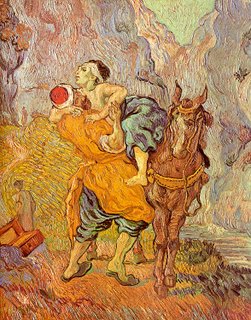
At that time Jesus said to His disciples: Blessed are the eyes that see the things which you see. For I say to you, that many prophets and kings have desired to see the things that you see, and have not seen them; and to hear the things that you hear, and have not heard them. And behold a certain lawyer stood up, tempting him, and saying, Master, what must I do to possess eternal life? But he said to him: What is written in the law? how readest thou? He answering, said: Thou shalt love the Lord thy God with thy whole heart, and with thy whole soul, and with all thy strength, and with all thy mind: and thy neighbour as thyself. And he said to him: Thou hast answered right: this do, and thou shalt live. But he willing to justify himself, said to Jesus: And who is my neighbour? And Jesus answering, said: A certain man went down from Jerusalem to Jericho, and fell among robbers, who also stripped him, and having wounded him went away, leaving him half dead. And it chanced, that a certain priest went down the same way: and seeing him, passed by. In like manner also a Levite, when he was near the place and saw him, passed by. But a certain Samaritan being on his journey, came near him; and seeing him, was moved with compassion. And going up to him, bound up his wounds, pouring in oil and wine: and setting him upon his own beast, brought him to an inn, and took care of him. And the next day he took out two pence, and gave to the host, and said: Take care of him; and whatsoever thou shalt spend over and above, I, at my return, will repay thee.
Which of these three, in thy opinion, was neighbour to him that fell among the robbers? But he said: He that shewed mercy to him. And Jesus said to him: Go, and do thou in like manner.

Why does Jesus call His disciples blessed?
Because they had the happiness which so many kings, patgriarchs, and prophets had desired in vain - in seeing the Saviour of the world, and of hearing His teaching.

What is it to love God?
To acknowledge God as the biggest and most perfect good; that His will should be fulfilled by all; and so zealously to observe His commandment that we would lose all the goods of life, and even life itself, rather than transgress these commands and be separated from God.

What does it mean to love God with the whole heart, etc?
"With thy whole heart" signifies with all the motions and inclinations of the heart; "with thy whole soul," with all the thoughts, conceptions of the soul; "with thy whole mind," with all thy strength," with all the powers and faculties of body and soul - with all the acts and motions of the senses. All these should be directed to God alone, as the object and end of man.

How can this be done?
By doing whatever we do, whether it be mental or manual labour, eating, drinking, or recreation, with the intention of doing the will of God and what is pleasing to Him. By this it is understoos that idle talk, intemperance in meat and drink, and in general all sinful works, cannot be offered to God, because they are contrary to His will and therefore deserve punishment.

Is that true love which loves God because he does us good?
That love is truly good and praiseworthy, but not perfect, for self-interest creeps in with it.

What, then, is the perfect love of God?
When we love God only because He is in Himself the highest good and most worthy of love. In such manner must we endeavour to love God; not out of self-interest, not from the expectation of reward, nor yet from fear of punishment.

Can every one thus love God?
Yes; for there is no state of life in which we cannot refer everything to God. Love does not require great deeds, but that we should avoid evil, and refer everything to God; and all can do this.

ASPIRATIONS
O Jesus, rich in love, Who hast so earnestly exhorted us to love of God and of our neighbour, engrave deep in our hearts, we pray Thee, this commandment of love, that whatever we do or leave undone, all our thoughts, words, and works may= begin and end in love of Thee; and that no tribulations, temptation, or danger, nor even death itself, may ever separate us from Thee. Grant, also, that out of love to Thee we may love our neighbour as ourselves, and by this love may we deserve to have Thee as a saviour and merciful judge. Read whole post......
St John of the Cross
"The Dark night of the soul" CHAPTER XI part II

Oh, happy chance!

3. When God leads the soul into this night of sense in order to purge the sense of its lower part and to subdue it, unite it and bring it into conformity with the spirit, by setting it in darkness and causing it to cease from meditation (as He afterwards does in order to purify the spirit to unite it with God, as we shall afterwards say), He brings it into the night of the spirit, and (although it appears not so to it) the soul gains so many benefits that it holds it to be a happy chance to have escaped from the bonds and restrictions of the senses of or its lower self, by means of this night aforesaid; and utters the present line, namely: Oh, happy chance! With respect to this, it behoves us here to note the benefits which the soul finds in this night, and because of which it considers it a happy chance to have passed through it; all of which benefits the soul includes in the next line, namely:

I went forth without being observed.

4. This going forth is understood of the subjection to its sensual part which the soul suffered when it sought God through operations so weak, so limited and so defective as are those of this lower part; for at every step it stumbled into numerous imperfections and ignorances, as we have noted above in writing of the seven capital sins. From all these it is freed when this night quenches within it all pleasures, whether from above or from below, and makes all meditation darkness to it, and grants it other innumerable blessings in the acquirement of the virtues, as we shall now show. For it will be a matter of great pleasure and great consolation, to one that journeys on this road, to see how that which seems to the soul so severe and adverse, and so contrary to spiritual pleasure, works in it so many blessings. These, as we say, are gained when the soul goes forth, as regards its affection and operation, by means of this night, from all created things, and when it journeys to eternal things, which is great happiness and good fortune: first, because of the great blessing which is in the quenching of the desire and affection with respect to all things; secondly, because they are very few that endure and persevere in entering by this strait gate and by the narrow way which leads to life, as says Our Saviour. The strait gate is this night of sense, and the soul detaches itself from sense and strips itself thereof that it may enter by this gate, and establishes itself in faith, which is a stranger to all sense, so that afterwards it may journey by the narrow way, which is the other night—that of the spirit—and this the soul afterwards enters in order in journey to God in pure faith, which is the means whereby the soul is united to God. By this road, since it is so narrow, dark and terrible (though there is no comparison between this night of sense and that other, in its darkness and trials, as we shall say later), they are far fewer that journey, but its benefits are far greater without comparison than those of this present night. Of these benefits we shall now begin to say something, with such brevity as is possible, in order that we may pass to the other night. Read whole post......

Saturday, August 26, 2006

PRUDENCE
taken from "Divine Intimacy" by Fr Gabriel of St Mary Magdalen, OCD

PRESENCE OF GOD - Show me, O Lord, the way of true prudence

MEDITATION
1. If we wish to attain union with God, our whole life should be directed toward Him; and as our life is made up of many acts, we should see that each one is step forward on the way that leads to Him. Supernatural prudence is that virtue which suggests to us what we should do and what we should avoid in order to reach the goal we have set ourselves. If we wish to reach union with God, prudence tells us to confirm ourself in everything to His will, to detach ourself from all things, even the least, if it be contrary to His divine will. If we wish to become saint, we must perform these acts of charity and generosity without recoiling from the sacrifice. If we wish to become a soul of prayer, we must strive to be recollected, to avoid useless conversation, to mortify our curiosity, and to apply ourself diligently to prayer. Thus prudence prescribes what we ought to do and what we ought to avoid, whether in view of our final end - union with God, sanctity - or in view of an immediate goal - such as the acquisition of particuular virtues - which, however, always must be ordered to our final end. The parable of the wise and foolish virgins effectively demonstrates the need of this virtue. They all slept while waiting for the bridegroom to come; when he arrived, the first five were addmitted into the banquet hall, the other five were refused simply because they had not had the prudence to provide themselves with sufficient oil to fill their lamps. And the parable concludes: "Watch ye therefore, because you know not the day nor the hour" (Matt 25, 13). Supernatural prudence counsels us first of all to make good use of the time God gives us and the opportunities he offers us to practice virtue, because "the night
cometh, when no man can work" (Jn 9,4). When, through indolence or carelessness, we miss an opportunity to do a good deed, it is lost forever; others may present themselves later, it is true, but that one will never return again.

2....true supernatural prudence consists in setting the highest value on each fleeting moment in view of our eternal goal. Human prudence values time as a means to accumulate earthly goods; supernatural prudence values it as a means of accumulate eternal goods, "Lay not up to yourself treasures on earth....but lay up to yourselves treasures in heaven, where neither the rust not moth doth consume....Seek you therefore the kingdom of God, and His justice, and all these things shall be addedd unto you" (Matt 6, 19, 20, 33). these are the chief rulers of prudence, dictated by Jesus Himself.

St. Therese of Child Jesus said to a religious who told her that she disliked doing a certian act of charity which required a great spirit of sacrifice, "I would have been glad to do it, since we are on earth to suffer. The more we suffer, the happier we are. Oh! how little you know about regulating your affairs!" ((Unedited Souvenirs). Supernatural prudence teaches as how to regulate our affairs, not in view of earthly affairs, but in view of our progress in the way of perfection; and aove all in view of the glory of God and the good of souls. Supernatural prudence does not judge things according to their human value, according to the pleasures or displeasure they give us....Christian prudence is opposed to the prudence of the flesh, which resolves everything with an eye to earthly happiness, without any regard for the law of God. "The wisdom of the flesh is an enemy to God; for it is not subject to the law of God, neither can it be" (Rom 8, 7). Supernatural prudence far surpassess natural prudence which is not bad, but which is incapable of directing our actions to their supreme end, since it looks to earthly goals.

COLLOGUY
....Teach me, O Lord, to give the greatest amount of love to each instant, to make eternal every passing moment, by giving it the addedd value of charity. (Sr. Carmela of the Holy Spirit, OCD) Read whole post......
SCRIPTURE CORNER

HEALTH OF THE SICK, PRAY FOR US

We read about Our Saviour in Luke's Gospel: And he sent them to preach the kingdom of God, and to heal the sick. Luke 9,2.
The same gift Our Lord bestowed on His Blessed Mother, Queen of all Saints and Angels. If Lord Jesus listened and granted Jair's request, then we can imagine Him to be more attentive to His Mother's prayers for her ill, miserable and suffering clients. He gave us to her care while dying on the Cross: Woman, behold thy son. Jn 19, 26.
How wrong are those who do not want to acknowledge Our Lady's loving patronage over us, poor sinners. There are many blessed, holy and privileged places all over the world visited by millions of pilgrims and renown for countless miracles. Do we need more proof? The words, Our saviour once said to man begging for help, he can also say now to us: If thou canst believe, all things are possible to him that believeth. Mk 9, 22. Read whole post......

Friday, August 25, 2006

SAINT LOUIS IX King of France (1215-1270)

Spiritual Bouquet: Watch and pray, that you may not enter into temptation. The spirit is willing, but the flesh is weak. St. Matthew 26:41

The mother of the incomparable Saint Louis IX of France, Blanche of Castille, told him when he was still a child that she would rather see him dead in a coffin than stained by a single mortal sin. He never forgot her words. Raised to the throne and anointed in the Rheims Cathedral at the age of twelve, while still remaining under his mother’s regency for several years, he made the defense of God’s honor the aim of his life.

Before one year of their mutual sovereignty had ended, the Catholic armies of France, by a particular blessing, had crushed the Albigensians of the south who had risen up under a heretical prince, and forced them by stringent penalties to respect the Catholic faith. Amid the cares of government, the young prince daily recited the Divine Office and heard two Masses. The most glorious churches in France are still memorials to his piety, among them the beautiful Sainte Chapelle of Notre Dame Cathedral in Paris, where the Crown of Thorns, the great relic which he brought back from the Holy Land, is enshrined. When his courtiers remonstrated with Louis for his law that blasphemers must be branded on the lips, he replied, “I would willingly have my own lips branded if I could thereby root out blasphemy from my kingdom.” A fearless protector of the weak and the oppressed, a monarch whose justice was universally recognized, he was chosen to arbitrate in all the great feuds of his age.

In 1248, to rescue the land where Christ had walked, he gathered round him the chivalry of France, and embarked for the East. He visited the holy places; approaching Nazareth he dismounted, knelt down to pray, then entered on foot. He visited the Holy House of Nazareth and on its wall a fresco was afterwards painted, still visible when the House was translated to Loreto, depicting him offering his manacles to the Mother of God. Wherever he was: at home with his many children, facing the infidel armies, in victory or in defeat, on a bed of sickness or as a captive in chains, King Louis showed himself ever the same — the first, the best, and the bravest of Christian knights.

When he was a captive at Damietta, an Emir rushed into his tent brandishing a dagger red with the blood of the Sultan, and threatened to stab him also unless he would make him a knight. Louis calmly replied that no unbeliever could perform the duties of a Christian knight. In the same captivity he was offered his liberty on terms lawful in themselves, but enforced by an oath which implied a blasphemy, and although the infidels held their swords’ points at his throat and threatened a massacre of the Christians, Louis inflexibly refused.

The death of his mother recalled him to France in 1252; but when order was re-established he again set out for a second crusade. In August of 1270 his army landed at Tunis, won a victory over the enemy, then was laid low by a malignant fever. Saint Louis was one of the victims. He received the Viaticum kneeling by his camp bed, and gave up his life with the same joy in which he had given all else for the honor of God.

Reflection: Saint Louis wrote to his oldest son Philip, heir to the crown: “I recommend to you before all else to apply yourself with all your heart to love God.”

Source: Little Pictorial Lives of the Saints, a compilation based on Butler’s Lives of the Saints and other sources by John Gilmary Shea (Benziger Brothers: New York, 1894).

The picture of the King is by El Greco

after www.magnificat.ca Read whole post......
SCRIPTURE CORNER

ON THE DUTIES OF THE STATE part two

One of the most important duty of the state is purity of life, subjugation of sensuality out of necessity fot the body longs for it due to the corruption of our nature For the flesh lusteth against the spirit: and the spirit against the flesh; for these are contrary one to another: so that you do not the things that you would Gal 5,17.
God Himself highly value and rewards this virtue, blessing those who remain pure like Patriarch Joseph, John the Baptist, Susanna, Mary, Joseph the Foster Father of Jesus, John the Apostle, Holy Innocents Blessed are the clean of heart: for they shall see God Matt 5, 8.
And how people of the world value purity? Even famous from immorality ancient Romans highly respected consecrated virgins (vestals) and german tribes particularly esteemed their virginal priestesses. Since, by the grace of God Our Lady became virgin mother, Lord Jesus and apostles praised the virtue of purity the most, this virtue blossomed in Christian world. The worst enemy of purity is lust But I see another law in my members, fighting against the law of my mind, and captivating me in the law of sin, that is in my members. Rom 7, 23.
Eeven cedars of Libanon, like David and Solomon were defeated by lust. Be watchful then of seducers and do not trust yourself. Indecent, blasphemous movies, books, newspapers, TV programmes. No more complains, it is time to act. Catholic Action may help to cope Let no sin therefore reign in your mortal body, so as to obey the lusts thereof Rom 6, 12 Read whole post......

Thursday, August 24, 2006

CHAPTER XI
from "Dark night of the soul" by St. John of the Cross

Wherein are expounded the three lines of the stanza.

THIS enkindling of love is not as a rule felt at the first, because it has not begun to take hold upon the soul, by reason of the impurity of human nature, or because the soul has not understood its own state, as we have said, and has therefore given it no peaceful abiding-place within itself. Yet sometimes, nevertheless, there soon begins to make itself felt a certain yearning toward God; and the more this increases, the more is the soul affectioned and enkindled in love toward God, without knowing or understanding how and whence this love and affection come to it, but from time to time seeing this flame and this enkindling grow so greatly within it that it desires God with yearning of love; even as David, when he was in this dark night, said of himself in these words, namely: 'Because my heart was enkindled (that is to say, in love of contemplation), my reins also were changed': that is, my desires for sensual affections were changed, namely from the way of sense to the way of the spirit, which is the aridity and cessation from all these things whereof we are speaking. And I, he says, was dissolved in nothing and annihilated, and I knew not; for, as we have said, without knowing the way whereby it goes, the soul finds itself annihilated with respect to all things above and below which were accustomed to please it; and it finds itself enamoured, without knowing how. And because at times the enkindling of love in the spirit grows greater, the yearnings for God become so great in the soul that the very bones seem to be dried up by this thirst, and the natural powers to be fading away, and their warmth and strength to be perishing through the intensity of the thirst of love, for the soul feels that this thirst of love is a living thirst. This thirst David had and felt, when he said: 'My soul thirsted for the living God.' Which is as much as to say: A living thirst was that of my soul. Of this thirst, since it is living, we may say that it kills. But it is to be noted that the vehemence of this thirst is not continuous, but occasional although as a rule the soul is accustomed to feel it to a certain degree.
2. But it must be noted that, as I began to say just now, this love is not as a rule felt at first, but only the dryness and emptiness are felt whereof we are speaking. Then in place of this love which afterwards becomes gradually enkindled, what the soul experiences in the midst of these aridities and emptinesses of the faculties is an habitual care and solicitude with respect to God, together with grief and fear that it is not serving Him. But it is a sacrifice which is not a little pleasing to God that the soul should go about afflicted and solicitous for His love. This solicitude and care leads the soul into that secret contemplation, until, the senses (that is, the sensual part) having in course of time been in some degree purged of the natural affections and powers by means of the aridities which it causes within them, this Divine love begins to be enkindled in the spirit. Meanwhile, however, like one who has begun a cure, the soul knows only suffering in this dark and arid purgation of the desire; by this means it becomes healed of many imperfections, and exercises itself in many virtues in order to make itself meet for the said love, as we shall now say with respect to the line following: Read whole post......
SCRIPTURE CORNER
ON THE DUTIES OF THE STATEPart 1

It is God's will that we all should work - In the sweat of thy face shalt thou eat bread till thou return to the earth, out of which thou wast taken. Gen 3, 19.
Our well being and satisfaction depend on the work done -The life of a labourer that is content with what he hath, shall be sweet, and in it thou shalt find a treasure. Ecclessiasticus 40, 18.
Since Our Lord Jesus sanctified work through His own labour, work then will give us eternal reward as promised Go you also into my vineyard, and I will give you what shall be just. Mt 20, 4.
Sense of duty is to be the leading force in our lives. For example, God wants us to be pious, which in latin is devotio, or devotion to God. Remembering Him joyfully in morning and evening prayers, blessings before and after meal, saying Angelus, keeping Sunday holy, taking regular Communions, these are the duties of Christian life which will be greatly rewarded The generation of the righteous shall be blessed Ps 111, 2
Another example - God told us to respect and love our parentsHonour thy father and thy mother, that thou mayest be longlived upon the land which the Lord thy God will give thee. Ex 20, 12 . This is natural law, for after God we owe to them a lot. To ensure God's blessing we should love and respect them, in particular in their old age when they become weak and vulnerableThat you may approve the better things, that you may be sincere and without offence unto the day of Christ. Ph 1, 10 Read whole post......

Wednesday, August 23, 2006

SCRIPTURE CORNER

TOWARDS HEAVEN

Beloved Apostle once said: "The whole world is seated in wickedness" (1 Jn 5, 19) and it is still very true today. In desparation one can ask "Lord, are they few that are saved?" (Lk 13, 23). Satan, world and sensuality are daedly enemies of the soul and our salvation - they are always active and can be defeated only by constant effort and struggle. That is why the old Job was groaning under opression: "The life of man upon earth is a warfare" (Job 7, 1). Never ending fight with evil and struggle for goodness. All these efforts will end for ever when the gates of heaven would be opened for us. But what is heaven? Blessed peace after long battle - a reward - "so shall we be always with the Lord" (1 Tes 4, 16). We will be there to adore God's infinite beauty, perfection and goodness, rejoicing in indescribable happiness. Read whole post......

Tuesday, August 22, 2006

SCRIPTURE CORNER

ABOUT HAPPINESS part two.

As we concluded in the first part of the post, things temporal cannot bring true happiness. Only supernatural, eternal God can fill the gap. For the human soul and heart can only be truly satisfied with the beauty of infinite goodness and perfection which is God. Only He can give us all we need. St Peter on Mount Tabor found perfect happiness in the glory of Jesus. On Mount Alverni, St. Francis after being in deep contemplation and unity with God could only exclaimed "My God and all mine". Napoleon was truly happy only once in his life - when he received his first holy communion. Maybe we also should go back to the moments of some deeply moving religious experience to realise our own Tabor-like true happiness. For St. Augustin says "You created us for yourself, O God, and our hearts are restless until we will find rest in you". St. Teresa perfectly summarized the point saying "God only suffices". Let us renounce all inordinate attachements to things temporal and longing for wordly happiness. Let us stay with God instead, living for Him and through Him, keeping in mind the words of the Apostle:

But I am straitened between two: having a desire to be dissolved and to be with Christ, a thing by far the better (Phil 1: 23)
Read whole post......

Monday, August 21, 2006

St John of the Cross "Dark night of the soul" - CHAPTER X

Of the way in which these souls are to conduct themselves in this dark night.


3. It is well for those who find themselves in this condition to take comfort, to persevere in patience and to be in no wise afflicted. Let them trust in God, Who abandons not those that seek Him with a simple and right heart, and will not fail to give them what is needful for the road, until He bring them into the clear and pure light of love. This last He will give them by means of that other dark night, that of the spirit, if they merit His bringing them thereto.
4. The way in which they are to conduct themselves in this night of sense is to devote themselves not at all to reasoning and meditation, since this is not the time for it, but to allow the soul to remain in peace and quietness, although it may seem clear to them that they are doing nothing and are wasting their time, and although it may appear to them that it is because of their weakness that they have no desire in that state to think of anything. The truth is that they will be doing quite sufficient if they have patience and persevere in prayer without making any effort. What they must do is merely to leave the soul free and disencumbered and at rest from all knowledge and thought, troubling not themselves, in that state, about what they shall think or meditate upon, but contenting themselves with merely a peaceful and loving attentiveness toward God, and in being without anxiety, without the ability and without desired to have experience of Him or to perceive Him. For all these yearnings disquiet and distract the soul from the peaceful quiet and sweet ease of contemplation which is here granted to it.
5. And although further scruples may come to them—that they are wasting their time, and that it would be well for them to do something else, because they can neither do nor think anything in prayer—let them suffer these scruples and remain in peace, as there is no question save of their being at ease and having freedom of spirit. For if such a soul should desire to make any effort of its own with its interior faculties, this means that it will hinder and lose the blessings which, by means of that peace and ease of the soul, God is instilling into it and impressing upon it. It is just as if some painter were painting or dyeing a face; if the sitter were to move because he desired to do something, he would prevent the painter from accomplishing anything and would disturb him in what he was doing. And thus, when the soul desires to remain in inward ease and peace, any operation and affection or attentions wherein it may then seek to indulge will distract it and disquiet it and make it conscious of aridity and emptiness of sense. For the more a soul endeavours to find support in affection and knowledge, the more will it feel the lack of these, which cannot now be supplied to it upon that road.
6. Wherefore it behoves such a soul to pay no heed if the operations of its faculties become lost to it; it is rather to desire that this should happen quickly. For, by not hindering the operation of infused contemplation that God is bestowing upon it, it can receive this with more peaceful abundance, and cause its spirit to be enkindled and to burn with the love which this dark and secret contemplation brings with it and sets firmly in the soul. For contemplation is naught else than a secret, peaceful and loving infusion from God, which, if it be permitted, enkindles the soul with the spirit of love, according as the soul declares in the next lines, namely:

Kindled in love with yearnings. Read whole post......
SCRIPTURE CORNER

ABOUT HAPPINESS part one

We all long to be happy and we should be. We are created to be happy. Let us then look first at what makes us unhappy. Wordly possessions and riches do not contribute to happiness for Our Lord calls them "thorns" (Matt 13,7) which "opress and tear the soul to pieces" as St. Gregory says. Why? Because the more we possess the more we desire to have. True happiness does not live in magnificent palaces. We cannot find it in friendship or pleasures also. For sincere friendship can hardly be found:

For all seek the things that are their own.Phil 2, 21

Even apparently the most real friendship is always tainted with egoizm. Relying too much on other people is like building the castle on the sand. Pleasures are costly and end quickly followed by desire to find better substitute. Science and art does not bring happiness as well, for St. Paul says: "For we know in part. 1 Cor 13, 9. Ever increasing problems to solve cannot bring real satisfaction. It cannot be found in human love also. Someone said, "Everybody has a mother, some have a friend, but hardly anyone has one truly beloved". Human love brings usually plenty of suffering but very little happiness. The most dissapointing is the love of honours - it makes people restless from desire. No true happiness can be found in sensuality, for lust and intemperance can bring only emptiness. The parable of prodigal son says it all. Even wealthy Solomon, who had all for his disposal, concluded in the end: "But this also is vanity, and presumption of spirit" (Ecclesiastes 6,9). Emperor Franz Joseph once said: "No suffering was spared me". Highly successful Goethe confessed he had not experienced in his long life a period of "several peacefull and satisfying weeks". And in his drama "Faust" he reveals he was always restless. Even if someone is happy in the world for a longer period, there is always unpleasant perspective of the old age approaching followed by the end of life. They are happy only by name. For the eternal truth is: "The eye is not filled with seeing, neither is the ear filled with hearing. Ecclesiastes 1, 8. Read whole post......

Sunday, August 20, 2006

SCRIPTURE CORNER
ABOUT MIRACLES

And so much the more did they wonder, saying: He hath done all things well; he hath made both the deaf to hear, and the dumb to speak. Mark 7, 37

Our Lord worked many historically proven miracles. Are miracles still happen today, someone can ask. This is an important question - in today's world, amid blooming science, advanced technical knowledge are miracles still happen? But Christ Our Lord promised us for ages to come:

And these signs shall follow them that believe. Mark 16, 17

The miracles still happen - this is the truth. Let us remember the greatest one - transubstantiation - granted to us during every Mass. Let us remember countless miracles which took place at Lourdes. Those listed in Church documents are all medically proven beyond doubts. In 1930, Medical Faculty of Paris University accepted thesis submitted by dr Henri Monnier and entitled "Analysis of some cases of healing that took place at Lourdes". The work was given very good reviews and marks by the panel of experts. In his work, dr Monnier demonstrated that the cures he analised could not have ever happened without supernatural intervention.

In every process of beatification or canonization, sound miracles, cures surpassing natural power are required to prove sanctity of the candidate - the clear stamp of supernatural approval is essential to recognize the real saint. They are carefully investigated by both ecclesiastical and medical experts. Almighty is active in His Church. For us, His children, we need to have a good will and open eyes. Otherwise the words of Our Saviour could not be surprising:

neither will they believe, if one rise again from the dead Luke 16, 31 Read whole post......