Thursday, August 10, 2006

St John of the Cross "Dark night of the soul" - CHAPTER V

Of imperfections with respect to spiritual gluttony.
part two

3. You will find that many of these persons are very insistent with their spiritual masters to be granted that which they desire, extracting it from them almost by force; if they be refused it they become as peevish as children and go about in great displeasure, thinking that they are not serving God when they are not allowed to do that which they would. For they go about clinging to their own will and pleasure, which they treat as though it came from God; and immediately their directors take it from them, and try to subject them to the will of God, they become peevish, grow faint-hearted and fall away. These persons think that their own satisfaction and pleasure are the satisfaction and service of God.
4. There are others, again, who, because of this gluttony, know so little of their own unworthiness and misery and have thrust so far from them the loving fear and reverence which they owe to the greatness of God, that they hesitate not to insist continually that their confessors shall allow them to communicate often. And, what is worse, they frequently dare to communicate without the leave and consent of the minister and steward of Christ, merely acting on their own opinion, and contriving to conceal the truth from him. And for this reason, because they desire to communicate continually, they make their confessions carelessly, being more eager to eat than to eat cleanly and perfectly, although it would be healthier and holier for them had they the contrary inclination and begged their confessors not to command them to approach the altar so frequently: between these two extremes, however, the better way is that of humble resignation. But the boldness referred to is a thing that does great harm, and men may fear to be punished for such temerity.
5. These persons, in communicating, strive with every nerve to obtain some kind of sensible sweetness and pleasure, instead of humbly doing reverence and giving praise within themselves to God. And in such wise do they devote themselves to this that, when they have received no pleasure or sweetness in the senses, they think that they have accomplished nothing at all. This is to judge God very unworthily; they have not realized that the least of the benefits which come from this Most Holy Sacrament is that which concerns the senses; and that the invisible part of the grace that it bestows is much greater; for, in order that they may look at it with the eyes of faith, God oftentimes withholds from them these other consolations and sweetnesses of sense. And thus they desire to feel and taste God as though He were comprehensible by them and accessible to them, not only in this, but likewise in other spiritual practices. All this is very great imperfection and completely opposed to the nature of God, since it is Impurity in faith.
6. These persons have the same defect as regards the practice of prayer, for they think that all the business of prayer consists in experiencing sensible pleasure and devotion and they strive to obtain this by great effort, wearying and fatiguing their faculties and their heads; and when they have not found this pleasure they become greatly discouraged, thinking that they have accomplished nothing. Through these efforts they lose true devotion and spirituality, which consist in perseverance, together with patience and humility and mistrust of themselves, that they may please God alone. For this reason, when they have once failed to find pleasure in this or some other exercise, they have great disinclination and repugnance to return to it, and at times they abandon it. They are, in fact, as we have said, like children, who are not influenced by reason, and who act, not from rational motives, but from inclination. Such persons expend all their effort in seeking spiritual pleasure and consolation; they never tire therefore, of reading books; and they begin, now one meditation, now another, in their pursuit of this pleasure which they desire to experience in the things of God. But God, very justly, wisely and lovingly, denies it to them, for otherwise this spiritual gluttony and inordinate appetite would breed in numerable evils. It is, therefore, very fitting that they should enter into the dark night, whereof we shall speak, that they may be purged from this childishness.
7. These persons who are thus inclined to such pleasures have another very great imperfection, which is that they are very weak and remiss in journeying upon the hard road of the Cross; for the soul that is given to sweetness naturally has its face set against all self-denial, which is devoid of sweetness.
8. These persons have many other imperfections which arise hence, of which in time the Lord heals them by means of temptations, aridities and other trials, all of which are part of the dark night. All these I will not treat further here, lest I become too lengthy; I will only say that spiritual temperance and sobriety lead to another and a very different temper, which is that of mortification, fear and submission in all things. It thus becomes clear that the perfection and worth of things consist not in the multitude and the pleasantness of one's actions, but in being able to deny oneself in them; this such persons must endeavour to compass, in so far as they may, until God is pleased to purify them indeed, by bringing them into the dark night, to arrive at which I am hastening on with my account of these imperfections. Read whole post......
SCRIPTURE CORNER

FOLLOWING CHRIST

Let not your heart be troubled. You believe in God, believe also in me Jn 14, 1

Jesus said to him: I am the way, and the truth, and the life. Jn 14, 6

These things I have spoken to you, that in me you may have peace. In the world you shall have distress: but have confidence, I have overcome the world. Jn 16, 33

the goodness and kindness of God our Saviour Tt 3, 4

lovest thou me more than this? Yea, Lord, thou knowest that I love thee Jn 21, 15

We must follow Christ in total abandonment and trust. He deserve it and He likes it for He says: have confidence, I have overcome the world.
Read whole post......
SAINT LAWRENCE Deacon and Martyr (†258)

Spiritual Bouquet:
These things I command you, that you may love one another. St. John 15:17

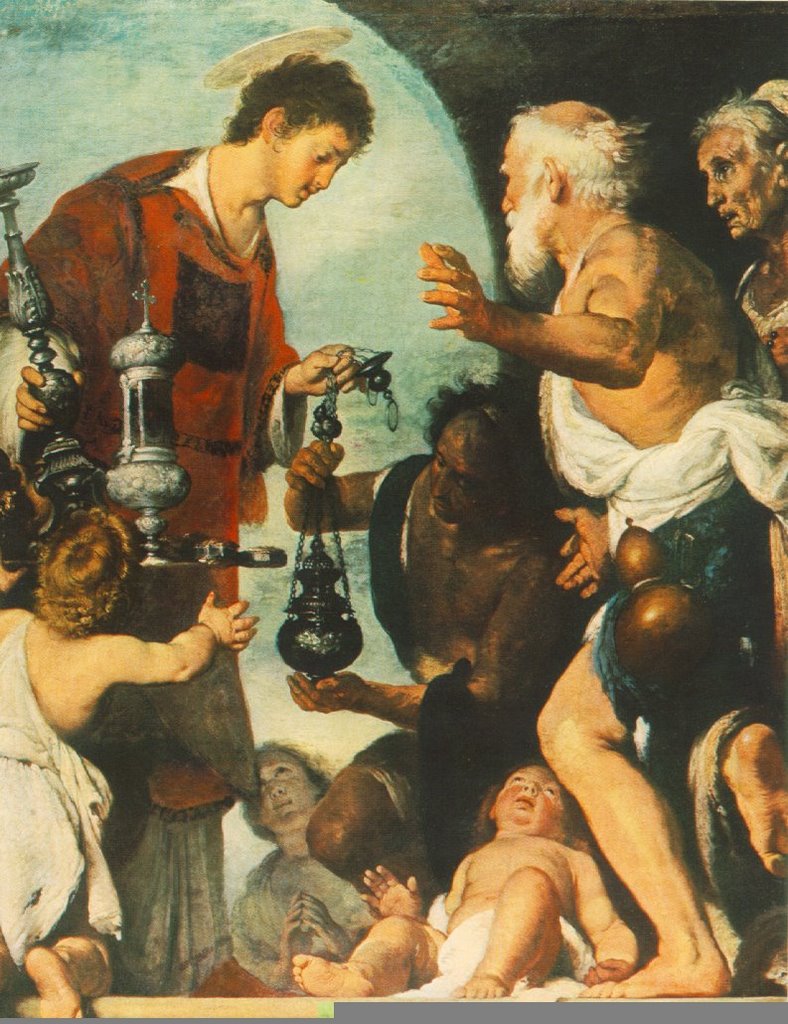
Saint Lawrence was Chief of the seven deacons of Rome. In the year 258 Pope Sixtus was led out to die, and Saint Lawrence followed beside him, weeping because unable to share his fate. “Where are you going, my father, without your son? Where are you going, holy pontiff, without your deacon? Never did you offer a sacrifice without my serving you at the altar. In what way have I displeased you?” The holy Pope comforted him with the words, “I am not abandoning you, my son; a more difficult trial and a more glorious victory are reserved for you; in three days you will follow me.”

This prophecy was fulfilled. After the Pope’s martyrdom the prefect of the city, knowing the rich offerings which the Christians put into the hands of the clergy, demanded the treasures of the Roman Church from Lawrence, their guardian. The Saint promised to show him, at the end of three days, riches exceeding all the wealth of the empire. He was granted the time of delay. The Archdeacon of Rome went about assembling the poor, the infirm, and the religious who lived by the alms of the faithful, and he brought them to the prefect on the appointed day. “Behold the treasures I promised you; I add pearls and precious stones — these virgins and widows consecrated to God; the Church has no other riches.” The prefect replied: “How dare you play games with me, miserable one? Is this how you show your contempt for the imperial power?”

Christ, whom Lawrence had served in His poor, gave him strength in the conflict which ensued. After being placed on the rack, he was stretched on a grill over a slow fire. He joked about his pains. “I am roasted enough on this side,” he said, “perhaps you should turn me over.” Soon, his gaze towards heaven, he gave up his soul to God. He was buried in the catacomb near the Tiburtine Way, called the Verano Field, a little over a mile from the city walls. The faithful watched there for three days to mourn their holy Archdeacon who had been so good to them. God, by the glory of this holy martyr, demonstrates the value He sets upon love for the poor. Innumerable prayers were offered at his tomb. Saint Lawrence continued from his throne in heaven his charity to those in need, granting them, as Saint Augustine says, “the smaller graces which they sought, and leading them to the desire of better gifts.”

Reflection: Our Lord appears before us in the persons of the poor. Charity to them is a great sign of predestination. It is almost impossible, the holy Fathers assure us, for any one who is charitable to the poor, above all for Christ’s sake, to perish.

Sources: Les Petits Bollandistes: Vies des Saints, by Msgr. Paul Guérin (Bloud et Barral: Paris, 1882), Vol. 9; Little Pictorial Lives of the Saints, a compilation based on Butler’s Lives of the Saints and other sources by John Gilmary Shea (Benziger Brothers: New York, 1894).
after www.magnificat.ca

Today's picture "Compassion of St. Lawrence' is by italian painter, Bernardo Strozzi (after http://keptar.demasz.hu/arthp/html/s/strozzi/index.htm) Read whole post......

Wednesday, August 09, 2006

SAINT JOHN VIANNEY Curé of Ars, Confessor (1786-1859)

Spiritual Bouquet:
I have appointed you that you should go and bear fruit, and that your fruit should remain. St. John 15:16


It has been said of more than one person, of more than one Saint, that they were the prodigies of their century. This is perhaps true of no one more than of the Curé of Ars. This man, who was so remarkably humble, for about thirty years saw the whole world, as it were, attentive to his virtues, the entire Christian world at his feet. He is certainly a marvel of the pastoral apostolate and sanctity.

Born three years before the French Revolution into a humble and profoundly Christian family, at Dardilly near Lyons, he was at first a little shepherd, occupied also with the cultivation of the land. From his earliest years he was noted for his candor, piety, love for the Blessed Virgin, and charity for the poor. He desired to become a priest and reached the altar through his piety rather than through his talents. Lack of schooling during the Revolution had made Latin grammar virtually inaccessible to his best efforts. The bishop asked, however, whether he was pious; and when he heard that he said his Rosary like an Angel, ordained him.

After a few years of parish work as an Assistant Pastor, in 1817 he was placed in charge of the parish of Ars, a small village considered backward and scarcely half-Christian. On his way there, solitary and in poverty, when he saw in the distance the steeple of the church, he knelt and prayed God to bless his ministry. His first concern was to visit his parishioners, and he soon won them over by his far-from-ordinary virtue. To their indifference to religion, then, a profoundly Christian spirit succeeded, and one saw the Lord’s day observed to perfection; under the influence of a Saint, the parish of Ars became like a religious community. Word of this transformation passed from one person to another and soon, from many surrounding regions people came to hear him, enter humbly into the confessional, and obtain miracles. These he attributed to Saint Philomena, whose tomb had recently been discovered, and whom he called his dear little Saint. He was very attentive to the beauty of the sanctuary, to the preparation of his sermons, and to the orphanage which he founded; no application was excessive where these were concerned. For himself he was unsparing, sleeping in a damp basement and persecuted there incessantly by the devil. The villagers themselves became aware of his terrible combats with the one he called the “grappin” — literally a sharp-pronged anchor — the fitting name he gave the ancient enemy.

Ten years later, the reputation of this humble country priest had spread over Europe, and from everywhere there came impious scoffers, unbelievers, and libertines, as well as fervent Christians and those in sorrow; the former were converted by the thousands, the latter consoled and strengthened for their combats. He spent ordinarily from sixteen to eighteen hours daily in the confessional, in winter with his feet on an unheated stone floor; and the rest of his time in preaching, prayer, and teaching catechism in the church. He died at the advanced age of 84, despite his unrelenting penance and long-standing rheumatism, and loved “by the whole world.”

Reflection: Let us pray for holy priests to bring the world on its knees to its Saviour. No intention is more important than this one. The Curé of Ars will pray with us, if we ask him to do so, and protect the sacerdotal race from the unending, unrelenting dangers which threaten it everywhere.

Sources: Vie des Saints pour tous les jours de l’année, by Abbé L. Jaud (Mame: Tours, 1950); Life of the Curé of Ars, by Msgr. Francis Trochu (translated from the French). Read whole post......

Tuesday, August 08, 2006

St John of the Cross - "Dark night of the soul" - CHAPTER VI

Of imperfections with respect to spiritual gluttony.
part one

WITH respect to the fourth sin, which is spiritual gluttony, there is much to be said, for there is scarce one of these beginners who, however satisfactory his progress, falls not into some of the many imperfections which come to these beginners with respect to this sin, on account of the sweetness which they find at first in spiritual exercises. For many of these, lured by the sweetness and pleasure which they find in such exercises, strive more after spiritual sweetness than after spiritual purity and discretion, which is that which God regards and accepts throughout the spiritual journey. Therefore, besides the imperfections into which the seeking for sweetness of this kind makes them fall, the gluttony which they now have makes them continually go to extremes, so that they pass beyond the limits of moderation within which the virtues are acquired and wherein they have their being. For some of these persons, attracted by the pleasure which they find therein, kill themselves with penances, and others weaken themselves with fasts, by performing more than their frailty can bear, without the order or advice of any, but rather endeavouring to avoid those whom they should obey in these matters; some, indeed, dare to do these things even though the contrary has been commanded them.
2. These persons are most imperfect and unreasonable; for they set bodily penance before subjection and obedience, which is penance according to reason and discretion, and therefore a sacrifice more acceptable and pleasing to God than any other. But such one-sided penance is no more than the penance of beasts, to which they are attracted, exactly like beasts, by the desire and pleasure which they find therein. Inasmuch as all extremes are vicious, and as in behaving thus such persons are working their own will, they grow in vice rather than in virtue; for, to say the least, they are acquiring spiritual gluttony and pride in this way, through not walking in obedience. And many of these the devil assails, stirring up this gluttony in them through the pleasures and desires which he increases within them, to such an extent that, since they can no longer help themselves, they either change or vary or add to that which is commanded them, as any obedience in this respect is so bitter to them. To such an evil pass have some persons come that, simply because it is through obedience that they engage in these exercises, they lose the desire and devotion to perform them, their only desire and pleasure being to do what they themselves are inclined to do, so that it would probably be more profitable for them not to engage in these exercises at all. Read whole post......
SAINT CYRIACUS Deacon and Martyr and his COMPANIONS Martyrs (†303)

Spiritual Bouquet:
You have not chosen Me, but I have chosen you. St. John 15:16

Saint Cyriacus, born of a noble patrician family, embraced the Christian religion and gave all his wealth to the poor. He was ordained a deacon at Rome, under Pope Marcellinus. Diocletian was emperor at that time, assisted by Maximian, his favorite. The latter decided to build a beautiful palace for the emperor, with magnificent baths, and to make the Christians work at the construction. Among the new slaves were elderly gentlemen and persons of the highest rank, clerics and priests. The labor was hard and the food scanty. A Roman nobleman desired to relieve the sufferings of these laborers and sent four Christians with alms and encouragements; these were Saint Cyriacus, Saint Sisinius, Saint Largus and Saint Smaragdus. They pursued their charities at the risk of their lives, and they worked vigorously alongside those who were growing very weak. When Maximian heard of it, he had Saint Sisinius and an old gentleman whom he had helped, decapitated.

Saint Cyriacus was well known to Diocletian, who was fond of him. Suddenly Diocletian’s daughter became possessed by a furious demon, and she announced that only Cyriacus could deliver her. Diocletian sent for him, and he cured her. She became a Christian like her mother, who is today Saint Serena. A short time later the daughter of the king of Persia also became possessed, and cried out like Diocletian’s daughter that she could be delivered only by Cyriacus, who was in Rome. A message was sent to Diocletian, who asked his wife to persuade the deacon to go to Persia for this purpose. He did so with his two remaining Christian companions, and again cast out the demon, thus bringing about the conversion of the king, his family and four hundred persons, whom he baptized. The three confessors returned to Rome, having refused all compensation for their services, saying that they had received the gifts of God gratuitously and wished to share them gratuitously, not deriving profit from them. The barbarous Maximian, hearing of their return in 303, had them seized, imprisoned and tortured, and finally decapitated with twenty other courageous Christians. Their bodies were first buried near the place of their execution on the Salarian Way, but were later removed to the city. An abbey in France, at Altorf in Alsace, possesses relics of Saint Cyriacus and bears his name.

Reflection: To honor the martyrs and duly celebrate their feasts, we must learn their spirit and study to imitate them according to our state of life. We must, like them, resist evil, subdue our passions, suffer afflictions with patience, and bear with others without murmuring or complaining. The cross is the ladder by which we must ascend to heaven.

Sources: Les Petits Bollandistes: Vies des Saints, by Msgr. Paul Guérin (Bloud et Barral: Paris, 1882), Vol. 9; Little Pictorial Lives of the Saints, a compilation based on Butler’s Lives of the Saints and other sources by John Gilmary Shea (Benziger Brothers: New York, 1894). Read whole post......

Monday, August 07, 2006

St John of the Cross "Dark night of the soul" - CHAPTER V

Of the imperfections into which beginners fall with respect to the sin of wrath.


BY reason of the concupiscence which many beginners have for spiritual consolations, their experience of these consolations is very commonly accompanied by many imperfections proceeding from the sin of wrath; for, when their delight and pleasure in spiritual things come to an end, they naturally become embittered, and bear that lack of sweetness which they have to suffer with a bad grace, which affects all that they do; and they very easily become irritated over the smallest matter—sometimes, indeed, none can tolerate them. This frequently happens after they have been very pleasantly recollected in prayer according to sense; when their pleasure and delight therein come to an end, their nature is naturally vexed and disappointed, just as is the child when they take it from the breast of which it was enjoying the sweetness. There is no sin in this natural vexation, when it is not permitted to indulge itself, but only imperfection, which must be purged by the aridity and severity of the dark night.
2. There are other of these spiritual persons, again, who fall into another kind of spiritual wrath: this happens when they become irritated at the sins of others, and keep watch on those others with a sort of uneasy zeal. At times the impulse comes to them to reprove them angrily, and occasionally they go so far as to indulge it and set themselves up as masters of virtue. All this is contrary to spiritual meekness.
3. There are others who are vexed with themselves when they observe their own imperfectness, and display an impatience that is not humility; so impatient are they about this that they would fain be saints in a day. Many of these persons purpose to accomplish a great deal and make grand resolutions; yet, as they are not humble and have no misgivings about themselves, the more resolutions they make, the greater is their fall and the greater their annoyance, since they have not the patience to wait for that which God will give them when it pleases Him; this likewise is contrary to the spiritual meekness aforementioned, which cannot be wholly remedied save by the purgation of the dark night. Some souls, on the other hand, are so patient as regards the progress which they desire that God would gladly see them less so. Read whole post......
SCRIPTURE CORNER

TOWARDS HOLINESS

As children of obedience, not fashioned according to the former desires of your ignorance: But accordingly to him that hath called you, who is holy, be you also [in all manner of conversation] holy. 1 Pt 1, 14.

As he chose us in him before the foundation of the world, that we should be holy and unspotted in his sight in charity. Eph 1, 4

There shall not enter into it any thing defiled, or that worketh abomination or make a lie, but they that are written in the book of life of the Lamb. Rev 21, 27

This is the will of God our sanctification and because of this, it is possible to achieve. Read whole post......
St ALBERT OF TRAPANI
Carmelite Friar, 1307

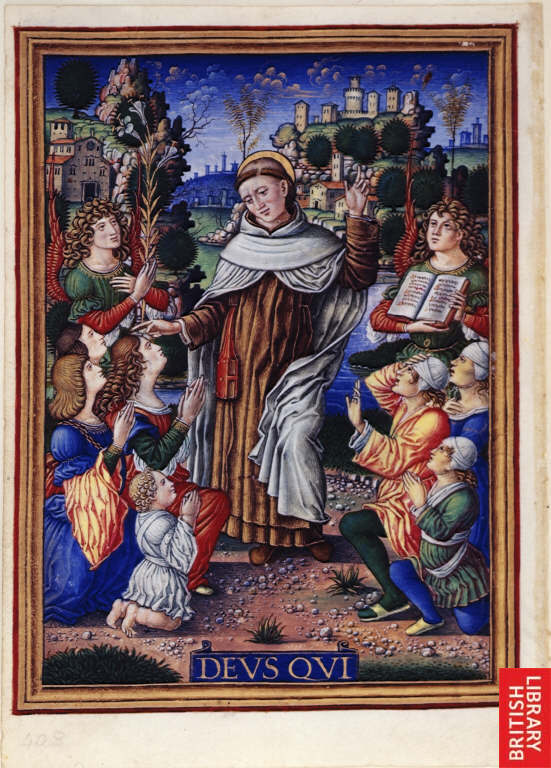
Carmelite hermit and missionary. He was born in Trapani, Sicily, and joined the Carmelite Order. After ordination, he was sent to nearby Messina, where he gathered thousands with his preaching and miracles. After serving as a missionary, Albert entered a monastic hermitage near Messina. He remained there until his death.
after http://www.catholic.org/saints/

Let us pray.
Lord God,
you made St. Albert of Trapani
a model of purity and prayer,
and a devoted servant of Our Lady.
May we practise these same virtues
and so be worthy always
to share the banquet of your grace.
We ask this through Christ our Lord.
Amen
prayer after www.carmelite.org


THE FRESCO OF SAINT ALBERT OF TRAPANI

It is a large fresco depicted on 1471, where s. Albert is surrounded by fourteen medallions of carmelite saints. Above, on the left: the Archangel Gabriel at the Annunciation; below st. Veronica (1472). Above, on the right our Lady at the Annunciation; below, st. Sebastian (1472)

after http://www.santuariodelcarmine-sanfelice.it/l_inglese/art.asp?Argomento=710&Id_Rec=245 Read whole post......

Sunday, August 06, 2006

SCRIPTURE CORNER

TOWARDS HOLINESS

For in many things we all offend. Jas 3,2

For he knoweth our frame. He remembereth that we are dust. Ps 102,14

For there is no just man upon earth, that doth good, and sinneth not. Ecc 7:21

peace to men of good will. Lk 2,14

We all can be saints and we must be. It is nothing extraordinary, it does not depend on excessive mortifications, fasts, penances, night vigils and long prayers. It is very simple, it is faithful following the rules of christian life in utmost simplicity for God and with God. Let us look at and follow the example of the greatest saints: the Most Holy Family living in the little house in Nazareth. All we need is a good will. Read whole post......

Saturday, August 05, 2006

SCRIPTURE CORNER

TOWARDS HOLINESS

"Good master, what good shall I do that I may have life everlasting?" (Mt 19, 16)

"And let the just feast, and rejoice before God" (Ps 67, 4)

"I must not return, nor go with thee". (3 Kings 13, 16)

"Blessed be the man that trusteth in the Lord, and the Lord shall be his confidence". (Jr 17, 7)

Holy fear of God is good for the soul but in complete trust in His mercy avoiding unreasonable scruples and worries.
Read whole post......
The DEDICATION of SAINT MARY of the SNOWS (435)

Spiritual Bouquet: Greater love than this no one has, that one lays down his life for his friends. St. John 15:13

There are in Rome three patriarchal churches in which, on different feast days, the Pope officiates. These are the Basilicas of Saint Peter on the Vatican Hill, Saint John Lateran, and Saint Mary Major on the Esquiline Hill. The last-named, the Liberian Basilica, was founded in the time of Pope Liberius, in the fourth century; it was consecrated to the Virgin Mary by Sixtus III in the year 435, under the title of Saint Mary ad Nives, or at the snow, because the Mother of God Herself chose, and indicated by a miracle, its site to be that of Her first church in Rome.

In the fourth century a patrician by the name of John and his pious spouse had no children; already advanced in age and without heirs, they resolved to consecrate their wealth to the Most Blessed Virgin. They prayed in order to know how the Queen of Heaven would like them to use their fortune. On August 5, 366, She appeared to each of them in a dream and told them that Her Divine Son’s and Her own will was that their wealth be employed in the construction of a church on Mount Esquiline, at a place which in the morning they would find covered with snow. They consulted together when the dawn broke, and went to the Pope at once to tell him what God had made known to them. He himself had had a similar dream and could not doubt that this was a celestial prodigy. He assembled the clergy and people, and all went in procession towards the indicated place, to verify the reality of the marvel. When they arrived on the hilltop, they saw an area covered with snow, extending over a space sufficient to build a vast church. It was built at the expense of the noble couple with great magnificence, and given the name of Saint Mary of the Snows.

The same Basilica is sometimes entitled Saint Mary ad Praesepe, of the Manger, from the holy crib or manger of Bethlehem, in which the Infant Jesus was laid at His birth. It was transported to Rome and kept in a sumptuous subterranean chapel of the church. Today this Basilica bears the name of Saint Mary Major, because it is, both by its beauty and its antiquity, the first of the numerous Roman churches dedicated to Mary.

Sources: Little Pictorial Lives of the Saints, a compilation based on Butler’s Lives of the Saints and other sources by John Gilmary Shea (Benziger Brothers: New York, 1894); Lives of the Saints for Every Day of the Year (Reprint of the work of John Gilmary Shea, with Appendix including recently canonized Saints) (Benziger Brothers: New York, 1955).

after www.magnificat.ca

The picture depicts Our Lady of the Snows and St Fransis of Assisi Read whole post......

Friday, August 04, 2006

SCRIPTURE CORNER

ON THE IMITATION OF CHRIST

If any man minister to me, let him follow me; and where I am, there also shall my minister be. If any man minister to me, him will my Father honour. Jn 12, 26

Jesus said to him: I am the way, and the truth, and the life. No man cometh to the Father, but by me. Jn 14,6

This things I have spoken to you, that in me you may have peace. In the world you shal have distress: but have confidence, I have overcome the world. Jn 16, 33

Let not your heart be troubled. You believe in God, believe also in me. Jn 14,1 Read whole post......
CHAPTER IV part two

"Dark night of the soul" by St John of the Cross

4. The third source whence these impure motions are apt to proceed in order to make war upon the soul is often the fear which such persons have conceived for these impure representations and motions. Something that they see or say or think brings them to their mind, and this makes them afraid, so that they suffer from them through no fault of their own.
5. There are also certain souls of so tender and frail a nature that, when there comes to them some spiritual consolation or some grace in prayer, the spirit of luxury is with them immediately, inebriating and delighting their sensual nature in such manner that it is as if they were plunged into the enjoyment and pleasure of this sin; and the enjoyment remains, together with the consolation, passively, and sometimes they are able to see that certain impure and unruly acts have taken place. The reason for this is that, since these natures are, as I say, frail and tender, their humours are stirred up and their blood is excited at the least disturbance. And hence come these motions; and the same thing happens to such souls when they are enkindled with anger or suffer any disturbance or grief.
6. Sometimes, again, there arises within these spiritual persons, whether they be speaking or performing spiritual actions, a certain vigour and bravado, through their having regard to persons who are present, and before these persons they display a certain kind of vain gratification. This also arises from luxury of spirit, after the manner wherein we here understand it, which is accompanied as a rule by complacency in the will.
7. Some of these persons make friendships of a spiritual kind with others, which oftentimes arise from luxury and not from spirituality; this may be known to be the case when the remembrance of that friendship causes not the remembrance and love of God to grow, but occasions remorse of conscience. For, when the friendship is purely spiritual, the love of God grows with it; and the more the soul remembers it, the more it remembers the love of God, and the greater the desire it has for God; so that, as the one grows, the other grows also. For the spirit of God has this property, that it increases good by adding to it more good, inasmuch as there is likeness and conformity between them. But, when this love arises from the vice of sensuality aforementioned, it produces the contrary effects; for the more the one grows, the more the other decreases, and the remembrance of it likewise. If that sensual love grows, it will at once be observed that the soul's love of God is becoming colder, and that it is forgetting Him as it remembers that love; there comes to it, too, a certain remorse of conscience. And, on the other hand, if the love of God grows in the soul, that other love becomes cold and is forgotten; for, as the two are contrary to one another, not only does the one not aid the other, but the one which predominates quenches and confounds the other, and becomes strengthened in itself, as the philosophers say. Wherefore Our Saviour said in the Gospel: 'That which is born of the flesh is flesh, and that which is born of the Spirit is spirit.' That is to say, the love which is born of sensuality ends in sensuality, and that which is of the spirit ends in the spirit of God and causes it to grow. This is the difference that exists between these two kinds of love, whereby we may know them.
8. When the soul enters the dark night, it brings these kinds of love under control. It strengthens and purifies the one, namely that which is according to God; and the other it removes and brings to an end; and in the beginning it causes both to be lost sight of, as we shall say hereafter. Read whole post......
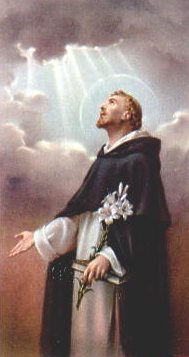
SAINT DOMINIC Founder(1170-1221)

Spiritual Bouquet: These things I have spoken to you that My joy may be in you, and that your joy may be made full. St. John 15:11

Saint Dominic de Guzman was born in Spain in 1170. As a student, he sold his books to feed the poor during a famine, and offered himself to ransom a slave. At the age of twenty-five, after taking the religious habit he became acting Superior of the Canons Regular of Saint Augustine in Osma, and was soon offered an episcopal chair at Compostella. He answered as afterward he also answered many times: “God has not sent me to be a bishop, but to preach.” He accompanied his prelate to southern France on a commission for the king of Castille. There his heart was well-nigh broken by the ravages of the Albigensian heresy, a variant of ancient Manicheanism, and the source of devastating wars in southern France. His life from that time on was devoted to the conversion of heretics and the defense of the Faith.

In the year 1199, while he was still a Canon Regular of Saint Augustine and was preaching near the Spanish coasts, he was taken captive, with all his audience and a Brother in religion, by a band of pirates. They placed the prisoners in their galleys at the oars. When a furious storm broke, the young Saint exhorted the disciples of Mohammed to think seriously of their souls, to open their eyes to the truth of Christianity, and above all, to invoke the Mother of God. They did not listen until his third exhortation, at a moment when it was clear the ship and passengers could not be saved. They swore to him then that if the God of Christians preserved them by the intercession of His Holy Mother, they would dedicate themselves to their service. Immediately the storm ceased, and the pirates kept their word.

When in his 46th year, and with six companions, he began the great Order of Preaching Friars, this Order with that of the Friars Minor, founded by his contemporary friend Saint Francis of Assisi, was the chief means God employed to renew Christian fervor during the Middle Ages. In addition, Saint Dominic founded his Second Order for nuns for the education of Catholic girls, and his Third Order, or Tertiaries, for persons of both sexes living in the world. God abundantly blessed the new Order, and France, Italy, Spain, and England welcomed the Preaching Friars. Our Lady took them under Her special protection. During a debate with the heretics, a book by the Saint, defending Her Immaculate Conception, was thrown into the flames along with one by the heretics, to see whether one might be spared. Saint Dominic’s was not injured, and many heretics were converted.

It was in 1208, while Saint Dominic knelt in the little chapel of Notre Dame de La Prouille, and implored the great Mother of God to save the Church, that Our Lady appeared to him and gave him the Rosary, bidding him to go forth and preach it. During the famous battles in southern France against the Albigensians, with his rosary in hand he revived the courage of the Catholic armies, led them to victory against overwhelming numbers, and finally subdued the heresy. His nights were spent in prayer; and, though all beheld him as an Angel of purity, before morning broke he would scourge himself to blood. His words rescued countless souls, and three times raised the dead to life. At length, on August 6, 1221, at the age of fifty-one, he gave up his soul to God.

Reflection: “God has never refused me what I have asked,” said Saint Dominic. How could God refuse to respond to the single intention of His Saints, which is His own — the salvation and sanctification of souls? Saint Dominic has left us the Rosary that we may learn, with Mary’s help, to ask what pleases God, and then to pray easily and simply with the same trust.

Sources: Les plus illustres captifs, by Rev. Fr. Calixte de la Providence, Trinitarian (Delhomme et Briguet: Lyons, 1892), Vol. I; Little Pictorial Lives of the Saints, a compilation based on Butler’s Lives of the Saints and other sources by John Gilmary Shea (Benziger Brothers: New York, 1894).

after www.magnificat.ca
Read whole post......

Thursday, August 03, 2006

SCRIPTURE CORNER

Topic: Imitation of Christ

For my yoke is sweet and my burden is light. Mt 11, 30

[on the practice of virtue and mortifications]The disciple is not above the master, nor the servant above his lord. It is enough for the disciple that he be as his master, and the servant as his lord. Mt 10, 24, 25

[on detachment] So likewise every one of you that doth not renounce all that he possesseth, cannot be my disciples. Lk 14,33

because I go to prepare a place for you, and if I shall go, and prepare a place for you, I will come again, and will take you to myself; that where I am, you also may be. Jn 14,2,3 Read whole post......
CHAPTER IV part one
"Dark Night of the Soul" by St. John of the Cross

Of other imperfections which these beginners are apt to have with respect to the third sin, which is luxury.

MANY of these beginners have many other imperfections than those which I am describing with respect to each of the deadly sins, but these I set aside, in order to avoid prolixity, touching upon a few of the most important, which are, as it were, the origin and cause of the rest. And thus, with respect to this sin of luxury (leaving apart the falling of spiritual persons into this sin, since my intent is to treat of the imperfections which have to be purged by the dark night), they have many imperfections which might be described as spiritual luxury, not because they are so, but because the imperfections proceed from spiritual things. For it often comes to pass that, in their very spiritual exercises, when they are powerless to prevent it, there arise and assert themselves in the sensual part of the soul impure acts and motions, and sometimes this happens even when the spirit is deep in prayer, or engaged in the Sacrament of Penance or in the Eucharist. These things are not, as I say, in their power; they proceed from one of three causes.
2. The first cause from which they often proceed is the pleasure which human nature takes in spiritual things. For when the spirit and the sense are pleased, every part of a man is moved by that pleasure to delight according to its proportion and nature. For then the spirit, which is the higher part, is moved to pleasure and delight in God; and the sensual nature, which is the lower part, is moved to pleasure and delight of the senses, because it cannot possess and lay hold upon aught else, and it therefore lays hold upon that which comes nearest to itself, which is the impure and sensual. Thus it comes to pass that the soul is in deep prayer with God according to the spirit, and, on the other hand, according to sense it is passively conscious, not without great displeasure, of rebellions and motions and acts of the senses, which often happens in Communion, for when the soul receives joy and comfort in this act of love, because this Lord bestows it (since it is to that end that He gives Himself), the sensual nature takes that which is its own likewise, as we have said, after its manner. Now as, after all, these two parts are combined in one individual, they ordinarily both participate in that which one of them receives, each after its manner; for, as the philosopher says, everything that is received is in the recipient after the manner of the same recipient. And thus, in these beginnings, and even when the soul has made some progress, its sensual part, being imperfect, oftentimes receives the Spirit of God with the same imperfection. Now when this sensual part is renewed by the purgation of the dark night which we shall describe, it no longer has these weaknesses; for it is no longer this part that receives aught, but rather it is itself received into the Spirit. And thus it then has everything after the manner of the Spirit.
3. The second cause whence these rebellions sometimes proceed is the devil, who, in order to disquiet and disturb the soul, at times when it is at prayer or is striving to pray, contrives to stir up these motions of impurity in its nature; and if the soul gives heed to any of these, they cause it great harm. For through fear of these not only do persons become lax in prayer—which is the aim of the devil when he begins to strive with them—but some give up prayer altogether, because they think that these things attack them more during that exercise than apart from it, which is true, since the devil attacks them then more than at other times, so that they may give up spiritual exercises. And not only so, but he succeeds in portraying to them very vividly things that are most foul and impure, and at times are very closely related to certain spiritual things and persons that are of profit to their souls, in order to terrify them and make them fearful; so that those who are affected by this dare not even look at anything or meditate upon anything, because they immediately encounter this temptation. And upon those who are inclined to melancholy this acts with such effect that they become greatly to be pitied since they are suffering so sadly; for this trial reaches such a point in certain persons, when they have this evil humour, that they believe it to be clear that the devil is ever present with them and that they have no power to prevent this, although some of these persons can prevent his attack by dint of great effort and labour. When these impurities attack such souls through the medium of melancholy, they are not as a rule freed from them until they have been cured of that kind of humour, unless the dark night has entered the soul, and rids them of all impurities, one after another. Read whole post......

Wednesday, August 02, 2006

Today opens the SCRIPTURE CORNER
with topics for daily reflections under the patronage of Our Lady of Mount Carmel

PERSONAL SANCTIFICATION

For this is the will of God, your sanctification. 1Thes 4,3

Be you therefore perfect, as also your heavenly Father is perfect. Mt 5, 48

[The Lord spoke to Moses, saying]: Speak to all the congregation of the children of Israel, and thou shalt say to them: Be you holy, because I the Lord your God am holy. Leviticus 19,2

for it is written: You shall be holy, for I am holy. 1Peter 1, 16

As he chose us in him before the foundation of the world, that we should be holy and unspotted in his sight in charity. Ephesians 1,4

and he that is holy, let him be sanctified still. Rev 22,11

[of heaven] There shall not enter into it any thing defiled, or that worketh abomination or maketh a lie, but they that are written in the book of the Lamb. Rev 21, 27 Read whole post......
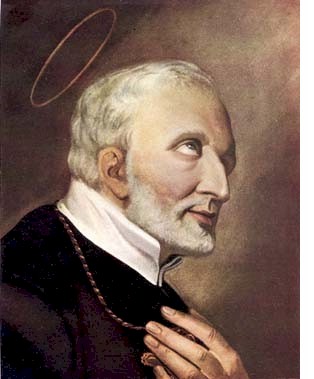
SAINT ALPHONSUS LIGUORI
Bishop and Doctor of the Church (1696-1787)

Spiritual Bouquet: As the Father has loved Me, I also have loved you. St. John 15:9

Saint Alphonsus was born of noble parents near Naples, in 1696. His spiritual formation was entrusted to the Oratorian Fathers of that city, and from his boyhood Alphonsus was known as a very devout little Brother of the Minor Oratory. At the early age of sixteen he became a doctor in civil law; and entering this career with ardor, he met great success and renown. A mistake, however, by which he lost an important case, showed him the vanity of human fame and glory. He decided to abandon the legal profession at the age of twenty-seven, to labor for the glory of God alone. Alphonsus’ father long opposed his decision, but as a man of virtue consented at last.

Saint Alphonsus was ordained a priest in 1726, and he soon became as renowned a preacher as he had been a lawyer. His father stopped in a church to pray one day, and amazed, heard his son preaching; he suddenly saw clearly how God had marvelously elevated his son, and was filled with joy, saying: “My son has made God known to me!” As for Alphonsus, he loved and devoted himself to the most neglected souls in the region of Naples. He was a very perfect confessor, and wrote a manual which has been used ever since for the instruction of those who administer the sacrament of Penance. A musician of the first rank, Saint Alphonsus gave up his instruments to devote himself more perfectly to his apostolic labors; he nonetheless composed joyous religious hymns for the poor folk he heard singing in the streets, that they might glorify God and not waste their voices and efforts in vain and worldly songs.

To extend and continue his work, he later founded the missionary Congregation of the Most Holy Redeemer, for the evangelization of the poor. At the age of sixty-six he became Bishop of Saint Agatha, a suffragan diocese of Naples, and undertook the reform of his diocese with the zeal of a Saint. He made a vow never to waste a moment of time, and, though his life was spent in prayer and work, he also composed a vast number of books. These volumes were filled with such great science, unction, and wisdom that in 1871 he was declared by Pius IX a Doctor of the Church. Saint Alphonsus wrote his first book at the age of forty-nine, and in his eighty-third year had published about sixty volumes; at that time his director forbade him to continue writing. The best known of his books is his volume entitled “The Glories of Mary”, by which he exalts the graces and narrates the wondrous deeds of mercy of the Mother of God for those who invoke Her.

Very many of these books were written in the half hours snatched from his labors as a missionary, as a religious Superior, and finally as a Bishop, often in the midst of unrelenting bodily and mental sufferings. With his left hand he would hold a piece of marble against his aching head, while his right hand wrote. Yet he counted no time lost which was spent in charity. He did not refuse to maintain a long correspondence with a simple soldier who asked for his advice, or to play the harpsichord in his declining years, while he taught his novices to sing spiritual canticles. He lived in times of religious laxity, and met with many persecutions and disappointments. During his last seven years he was prevented by constant sickness from offering the adorable Sacrifice, but he received Holy Communion daily, and his love for Jesus Christ and his trust in Mary’s prayers sustained him to the end. He died in 1787, in his ninety-first year.

Reflection: Let us do with all our heart and attention the duty of each day, leaving to God the result as well as the care of the future.

Source: Little Pictorial Lives of the Saints, a compilation based on Butler’s Lives of the Saints and other sources by John Gilmary Shea (Benziger Brothers: New York, 1894).

after www.magnificat.ca

Chapter from the work of St Alphonsus "Uniformity to God's will"

2. Uniformity in all Things.

The essence of perfection is to embrace the will of God in all things,prosperous or adverse. In prosperity, even sinners find it easy to unite themselves to the divine will; but it takes saints to unite themselves to God's will when things go wrong and are painful to self-love. Our conduct in such instances is the measure of our love of God. St. John of Avila used to say: One Blessed be God in times of adversity, is worth more than a thousand acts of gratitude in times of prosperity [20].Furthermore, we must unite ourselves to God's will not only in things that come to us directly from his hands, such as sickness, desolation, poverty, death of relatives, but likewise in those we suffer from man for example, contempt, injustice, loss of reputation, loss of temporal goods and all kinds of persecution. On these occasions we must remember that whilst God does not will the sin, he does will our humiliation, our poverty, or our mortification, as the case may be. It is certain and of faith, that whatever happens, happens by the will of God: I am the Lord forming the light and creating the darkness, making peace and creating evil [21].From God come all things, good as well as evil. We call adversities evil; actually they are good and meritorious, when we receive them as coming from God's hands: Shall there be evil in a city which the Lord hath not done [22]? Good things and evil, life and death, poverty and riches are from God [23]. It is true, when one offends us unjustly, God does not will his sin, nor does he concur in the sinners bad will; but God does, in a general way, concur in the material action by which such a one strikes us, robs us or does us an injury, so that God certainly wills the offense we suffer and it comes to us from his hands. Thus the Lord told David he would be the author of those things he would suffer at the hands of Absalom: I will raise up evils against thee out of thy own house, and I will take thy wives before thy face and give them to thy neighbor [24] . Hence too God told the Jews that in punishment for their sins, he would send the Assyrians to plunder them and spread destruction among them: The Assyrian is the rod and staff of my anger. I will send him to take away the spoils [25] . Assyrian wickedness served as God's scourge for the Hebrews [26] is St. Augustine's comment on this text. And our Lord himself told St. Peter that his sacred passion came not so much from man as from his Father: The chalice which my Father hath given me, shall I not drink it [27]? When the messenger came to announce to Job that the Sabeans had plundered his goods and slain his children, he said: The Lord gave and the Lord taketh away [28]. He did not say: The Lord hath given me my children and my possessions, and the Sabeans have taken them away. He realized that adversity had come upon him by the will of God. Therefore he added: As it hath pleased the Lord, so is it done. Blessed be the name of the Lord [29]. We must not therefore consider the afflictions that come upon us as happening by chance or solely from the malice of men; we should be convinced that what happens, happens by the will of God. Apropos of this it is related that two martyrs, Epictetus and Atho, being put to the torture by having their bodies raked with iron hooks and burnt with flaming torches, kept repeating: Work thy will upon us, O Lord. Arrived at the place of execution, they exclaimed: Eternal God, be thou blessed in that thy will has been entirely accomplished in us [30]. Cesarius points up what we have been saying by offering this incident in the life of a certain monk: Externally his religious observance was the same as that of the other monks, but he had attained such sanctity that the mere touch of his garments healed the sick. Marveling at these deeds, since his life was no more exemplary than the lives of the other monks, the superior asked him one day what was the cause of these miracles. He replied that he too was mystified and was at a loss how to account for such happenings. What devotions do you practice? asked the abbot. He answered that there was little or nothing special that he did beyond making a great deal of willing only what God willed, and that God had given him the grace of abandoning his will totally to the will of God. Prosperity does not lift me up, nor adversity cast me down, added the monk. I direct all my prayers to the end that God's will may be done fully in me and by me.That raid that our enemies made against the monastery the other day, in which our stores were plundered, our granaries put to the torch and our cattle driven off did not this misfortune cause you any resentment? queried the abbot. No, Father, came the reply. On the contrary, I returned thanks to God's is my custom in such circumstances fully persuaded that God does all things, or permits all that happens, for his glory and for our greater good; thus I am always at peace, no matter what happens. Seeing such uniformity with the will of God, the abbot no longer wondered why the monk worked so many miracles [31] .


_________________________________________________________________

[20] St. John Avil. Letters 41.

[21] Isaias 45:6, 7.

[22] Amos, 3:6.

[23] Eccli. 11:14.

[24] 2 Kings, 12:11.

[25] Isaias, 10:5, 6.

[26] St. Aug. in Ps. 73.

[27] St. John, 18:11.

[28] Job. 1:21.

[29] Ibid.

[30] ML (Vitae Patrum) 73-402, etc.

[31] Caesarius: Dial. distin. 10: cap. 9.
_________________________________________________________________
Read whole post......
Tuesday, August 01, 2006

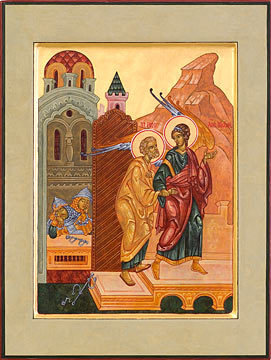
SAINT PETER'S CHAINS (44 A.D.)

Spiritual Bouquet: In this is My Father glorified, that you bear much fruit. St. John 15:8

In the year 44 King Herod Agrippa, after putting to death Saint James, son of Zebedee, was still avid for popular approval by the Jews. He had Saint Peter cast into prison, intending to put him to death publicly after the Passover; but the entire Church of Jerusalem was offering up prayers to God “without ceasing” (Acts 12:5) for the deliverance of the Chief Pastor of His flock, and God heard them favorably.

The king had taken all possible precautions to prevent the escape of his prisoner. He was guarded day and night by sixteen soldiers, four of whom kept sentry duty in turn — two in the same dungeon with him, and two at the gate. Saint Peter was fastened to the ground by two chains, and a soldier watched on either side of him. He lay fast asleep on the very night before the day fixed for his execution, when it pleased God to deliver him out of the hands of his enemies. In the middle of the night, a bright light shone in the prison, and an Angel appeared beside him. He woke him from his sleep and bade him instantly rise, fasten his cincture, put on his sandals and cloak, and follow him. The Apostle did so, for the chains had fallen off his wrists. Following his heavenly guide, he passed after him through the first and second watches, and when they arrived at the iron gate which led into the city, that gate opened before them of its own accord. The Angel conducted him through one street, then, suddenly disappearing, left him to seek refuge.

The Apostle went directly to the house of Mary, mother of John Mark, where several disciples were assembled and sending up their prayers to heaven for his deliverance. As he stood knocking, a young woman who had been sent to the door, hearing Peter’s voice, ran back in joy and informed the group that their Pastor was at the door. They paid no attention to her, saying she was beside herself, or that it was probably his Guardian Angel. But the knocking continued until they opened the door, and Saint Peter, entering, told them of his miraculous escape. Having enjoined them to notify the rest of the brethren, he departed to regions of greater security, carrying wherever he went the divine blessing and life.

Reflection: This miracle clearly confirms the divine promise, “If two of you consent upon earth about anything at all for which they ask, it shall be done for them by My Father in heaven.” (Matt. 18:19)

Sources: New Testament, Acts of the Apostles, Chapter 12; Little Pictorial Lives of the Saints, a compilation based on Butler’s Lives of the Saints and other sources by John Gilmary Shea (Benziger Brothers: New York, 1894).

after www.magnificat.ca Read whole post......