Sunday, July 23, 2006

Seventh Sunday after Pentecost
after "Devout Instructions" by Fr Goffine

In the Introit of the Mass the Church invites us to the praise of God in the following words: "Oh, clap your hands, all ye nations, shout unto God with the voice of joy, for the Lord is most high, He is terrible: He is great king over all the earth" (Ps. xlvi. 2,3). Glory be to the Father, etc.

Prayer
O God, Whose providence never faileth in what it doth order, we humbly beseech Thee to put away from us all things hurtful, and to give us all things profitable to us. Through Our Lord Jesus Christ, etc. Amen.

EPISTLE Rom. vi. 19-23
I speak an human thing, because of the infirmity of your flesh. For as you have yielded your members to serve uncleanness and iniquity, unto iniquity; so now yield your members to serve justice, unto sanctification. For when you were the servants of sin, you were free men to justice. What fruit therefore had you then in those things, of which you are now ashamed? For the end of them is death. But now being made free from sin, and become servants to God, you have your fruit unto sanctification, and the end life everlasting. For the wages of sin is death. But the grace of God, life everlasting, in Christ Jesus our Lord.

Explanation
In these words St. Paul admonishes the Romans that they ought henceforward to devote themselves as zealously to the service of God as they had hitherto done to that of iniquity, because the service of sin is death, but the service of God is life everlasting. The words "servants, to serve," denote the full and unconditional subjection of the Christian to God, without walking any longer according to his own will, just as, in regard to the state of sin, they indicate the dominion of the passions over sinner. There is no requirements more reasonable than that a man should labour for God and his own salvation as he has laboured for sin and hell. We should, therefore, often think on the wages of sin - eternal death; and when we are tempted, ask ourselves, "What shall I gain by my lust, my injustice, my vengeance? Ah, nothing but eternal death! And shall I, created to inherit eternal life, shall I make myself the heir of eternal death?"

GOSPEL Matt. vii.15-21
Beware of false prophets, who come to you in the clothing of sheep, but inwardly they are ravening wolves. By their fruits you shall know them. Do men gather grapes of thorns, or figs of thistles? Even so every good tree bringeth forth good fruit, and the evil tree bringeth forth evil fruit. A good tree cannot bring forth evil fruit, neither can an evil tree bring forth good fruit. Every tree that bringeth not forth good fruit, shall be cut down, and shall be cast into the fire. Wherefore by their fruits you shall know them. Not every one that saith to me, Lord, Lord, shall enter into the kingdom of heaven: but he that doth the will of my Father who is in heaven, he shall enter into the kingdom of heaven.

Who are meant by "false prophets"?
1. The worlds, which promises us honours and riches, but in the end rewards our toil and labour with disgrace and scorn. 2. The flesh, which promises pleasures and joys, but at last leaves nothing but the bitter reproaches of an unquiet conscience. 3. The devil, who promises us a long life, and time for repentance, while the obdurate sinner is cut off suddenly in the midst of his days. 4. All such evil-minded persons as conceal their wicked purposes under the mask of virtue and honesty, until they have entrapped unwary souls, and drawn them into all kinds of shameful misdeeds. It is these false prophets of Satan, and wolves of hell, that make the greatest havoc in the flock of Christ.
Why does Christ say, "every tree that bringeth not forth good fruit shall be cast into the fire"? He thereby warns us that faith alone, without good works, or, in other words, the mere desire for heaven without the practice of virtue, will not save us. Christ says plainly, "Not every one that says to Me, Lord, Lord, shall enter into the kingdom of heaven, but he that doth the will of My Father Who is in heaven." Jesus also saith, "Whosoever shall do the will of My Father Who is in heaven, he is My brother, and sister, and mother" (Matt. xii. 50). Endeavour, therefore, O Christian, to fulfill in all things the will of God, and secure thy salvation by the exercise of good works.

INSTRUCTION ON GOOD WORKS
What are good works?
All actions of men which are done according to the will of God, from love of Him, and by the help of grace.
Which are the principal good works?
Prayer, fasting, and almsgiving. Prayer invluding all acts belonging to the service of God; fasting, all mortifications of the body; almsgiving, all works of mercy.
How many are the works of mercy?
Those which have for their object the salvation of our neighbour; as, 1. to admonish the sinner; 2. to instruct the ignorant; 3. to counsel the doubtful; 4. to comfort the prisoners; 5. to shelter the housless; 6. to visit the sick; 7. to bury the dead (Matt. xxv. 42, 43).
What is necessary to render works meritorious?
1. They must be good in themselves; 2. they must be done by the grace of God; 3. in the state of grace; 4. by free will; 5. with the good intention of pleasing God.
Can we be saved without good works?
No; for Christ says expressly, "Every tree that bringeth not forth good fruit shall be cut down and shall be cast into the fire." And that servant in the Gospel (Matt. xxv. 25) who neither wasted his talent nor yet traded with it, but digged into the earth and hid his lord's money, was therefore cast into the outer darkness Read whole post......

Saturday, July 22, 2006

Feast of the Holy penitent Mary Magdalen
from "Devout Instructions" by Fr Goffine

Mary Magdalen, a sister of Lazarus and of Martha, of Bethany, was a notorious sinner in Jerusalem. Moved by the preaching of Jesus, she did public penance. She went openly into the house of the Pharisee with whom Jesus was sitting at the table, threw herself at His feet, anointed them with precious ointment, washed them with her hair. Jesus, knowing her contrite heart, forgave her her sins (Luke vii. 37, 38), and from that time forward she became the most zealous and faithful of the women who were discilples of Our Lord. She followed Him, always ministered unto Him of her substance (Luke viii. 3), and when He, died was standing under the cross.

PRAYER.
We beseech Thee, O Lord, that we may be helped by the intercession of blessed Mary Magdalen, at whose prayers Thou didst raise up again to life her brother Lazarus, who had been dead for four days. Who livest, etc. Amen.

EPISTLE. Cant. iii. 2-5; viii 6,7
I will rise, and will go about the city: in the streets and the broad ways I will seek him whom my soul loveth: I sought him, and I found him not. The watchmen who keep the city, found me: Have you seen him, whom my soul loveth? When I had a little passed by them, I found him whom my soul loveth: I held him: and I will not let him go, till I bring him into my mother's house, and into the chamber of her that bore me. I adjure you, O daughters of Jerusalem, by the roes and the harts of the fields, that you stir not up, nor awake my beloved, till she please. Put me as a seal upon thy heart, as a seal upon thy arm, for love is strong as death, jealousy as hard as hell, the lamps thereof are fire and flames. Many waters cannot quench charity, neither can the floods drown it: if a man should give all the substance of his house for love, he shall despise it as nothing.

GOSPEL. Luke vii 36-50
And one of the Pharisees desired him to eat with him. And he went into the house of the Pharisee, and sat down to meat. And behold a woman that was in the city, a sinner, when she knew that he sat at meat in the Pharisee's house, brought an alabaster box of ointment; And standing behind at his feet, she began to wash his feet, with tears, and wiped them with the hairs of her head, and kissed his feet, and anointed them with the ointment. And the Pharisee, who had invited him, seeing it, spoke within himself, saying: This man, if he were a prophet, would know surely who and what manner of woman this is that toucheth him, that she is a sinner. And Jesus answering, said to him: Simon, I have somewhat to say to thee. But he said: Master, say it. A certain creditor had two debtors, the one who owed five hundred pence, and the other fifty. And whereas they had not wherewith to pay, he forgave them both. Which therefore of the two loveth him most? Simon answering, said: I suppose that he to whom he forgave most. And he said to him: Thou hast judged rightly. And turning to the woman, he said unto Simon: Dost thou see this woman? I entered into thy house, thou gavest me no water for my feet; but she with tears hath washed my feet, and with her hairs hath wiped them. Thou gavest me no kiss; but she, since she came in, hath not ceased to kiss my feet. My head with oil thou didst not anoint; but she with ointment hath anointed my feet. Wherefore I say to thee: Many sins are forgiven her, because she hath loved much. But to whom less is forgiven, he loveth less. And he said to her: Thy sins are forgiven thee. And they that sat at meat with him began to say within themselves: Who is this that forgiveth sins also? And he said to the woman: Thy faith hath made thee safe, go in peace.

Magdalen, who had sinned openly did penance. In like manner, he who has given public scandal must seek to make amends for it by public good example. Magdalen confessed her sins, says St Ambrose, not with words, but with abundant tears of penitence. To tell her sins to Christ, the All-knowing, was not necessary; but what a confession was there in the posture of humiliation, and in the tears that flowed from the contrite sinner. Would you obtain forgiveness? Confess with contrition, like Magdalen. The words, "Thy faith hath made thee safe," denote a faith active as love. Faith and love are in truth never separated, for he only loves according to God's will who believes in Him. Therefore believe in truth, love, and show your love by earnest hatred of every sin, by fighting against your passions, by change of your life, and by humble confession, and as true as God lives you will be saved, as was Magdalen; the peace of God will enter into your heart.

Aspiration.
O most loving Jesus, give me an earnest will to forsake all evil, and to return to Thee, my chief good, to repent of my sins out of true love, to guard against them for the future, to shun the occasion by which I have hitherto been enticed into sin, and by the practice of good works to redeem the time lost. Grant me this, O Jesus, by the bitter passion and death, and through the intercession of the holy penitent Magdalen. Amen. Read whole post......

Friday, July 21, 2006

“I will fear no wild beasts and pass over the mighty and the frontiers.

11. Evil spirits, the second enemy of the soul, are called the mighty, because they strive with all their might to seize on the passes of the spiritual road; and because the temptations they suggest are harder to overcome, and the craft they employ more difficult to detect, than all the seductions of the world and the flesh; and because, also, they strengthen their own position by the help of the world and the flesh in order to fight vigorously against the soul. Hence the Psalmist calls them mighty, saying: The mighty have sought after my soul. The prophet Job also speaks of their might: There is no power upon the earth that may be compared with him who was made to fear no man.

12. There is no human power that can be compared with the power of the devil, and therefore the divine power alone can overcome him, and the divine light alone can penetrate his devices. No soul therefore can overcome his might without prayer, or detect his illusions without humility and mortification. Hence the exhortation of St. Paul to the faithful: Put on the armor of God, that you may stand against the deceits of the devil: for our wrestling is not against flesh and blood. Blood here is the world, and the armor of God is prayer and the cross of Christ, wherein consist the humility and mortification of which I have spoken.

13. The soul says also that it will cross the frontiers: these are the natural resistance and rebellion of the flesh against the spirit, for, as St. Paul says, the flesh lusts against the spirit, and sets itself as a frontier against the soul on its spiritual road. This frontier the soul must cross, surmounting difficulties, and trampling underfoot all sensual appetites and all natural affections with great courage and resolution of spirit: for while they remain in the soul, the spirit will be by them hindered from advancing to the true life and spiritual delight. This is set clearly before us by St. Paul, saying: If by the spirit you mortify the deeds of the flesh, you shall live. This, then, is the process which the soul in this stanza says it becomes it to observe on the way to seek the Beloved: which briefly is a firm resolution not to stoop to gather flowers by the way; courage not to fear the wild beasts, and strength to pass by the mighty and the frontiers; intent solely on going over the mountains and the strands of the virtues, in the way just explained. Read whole post......

Thursday, July 20, 2006

“I will fear no wild beasts and I will go over the mighty and the frontiers.”

Here we have the three enemies of the soul which make war against it, and make its way full of difficulties. The wild beasts are the world; the mighty, the devil; and the frontiers are the flesh.

9. The world is the wild beasts, because in the beginning of the heavenly journey the imagination pictures the world to the soul as wild beasts, threatening and fierce, principally in three ways. The first is, we must forfeit the world’s favor, lose friends, credit, reputation, and property; the second is not less cruel: we must suffer the perpetual deprivation of all the comforts and pleasures of the world; and the third is still worse: evil tongues will rise against us, mock us, and speak of us with contempt. This strikes some persons so vividly that it becomes most difficult for them, I do not say to persevere, but even to enter on this road at all.

10. But there are generous souls who have to encounter wild beasts of a more interior and spiritual nature—trials, temptations, tribulations, and afflictions of diverse kinds, through which they must pass. This is what God sends to those whom He is raising upwards to high perfection, proving them and trying them as gold in the fire; as David says: “Many are the tribulations of the just; and out of all these our Lord will deliver them.” But the truly enamored soul, preferring the Beloved above all things, and relying on His love and favor, finds no difficulty in saying: “I will fear no wild beats and pass over the mighty and the frontiers.”

affter "Dark night of the soul" by St. John of the Cross Read whole post......

Wednesday, July 19, 2006

“I will go over mountains and strands.”

5. Mountains, which are lofty, signify virtues, partly on account of their height and partly on account of the toil and labor of ascending them; the soul says it will ascend to them in the practice of the contemplative life. Strands, which are low, signify mortifications, penances, and the spiritual exercises, and the soul will add to the active life that of contemplation; for both are necessary in seeking after God and in acquiring virtue. The soul says, in effect, “In searching after my Beloved I will practice great virtue, and abase myself by lowly mortifications and acts of humility, for the way to seek God is to do good works in Him, and to mortify the evil in ourselves, as it is said in the words that follow:

“I will gather no flowers.”

6. He that will seek after God must have his heart detached, resolute, and free from all evils, and from all goods which are not simply God; that is the meaning of these words. The words that follow describe the liberty and courage which the soul must possess in searching after God. Here it declares that it will gather no flowers by the way—the flowers are all the delights, satisfactions, and pleasures which this life offers, and which, if the soul sought or accepted, would hinder it on the road.

7. These flowers are of three kinds—temporal, sensual, and spiritual. All of them occupy the heart, and stand in the way of the spiritual detachment required in the way of Christ, if we regard them or rest in them. The soul, therefore, says, that it will not stop to gather any of them, that it may seek after God. It seems to say, I will not set my heart upon riches or the goods of this world; I will not indulge in the satisfactions and ease of the flesh, neither will I consult the taste and comforts of my spirit, in order that nothing may detain me in my search after my Love on the toilsome mountains of virtue. This means that it accepts the counsel of the prophet David to those who travel on this road: “If riches abound, set not your heart upon them,” This is applicable to sensual satisfactions, as well as to temporal goods and spiritual consolations.

8. From this we learn that not only temporal goods and bodily pleasures hinder us on the road to God, but spiritual delight and consolations also, if we attach ourselves to them or seek them; for these things are hindrances on the way of the cross of Christ, the Bridegroom. He, therefore, that will go onwards must not only not stop to gather flowers, but must also have the courage and resolution to say as follows: “I will fear no wild beasts and I will go over the mighty and the frontiers.”

after "Dark night of the soul" by St John of the Cross Read whole post......

Tuesday, July 18, 2006

“In search of my Love.”

2. Here the soul makes it known that to find God it is not enough to pray with the heart and the tongue, or to have recourse to the help of others; we must also work ourselves, according to our power. God values one effort of our own more than many of others on our behalf; the soul, therefore, remembering the saying of the Beloved, “Seek and you shall find,” is resolved on going forth, as I said just now, to seek Him actively, and not rest till it finds Him, as many do who will not that God should cost them anything but words, and even those carelessly uttered, and for His sake will do nothing that will cost them anything. Some, too, will not leave for His sake a place which is to their taste and liking, expecting to receive all the sweetness of God in their mouth and in their heart without moving a step, without mortifying themselves by the abandonment of a single pleasure or useless comfort.

3. But until they go forth out of themselves to seek Him, however loudly they may cry they will not find Him; for the bride in the Canticle sought Him in this way, but she found Him not until she went out to seek Him: “In my little bed in the nights I have sought Him Whom my soul loves: I have sought Him and have not found Him. I will rise and will go about the city: by the streets and highways I will seek Him Whom my soul loves.” She afterwards adds that when she had endured certain trials she “found Him.”

4. He, therefore, who seeks God, consulting his own ease and comfort, seeks Him by night, and therefore finds Him not. But he who seeks Him in the practice of virtue and of good works, casting aside the comforts of his own bed, seeks Him by day; such a one shall find Him, for that which is not seen by night is visible by day. The Bridegroom Himself teaches us this, saying, “Wisdom is clear and never fades away, and is easily seen of them that love her, and is found of them that seek her. She prevents them that covet her, that she first may show herself to them. He that awakes early to seek her shall not labor; for he shall find her sitting at his doors.” The soul that will go out of the house of its own will, and abandon the bed of its own satisfaction, will find the divine Wisdom, the Son of God, the Bridegroom waiting at the door without, and so the soul says: "I will go over mountains and strands"

after "Dark night of the soul" by St. John of the Cross Read whole post......

Monday, July 17, 2006

The Carmelite Martyrs of Compiegne

On this day in 1794 all the nuns of the Carmelite monastery of Compiegne were guillotined by the revolutionary French republicans. They offered their lives for France and her liberation from the terror. They were the last executed under that regime and the terror soon ended.....A short excerpt from the booklet written a few years ago by Terry Newkirk (www.ourgardenofcarmel.org/martyrs.html) herself a Carmelite Secular:

"An ironic sidelight: the one nun of royal blood, Marie of the Incarnation, happened to be away at the time of the arrest and thus escaped execution; one of only three survivors of her community, she became the martyrs' first historian, collecting eyewitness accounts of the nuns deaths. Reverend Mother Émilienne, Superior General of the Sisters of Charity of Nevers, wrote in a letter: " 'I learned from a person who was a witness to their martyrdom that the youngest of these good Carmelites was called first and that she went to kneel before her venerable Superior, asked her blessing and permission to die. She then mounted the scaffold singing Laudate Dominum omnes gentes. She then went to place herself beneath the blade (not) allowing the executioner to touch her. All the others did the same. The Venerable Mother was the last sacrificed. During the whole time, there was not a single drum-roll; but there reigned a profound silence.' "Sister Charlotte of the Resurrection, seventy-eight and an invalid, having been thrown roughly to the pavement from the tumbrel, was heard to speak words of forgiveness and encouragement to her tormentor. Sister Julie had an extreme horror of the guillotine; yet she refused to leave her sisters even when her family sent for her, saying, 'We are victims of the age, and we must sacrifice ourselves for its reconciliation with God.' Another witness said of the nuns, 'They looked like they were going to their weddings.'
"Throughout France a vaunted new age of spiritual maturity, free from the bonds of sectarian religion, was underway. On June 20, 1794, a Feast of the Supreme Being" was celebrated in Compiègne. In November of the previous year, the worship of Reason was officially proclaimed: the church of Saint-Jacques in Compiégne became the Temple of Reason. The church of Saint- Antoine became a public meeting hall and fodder storehouse. In December, the Mayor of Paris had announced in the Temple of Reason that the Declaration of the Rights of Man would henceforth be the catechism of the French, and that the Constitution would be their Gospel. The prevailing mood of the times is reflected in a letter of July 17, 1794, from municipal officials of Compiègne to the Comité du Sureté Nationale: " 'The citizens of the Commune of Compiègne and of the District celebrated a civic festival on the 26 of this month (Messidor) in memory of the taking of the Bastille and in rejoicing for the recent victories of our armies. The minutes of the Municipalites attest that everywhere people were animated by the same spirit. The festival was concluded with dances and patriotic banquets.' "Yet there must have been a growing public unease not evident in this letter. Something in the sight of the nuns being executed seems to have affected even the hardened Parisian crowd, accustomed to cheering loudly each fall of the guillotine blade. Within ten days, by July 27, 1794, Robespierre and the provisional revolutionary government were finished."

The Catholic Encyclopaedia lists all of the 16 martyrs:

"Madeleine-Claudine Ledoine (Mother Teresa of St. Augustine), prioress, b. in Paris, 22 Sept., 1752, professed 16 or 17 May, 1775;

"Marie-Anne (or Antoinette) Brideau (Mother St. Louis), sub-prioress, b. at Belfort, 7 Dec., 1752, professed 3 Sept, 1771;

"Marie-Anne Piedcourt (Sister of Jesus Crucified), choir-nun, b. 1715, professed 1737; on mounting the scaffold she said "I forgive you as heartily as I wish God to forgive me";

"Anne-Marie-Madeleine Thouret (Sister Charlotte of the Resurrection), sacristan, b. at Mouy, 16 Sept., 1715, professed 19 Aug., 1740, twice sub-prioress in 1764 and 1778. Her portrait is reproduced opposite p. 2 of Miss Willson's work cited below;

"Marie-Antoniette or Anne Hanisset (Sister Teresa of the Holy Heart of Mary), b. at Rheims in 1740 or 1742, professed in 1764;

"Marie-Françoise Gabrielle de Croissy (Mother Henriette of Jesus), b. in Paris, 18 June, 1745, professed 22 Feb., 1764, prioress from 1779 to 1785;

"Marie-Gabrielle Trézel (Sister Teresa of St. Ignatius), choir-nun, b. at Compiègne, 4 April, 1743, professed 12 Dec., 1771;

"Rose-Chrétien de la Neuville, widow, choir-nun (Sister Julia Louisa of Jesus), b. at Loreau (or Evreux), in 1741, professed probably in 1777;

"Anne Petras (Sister Mary Henrietta of Providence), choir-nun, b. at Cajarc (Lot), 17 June, 1760, professed 22 Oct., 1786.

"Concerning Sister Euphrasia of the Immaculate Conception accounts vary. Miss Willson says that her name was Marie Claude Cyprienne Brard, and that she was born 12 May, 1736; Pierre, that her name was Catherine Charlotte Brard, and that she was born 7 Sept., 1736. She was born at Bourth, and professed in 1757;

"Marie-Geneviève Meunier (Sister Constance), novice, b. 28 May, 1765, or 1766, at St. Denis, received the habit 16 Dec., 1788. She mounted the scaffold singing "Laudate Dominum". In addition to the above, three lay sisters suffered and two tourières.

"The lay sisters are:

"Angélique Roussel (Sister Mary of the Holy Ghost), lay sister, b. at Fresnes, 4 August, 1742, professed 14 May, 1769;

"Marie Dufour (Sister St. Martha), lay sister, b. at Beaune, 1 or 2 Oct., 1742, entered the community in 1772;

"Julie or Juliette Vérolot (Sister St. Francis Xavier), lay sister, b. at Laignes or Lignières, 11 Jan., 1764, professed 12 Jan., 1789.

"The two tourières, who were not Carmelites at all, but merely servants of the nunnery were: Catherine and Teresa Soiron, b. respectively on 2 Feb., 1742 and 23 Jan., 1748 at Compiègne, both of whom had been in the service of the community since 1772."

after http://thesixbells.blogspot.com Read whole post......
Reading from the "Common of the Saints - Feast of the Blessed Virgin Mary"

Proverbs of Solomon ch.8, 12-25; 34-36
I wisdom dwell in counsel, and am present in learned thoughts. The fear of the Lord hateth evil: I hate arrogance, and pride, and every wicked way, and a mouth with a double tongue. Counsel and equity is mine, prudence is mine, strength is mine. By me kings reign, and lawgivers decree just things. By me princes rule, and the mighty decree justice. I love them that love me: and they that in the morning early watch for me, shall find me. With me are riches and glory, glorious riches and justice. For my fruit is better than gold and the precious stone, and my blossoms than choice silver. I walk in the way of justice, in the midst of the paths of judgment. That I may enrich them that love me, and may fill their treasures. The Lord possessed me in the beginning of his ways, before he made any thing from the beginning. I was set up from eternity, and of old before the earth was made. The depths were not as yet, and I was already conceived. neither had the fountains of waters as yet sprung out: The mountains with their huge bulk had not as yet been established: before the hills I was brought forth. Blessed is the man that heareth me, and that watcheth daily at my gates, and waiteth at the posts of my doors. He that shall find me, shall find life, and shall have salvation from the Lord

Sermon of St. John Chrysostom.

The Son of God did not choose for his mother a rich or wealthy woman, but that blessed Virgin, whose soul was adorned with virtues. For it was because the blessed Mary had observed chastity in a way that was above all human nature, that she conceived Christ the Lord in her womb. Let us then fly to this most holy Virgin and Mother of God, and avail ourselves to her patronage. Therefore let all you, who are virgins, flee to the Mother of the Lord; for she, by her patronage, will guard in you that beautiful, precious, and incorruptible possession. The Blessed Mary, ever a Virgin, dearest brethren, was in truth a great wonder. For what greater or more wonderful one has ever at any time been discovered? She alone is greater far than heaven and earth. What is holier than she? Not the Prophets, not the Apostles, not the Martyrs, not the Patriarchs, not the Angels, not the Thrones, not the Dominations, not the Seraphim, not the Cherubim; in truth no creature whatever, whether visible or invisible, is to be found greater or more excellent than she. She is at once the handmaid of God, and his Mother; at once a Virgin and a parent. She is the mother of him, who was begotten of the Father, before the beginning of all things; whom Angels and men acknowledge to be the Lord of all things. Would thou know how much greater is this Virgin than any of the heavenly Powers? They stand in his presence with fear and trembling, and veiled faces; she offers human nature to him whom she brought forth. Through her we obtain the forgiveness of our sins. Hail, then, O mother, heaven, maiden, virgin, throne, ornament, glory and foundation of our Church: pray without ceasing for us to Jesus, thy Son and our Lord, that through thee we may find mercy in the day of judgment, and may be able to obtain those good things which are prepared for those good things which are prepared for those who love God, through the grace and loving-kindness of Jesus Christ our Lord: to whom, with the Father and the Holy Ghost, be glory, and honour, and dominion, now and for ever, world without end. Amen. Read whole post......

Sunday, July 16, 2006

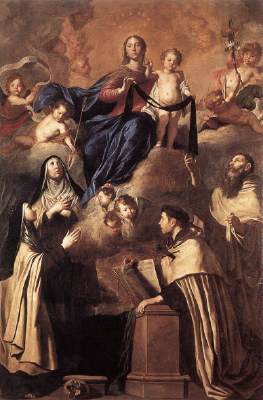
Our Lady of Mount Carmel

PRESENCE OF GOD - O Mary, Beauty of Carmel, make me worthy of your protection, clothe me with your scapular, and be the teacher of my interior life.

MEDITATION
1. The Blessed Virgin is a Mother who clothes us with grace and takes our supernatural life under her protection, in order to bring it to its full flowering in eternal life. She, the Immaculate, full of grace from the first moment of her conception, takes our souls stained by sin, and with a maternal gesture, cleanses them in the Blood of Christ and clothes them with grace, whichh, together with Him ahe has merited for us. We can truly say that the garment of grace was woven by the blessed hands of Mary, who day by day, moment by moment, gave herself entirely, in union wih her Son, for our salvation. Legend tells of the seamless robe which the Blessed Virgin wove for Jesus; but, for us - and in reality - she has done much more. She has cooperated in obtaining the garment of our eternal salvation, the wedding garment in which we shall enter the banquet hall of heaven. How she longs that this robe be imperishable! From the moment we received it, Mary has never ceased to follow us with her maternal gaze, to safeguard within us the life of grace. Each time we are converted and return to God or rise again after falling into sin - be it great or small - each time we increase in grace, all, everything, is effected through Mary's meditation. The scapular, the little habit, that our Lady of Mount Carmel offers us, is only the external symbol, but also the sign, the pledge of eternal salvation. "My beloved son," Mary said to St. Simone Stock, "take this scapular...whoever dies clothed in it will not suffer eternal fire." The Blessed Virgin gives the assurance of the supreme grace of final perseverance to all who wear worthily her little habit.
"Those who wear scapular," said Pius XII, "profess to belong to Our Lady." Because we belong to Mary she takes special care of our souls. One who belongs to her cannot be lost or be touched by eternal fire. Her powerful maternal intercession gives her the right to repeat, for her children, the words of Jesus: "Holy Father....those whom Thou gavest me have I kept; and none of them is lost" (Jn 17, 12).

2. Devotion to Our Lady of Mount Carmel indicates a strong call to the interior life, which, in a very special way, is Mary's life. The Blessed Virgin wants us to resemble her in heart and mind much more than in externals. If we penetrate into Mary's soul, we see that grace produced in her a very rich interior life: a life of recollection, prayer, uninterrupted giving of herself to God, and of constant contact and intimate union with Him. Mary's soul is a sanctuary reserved to God alone where no creature has ever left an imprint; here reign love and zeal for the glory of God and the salvation of men.
Those who wish to live truly devouted to our Lady of Mount Carmel, must follow Mary into depth of the interior life. Carmel is the symbol of the contemplative life, of life wholly consecrated to seeking God and tending wholly toward divine intimacy; and she who best realises this very high ideal is Mary, Queen, Beauty of Carmel. Judgement shall dwell in the wilderness and justice shall sit in Carmel. And the work of justice shall be peace, and the service of justice quietness and security for ever. And my people shall sit in the beauty of peace, and in the tabernacles of confidence." These verses, taken from Isaias (32, 16-18) and repeated in the Office proper to Our Lady of Mount Carmel, delineate very well the contemplative spirit and, at the same time, they are a beautiful picture of Mary's soul which is a real "garden" (Carmel in Hebrew signifies garden) of virtues, an oasis of silence and peace, where justice and equity reign; an oasis of security completely enveloped in the shadow of God, and filled with God. Every interior soul, even if living amid tumult of the world, must strive to reach this peace, this interior silence, which alone makes continual contact with God possible. It is our passions and attachments that make noise within us, that disturb our peace of mind and interrupt our intimate converse with God. Only the soul that is whholly detached and in complete control of its passions can, like Mary, be a solitary, silent "garden" where God will find His delights. This is the grace we ask of Our Lady today when we choose her to be the Queen and mistress of our interior life.

COLLOQUY
"O Mary, flower of carmel, fruitful vine, splendour of heaven, who brought forth the Son of God yet remained a Virgin, sweet and Immaculate Mother, grant the favours your children implore, O Star of the sea" (St. Simon Stock).
"O most Blessed Virgin: has anyone ever invoked your aid without being helped? We, your children, rejoice with your for all your virtues, but particularly for your mercy. We praise your virginity, we admire your humility; but for the needy, mercy has even a sweeter savour. We have a more tender love for mercy, we recall it mmore often, and we invoke it more frequently. Truly your mercy has obtained the redemption of the world; together with your prayers, it has secured the salvation of all mannkind. Oh Mary, who can measure the length, breadth, height and depth of your mercy? Its length reaches to the end of time, to help all who call upon it....Thus your most powerful and merciful charity is poured over us like a compassionate and helpful love" (St. Bernard). Read whole post......

OUR LADY OF MOUNT CARMEL

Feast of Our Lady of Mount Carmel

The Introit of the Mass is as follows: "Let us rejoice in the Lord and celebrate a festal-day of the Blessed Virgin Mary, on whose solemn feast the angels rejoice, and give praise to the Son of God. My heart hath uttered a good word; I speak of my works for the King."

Prayer
O, God, Who hast honoured the Order of Carmelites with the particular title of the most Blessed Virgin, Thy Mother, mercifully grant that, protected by her prayers whose commemoration we this day celebrate with a solemn office, we may deserve to arrive at joy everlasting. Who livest, etc. Amen.

EPISTLE. Ecclus. xxiv. 23-31
As the vine I have brought forth a pleasant odour: and my flowers are the fruit of honour and riches. I am the mother of fair love, and of fear, and of knowledge, and of holy hope. In me is all grace of the way and of the truth, in me is all hope of life and of virtue. Come over to me, all ye that desire me, and be filled with my fruits. For my spirit is sweet above honey, and my inheritance above honey and the honeycomb. My memory is unto everlasting generations. They that eat me, shall yet hunger: and they that drink me, shall yet thirst. He that hearkeneth to me, shall not be confounded: and they that work by me, shall not sin. They that explain me shall have life everlasting.

Explanation
The Church applies this epistle to Mary, thereby encouraging us fervently to honour the blessed Mother of God, in whom the Eternal Wisdom dwelt bodily, through whom He was given to us, that by her intercession our understanding may be enlightened, our will strengthened, and we be inspired with fresh zeal to practise ourselves, and to prevail on others to practise also, whatever is chaste, becoming, and holy.

GOSPEL. Luke xi. 27, 28
And it came to pass, as he spoke these things, a certain woman from the crowd, lifting up her voice, said to him: Blessed is the womb that bore thee, and the paps that gave thee suck. But he said: Yea rather, blessed are they who hear the word of God, and keep it.

After "Devaout Instructions" by Fr Goffine Read whole post......

Carmelite Devotions

THE ROSARY OF SAINT JOSEPH

This Rosary, composed of nine mysteries in all, is divided into three parts, each part consisting of three decades, in honor of the thirty years that St. Joseph passed in the company of Jesus and Mary. Like the Rosary of the Blessed Virgin Mary, each decade is comprised of one Our Father, ten Hail Marys, and a Glory Be. Each part concludes with an act of contrition, asking St. Joseph to obtain pardon and mercy for you. As with the Rosary of the Blessed Virgin Mary, it may thus be conveniently divided into thirds, not necessarily recited consecutively.

First Part

The Incarnation.

The Perplexity of St. Joseph (as to whether he should abandon his Virgin Spouse).

The Birth of Our Lord Jesus Christ in Bethlehem.

Second Part

The Presentation of the Infant Jesus in the Temple.

The Flight of the Holy Family into Egypt.

The Finding of the Child Jesus in the Temple.

Third Part

The Hidden Life of Jesus at Nazareth.

The death of St. Joseph.

The Coronation of St. Joseph in Heaven.

BLESSING OF THE ROSARY OF ST. JOSEPH

(Formerly reserved to the Order of Carmelites)

P: Our help is in the name of the Lord.
All: Who made heaven and earth.
P: The Lord be with you.
All: May He also be with you.

Let us pray.
Almighty and merciful God, who, out of exceeding love for us,
willed that your only-begotten Son, our Lord Jesus Christ, come
down from heaven to earth for our salvation, taking flesh at the
angel's message in the sacred womb of the blessed Virgin, in
order to snatch us from Satan's tyranny; we humbly beg you in
your boundless goodness to bless + this rosary, made and
dedicated to the honor and praise of the Mother of your Son and
of St. Joseph, her devoted spouse. Let it be endowed with such
power of the Holy + Spirit, that whoever carries it on his
person, or reverently keeps it in his home, may always and
everywhere in this life be shielded from every visible and
invisible foe, and at his death deserve to be presented to you by
these holy spouses, laden with the merits of good works; through
Christ our Lord.
All: Amen.

It is sprinkled with holy water.

Sources: Particia S. Quintiliani, “My Treasury of Chaplets” (WORCESTER: Particia S. Quintiliani, 1994), pp 190-191; Philip T. Weller, “The Roman Ritual, Volume II” (MILWAUKEE: The Bruce Publishing Company, 1964).

after www.ctocds.com
Read whole post......

Saturday, July 15, 2006

O Queen, who art the beauty of Carmel, pray for us

II. THE NOTES OF CARMEL
by PAUL MARIE DE LA CROIX of the Order of Discalced Carmelites

Primacy of the contemplative spirit.

A direct and intimate experience with God is the basis of Carmel
spirituality. Therefore, before any Rule, and in order that the Rule may
be lived when it is formulated, a contemplative spirit and a deep sense of
God are required of those who wish to lead the life of Carmel. Of one who understands how to stay before God, no special activity, no special practical disposition is required. While, on the contrary, this sense of God, this thirst to remain in His presence does not belong to that category of realities that a Rule or a technique can call into being. Nor can they be developed in any way ascertainable by the sense. They must exist prior to the realization of a contemplative religious life. God Himself has placed them in the soul's very center and ceaselessly maintains them by means of His grace and His Holy Spirit. This enables us to understand how, although it is not an institution in the western meaning of the term but only a place for the election of a spiritual reality, Carmel has long been able to exist in a free, spontaneous, elementary way and to subsist through the sheer power of its "spirit". This primacy of "spirit", necessary in every religious institute seems even more necessary in Carmel.No exterior activity, whatever be its form, not even fidelity to the Rule, jealously guarded though this must be, can ever take the place of what ought to be the soul of Carmel, we mean the divine current that reaches the depths of man's being and impels the Carmelite to return constantly to his center. This search for God, so essential and so secret, leads of itself to
simplicity and spiritual poverty. Instinctively the soul seeking God longs to be disencumbered, to be delivered from all things spiritual and material, in order to think of God alone, to be freed from things of the flesh in order to attain to life in the spirit, and to become altogether spiritual. An idea like this necessarily leads to a spiritual conception of religious life. In fact, nowhere as much as in Carmel must life and observances be vivified by the spirit. That is why a religious as familiar with the origins of Carmel as John of Saint-Samson could write in "De la perfection et decadence de la vie religieuse": "I say that in the days of these first patriarchs and founders, religious life (at Carmel) was a body strongly and excellently animated by spirit, or rather it was all spirit, and all fervent spirit." In fact the ideal of Carmel was always, according to the expression of this same author in "Le vrai esprit du Carmel," "to live in a state of great purity... and to enter into God with all one's strength". It is obvious that John of Saint-Samson here refers to the "Institution des premiers moines," a text highly representative of the spirit of Carmel and of its oldest and purest mystical traditions. In it we read these lines in which the author seeks to describe the life of the first hermits of Carmel. "This life has a double end. The first is ours as the result of our virtuous work and effort, divine grace aiding us. It consists in offering God a holy heart, freed from all stain of actual sin. We attain this end
when we are perfect and in Carith (which means ' hidden in charity ')...
The second end of this life is communicated to us as God's pure gift. I mean that not only after death but here in this mortal life we can in some way in our hearts taste and experience in spirit the power of the divine presence and the sweetness of heavenly glory. This is called drinking from the torrent of divine pleasure."
At Carmel, purity of heart is never disassociated from delight in things divine. The illusion most to be dreaded has always been to aspire to the highest gifts while disdaining or underestimating the necessary publications. There is another and equally dangerous snare: to try to live a life of high perfection for its own sake and not to aspire to receive the communication of divine life. Carmelite spirituality consists of a supernatural balance which is only possible where there is habitual recourse to the spirit with humility of heart. Although Carmel can see the weakness of its children without astonishment or pessimism, and because it
counts on the abundance of divine mercy to remain undisturbed, it has no pity for the slightest shadow that soils the soul. A man who voluntarily harbors some vain attachment in his heart is not a spiritual man. But of what price is purity without spiritual fruitfulness? A detachment in which there is no love? In fact theological primacy makes it impossible for the Carmelite soul to deviate in his pursuit of his double goal. If he aspires to love with the love of God Himself, it is because he is strong in his hope, resolute in his faith, docile in all things to the invitations of the Spirit; it is because he depends on God alone.

Presence to God and zeal for souls.

No one will be surprised that in such a climate a connatural form of activity will spontaneously come into being, we mean prayer understood not so much as an exercise but as being present to God. This is altogether objective and interior, silent and sustained, detached and spiritual.To prayer, as it is understood at Carmel, there are no limits; just as there are no limits to the quality of interior silence that it realizes and the links it fashions between man and his God. According to the
measure of the soul's generosity and divine grace, the living God possesses and vivifies this solitude.The exercise of prayer at Carmel is accompanied by a minimum of material conditions. Prayer involves no rigorously prescribed methods. For its
development it requires the liberty and fidelity of a soul constantly visited and vivified by the spirit. The Rule faithfully preserves this conception of life with God. The central obligation there laid down is "to meditate night and day on the Law of the Lord". But the example of Elias, as well as an inner exigency, urges the hermits to realize within themselves and without, a spirit of silence and solitude eminently favorable to prayer and of which the desert is the most perfect expression. The desert calls out to the spirit and the spirit calls out to the desert. Between the spirit of Carmel and the desert there is a living relation.
Carmel's prayer is the desert in which the spirit dwells. But the desert also induces thirst, and prayer slakes the soul's thirst only to create new capacities for the infinite. "They that drink me shall yet thirst" (Eccl. 24: 29). If it is not without meaning that the word of God was heard in a desert, it is equally significant that the possession of the Promised Land was conditioned by an exodus through that same desert. The soul, too, arrives at a meeting with God, in prayer, only at the price of an exodus painful to sense and spirit. But the soul then knows the infinite value of things divine and enjoys that liberty of the children of God which is characteristic of Carmelite spirituality. This search for God in silence and solitude, this absence of imposed forms of prayer, a colloquy that is free and truly heart-to-heart in "the place of the espousals"--this is what the desert means, this is what has characterized Carmel from the beginning.
Life of God and desert: these timeless realities are never separated in
the Old Testament or in the New. The desert of the soul is the very place of God's communication. "The land that was desolate and impassable shall be glad, and the wilderness shall rejoice, and shall flourish like the lily" (Is. 35: 1). The depth in which the intuitions of the Carmelite soul are rooted may make them seem obscure. They are, nevertheless, astonishingly living and active. Consciously or not, the soul unceasingly returns there, to strive to live them fully and directly. If no one is more convinced than the Carmelite of the riches and benefits of tradition, it is also true that no one is more faithfully and lovingly attached to it, yet no one else is more fully persuaded that it is necessary to live personally and to experience in direct contact the mystery of God. Tradition may indeed explain and give a love for the divine realities tasted in prayer: it cannot confer that supreme and incommunicable knowledge which is a fruit of divine wisdom. This comes only to him who suffers God in his soul and in his life.

To remain living and active, the revelation of the divine transcendence and mercy ought to be renewed in each one of us. But as soon as the divine revelation crosses the threshold of our inner dwelling, there is a dawn and centuries vanish. The soul brought back to an absolute beginning watches the flowering of an eternal spring in his own soul. Is not "the verdant one" the meaning of Elias' name? God Himself is there and speaks to the soul. And the soul making her own the words of the prophet, murmurs: "He liveth. He before whom I am".--"As the Lord liveth, and as thy soul liveth. . . " (Cf. 3 Kgs. 1 7: 1, 4 Kgs. 2: 6). The spirit of Carmel is none other than this power and life which spring from the divine word and seek to enter the soul; none other than this divine presence which is waiting to be received and communicated in a reciprocal gift. Today, no more than in the first days, can this word wait for tomorrows in which it will be accomplished. If the impossible were to take place and the past were suddenly obliterated and tradition no longer existed, and the call of the living God were to sound for the first time in a soul, this call would carry with it the spirit of Carmel in all its freshness, its newness, its eternal richness. Because it is of God and is pure reference to God, this spirit is
distinguished by a clarity, a simplicity and a limpidity that are absolute. It has nothing to do with techniques. It fears more than all else material and spiritual encumbrances, multiplicity of means, devotions and spiritual exercises. It is God just as He is that it seeks and desires: God, for the mind all mystery, but for the soul light and delicious knowledge.

The spirit of Carmel is a spirit of childhood, of original life, of newness, of immediate proximity to the divine outpouring. It drinks "of the torrent" without a shell; it does not kneel down but stands erect. It is born of God in all its profundity and passes into man renewing and in truth creating him. That is why this spirit is so immediate, so lacking any kind of transition, so without compromise; so bare, with the bare life of the Old Testament; that is why it is so essential. Strengthened by a power that transcends human means and traverses, without ignoring, what is relative, it discovers its goal and goes straight towards it with a totalitarian exigency of unitive transformation. In short, it advances with a thirst for the absolute, which, once having been felt, can never more be slaked. Without the least shadow of pessimism, the least disdain for the world, the Carmelite is deeply conscious of the infinite distance separating the created from the uncreated, God from His creature. Prayer gives him an understanding, better still, permits him to acquire a kind of experience of the absolute. It is also through prayer that the Carmelite, we read in the second chapter of the "Institution des premiers moines," "tastes in his heart and experiences in his soul the strength of the divine Presence and the sweetness of the glory from above". This does not make the spirit of Carmel aloof toward what is created and toward those who live and grow in the earthy and the relative; this experience of God, on the contrary, is the origin of the most active zeal for souls which is characteristic of the action and person of the prophet Elias. Carmel has never, in fact, separated the apostolic from the contemplative life in its father Elias "who was afire with zeal for the Yahweh of
armies" (3 Kgs. 19: 10; 18) with fierce energy preserved in the people of Israel belief in the true God, and who has never ceased to serve as a model to the Order that claims him as founder. In 1275 Nicholas the Frenchman, the seventh prior general, recalled this in these words in his "Ignea Sagitta": "Conscious of their own imperfection, the hermits of Mount Carmel remained long in solitude. But because they desired to be in some way useful to their neighbor, and lest on this point they incur guilt, at times, yet very rarely, they left their hermitage. And as it was with the scythe of contemplation that they harvested in the desert so now in preaching they will scatter the grain on the threshing floor and with open hands they will sow the seed." So it came about that from the beginning Carmelite prayer has had an apostolic side and overflows with missionary fervor. Although these spiritual realities are part of the distant epochs of its pre-history, they have come down through the ages and will always be characteristic of Carmel. This inalienable treasure transmitted to us from century to century by the hermits seems to us in its brilliance and marvelous freshness like an ancient jewel discovered in all its beauty in the desert sands. Read whole post......
Carmelite Devotions

Devotion to the Holy Face

Sister Marie de Saint-Pierre, born in 1816 at Rennes (France), entered the Carmelite monastery at Tours in 1839, having already a rich prayer life and an intense devotion to the Infant Jesus. In 1843 our Lord urged her to undertake herself and to encourage in others reparation for blasphemies, revealing that the adoration of His holy face would honor Him and serve in the work of reparation.
Further, our Lord informed that adoration of His holy face in reparation would render Him the same service as St. Veronica’s wiping from His holy face the spittle, dust, sweat, and blood that covered it as He struggled on the road to Calvary. In a later vision that same year, our Lord told Sr. Marie that His sacred face is “like a divine stamp” that reproduces the image of God in souls. During the course of the revelations, which took place over five years (from 1843 until 1848), our Lord made several promises to the Carmelite nun.

On October 27, 1845, our Lord said, “By My holy face you will work wonders.”

On November 5, 1845, Sr. Marie realized by “divine illumination” that through devotion to His holy face in reparation for the outrages committed against God, our Lord would restore His image in souls by applying to them the virtue of His holy face.
On March 12, 1846, our Lord promised that “all who defend His cause in the work of reparation, whether by their words, their prayers, or their writings, He would Himself present before His eternal Father and that He would give them His kingdom.” Moreover, He promised that at the death of those who strive to atone for blasphemies “He would purify . . . their souls by effac- ing the stains of sin and that He would restore to them their original beauty.”

On November 22, 1846, our Lord assured Sr. Marie that through His holy face she would obtain the conversion of many sinners: “Nothing that you ask in virtue of the holy face will be refused you.”

The Golden Arrow
On March 16, 1844 Our Lord told Sister Mary of St. Peter, “Oh! If you only knew what great merit you acquire by saying even once, ‘Admirable is the Name of God,’ in a spirit of reparation for blasphemy.” He revealed the following prayer to her:

May the most holy,
most sacred,
most adorable,
most incomprehensible
and ineffable Name of God
be forever praised,
blessed,
loved,
adored
and glorified
in Heaven,
on earth,
and under the earth,
by all the creatures of God,
and by the Sacred Heart of Our Lord Jesus Christ,
in the Most Holy Sacrament of the Altar. Amen.

After receiving this prayer, Sister Mary of St. Peter was given a vision in which she saw the Sacred Heart of Jesus delightfully wounded by this “Golden Arrow” as torrents of graces streamed from It for the conversion of sinners.

Prayer to the Holy Face (Composed by St. Thérèse of the Child Jesus and of the Holy Face)
As she herself tells in The Story of a Soul, St. Thérèse had a fervent devotion to the holy face, where she found unfathomable “depths of treasures hidden.” She wrote further, “Ah, I desired that, like the face of Jesus, [and now quoting Isaiah] ‘my face be truly hidden that no one on earth would know me.’”
On August 5, 1899, just a few weeks before her death, to celebrate the Feast of the Transfiguration her sisters brought to the infirmary from the choir the “picture of the holy face she so much loved and hung it where she could see it” Looking at the picture, she said, “Oh, how much good that holy face has done me in my life!”

O adorable face of Jesus,
sole beauty which ravishes my heart,
vouchsafe to impress on my soul
Your divine likeness
so that it may not be possible
for You to look at Your spouse
without beholding Yourself!
O my Beloved,
for love of You I am content
not to see here on earth
the sweetness of Your glance,
nor to feel the ineffable kiss
of Your sacred lips,
but I beg of You
to inflame me with Your love
so that it may consume me quickly
and that soon I (name) may behold
Your glorious countenance in heaven.

Sources: “The Little Book of Carmelite Spirituality and Practice” and various web sites.

after www.ctocds.com Read whole post......

Friday, July 14, 2006

O Queen, who art the beauty of Carmel, pray for us

"God is Love" by Fr. Marie-Eugene of the Child Jesus- French Discalced Carmelite priest, now he is in process of beatification.

ST THÉRÈSE OF THE CHILD JESUS AND THE HOLY FACE

God is Love: certitude in times of darkness

A little later her sister, Mother Agnes, now Prioress, gave her to Mother Marie de Gonzague as an assistant in the formation of the novices, among whom in 1894 was her sister Celine. Assigned to the novitiate, Thérèse found an opportunity to explain her teaching, which otherwise she would never have formulated. Obliged to speak to her sisters, she told them what she felt and experienced. When they questioned her, she quoted by heart passages from St. John of the Cross - as she often did at recreation - for that was her life. Thérèse thus explained a little of her doctrine, but always in the midst of distress, because of the opposition of her surroundings and the sermons she had to listen to. Her teaching was quite different from all this. In her obscure contemplation she had made the discovery of the God who is Love, an obscure discovery but one which she grasped almost by second nature and which created certitude in the depths of her soul. God is Love. She could say:
"I contemplate and adore the other divine perfections ... through Mercy. All of these perfections appear to be resplendent with Love." There was nothing but this in God. The searching went on in darkness. Thérèse only explained what she had to explain, either for the novices or when asked to write the story of her life later. Habitually she lived in the dark. We might say that she found herself bogged down in what is often called the purification of the spirit. This consists far less in keen sufferings marked by distinct stages - some of these there were indeed - than in a muddled fog or kind of quicksand in which one becomes enmired and unable to move." This trial continued in anguish, but with upward thrusts toward God and convictions that she had found him. There was an apparent contradiction between her progressive discovery of sin and of sinful tendencies in herself and others, and her discovery of God. The God whom Thérèse discovered was the God of Love. At the same time she saw that around her, and even in her Carmel, God was not known. The God who is Love was not known! They knew the God of justice, quid pro quo, and they tried to acquire merits. But, thought Thérèse, this was not the way to win him. God is Love, God is Mercy. But what is Mercy? It is the Love of God which gives itself beyond all demands and rights. The Council of Trent declared that God bestows his gifts in two ways: out of justice, that is, as a reward for merits, and out of Mercy, that is, surpassing all merit. Thus he is true to his own nature, for he is Love, Goodness which pours itself out. He has a need to give. Therein ties his joy. Thérèse read the Gospels. What did she find there? Mary Magdalen: God had forgiven her much, and therefore she loved much." Thérèse also contemplated the prodigal son and the fathers joy in receiving him back: joy, for this was his opportunity to give himself. There will be more rejoicing in heaven over one sinner repenting than over ninety-nine upright people who have no need of repentance. What glorifies God and "delights him' is to be able to give himself, and give himself freely. This was Thérèse's discovery: what gives God joy is the power to give more than what is required by strict justice, freely, based on our needs and the exegencies of his nature which is Love, and not on our merits. Thérèse felt acutely the tension of her surroundings, the opposition between her light, her needs, and what she saw being practiced around her . People kept score with God. When you stood before the eternal Father who was to judge you, he would look at your list of merits. You would have obtained so many indulgences, you would have so many merits, and your place would be assigned. For her part Thérèse said: I shall take care not to present any merits of mine, but only those of our Lord. As for me, I shall have nothing, I do not want to present anything, I prefer to let God love me as much as he wants." Then she added, "It is because of this that I shall get such a good reception." Here we have the heart of her teaching.

Surrender to Love

Seeing that God was not loved, she, Thérèse, would 'make reparation' too. The Love of God, Merciful Love, was not known. So
seldom did people have recourse to Mercy; everyone appealed to Justice. They kept accounts with God, while he wished to give himself according to his own exigencies. Thérèse said to herself. "God has so much Love to give, and he can't do it; people present only their own merits, and these are so paltry." She therefore presented herself before God, saying: "Give me this love; I accept to be a victim of Love that is, to receive all the Love which others do not receive because they will not let you Love them as you wish. Such was her confidence in the Mercy which exceeds justice. She then dreamt of making her offering to Merciful Love. But it was not directly in order to receive Love, it was 'to please God"- it was so that God might have the opportunity to give himself as intensely as he desired. She would be a victim of Love, she accepted to be consumed by Love, if only God could have his way. Her object was to please him, no to be a saint; it was not even directly to give him to others, but only to please him. Her offering was God-centered. Thérèse looked only at God and she lived by this Love. She wanted to delight God, to give him joy, to let him Love. In the Gospels she also pondered the scene with the children. To
enter God's kingdom, one must be a child. True, one must also be a saint. But who is greater? The smaller, because it is the weaker. Not by reason of any merits, but because the child, in its weakness and poverty, offers God the widest vessel, capable of holding all. Here we have the essence of St. Thérèse of the Child Jesus' mystical theology. She also found in St. John of the Cross the most distant horizons of Love, In the Living Flame and the Spiritual Canticle he describes in a rich and comprehensive way the working of God's Love in the soul. These descriptions correspond clearly to Thérèse's experience"

God is Love, Goodness pouring itself out.

A new spirituality

The teaching of St. Thérèse of the Child Jesus was based on this central experience. The greatest grace of her life was her
understanding of Mercy. The theology she elaborated flowed from a personal insight, something which came naturally to her. At times she experienced suffering so intense that she said, "When I am in heaven, if I have been mistaken about this, I will come and let you know. But in the depths of her being she was certain. Her entire teaching flowed from this light in the next talk I shall try to enlarge on this, but now I should like to show how this doctrine has changed our spirituality, so to say. She was not the only one, there had been other messages of Love through the ages, but I believe that Thérèse's is still the most important one from a theological and spiritual point of view. In the years following her death Pius X recommended frequent
Communion, which points us toward positive holiness. The holiness and asceticism of the 19th century were negative: people sought above all to purify themselves and make reparation to God. The characteristic note of spirituality in our times is the positive aspect of love which has become a part of our way of life. This is why it succeeds. in each era we follow the grace and light God gives us. Formerly the stress was more on sacrifice; today it is on presence and contact. There was a grandeur about former times, but people did not have the same understanding of Love and Mercy. Their spirituality did not appeal to the majority, since few were strong enough to live by it. Now, on the other hand, as the concept of divine Mercy has been brought to the fore, it has been a powerful influence in opening up the mystical life to the many. Two periods can be distinguished here. I believe St. Thérèse of the Child Jesus is the herald of the new one. She has exemplified and modernized, in a certain sense, the spirituality of St. Paul, who said, "Through the grace of God I am what I am, and the grace he gave me has not been without result" Thérèse's greatness lay in her discovery of Mercy. On one occasion she said to her infirmarian, "You know well that you are taking care of a little saint." They cut her finger nails. 'Keep them,' she said, "some day someone will treasure them." She also remarked: 'They say I have virtue but that isn't true; they are mistaken. I do not have virtue. God gives me what I need at each instant. I have only what I need for the present moment. These paradoxes are extraordinary and disconcerting. There is a certain quality of greatness in St. Thérèse. I assure you that I have studied her in depth for forty years and her greatness has often overwhelmed me. She has renewed our understanding of the gifts of the Holy Spirit, as we see them operating in her contemplation. It harmonizes with the teaching of St. Thomas. It is not a matter of sentimentality or of novelties. It is a rediscovery, an illustration of the traditional doctrine. I believe this is one of the great graces granted to our times. In her surroundings, Thérèse was unique. I have known Mother Agnes since 1927. I loved and revered her deeply. She was a very holy soul, and the same was true of Sister Genevieve. But St. Thérèse of the Child Jesus was a giant in comparison and far surpassed them. She is the only one, we could say, to have read and perfectly understood St. John of the Cross. In spite of her superior intelligence and spiritual knowledge, however, she showed perfect submission - a sure proof that her understanding was indeed supernatural. To be practical, we should exploit this theological knowledge of God, of Mercy. St. Thérèse of the Child Jesus has left her mark on our times. She has, so to say, popularized contemplation and
sanctity itself.

(c) 1997 Discalced Carmelite Friars/Oklahoma-USA

-------------------------------------------------------

Provided courtesy of:

Eternal Word Television Network
PO Box 3610
Manassas, VA 22110
Voice: 703-791-2576
Fax: 703-791-4250
Web: http://www.ewtn.com
Email address: sysop@ewtn.com

------------------------------------------------------- Read whole post......
Carmelite Devotions

Devotion to the Infant Jesus of Prague

In 1628, the Carmelite friars in Prague received a gift of a beautiful statue of the infant Jesus from a devout noblewoman, a Princess Polixena. They placed the statue in their Church in order to venerate the infant Jesus of Prague, their veneration then being the source of numerous and miraculous favors.

In 1631, when enemies of the Church sacked Prague, they mocked the Holy Infant and threw the statue into a heap of trash in an obscure place. Some years later, Ven. Father Cyril of the Mother of God, a Carmeiite of the Prague monastery, found the statue. One day, while praying before the holy image, Father Cyril heard the consoling words, “Have pity on Me and I will have pity on you; restore My hands and I will give you peace; the more you honor Me, the more I will bless you.”

So many graces, blessings, and miraculous cures came to those who embraced this devotion that it spread throughout the Catholic world and continues to be a source of much grace to this day.


Prayer of Ven. Father Cyril, O.C.D.


Infant Jesus,
unto You With a humble trust I pray.

Through Your mother’s sinless heart,
Help me in my need today.

I believe that You are God,
With a power that is divine.
Full of confidence I ask
That You grant this prayer of mine.

Firm my purpose to amend,
I resolve to grieve no more
That most loving heart of Yours
Out of which all mercies pour.

My whole life I give to You,
I will serve You , Infant King,
Suffer for You patiently,
Do Your will in everything.

Little Jesus, for Your sake
I will love my neighbor, too.
I will seek the other’s good
Through the love I bear for You.
Save me through Your mother’s prayers,
And St. Joseph’s, grant me then
With the heavenly choirs to sing
Endless praise to You. Amen!

Source: “The Little Book of Carmelite Spirituality and Practice”

after www.ctocds.com Read whole post......

Thursday, July 13, 2006

O Queen, who art the beauty of Carmel, pray for us

"Dark night of the soul"
CHAPTER X


Of the way in which these souls are to conduct themselves in this dark night.

DURING the time, then, of the aridities of this night of sense (wherein God effects the change of which we have spoken above, drawing forth the soul from the life of sense into that of the spirit—that is, from meditation to contemplation—wherein it no longer has any power to work or to reason with its faculties concerning the things of God, as has been said), spiritual persons suffer great trials, by reason not so much of the aridities which they suffer, as of the fear which they have of being lost on the road, thinking that all spiritual blessing is over for them and that God has abandoned them since they find no help or pleasure in good things. Then they grow weary, and endeavour (as they have been accustomed to do) to concentrate their faculties with some degree of pleasure upon some object of meditation, thinking that, when they are not doing this and yet are conscious of making an effort, they are doing nothing. This effort they make not without great inward repugnance and unwillingness on the part of their soul, which was taking pleasure in being in that quietness and ease, instead of working with its faculties. So they have abandoned the one pursuit, yet draw no profit from the other; for, by seeking what is prompted by their own spirit, they lose the spirit of tranquillity and peace which they had before. And thus they are like to one who abandons what he has done in order to do it over again, or to one who leaves a city only to re-enter it, or to one who is hunting and lets his prey go in order to hunt it once more. This is useless here, for the soul will gain nothing further by conducting itself in this way, as has been said.
2. These souls turn back at such a time if there is none who understands them; they abandon the road or lose courage; or, at the least, they are hindered from going farther by the great trouble which they take in advancing along the road of meditation and reasoning. Thus they fatigue and overwork their nature, imagining that they are failing through negligence or sin. But this trouble that they are taking is quite useless, for God is now leading them by another road, which is that of contemplation, and is very different from the first; for the one is of meditation and reasoning, and the other belongs neither to imagination nor yet to reasoning.
3. It is well for those who find themselves in this condition to take comfort, to persevere in patience and to be in no wise afflicted. Let them trust in God, Who abandons not those that seek Him with a simple and right heart, and will not fail to give them what is needful for the road, until He bring them into the clear and pure light of love. This last He will give them by means of that other dark night, that of the spirit, if they merit His bringing them thereto.
4. The way in which they are to conduct themselves in this night of sense is to devote themselves not at all to reasoning and meditation, since this is not the time for it, but to allow the soul to remain in peace and quietness, although it may seem clear to them that they are doing nothing and are wasting their time, and although it may appear to them that it is because of their weakness that they have no desire in that state to think of anything. The truth is that they will be doing quite sufficient if they have patience and persevere in prayer without making any effort. What they must do is merely to leave the soul free and disencumbered and at rest from all knowledge and thought, troubling not themselves, in that state, about what they shall think or meditate upon, but contenting themselves with merely a peaceful and loving attentiveness toward God, and in being without anxiety, without the ability and without desired to have experience of Him or to perceive Him. For all these yearnings disquiet and distract the soul from the peaceful quiet and sweet ease of contemplation which is here granted to it.
5. And although further scruples may come to them—that they are wasting their time, and that it would be well for them to do something else, because they can neither do nor think anything in prayer—let them suffer these scruples and remain in peace, as there is no question save of their being at ease and having freedom of spirit. For if such a soul should desire to make any effort of its own with its interior faculties, this means that it will hinder and lose the blessings which, by means of that peace and ease of the soul, God is instilling into it and impressing upon it. It is just as if some painter were painting or dyeing a face; if the sitter were to move because he desired to do something, he would prevent the painter from accomplishing anything and would disturb him in what he was doing. And thus, when the soul desires to remain in inward ease and peace, any operation and affection or attentions wherein it may then seek to indulge will distract it and disquiet it and make it conscious of aridity and emptiness of sense. For the more a soul endeavours to find support in affection and knowledge, the more will it feel the lack of these, which cannot now be supplied to it upon that road.
6. Wherefore it behoves such a soul to pay no heed if the operations of its faculties become lost to it; it is rather to desire that this should happen quickly. For, by not hindering the operation of infused contemplation that God is bestowing upon it, it can receive this with more peaceful abundance, and cause its spirit to be enkindled and to burn with the love which this dark and secret contemplation brings with it and sets firmly in the soul. For contemplation is naught else than a secret, peaceful and loving infusion from God, which, if it be permitted, enkindles the soul with the spirit of love, according as the soul declares in the next lines, namely: Read whole post......
Carmelite Devotions

Santa Maria della Bruna

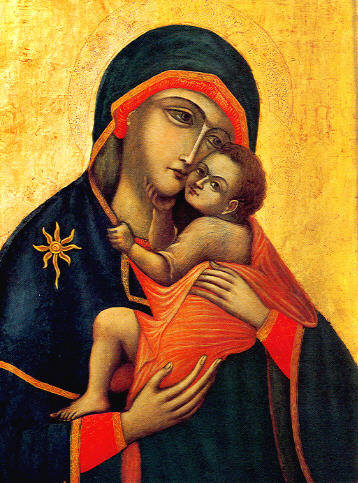
Story of the Miraculous Painting of Our Lady of Mount Carmel

According to legend, St. Luke painted this image of Our Lady of Mount Carmel, who holds the Infant Jesus in her arms. An expression of great tenderness seems to suggest that our Lady is contemplating the great mysteries of redemption. The Infant’s right hand caresses His mother’s face, and the left grasps the edge of her veil. His position and expression seem to speak of His great love for His mother. A crown on top of her large veil, with star ornaments on the veil at the shoulder, is reminiscent of St. Bernard’s words that Mary is a “brilliant star who enlightens us with the splendor of her virtues.” This image was venerated by the hermit Friars of the Blessed Virgin Mary in their original home on Mount Carmel.

In the beginning of the thirteenth century, the religious of the Carmelite Order, forced by Mohammedans to flee their peaceful solitude by the sea, brought the painting from Mount Carmel to Naples. When settled, their first concern was to place the painting above the high altar in their Church, where it secured countless miracles for the people venerating it. It hung there for more than 100 years, until placed in a side chapel at the order of the Empress Margaret. Then, in the jubilee year of 1500, the ancient picture of Our Lady of Mount Carmel was carried in procession to Rome by the pious Neapolitans. During the pilgrimage, several people were miraculously cured, including Thomas Saccone, who had been blind and lame.

Skeptical of these miracles, “King Frederic II of Naples conceived a plan to test the power of the Heavenly Mother. He ordered that all the sick and infirm [of the city] assemble before the image with written documentation of their maladies. High Mass was celebrated and special hymns were sung, and when the miraculous picture was unveiled, a ray of light fell upon the face of the Madonna, reflecting its brilliance on the assembled sick. The instantaneous healing of each person was authenticated” (Cruz, p. 160).

Sources: “The Little Book of Carmelite Spirituality and Practice”, with additional information from Joan Carroll Cruz's “Miraculous Images of Our Lady” (Rockford: TAN Books and Publishers, Inc., 1993).

after www.ctocds.com Read whole post......

Wednesday, July 12, 2006

O Queen, who are the beauty of Carmel, pray for us

ST.JOHN OF THE CROSS
"Dark night of the soul"

CHAPTER IX

Of the signs by which it will be known that the spiritual person is walking along the way of this night and purgation of sense.

BUT since these aridities might frequently proceed, not from the night and purgation of the sensual desires aforementioned, but from sins and imperfections, or from weakness and lukewarmness, or from some bad humour or indisposition of the body, I shall here set down certain signs by which it may be known if such aridity proceeds from the aforementioned purgation, or if it arises from any of the aforementioned sins. For the making of this distinction I find that there are three principal signs.
2. The first is whether, when a soul finds no pleasure or consolation in the things of God, it also fails to find it in any thing created; for, as God sets the soul in this dark night to the end that He may quench and purge its sensual desire, He allows it not to find attraction or sweetness in anything whatsoever. In such a case it may be considered very probable that this aridity and insipidity proceed not from recently committed sins or imperfections. For, if this were so, the soul would feel in its nature some inclination or desire to taste other things than those of God; since, whenever the desire is allowed indulgence in any imperfection, it immediately feels inclined thereto, whether little or much, in proportion to the pleasure and the love that it has put into it. Since, however, this lack of enjoyment in things above or below might proceed from some indisposition or melancholy humour, which oftentimes makes it impossible for the soul to take pleasure in anything, it becomes necessary to apply the second sign and condition.
3. The second sign whereby a man may believe himself to be experiencing the said purgation is that the memory is ordinarily centred upon God, with painful care and solicitude, thinking that it is not serving God, but is backsliding, because it finds itself without sweetness in the things of God. And in such a case it is evident that this lack of sweetness and this aridity come not from weakness and lukewarmness; for it is the nature of lukewarmness not to care greatly or to have any inward solicitude for the things of God. There is thus a great difference between aridity and lukewarmness, for lukewarmness consists in great weakness and remissness in the will and in the spirit, without solicitude as to serving God; whereas purgative aridity is ordinarily accompanied by solicitude, with care and grief as I say, because the soul is not serving God. And, although this may sometimes be increased by melancholy or some other humour (as it frequently is), it fails not for that reason to produce a purgative effect upon the desire, since the desire is deprived of all pleasure and has its care centred upon God alone. For, when mere humour is the cause, it spends itself in displeasure and ruin of the physical nature, and there are none of those desires to sense God which belong to purgative aridity. When the cause is aridity, it is true that the sensual part of the soul has fallen low, and is weak and feeble in its actions, by reason of the little pleasure which it finds in them; but the spirit, on the other hand, is ready and strong.
4. For the cause of this aridity is that God transfers to the spirit the good things and the strength of the senses, which, since the soul's natural strength and senses are incapable of using them, remain barren, dry and empty. For the sensual part of a man has no capacity for that which is pure spirit, and thus, when it is the spirit that receives the pleasure, the flesh is left without savour and is too weak to perform any action. But the spirit, which all the time is being fed, goes forward in strength, and with more alertness and solicitude than before, in its anxiety not to fail God; and if it is not immediately conscious of spiritual sweetness and delight, but only of aridity and lack of sweetness, the reason for this is the strangeness of the exchange; for its palate has been accustomed to those other sensual pleasures upon which its eyes are still fixed, and, since the spiritual palate is not made ready or purged for such subtle pleasure, until it finds itself becoming prepared for it by means of this arid and dark night, it cannot experience spiritual pleasure and good, but only aridity and lack of sweetness, since it misses the pleasure which aforetime it enjoyed so readily.
5. These souls whom God is beginning to lead through these solitary places of the wilderness are like to the children of Israel, to whom in the wilderness God began to give food from Heaven, containing within itself all sweetness, and, as is there said, it turned to the savour which each one of them desired. But withal the children of Israel felt the lack of the pleasures and delights of the flesh and the onions which they had eaten aforetime in Egypt, the more so because their palate was accustomed to these and took delight in them, rather than in the delicate sweetness of the angelic manna; and they wept and sighed for the fleshpots even in the midst of the food of Heaven. To such depths does the vileness of our desires descend that it makes us to long for our own wretched food and to be nauseated by the indescribable blessings of Heaven.
6. But, as I say, when these aridities proceed from the way of the purgation of sensual desire, although at first the spirit feels no sweetness, for the reasons that we have just given, it feels that it is deriving strength and energy to act from the substance which this inward food gives it, the which food is the beginning of a contemplation that is dark and arid to the senses; which contemplation is secret and hidden from the very person that experiences it; and ordinarily, together with the aridity and emptiness which it causes in the senses, it gives the soul an inclination and desire to be alone and in quietness, without being able to think of any particular thing or having the desire to do so. If those souls to whom this comes to pass knew how to be quiet at this time, and troubled not about performing any kind of action, whether inward or outward, neither had any anxiety about doing anything, then they would delicately experience this inward refreshment in that ease and freedom from care. So delicate is this refreshment that ordinarily, if a man have desire or care to experience it, he experiences it not; for, as I say, it does its work when the soul is most at ease and freest from care; it is like the air which, if one would close one's hand upon it, escapes.
7. In this sense we may understand that which the Spouse said to the Bride in the Songs, namely: 'Withdraw thine eyes from me, for they make me to soar aloft.' For in such a way does God bring the soul into this state, and by so different a path does He lead it that, if it desires to work with its faculties, it hinders the work which God is doing in it rather than aids it; whereas aforetime it was quite the contrary. The reason is that, in this state of contemplation, which the soul enters when it forsakes meditation for the state of the proficient, it is God Who is now working in the soul; He binds its interior faculties, and allows it not to cling to the understanding, nor to have delight in the will, nor to reason with the memory. For anything that the soul can do of its own accord at this time serves only, as we have said, to hinder inward peace and the work which God is accomplishing in the spirit by means of that aridity of sense. And this peace, being spiritual and delicate, performs a work which is quiet and delicate, solitary, productive of peace and satisfaction and far removed from all those earlier pleasures, which were very palpable and sensual. This is the peace which, says David, God speaks in the soul to the end that He may make it spiritual. And this leads us to the third point.
8. The third sign whereby this purgation of sense may be recognized is that the soul can no longer meditate or reflect in the imaginative sphere of sense as it was wont, however much it may of itself endeavour to do so. For God now begins to communicate Himself to it, no longer through sense, as He did aforetime, by means of reflections which joined and sundered its knowledge, but by pure spirit, into which consecutive reflections enter not; but He communicates Himself to it by an act of simple contemplation, to which neither the exterior nor the interior senses of the lower part of the soul can attain. From this time forward, therefore, imagination and fancy can find no support in any meditation, and can gain no foothold by means thereof.
9. With regard to this third sign, it is to be understood that this embarrassment and dissatisfaction of the faculties proceed not from indisposition, for, when this is the case, and the indisposition, which never lasts for long, comes to an end, the soul is able once again, by taking some trouble about the matter, to do what it did before, and the faculties find their wonted support. But in the purgation of the desire this is not so: when once the soul begins to enter therein, its inability to reflect with the faculties grows ever greater. For, although it is true that at first, and with some persons, the process is not as continuous as this, so that occasionally they fail to abandon their pleasures and reflections of sense (for perchance by reason of their weakness it was not fitting to wean them from these immediately), yet this inability grows within them more and more and brings the workings of sense to an end, if indeed they are to make progress, for those who walk not in the way of contemplation act very differently. For this night of aridities is not usually continuous in their senses. At times they have these aridities; at others they have them not. At times they cannot meditate; at others they can. For God sets them in this night only to prove them and to humble them, and to reform their desires, so that they go not nurturing in themselves a sinful gluttony in spiritual things. He sets them not there in order to lead them in the way of the spirit, which is this contemplation; for not all those who walk of set purpose in the way of the spirit are brought by God to contemplation, nor even the half of them—why, He best knows. And this is why He never completely weans the senses of such persons from the breasts of meditations and reflections, but only for short periods and at certain seasons, as we have said. Read whole post......
Carmelite Devotions

Mater Gratiae(Our Lady of the Bowed Head)

This miraculous oil painting was rescued from a heap of rubbish and restored in 1610 by Ven. Dominic of Jesus and Mary, Prepositor General of the Order of Discalced Carmelites. According to the testimony of Ven. Dominic, our Lady spoke to him and promised, "'All those who implore my protection, devoutly honoring this picture, will obtain their petitions, and will receive many graces. Moreover, I shall hearken in a special manner to the prayers that shall be addressed to me for the relief of the souls in purgatory'" (Joan Carroll Cruz, Miraculous Images of Our Lady, [TAN Books & Publishers, Inc., 1993) p. 13].

PRAYER

Lord, Jesus, the hour is come:
glorify Thy Mother that Thy Mother may glorify Thee.
Manifest to all her power and efficacious mediation,
and grant us the favors we implore through her intercession.
Hear us for Thy Mother's sake,
hear us for love of Thy Mother,
we beseech Thee, Lord Jesus!
Show Thyself her Son and procure her triumph
which we desire in view of Thine Own.
That Thy Kingdom may come,
may we have the kingdom of Mary, Mother of Grace. Amen.

PRAYER

Virgin most holy,
Mother of the Word Incarnate,
Treasurer of graces,
and Refuge of poor sinners:
we fly to thy motherly affection
with lively faith,
and we beg of thee the grace
ever to do the will of God.
Into thy most holy hands
we commit the keeping of our hearts,
asking thee for health of soul and body,
in the certain hope that thou,
our most loving Mother,
wilt hear our prayer.
Wherefore with lively faith we say:

Hail Mary three times
Prayers taken from a holy card distributed by the Monastary of Discalced Carmelites, New Orleans, LA, with Nihil obstat and Imprimatur dated March 5, 1949.

after www.ctocds.com Read whole post......

Tuesday, July 11, 2006

O Queen, who art the beauty of Carmel, pray for us
"Dark night of the soul"
CHAPTER VIII - ST John of the Cross

In a dark night.

Wherein is expounded the first line of the first stanza, and a beginning is made of the explanation of this dark night.

THIS night, which, as we say, is contemplation, produces in spiritual persons two kinds of darkness or purgation, corresponding to the two parts of man's nature—namely, the sensual and the spiritual. And thus the one night or purgation will be sensual, wherein the soul is purged according to sense, which is subdued to the spirit; and the other is a night or purgation which is spiritual, wherein the soul is purged and stripped according to the spirit, and subdued and made ready for the union of love with God. The night of sense is common and comes to many: these are the beginners; and of this night we shall speak first. The night of the spirit is the portion of very few, and these are they that are already practised and proficient, of whom we shall treat hereafter.
2. The first purgation or night is bitter and terrible to sense, as we shall now show. The second bears no comparison with it, for it is horrible and awful to the spirit, as we shall show presently. Since the night of sense is first in order and comes first, we shall first of all say something about it briefly, since more is written of it, as of a thing that is more common; and we shall pass on to treat more fully of the spiritual night, since very little has been said of this, either in speech or in writing, and very little is known of it, even by experience.
3. Since, then, the conduct of these beginners upon the way of God is ignoble, and has much to do with their love of self and their own inclinations, as has been explained above, God desires to lead them farther. He seeks to bring them out of that ignoble kind of love to a higher degree of love for Him, to free them from the ignoble exercises of sense and meditation (wherewith, as we have said, they go seeking God so unworthily and in so many ways that are unbefitting), and to lead them to a kind of spiritual exercise wherein they can commune with Him more abundantly and are freed more completely from imperfections. For they have now had practice for some time in the way of virtue and have persevered in meditation and prayer, whereby, through the sweetness and pleasure that they have found therein, they have lost their love of the things of the world and have gained some degree of spiritual strength in God; this has enabled them to some extent to refrain from creature desires, so that for God's sake they are now able to suffer a light burden and a little aridity without turning back to a time which they found more pleasant. When they are going about these spiritual exercises with the greatest delight and pleasure, and when they believe that the sun of Divine favour is shining most brightly upon them, God turns all this light of theirs into darkness, and shuts against them the door and the source of the sweet spiritual water which they were tasting in God whensoever and for as long as they desired. (For, as they were weak and tender, there was no door closed to them, as Saint John says in the Apocalypse, iii, 8). And thus He leaves them so completely in the dark that they know not whither to go with their sensible imagination and meditation; for they cannot advance a step in meditation, as they were wont to do afore time, their inward senses being submerged in this night, and left with such dryness that not only do they experience no pleasure and consolation in the spiritual things and good exercises wherein they were wont to find their delights and pleasures, but instead, on the contrary, they find insipidity and bitterness in the said things. For, as I have said, God now sees that they have grown a little, and are becoming strong enough to lay aside their swaddling clothes and be taken from the gentle breast; so He sets them down from His arms and teaches them to walk on their own feet; which they feel to be very strange, for everything seems to be going wrong with them.
4. To recollected persons this commonly happens sooner after their beginnings than to others, inasmuch as they are freer from occasions of backsliding, and their desires turn more quickly from the things of the world, which is necessary if they are to begin to enter this blessed night of sense. Ordinarily no great time passes after their beginnings before they begin to enter this night of sense; and the great majority of them do in fact enter it, for they will generally be seen to fall into these aridities.
5. With regard to this way of purgation of the senses, since it is so common, we might here adduce a great number of quotations from Divine Scripture, where many passages relating to it are continually found, particularly in the Psalms and the Prophets. However, I do not wish to spend time upon these, for he who knows not how to look for them there will find the common experience of this purgation to be sufficient.

after www.ccel.org Read whole post......